If your life insurance pays a dividend, does that mean you should leave it in the policy? Not necessarily. The same dividend can help pay a bill, reduce your insurance costs, or purchase additional coverage, with different consequences for your budget and taxes.
Choosing among life insurance dividend options starts with deciding what you need the money to do. A growing policy value may suit a long-term goal, while cash in your checking account may be more useful to a family facing childcare costs or an uneven income.
Table of Contents
- Life Insurance Dividend Options at a Glance
- How Insurers Set the Dividend You Receive
- How Each Dividend Option Is Taxed
- Which Dividend Option Most Policyholders Choose
- Same Dividend, Three Outcomes in a Worked Example
- Risks and Mistakes That Cut Dividend Value
- Confirm Your Dividend Election Before Your Next Anniversary
Life Insurance Dividend Options at a Glance
What does your dividend do after the insurer credits it? A participating whole life policy may pay dividends, but your dividend election determines where that value goes. The election is usually recorded when you buy the policy, and an insurer's default may apply if you don't make an active choice.
Start with your annual statement rather than assuming you have the option you remember selecting. Available elections and change procedures are governed by your contract.
What the available elections do
Cash means the insurer pays the dividend to you. You can spend or save it elsewhere, but that payment doesn't purchase additional policy value.
With premium reduction, the insurer applies the dividend toward a premium. You pay the remaining amount yourself, so this option supports cash flow rather than adding coverage.
Paid-up additions use the dividend to buy small amounts of fully paid permanent insurance. Those additions have cash value and increase the death benefit without requiring future premiums for that purchased coverage.
Accumulate at interest means leaving dividends on deposit with the insurer. Keep the deposited dividends separate from the interest they earn when reviewing your tax records.
Term purchase, when available, uses the dividend to buy one-year term additions. The dividend pays for that temporary protection, but it doesn't make the added coverage permanent.
Dividend options compared
| Option | What the Dividend Does | General Tax Effect | Best Fit |
|---|---|---|---|
| Cash | Paid out to you | Not taxed until cumulative dividends exceed premiums paid | Immediate cash needs |
| Premium reduction | Lowers the premium you owe | Generally not taxable | Tight monthly budgets |
| Paid-up additions | Buys fully paid permanent coverage with cash value | Generally not taxable while within premium basis | Building cash value and coverage over time |
| Accumulate at interest | Stays with the insurer and earns interest | Interest taxable as credited | Short-term savings with access |
| Term purchase | Buys one-year term additions | Generally not taxable | Extra death benefit for a short period |
The tax descriptions assume an ordinary qualifying policy and don't resolve special contract circumstances. Access to accumulated dividends also follows the insurer's withdrawal procedures, so don't assume it works exactly like a checking account.
Find the election on your statement, then read across the table. Match the option to a purpose before changing it, and confirm whether your contract uses a secondary election for any dividend amount left over.
How Insurers Set the Dividend You Receive
An insurer collects premiums to pay claims, cover operating costs, and maintain the insurance pool. A participating policy may return part of those premiums when the insurer collects more than it needs, explains the National Association of Insurance Commissioners.
Bring your annual statement to a discussion so you can connect the explanation to your own contract.

Dividends belong to participating policies, not ordinary nonparticipating coverage. If you're unsure which you own, understanding participating insurance policies helps distinguish eligibility for dividends from the separate decision about how to use them.
The experience behind the dividend scale
The insurer's dividend scale is its current framework for allocating dividends. It isn't an interest rate applied to every dollar you've paid.
The NAIC's life insurance overview distinguishes contractual guarantees from dividends tied to insurer experience. The main experience factors are:
- Mortality: How death claims compare with the insurer's expectations.
- Investment results: How the insurer's portfolio performs.
- Expenses: What the insurer spends administering policies and operating its business.
A change in any component can affect the scale even if your contractual guarantees haven't changed. That's why an insurer's investment results alone don't tell you what your next dividend will be.
Dividends are generally credited annually, often on the policy anniversary. Your statement should identify the amount credited and how the insurer applied it.
Separate the contract from the projection
A guaranteed value is an obligation written into the contract, subject to its conditions. A projected dividend is a nonguaranteed amount that may increase, decrease, or disappear.
Different insurers also use different dividend frameworks. Comparing their published scales without comparing premiums, coverage, and projected policy values can lead to the wrong conclusion.
Keep that distinction in mind when reviewing an explanation of dividend choices.
For a young family, the first question isn't how much a policy might distribute. It's whether the guaranteed protection is sufficient and affordable.
Practical rule: Treat dividends as an enhancement to insurance you can sustain, never as the funding assumption for essential protection.
How Each Dividend Option Is Taxed
A single dividend can reach you several ways, and each route carries its own tax answer. Under general federal tax treatment, dividends on a life insurance contract count as a partial return of the premiums you paid. They stay out of gross income until the cumulative dividends you have received exceed your total net premiums paid. One limit matters here: this treatment applies to an ordinary life insurance contract, and a modified endowment contract follows different rules.
Three of the standard elections share that framework while you remain inside your premium basis. Taking the dividend in cash, applying it toward your premium, or using it to buy paid-up additions all follow return-of-premium treatment. Receiving cash does not automatically create taxable income, and redirecting the same dividend back into the policy does not either.
The interest exception
Dividends left on deposit work differently. The dividend itself still follows the return-of-premium rule, but the interest the insurer credits on retained amounts is taxable under the policy's crediting and withdrawal terms.
Every dividend left on deposit therefore splits into two items: principal that follows the dividend rule and taxable interest that belongs on your return. Leaving everything with the insurer does not keep the interest off your tax return.
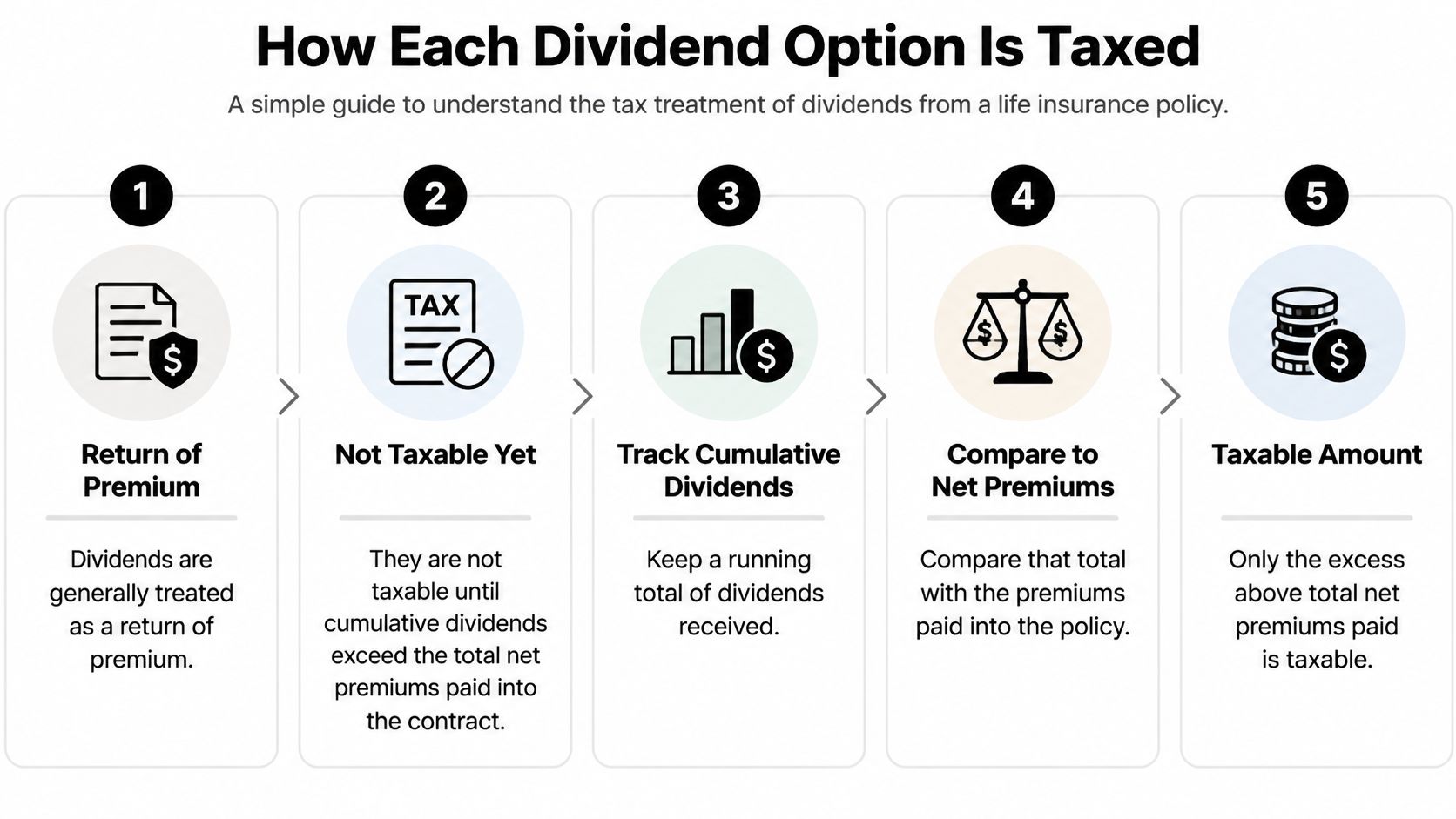
The sequence above covers an ordinary dividend year. Larger transactions follow their own calculations, and policy basis, your running tax measure, cannot be read off your most recent premium payment. New York's Department of Financial Services explains that surrender gain generally involves cash value exceeding premiums paid, adjusted for dividends. Policy loans, withdrawals, lapse, and modified-endowment-contract status can each change the outcome, so a surrender or large loan deserves its own review before you act.
Keep records that answer the tax question
Use a policy ledger or spreadsheet alongside the insurer's statements:
- Premium history: Record cumulative premiums and reconcile the insurer's reported basis.
- Dividend history: Track payments and how each dividend was used.
- Interest credited: Separate deposit interest from dividend principal.
- Other transactions: Record loans, withdrawals, repayments, and surrendered additions.
- Tax documents: Request the insurer's annual tax statement and retain it with your policy records.
For help distinguishing interest reporting from dividend principal, Allied Tax Advisors on dividend reporting provides additional reporting context. Have an independent tax professional determine which entries apply to your contract, since insurance dividends are not reported like stock dividends.
The tax question also shifts when you move from choosing an election to accessing policy value. If a surrender or loan is on the table, whether cash value in life insurance is taxable is worth settling first. Check state treatment alongside federal rules before any major transaction. Return of premium with defined exceptions is the accurate summary, and your records tell you exactly where you stand within it.
Which Dividend Option Most Policyholders Choose

Participating coverage represents a minority of the market measured by insured amount. According to American Council of Life Insurers tabulations of regulatory data, participating policies made up 28% of U.S. individual life insurance face amount in 2024, while nonparticipating policies accounted for 72%.
Read that figure carefully. Face amount measures dollars of coverage, so a small number of large participating policies can outweigh many small ones. The figure counts insured value, and says nothing about how many policyholders received a dividend. Participation itself establishes eligibility only. Whether a dividend is declared, and how large it is, remains a year-to-year outcome rather than a promise.
Why paid-up additions attract policyholders
Among participating whole-life policies, 88% elected paid-up additions in 2024, according to LIMRA. That finding describes a common election, and it cannot prove the option fits every household.
The appeal is easier to see once you follow the cash flow. A paid-up addition converts a dividend into a small block of fully paid permanent coverage with no new premium attached. The dividend works like a reinvested payout: instead of leaving the policy as cash, it buys more of the same asset. Where purchased additions participate in future dividends, each later dividend can fund further additions, creating a compounding chain. Those future amounts stay uncertain, so the chain resembles a growth rate without being one.
Your budget can justify another choice
Treat the election as a cash flow decision first. A newly married couple saving for a move may prefer cash, because the dividend can cover a bill the policy itself cannot. Parents managing childcare costs may value premium reduction more than an increase in illustrated coverage. A retiree might want a payment for current spending, while another policyholder leaves dividends on deposit for planned access later. Each choice solves a different budget problem, and none becomes a mistake because paid-up additions are more common.
A popular election tells you what other policyholders selected. It does not tell you which bill your household needs to pay.
Before the next anniversary, confirm which default your insurer applied, whether you actively chose it, and whether that election still fits your budget and tax position. A majority preference gives you a starting point for comparison. Your own situation makes the decision.
Same Dividend, Three Outcomes in a Worked Example
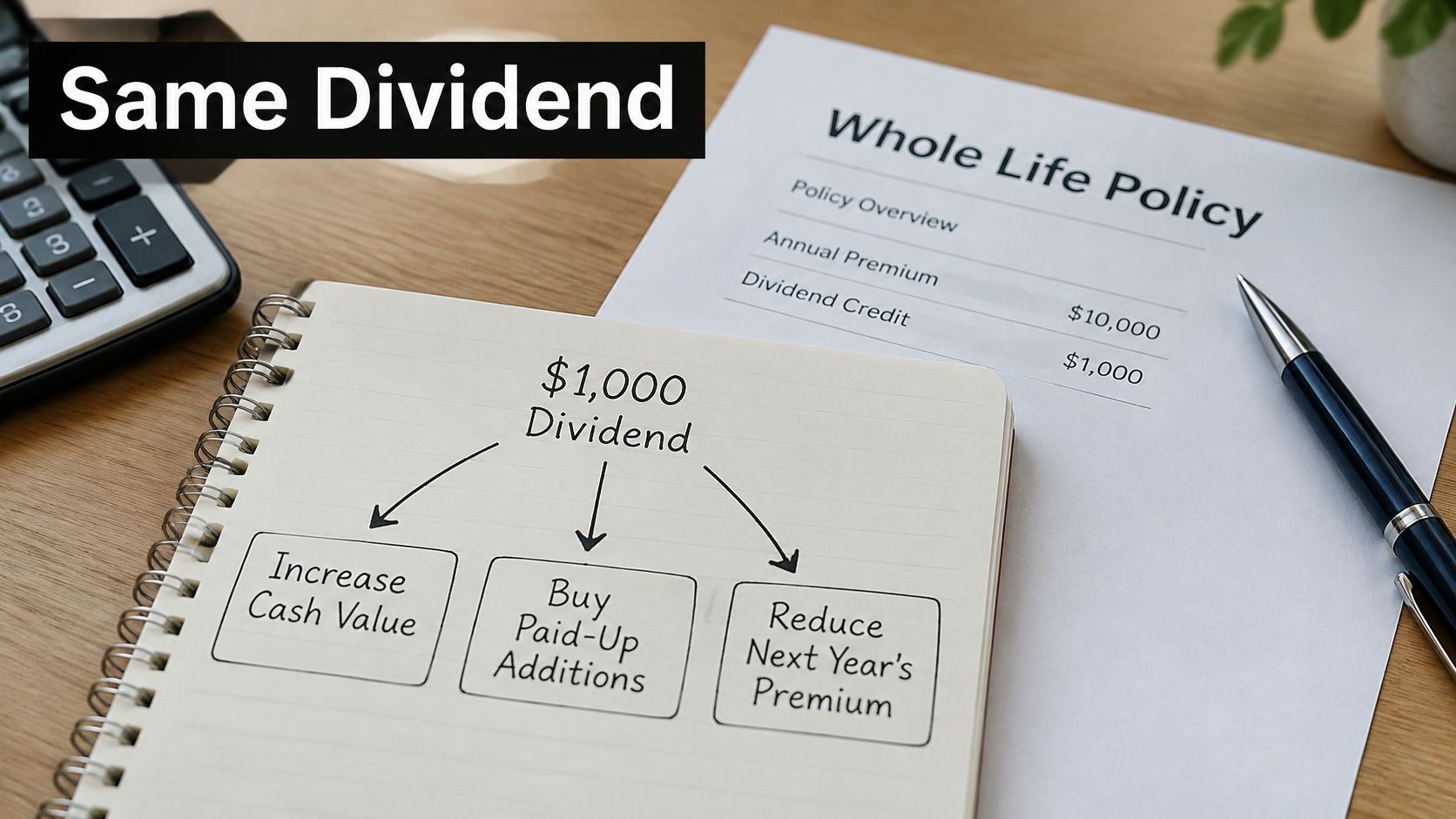
Assume a hypothetical whole life policy with an illustrative $3,000 annual premium and an illustrative $1,000 anniversary dividend. These figures are teaching assumptions, not a quote, a forecast, or a promised dividend.
The central comparison is between receiving money, reducing an expense, and buying policy value. Accumulation offers a further alternative, but it requires a separate interest-and-tax calculation.
Follow the money through each election
With cash, you receive the illustrative dividend and still pay the full contractual premium. Your household gets spendable money, but the dividend itself adds nothing to policy value; calling the payment income for budgeting purposes doesn't establish that it's taxable income.
With premium reduction, the illustrative calculation is $3,000 minus $1,000, leaving $2,000 out of pocket. The contractual premium hasn't changed, only the amount you fund from other money.
If the hypothetical dividend disappears entirely, your out-of-pocket payment returns to the illustrative $3,000. A partial dividend reduction would increase your payment by the amount of that reduction, not necessarily restore the entire bill.
With paid-up additions, the illustrative dividend purchases additional permanent coverage. You continue paying the base premium yourself, while the purchased additions contribute cash value and death benefit.
You can't calculate the added death benefit by treating the dividend as a dollar-for-dollar coverage purchase. The insurer must supply those values for the insured's age and contract.
Illustrative outcome of one $1,000 dividend on a $3,000 premium
| Option | Tax effect of the dividend | Effect on policy value |
|---|---|---|
| Cash | None while within premium basis; excess may be taxable | No added policy value |
| Premium reduction | None while within premium basis | Lower out-of-pocket premium, no added value; full premium returns if dividends disappear |
| Paid-up additions | None while within premium basis | Adds permanent coverage and cash value with each purchase |
| Accumulate at interest | Interest taxable as credited | Accumulated balance grows more slowly after accounting for tax |
With accumulation, the illustrative dividend remains on deposit and earns the insurer's applicable interest. Compare the after-tax result with your alternatives, and confirm whether you'd pay the tax from outside funds or withdraw money from the accumulated balance.
Compare the paths over time
For a deliberately simplified hypothetical, assume the illustrative dividend stays unchanged. Over ten years, cash elections would distribute $10,000, while premium reduction would offset $10,000 of premiums; over twenty years, those illustrative totals would each reach $20,000.
Those equal totals don't establish equal financial outcomes. Cash might be spent or saved elsewhere, premium savings might support other goals, and paid-up additions would require contract-specific projections rather than an invented return assumption.
Actuarial guidance on participating-policy dividends identifies dividend elections, premium patterns, riders, and loans as factors affecting illustrations. Request matching illustrations and compare cash value, death benefit, and out-of-pocket premiums at the hypothetical ten- and twenty-year checkpoints.
Mark every value that relies on the current scale. Keep premiums, riders, and loan assumptions consistent so you're comparing elections rather than different policy designs.
Risks and Mistakes That Cut Dividend Value
A policyholder compares two contracts and picks the one showing the bigger dividend. That instinct is the most common comparison mistake. A larger projection doesn't automatically mean a better contract, because premiums, expenses, guarantees, and the insurer's ability to support its illustrations all matter.
The actuarial standard governing life insurance illustrations addresses how illustrated nonguaranteed elements should relate to insurer experience. An illustration works like a forecast: it describes what happens under stated assumptions, not what the insurer owes you.
Questions that expose the trade-offs
Bring specific questions to the insurer rather than asking only whether dividends have historically been paid.
- Payment shock: If I use premium reduction, how much must I pay if dividends shrink or stop? Identify where that additional money would come from.
- Liquidity: If dividends buy additions, what cash could I access afterward? Request the surrender value of those additions rather than equating the purchase amount with immediately available cash.
- Tax reporting: Which amounts will the insurer report as interest or taxable distributions? Confirm how your records reconcile with its basis calculation.
- Loans and lapse: What would happen to the policy and tax result if an outstanding loan grew while coverage lapsed or was surrendered?
Each question connects an election to a real cash flow. Together they reveal whether a particular option fits the household paying the premiums.
The NAIC's life insurance disclosure model cautions against describing dividends as tax-free without explaining their return-of-premium character and tax treatment. Ask for the same clarity when someone describes an option as free coverage or a permanent premium discount.
Test the policy without relying on optimism
Request a current-scale illustration and a reduced-scale illustration with matching assumptions. Then examine whether you can maintain the needed guaranteed death benefit without projected dividends.
Budget test: If essential protection becomes unaffordable without the illustrated dividend, reconsider the premium commitment before choosing an election.
Also ask which values reflect additions already purchased and which assume future purchases. Existing paid-up coverage is an asset you already own. Projected future coverage is a plan that depends on dividends not yet declared, and the two aren't interchangeable.
Keep the insurance decision separate from broader investment decisions. Someone comparing elections may also be weighing unrelated products such as retirement diversification through precious metals IRAs, and that kind of arrangement answers a different question entirely. It says nothing about a policy's guarantees, liquidity, or premiums.
Before you commit, decide what each dividend dollar is for: offsetting premiums, building accessible savings, or adding coverage. Then decide what you'd do if the declared amount came in smaller than illustrated. A purpose and a backup plan will serve you better than any headline scale.
Confirm Your Dividend Election Before Your Next Anniversary
Your annual review should end with a documented decision, not just a new illustration filed away. Use the life insurance policy review checklist to keep the dividend election connected to your broader coverage needs.
Whole life covers the insured for their entire life and includes a cash value savings component that grows over time, with premiums significantly higher than term life. An election can affect the future path of surrender value and borrowing capacity, so review both protection and access to money.
Complete the review in order
- Find the active election. Locate it on your statement or policy summary. Confirm any secondary election and whether a default applies.
- Request matching illustrations. Obtain current-scale and reduced-scale versions using the same coverage, riders, premium schedule, and loan assumptions.
- Separate the guarantees. Compare guaranteed death benefit and guaranteed cash value independently from projected dividends and future additions.
- Reconcile your records. Update cumulative premiums, dividends, credited interest, withdrawals, and loans against the insurer's figures.
- Get an independent tax review. Review the records annually, with particular attention before a loan, surrender, or material policy change.
- Confirm the change procedure. Ask for the election deadline, required paperwork, and effective date. Submit changes early enough for the intended anniversary and retain confirmation.
Connect the election to your coverage needs
Depending on policy type, coverage can be adjusted or converted to permanent insurance. Don't assume that changing a dividend election changes the underlying policy's premium obligation or conversion provisions.
At Coveredly, our team guides customers through each step, answers questions, and helps them choose coverage for their situation. Bring your statement and your main goal, whether that's easing the budget, preserving liquidity, or maintaining protection, so the review addresses a concrete decision.
Visit Coveredly for help understanding your coverage choices and the questions to ask about your dividend election. Our team can walk you through your review, explain the trade-offs, and help you choose coverage that fits your situation before you make a change.