You and your business partner probably already have an unspoken script for hard decisions. One of you handles sales, the other handles operations. One pushes for speed, the other catches the risks. You trust each other, and that trust helped build the company.
But there's a question most partners keep postponing: what happens if one of you dies unexpectedly?
That question isn't just about grief. It's about control, cash, payroll, clients, lenders, and family. A deceased partner's ownership doesn't just vanish. It goes somewhere. If you haven't planned for that transfer, the business can end up in a legal and financial mess at the worst possible moment.
That's why life insurance for business partners matters. Not as a stand-alone product. Not as a box to check. It matters as a funding tool tied to a legal succession plan, so the surviving partner has money to buy the deceased partner's share and keep the company moving.
Think of it as a prenuptial agreement for your business. The insurance provides the cash. The buy-sell agreement tells everyone what happens next.
Table of Contents
- Your Business Is Your Life's Work Protect It
- Why a Handshake Agreement Guarantees Chaos
- Choosing Your Buy-Sell Structure Cross-Purchase vs Entity-Purchase
- Calculating Your Coverage How Much Insurance Is Enough
- Navigating Ownership Beneficiaries and Tax Rules
- Your Implementation Checklist From Conversation to Coverage
- Common Questions and Real-World Scenarios
Your Business Is Your Life's Work Protect It
Two founders spend years building a firm. They split sacrifices nobody sees. Missed paychecks early on. Weekend client calls. Stress at home. Slowly, the company becomes valuable. Then one day, during a routine planning meeting, one asks a blunt question: if I'm gone next month, who owns my half?
That moment changes the conversation.
For most partners, life insurance for business partners starts as a fear-based topic. It feels morbid. In practice, it's an operational topic. It answers a basic business survival question: how does the surviving partner get the cash to buy the deceased partner's interest without gutting the company?
According to J.P. Morgan Private Bank's overview of life insurance for business owners, over 50% of small businesses would close within a year if a key owner died, yet only 20% have key person life insurance in place. That gap should get every partnership's attention.
Why this is bigger than a policy
A partner's death creates two immediate pressures at once.
- Ownership pressure: Someone now owns that share, and the surviving partner may not want to run the company with the deceased partner's family.
- Cash pressure: Even if everyone agrees on a buyout, the money has to come from somewhere.
Without planning, the surviving owner often has bad options. Use company cash needed for payroll. Borrow under stress. Sell assets. Argue over valuation. Delay decisions while the business wobbles.
Practical rule: The best succession plan creates clarity before anyone needs it.
The clean version looks different. The partners agree in advance on what happens. They document it. They line up insurance as the funding source. When one dies, cash arrives and ownership transfers under the rules they already approved.
That's why some founders pair this with broader continuity planning such as key person life insurance coverage for a critical owner or employee. It solves a different problem, but the mindset is the same: protect the company before a crisis turns everyone into improvisers.
Why a Handshake Agreement Guarantees Chaos
A lot of partners think trust is the plan.
They've said the right things out loud. “If something happens to me, you'll take care of my family.” “My spouse wouldn't want to be involved anyway.” “We'll figure it out.” Those statements may be sincere. They're still not a succession plan.
Financial forums and legal experts warn that life insurance is “useless (or worse) without that agreement,” because state probate laws can give heirs immediate ownership rights, potentially forcing the surviving partner into litigation or a sale of the business, as discussed in the Bogleheads forum conversation on buy-sell planning.
The insurance is money. The agreement is the instruction manual
This is the point many guides skip.
A life insurance policy by itself is just a pool of money that pays when someone dies. It doesn't automatically force a buyout. It doesn't automatically set a price. It doesn't automatically stop heirs from inheriting ownership rights. The policy funds the plan. It is not the plan.
The buy-sell agreement is the legal document that answers questions such as:
- Who must buy and who must sell: Does the surviving partner buy the interest, or does the company redeem it?
- How the business is valued: Fixed price, formula, or periodic valuation process.
- When the transfer happens: Immediately, within a set window, or under specific conditions.
- How insurance proceeds are used: The agreement should tie the death benefit to the ownership transfer.
What chaos looks like in real life
If there's no written agreement, several things can happen fast.
| Problem | What it means for the surviving partner |
|---|---|
| Heirs inherit ownership | You may suddenly have new co-owners who never expected to run a business |
| Valuation fights start | The family wants one number, you think the business is worth another |
| Cash gets trapped | Even if a policy exists, the payout may not land where it needs to |
| Operations suffer | Staff, customers, and lenders sense instability |
Trust is valuable in a partnership. It's just not enforceable in probate court.
A handshake works when both people are alive and aligned. Death introduces family members, attorneys, estate rules, and conflicting incentives. That's why founders need to treat this like governance, not sentiment.
Choosing Your Buy-Sell Structure Cross-Purchase vs Entity-Purchase
Once you accept that the agreement matters most, the next decision is structure. Most partnerships use one of two paths: cross-purchase or entity-purchase. Both can work. They place the ownership, beneficiary, and buyout mechanics in different hands.
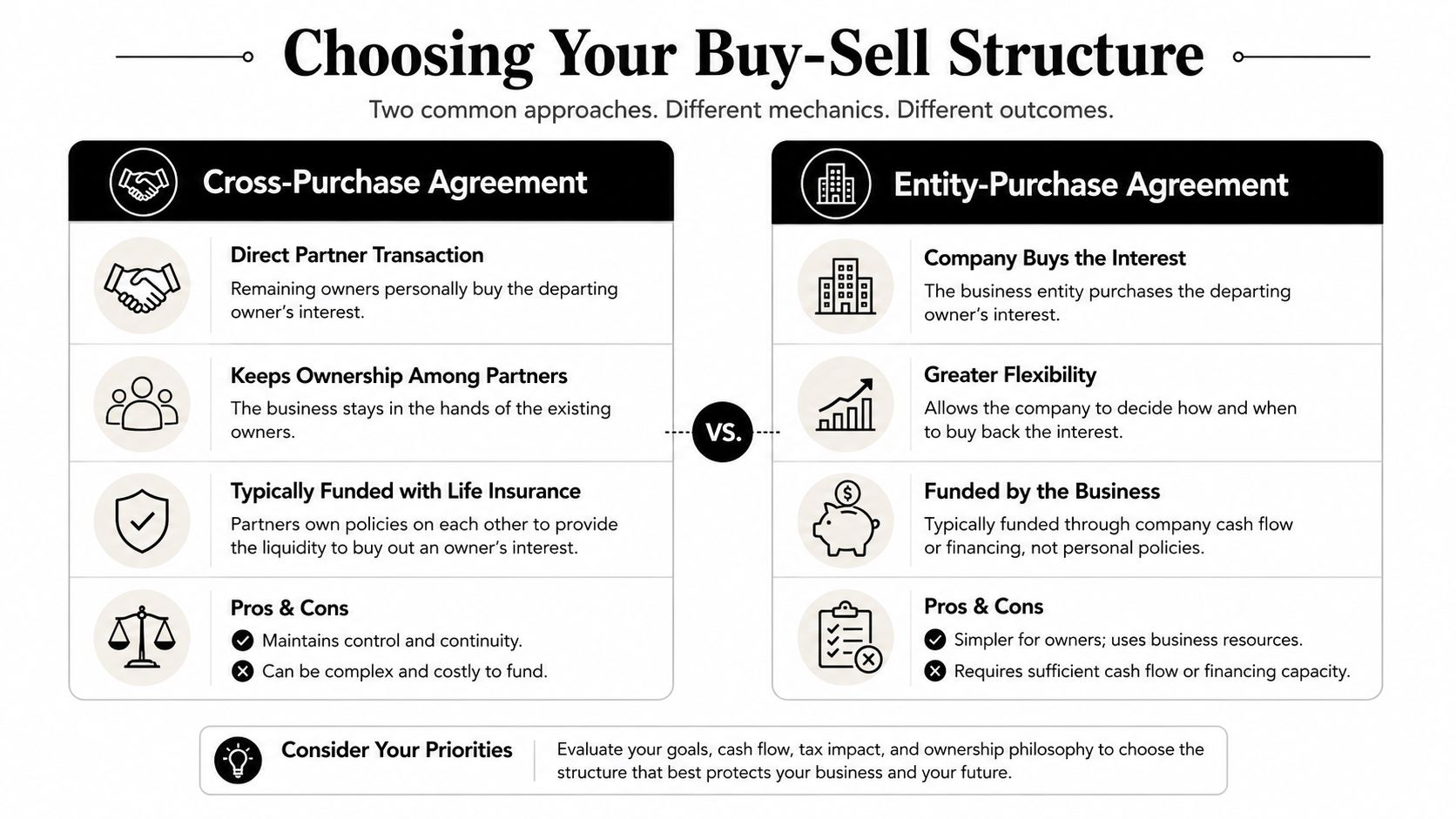
The broad rule is straightforward. The cross-purchase model is often preferred for smaller partnerships because it lets the surviving partner receive the death benefit directly to complete the buyout, while the entity model puts the company in the middle and can create different cash flow and tax considerations, as explained in 360 Financial's discussion of life insurance for business partners.
Two ways to fund the same promise
Think of cross-purchase as the partners buying each other's seats at the table. Think of entity-purchase as the company buying back the seat itself.
Cross-purchase agreement
In a cross-purchase setup, each partner owns a policy on the other partner.
If Partner A dies, Partner B receives the death benefit and uses it to buy A's ownership interest from A's estate or family, according to the buy-sell agreement. For a two-person company, this is usually easy to understand and easy to explain.
Why founders like it
- Direct control: The surviving partner gets the funds directly.
- Clean intent: The money is clearly tied to the buyout obligation.
- Good fit for small partnerships: Especially when there are only two owners.
What to watch
- More moving parts as owners increase: More owners usually mean more policies.
- Ongoing coordination: Ownership and beneficiary details must stay current.
Entity-purchase agreement
In an entity-purchase setup, the company owns the policy on each partner.
If a partner dies, the business receives the death benefit and uses it to redeem the deceased owner's interest. The family gets paid, and the business retires the shares or units under the agreement.
Why some firms choose it
- Administrative simplicity: The company manages the policies.
- Useful for multiple owners: Centralized ownership can be easier to maintain.
What to watch
- Company cash flow matters: The business is in the middle of the transaction.
- Documentation must be precise: The agreement and policy setup need to align closely.
How this differs from key person coverage
Founders often mix up buy-sell insurance and key person insurance. They're related, but they solve different problems.
A buy-sell arrangement answers: who gets the ownership, and how is that transfer funded?
Key person insurance answers: how does the company absorb the loss of a critical person's revenue, relationships, or leadership?
That's why it helps to read a plain-English guide on life insurance options for small business owners before choosing a structure. You may need one solution, the other, or both.
If your plan's main goal is to transfer ownership cleanly, focus first on the buy-sell design. Don't let a general business policy substitute for a succession agreement.
Calculating Your Coverage How Much Insurance Is Enough
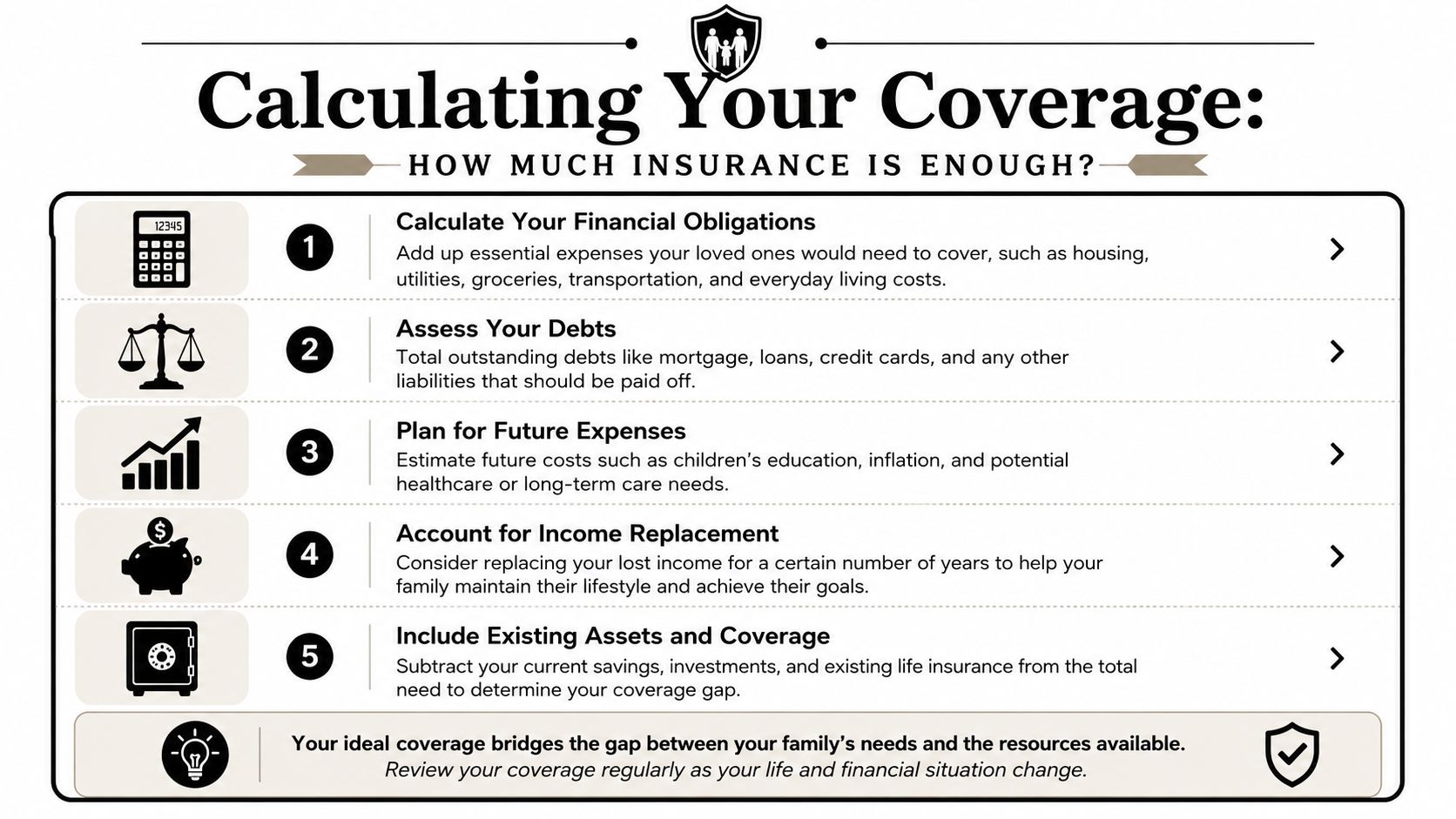
Two founders can agree on everything about the business, buy matching policies, and still leave a dangerous hole in the plan. The usual mistake is treating the insurance amount like a rough estimate instead of a funding target tied to real obligations.
The cleaner way to calculate coverage is to start with the number your buy-sell agreement would require at death, then add the liabilities that do not disappear when one partner is gone. Insurance is only the cash. Your agreement is the instruction manual that tells that cash where to go.
Start with the ownership value
Begin with the buyout price. If you and your partner have not agreed on how the business will be valued, the coverage number is just a guess with nicer packaging.
Common valuation methods include:
- Fixed value: The partners agree on a number and update it on a set schedule.
- Formula method: The agreement ties value to revenue, earnings, or another defined metric.
- Independent appraisal: A third party sets the value either periodically or when a triggering event occurs.
What matters is not picking the fanciest method. What matters is picking one method and putting it in writing so the policy amount matches the buyout obligation. A practical resource like this guide to how much life insurance you may need can help you frame the math, but the business number should come from your valuation terms, ownership percentages, and the price your agreement requires someone to pay.
Then add the debt exposure founders often skip
This is the part many startup teams miss.
If the policy only covers the deceased partner's equity, the survivor may receive enough money to buy the shares but still face loan payments, lender pressure, or a cash squeeze. Coverage should reflect the full financial shock of the death, not just the cap-table math.
A recent video discussion on business debt and partner coverage highlighted increased use of personal guarantees on small business loans over the prior 12 months in this video discussion on business debt and partner coverage. That matters because personally guaranteed debt often survives as a real business problem even after an owner dies.
If both partners signed for a line of credit, equipment loan, or SBA-related obligation, the lender still expects repayment. In practice, that can leave the surviving partner dealing with two problems at once. They must fund the ownership transfer and stabilize debt the deceased partner helped support personally.
A stronger coverage estimate usually includes three buckets:
- Buyout amount based on the valuation method in the agreement
- Debt tied to personal guarantees or other obligations that could pressure the survivor
- Short-term cash needs such as payroll, vendor payments, or working capital during the transition
Later in the planning process, many teams compare these assumptions against the mechanics discussed in the video below.
Coverage mistake to avoid: Insuring the share value while leaving personally guaranteed debt and transition cash needs out of the calculation.
A useful way to frame it is this. The policy should fund the price of the ownership transfer and protect the business from the immediate cash strain that follows. If it does only one job, the surviving partner may inherit a contract they can honor on paper but cannot afford in real life.
Navigating Ownership Beneficiaries and Tax Rules
This is the part founders usually delegate, then regret not understanding.
The buy-sell agreement may be perfectly drafted, but if the policy owner and beneficiary designations don't match that agreement, the plan can fail. Small errors here create big consequences because insurance companies pay according to the policy contract, not according to what the partners “meant.”
A legally binding buy-sell agreement is essential because it requires the death benefit to be used for the buyout. Without it, the payout may go to the deceased partner's personal estate, causing a 100% failure in funding the business transition, as described in Experian's explanation of life insurance for business owners.
The paperwork has to match the plan
The structure determines who should own the policy and who should receive the proceeds.
For example:
- In a cross-purchase arrangement, each partner typically owns the policy on the other partner and is also the beneficiary.
- In an entity-purchase arrangement, the business typically owns the policies and receives the death benefit.
If those details drift away from the buy-sell agreement, the wrong party may receive the funds. Then the surviving partner still has a buyout obligation, but not the money to satisfy it.
That's why the legal document and policy setup should be reviewed together, not separately.
Where founders often get tripped up
The common mistakes are usually boring administrative issues, which is exactly why they're dangerous.
| Detail | Why it matters |
|---|---|
| Policy owner | Determines who controls the contract |
| Beneficiary | Determines who receives the death benefit |
| Buy-sell language | Determines how the money must be used |
| Ownership updates | Keeps the plan aligned if the cap table changes |
The tax side is usually simpler to understand than people expect. In many standard discussions of these arrangements, premiums are treated as a business or personal cost of protection rather than a deductible operating expense, while the death benefit is generally structured to create liquidity for the buyout. The exact tax treatment depends on the arrangement and the parties involved, so founders should have both legal and tax advisors confirm the details before signing.
The goal isn't just to own insurance. The goal is to create a transfer that works under stress, with no ambiguity about who gets paid and why.
One more technical point matters here. Partners can't set this up unilaterally in secret. Consent and participation are part of making the arrangement valid and workable, especially when medical underwriting is involved.
Your Implementation Checklist From Conversation to Coverage
Monday morning. One founder is gone, the family needs clarity, the team wants direction, the bank still expects debt payments, and the surviving partner is trying to figure out who owns what by Friday.
That is not the moment to start drafting terms.
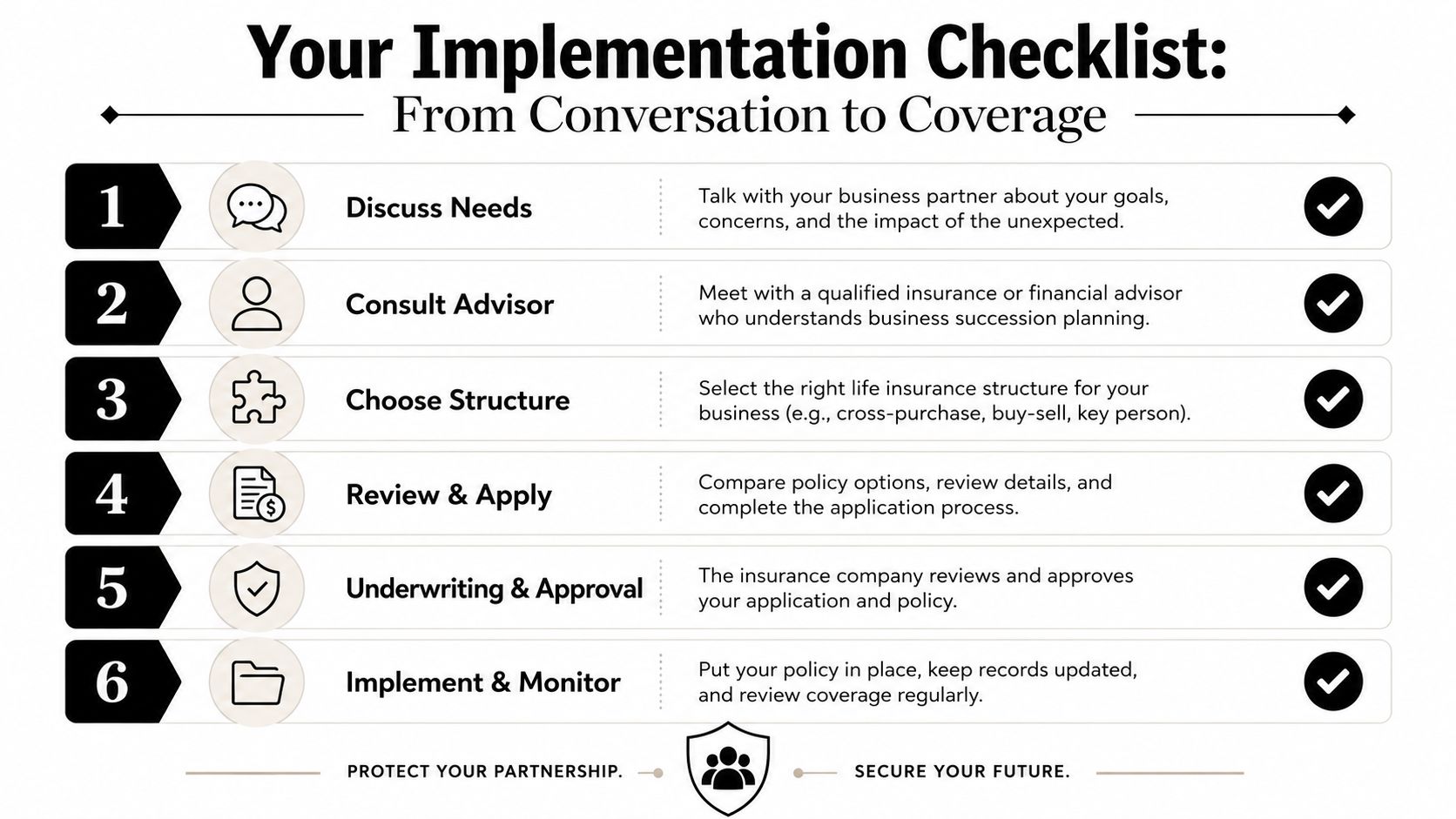
A workable plan is built in order, the same way you would build a product release. First decide the outcome. Then write the rules. Then fund those rules. Life insurance only supplies cash. The buy-sell agreement tells everyone where that cash goes, when it must be used, and whether part of it also needs to cover debt tied to personal guarantees.
A workable sequence for busy founders
Start with the business outcome, not the policy
Agree on the end result first. If one of you dies, should the surviving partner own the company outright, or should the business redeem the deceased owner's interest? Decide how the family gets paid, how quickly the transfer should happen, and whether company debt with personal guarantees also needs to be cleared as part of the plan.Hire an attorney to draft the buy-sell agreement
This document is the instruction manual for the insurance money. It should spell out the trigger events, who must buy, who must sell, how the price is set, and how payment works. If that legal document is vague, the insurance payout can arrive on time and still fail to solve the ownership problem.Choose a valuation method that can survive stress
A fixed number often gets stale. A formula, appraisal process, or defined review schedule usually holds up better because it gives everyone a way to reach a price when emotions are high and time is short.Apply for coverage that matches the obligation
Once the legal structure is clear, line up each policy with a specific responsibility inside the agreement. That may include the buyout amount, business debt backed by personal guarantees, or both. Coverage is not just about replacing equity. It is also about preventing a death from triggering a cash crunch or a fight with lenders.Check every moving part together
Review the agreement, policy application, ownership, and beneficiary designations side by side. A buy-sell plan works like a prenuptial agreement for your business. The paper and the money have to point to the same result.Put the review on the calendar now
Review the plan at least annually and after any major change, such as new debt, a valuation jump, a new owner, or a revised cap table. A plan written for last year's company can break when this year's company needs it.
A simple division of labor keeps this from dragging on:
- Founders decide the outcome they want for ownership, family treatment, and debt.
- Attorney writes the rules that make that outcome enforceable.
- Insurance professional sets up the policies to fund those rules.
- Tax advisor reviews the structure before documents are signed.
- Operations or finance lead tracks annual reviews and updates.
Claims often move faster than a negotiated buyout or a probate process. That helps, but speed only matters if the agreement already tells everyone what happens next. Without that instruction manual, quick money can still turn into slow chaos.
Common Questions and Real-World Scenarios
Two founders can agree on the big picture in ten minutes. Trouble starts in month 18, when real life changes the facts. A health issue appears. A new partner joins. The company takes on a loan backed by personal guarantees. That is when a buy-sell plan stops being a theory and starts acting like an instruction manual.

What if one partner is uninsurable
This is more common than founders expect, especially after a diagnosis, a risky medical history, or even certain hobbies. The key point is that the legal agreement can still require a buyout even if insurance is unavailable.
In that case, insurance is off the table, but the plan is not. You can fund the obligation with a cash reserve, an installment note, borrowed funds, or a sinking fund built over time. The agreement should spell out the payment terms clearly, including timing, valuation method, and whether the business or the surviving owner is responsible.
Debt deserves special attention here.
If the deceased partner personally guaranteed a business loan, the surviving owner may need cash for more than the equity purchase. They may need enough to refinance debt, satisfy a lender, or protect the estate from a guarantee claim. Coverage, in practical terms, means keeping the company solvent and the family out of a lender dispute.
What if the partnership changes later
Then the documents and the policies need to change with it.
A buy-sell agreement written for a two-owner startup can fail badly after a funding round, a new co-founder, or a major change in value. Ownership percentages drift. Debt grows. Personal guarantees appear. Retirement plans change. If the paperwork still reflects the old company, the payout can land in the wrong place or fall short of the actual obligation.
A simple test helps. Compare four items side by side: the cap table, the valuation method, the debt schedule, and the policy details. If those four do not match, the plan needs work.
Can I insure my partner without them knowing
No. A business partner must generally consent to the policy and participate in underwriting.
That requirement protects everyone involved. Life insurance on a partner is not a private workaround. It is a shared business decision with legal and financial consequences for the company, the surviving owner, and the insured partner's family. Open consent also forces the conversation founders often postpone: who gets the money, what it must pay for, and what happens to the ownership after death.
Healthy partnerships put the hard terms in writing while trust is high, not later when grief and money are in the room together.
Here is the larger lesson. Life insurance is a funding tool. The buy-sell agreement is the document that gives that money instructions. Without the agreement, a payout is just cash. With the agreement, it becomes a planned transfer of ownership, a source of liquidity for debt tied to personal guarantees, and a way to keep the business from drifting into conflict.
If you're ready to put a real succession funding plan behind your partnership, Coveredly offers a digital way to explore term life insurance that fits busy founders and business owners. It's built to make coverage simpler, with flexible online options and up to $3mm of term life insurance with no exams for most, so you can move from vague good intentions to documented protection.