
The most repeated piece of advice about life insurance for lawyers is to buy 10 to 15 times your income and get on with your day. That number is a starting point pretending to be an answer. It ignores the three separate jobs a lawyer's coverage usually has to do, and it assumes the group certificate in your benefits portal counts as one of them.
A lawyer's real balance sheet has a single dominant asset, and it isn't the condo or the retirement account. It's the next 20 or 30 years of billing capacity. Insure that with one policy and you've built half a plan. The other half is firm continuity, which is a business problem with a business solution, and beneficiary paperwork, which decides whether either policy pays the person you intended.
Here's the framework I use. Term insurance for household income replacement, separately owned policies for buy-sell and key-person funding at the firm, and a beneficiary audit that ties both together. By the end of this you should be able to write down four things: a target face amount, a policy type, an owner for each policy, and a named beneficiary for each policy.
Table of Contents
- Why Lawyers Need a Deliberate Life Insurance Plan
- How Much Life Insurance a Lawyer Actually Needs
- Term vs Whole Life for Lawyers
- Coverage Planning at Every Career Stage
- Buy-Sell and Key-Person Coverage for Firm Owners
- Getting Through Underwriting With Confidence
- Beneficiary Designations That Hold Up
- How to Put Your Policy in Place
Why Lawyers Need a Deliberate Life Insurance Plan
The house, the retirement account, and the partnership interest all run on the same engine, which is your future earnings. If that engine stops, everything it funds stops with it. Life insurance is the mechanism that converts your remaining earning years into cash for the people who were counting on them.
Consider the lawyer this guide is written for. Two children, a mortgage, student debt from three years of law school, and a compensation package with a bonus component that moves with the market. The American Bar Association's demographics profile puts the median age of U.S. lawyers at 46 in 2023, which is precisely the stretch when obligations peak, and its profile of the legal profession counts roughly 1.37 million active U.S. lawyers, up from 1.35 million a year earlier. Twenty more working years is the largest number on most lawyer household balance sheets, larger than the mortgage and often larger than everything else combined.

The trap is the group certificate. Firm life insurance feels like coverage because it shows up in your benefits portal with a multiple attached, and it usually disappears when you lateral, go in-house, or hang a shingle. The household need doesn't disappear with it. Nearly half of U.S. adults told LIMRA's 2024 research their families would face financial hardship within six months if the primary wage earner died unexpectedly.
Income protection for attorneys also isn't only about death benefits. A practice built on 60-hour weeks has to plan for the months someone spends recovering from law firm exhaustion, and that's a disability question far more often than a life insurance one. Good lawyer financial planning separates the two rather than treating one policy as a catch-all.
How Much Life Insurance a Lawyer Actually Needs
Skip the calculator that asks three questions and returns a round number. A usable life insurance needs worksheet builds the figure from your actual obligations, and the result is something you can defend to a spouse, a lender, or a business partner.
Start with scale. The Bureau of Labor Statistics reports a 2025 median lawyer wage of $159,670 across roughly 863,700 lawyer jobs, and projects lawyer employment to grow 5% from 2025 to 2035. The median tells you the income you're replacing is large. The distribution tells you your own compensation history matters more than any national figure.
| Need | What to count |
|---|---|
| Income replacement | After-tax income survivors need each year, multiplied by the support years |
| Mortgage payoff | Remaining home-loan principal, not the original loan amount |
| Education funding | Tuition, housing and fees for each child, in today's dollars |
| Debts and final costs | Student loans, credit cards, funeral and estate settlement |
| Firm obligations | Capital account, personal guarantees, buy-sell share |
| Less liquid assets | Savings, investments and existing group life |
| Target face amount | Total needs minus available assets |
Walking the worksheet line by line
Take a married lawyer with two children. Survivors need $100,000 a year after tax for 20 years. Discounted at a 3% real rate, that obligation alone is roughly $1.49 million, before you add a single other item.
Now stack the rest. A $350,000 mortgage balance. $200,000 set aside for two college educations. $80,000 covering student loans, cards, and final costs. The total need lands near $2.12 million. Subtract $250,000 of savings and existing group coverage, and the target face amount is roughly $1.87 million.
Run the same arithmetic with your own numbers in about 20 minutes, then write the result down. A number on paper changes how you read every quote you get afterward.
Why ten to fifteen times income is a floor and not a target
The common shortcut is 10 to 15 times annual income, and as a floor it isn't wrong. At the median wage it implies roughly $1.6 million to $2.4 million, which is the same neighborhood the worksheet produced. What the multiple can't see is the shape of your pay. Base salary, bonus, partnership-track equity, and future origination income all move in different directions, and a single multiple flattens all of it.
Run two scenarios instead of one. The base case assumes your current cash compensation continues. The upside case assumes the partnership track matures and your income steps up within five years, which raises the face amount because the household has built its spending around a number that isn't here yet. Lawyers with high and volatile income should size against the upside, which is why coverage planning for high income earners deserves its own review rather than a checkbox.
One more input that's easy to skip. Early-career coverage locks in protection while your health history is short and clean, and the face amount can be adjusted later as assets accumulate. Under-insuring at 32 because you expect to be richer at 45 is a bet that your insurability survives the next 13 years. We size coverage around the numbers on your worksheet rather than a multiple, because the multiple can't tell the difference between a solo practitioner with a mortgage and a partner with a capital account.
Term vs Whole Life for Lawyers
Two products, one job each. The decision isn't philosophical, it's structural.
| Factor | Term life | Whole life |
|---|---|---|
| Coverage period | A set term of 10, 20 or 30 years | Lifetime |
| Primary job | Replace income during the earning years | Permanent protection and estate liquidity |
| Cash value | None, it's pure protection | Savings component that grows over time |
| Premium cost | Lowest cost per dollar of coverage | Substantially higher for the same face amount |
| Flexibility | Many policies convert to permanent without a new medical exam | Policy loans and withdrawals against cash value |
| Best fit | Mortgage, dependents and partnership-building years | Estate taxes, legacy goals, permanent business needs |
The default verdict for most lawyers is term, sized to the years your family depends on your income. Match the term length to the obligation: a 20-year term covers a child born today through college, and a 30-year term covers a mortgage plus a second child plus the years before your investment portfolio can carry the household on its own.
The conversion clause is your hedge
Many term policies convert to permanent coverage without new medical underwriting. That feature is the reason to start with term and stop agonizing. You buy the cheap protection now, keep the right to buy permanent protection later, and you don't have to predict your health, your estate tax exposure, or your firm's future in your thirties.
Ask specifically which permanent products the conversion privilege reaches, whether the conversion can happen at your original health class, and whether there's a deadline. A conversion right that expires in year eight of a 20-year policy is a different asset from one that runs the full term.
The mistake that shows up most often
Buying permanent coverage young to build cash value before the family's income-replacement need is covered. The result is usually a policy with a face amount well below the worksheet total and a premium three to five times what the term equivalent would cost. You end up paying more for less protection during the exact years the need is largest.
Practical rule: cover the income-replacement need with convertible term first. Then, if estate liquidity or a permanent business obligation exists, add permanent coverage with the surplus.
Whole life earns its place in specific situations: an estate large enough to face liquidity pressure, a permanent buy-sell obligation that never expires, or a legacy goal you want funded regardless of how long you live. It's a targeted tool, not a default.
Coverage Planning at Every Career Stage
The right structure changes as your obligations change. Here's how I'd frame it at each stage.
A single associate with no dependents needs modest coverage, enough to retire student debt and cover final costs so a parent isn't writing checks at a funeral. That purchase is about insurability. Buying a small policy at 29 while healthy costs little and preserves the option to add face amount later through the same carrier.
A newly married lawyer or new parent has the opposite problem. Income replacement is now the dominant need, and a 20- or 30-year term sized to childcare, mortgage and education goals is the right instrument. This is the stage where under-buying is most common and most damaging.
A mid-career partner usually needs layers, not a bigger single policy. Personal term covers the family. A separately owned policy, with the firm or partners as owner and beneficiary, covers the capital account and buy-sell exposure. Two policies, two owners, two beneficiaries, and neither one substitutes for the other.
A senior partner often shifts toward estate liquidity, final taxes and equalizing heirs who won't inherit the practice. A smaller term policy or a permanent contract can fit here, and the coverage may be more about estate mechanics than income replacement.
| Career stage | Main risks to cover | Sensible structure |
|---|---|---|
| Single associate | Student debt, final expenses, future insurability | Small term policy bought while healthy |
| Newly married or new parent | Income replacement, mortgage, childcare, education | 20 to 30 year term sized to family obligations |
| Mid-career partner | Family income plus firm capital and buy-sell exposure | Personal term plus separately owned firm coverage |
| Solo practitioner | Family income and practice wind-down costs | Personal term plus key-person or continuity coverage |
| Senior partner | Estate liquidity, final taxes, equalizing heirs | Smaller term plus possible permanent policy |
What the group plan doesn't do
Employer benefits are not a substitute for portable protection, and the ownership numbers show why. LIMRA's 2024 life insurance fact sheet reports that 51% of U.S. consumers owned life insurance while 42%, about 102 million adults, said they needed coverage or more of it. Among owners, 55% held only individual coverage, 25% held only workplace coverage, and 19% had both, while 22% of owners said their coverage wasn't enough.
Read that 25% again. A quarter of insured households are relying entirely on a benefit that ends with the job. For a lawyer, that's an employer coverage gap that opens every time you change firms or move into private practice.
The solo practitioner case
A sole owner carries two exposures at once. The family needs income replacement sized to their actual spending, which is ordinary worksheet work. The practice needs enough cash to fund a wind-down: notifying clients, transferring files in an orderly way, covering a lease, and paying staff through the transition.
Ask the blunt question before you buy anything. If you died on a Tuesday, could the practice survive to Friday? If the answer is no, the continuity policy isn't optional, and the face amount should reflect the actual cost of closing well rather than a round number.
Requote your personal coverage at every firm move, partnership change, marriage, birth, and home purchase. Those are the five events that break old numbers.
Buy-Sell and Key-Person Coverage for Firm Owners
Owning the practice changes what insurance is for. For an owner, life insurance is continuity capital, not just family protection, and it belongs in the same conversation as the partnership agreement.
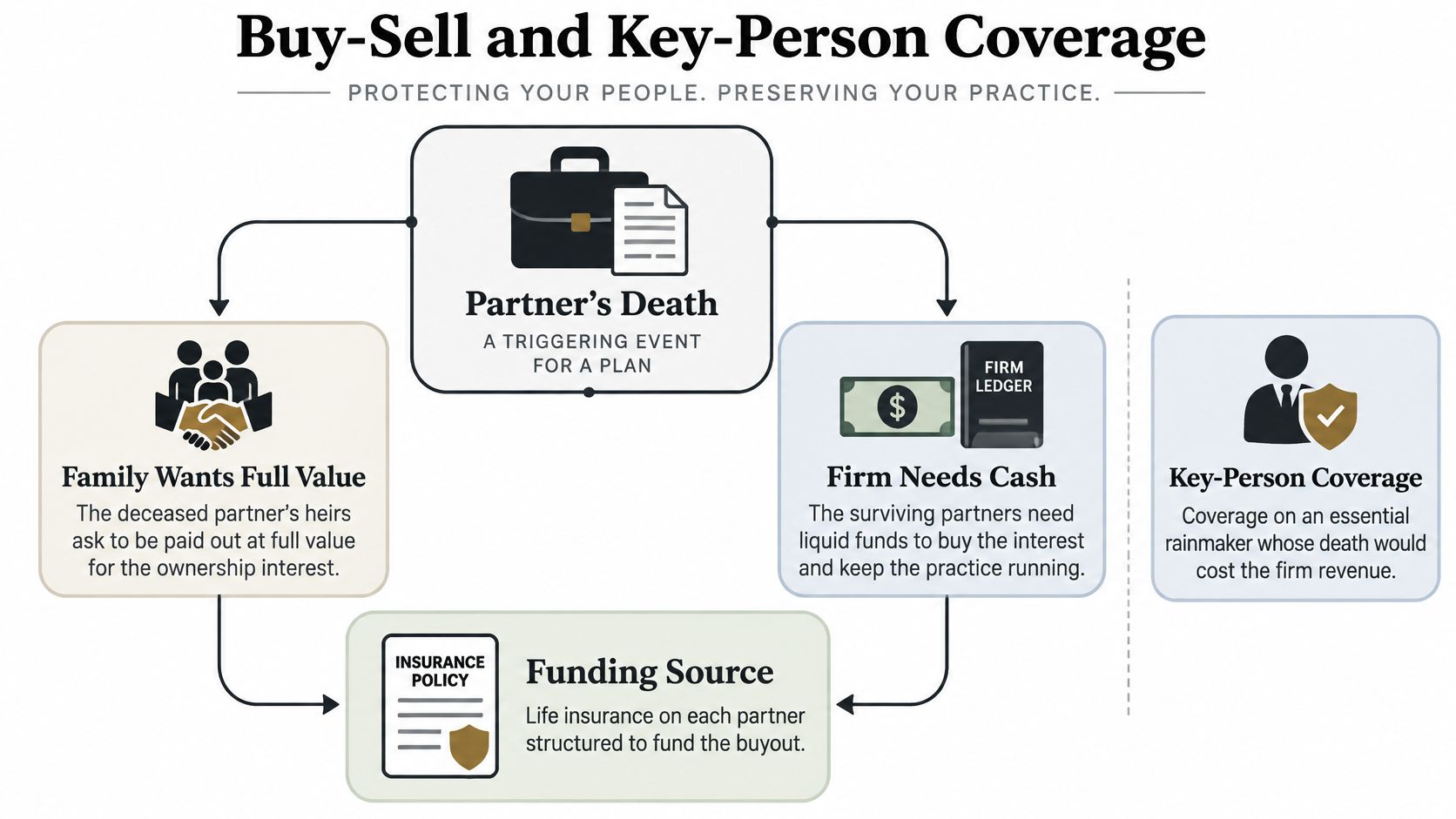
A partner's death creates two problems at once. The heirs want full value for the deceased partner's interest, and the firm needs cash to buy that interest without draining payroll, borrowing under pressure, or destabilizing client service. A buy-sell agreement life insurance structure solves both: the agreement creates the purchase obligation, and the policy supplies the liquidity. The BLS data on employment in U.S. offices of lawyers puts roughly 1.11 million people working in those offices in 2025, so practice continuity is a real operational exposure, not a theoretical one.
Cross-purchase versus entity-purchase
Say two partners each own half of a practice valued at $2 million. Under a cross-purchase arrangement, each partner owns a $1 million policy on the other and pays the premium personally. Under an entity-purchase, the firm owns both policies, pays the premiums, and receives the proceeds to buy out the deceased partner's interest.
| Factor | Cross-purchase | Entity-purchase |
|---|---|---|
| Policy owner | Each partner owns policies on the others | The firm owns the policies |
| Number of policies | Grows with the partner count (four partners need twelve) | One policy per owner |
| Administration | More policies to track and fund | Simpler to administer |
| Tax basis and transfer | Basis may step up for the surviving owner | Firm-level tax treatment; counsel must review |
| Best fit | Small partner groups with few owners | Larger firms with many owners |
The choice affects administration, basis, transfer mechanics and the number of policies, so document it alongside the partnership or shareholder agreement with counsel involved. Get this wrong and you can create a buyout that's fully funded and still doesn't close.
Valuation, not a round number
Tie the face amount to a defensible formula: an agreed fixed value, an appraisal process, or an earnings-based multiple. Then review it after any material change in revenue, partner ownership, debt, or profitability. A policy bought at $1 million against a practice now worth $3 million funds a third of a buyout.
Owners planning a sale or a partner transition should also think through the exit itself, and Exit Pathways' primer on what exit planning involves covers the sequencing that a buy-sell agreement plugs into. Coverage that funds a death buyout and coverage that funds a retirement buyout are different conversations with different timelines.
The rainmaker problem
Key-person insurance for law firms covers a narrower risk than buy-sell funding. It's protection on an individual whose death would cost the firm revenue: the partner with the biggest client relationships, the trial lawyer whose name closes the matter. The benefit goes to the firm, not the family, which is why it belongs in a separate policy with a separate beneficiary.
Two more clarifications that save owners from expensive confusion. Life insurance pays at death. Disability insurance pays during a living incapacity, which is the far more common loss of a working lawyer's services. And partner groups should coordinate ownership with the agreement itself; life insurance for business partners is a funding decision that follows the legal document, not a substitute for one.
Getting Through Underwriting With Confidence
The contrarian claim is simple. Waiting until you feel fully established is the riskier move, not the safer one. Every year you postpone adds age to the rate and adds medical history to the file, and one of those two things moves in the wrong direction every single year.
What carriers actually weigh
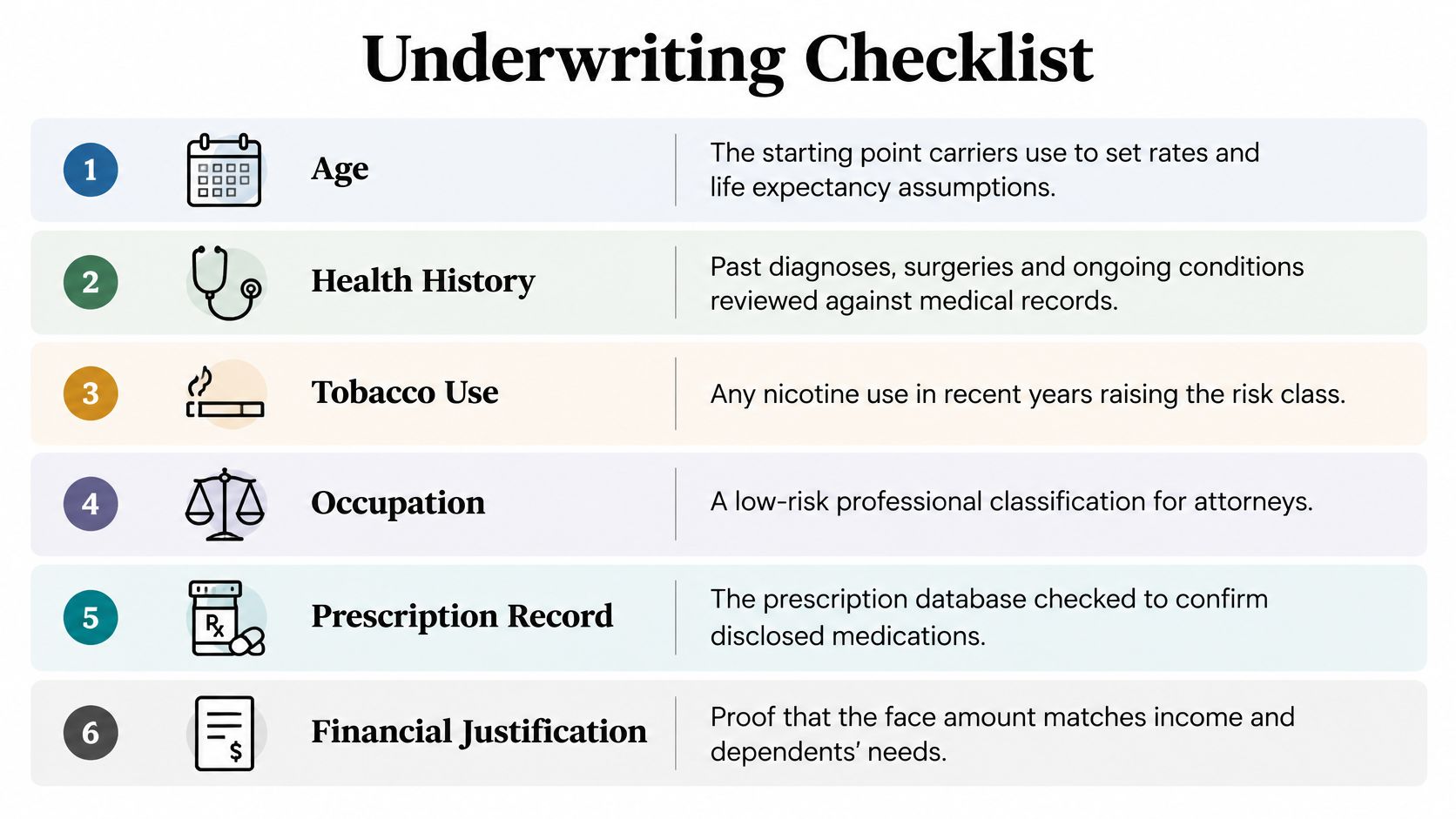
They look at age, health history, tobacco or nicotine use in recent years, occupation, the prescription database, and the financial justification for the face amount. Your occupation is a low-risk classification in their model, which is a quiet advantage lawyers carry into every application. The face amount is where some attorneys hit friction: a $3 million policy on a $160,000 salary needs a reason, and the reason is the worksheet from earlier in this article.
Digital underwriting removes the exam for many applicants. Answer the prescription and medical history questions exactly as they appear on the record, because the database is checked against what you disclose.
Mental health, therapy and medication
This is the part lawyer-focused content skips. Anxiety, depression, therapy, medication, a leave of absence, or past substance-use treatment all belong on the application, and disclosure is not an automatic decline.
Carriers weigh the diagnosis, current stability, treatment adherence, and time since the last episode. Well-managed conditions with consistent treatment often get standard or near-standard offers. An undisclosed history discovered later is a far worse outcome than a rated offer you can work with.
The numbers suggest this matters more than the industry admits. Fewer than one in four Gen Z and Millennial adults say they understand how underwriting works, and 53% of young adults who admit they aren't knowledgeable about life insurance also report a coverage gap, per LIMRA's 2025 research on young adults and coverage. That same 2025 review found biopsychosocial factors in 45% of claims reviews, with 67% involving people aged 25 to 44, which is exactly the window when lawyers marry, have children, and take on mortgages.
Here's a short walkthrough of how the application plays out in practice.
If you're rated or declined
A rated or declined application isn't the end of the process. Ask what evidence would change the decision: a letter from your treating physician, a longer stability period, a different medication history. Ask whether reconsideration is available at a future date, and whether a different policy structure fits better.
Many carriers offer flexible underwriting options for people with pre-existing conditions, so a single decline from one carrier is a data point, not a verdict. Getting the full picture of how underwriting life insurance works before you apply saves months of guessing.
Apply while you're healthy, disclose completely, and treat the first offer as a negotiation rather than a ruling.
Beneficiary Designations That Hold Up
The death benefit goes where the contract says it goes. Not where your will says, not where the firm's partnership agreement implies, and not where your family assumes. The National Association of Insurance Commissioners explains the mechanics plainly: primary beneficiaries receive the death benefit if eligible, and contingent beneficiaries receive proceeds only if a primary beneficiary dies before the insured.
When you name several people, specify either the percentage each receives or that proceeds split in equal shares. Leave it silent and you've handed an ambiguity to the claims department at the worst possible moment.
The mistakes lawyers actually make
Naming the estate. It invites probate delay and exposes the proceeds to creditor claims, and it's the single most common error in policies held by attorneys.
Leaving an ex-spouse in place. A divorce decree doesn't rewrite a beneficiary form. The insurer pays the named person.
Forgetting the contingent tier. A policy with one primary beneficiary and no contingent pays the estate if that person dies first, which drags you back into probate.
Assuming an informal understanding counts. Blended families, business interests and detailed estate plans all lose to a stale designation. Only the form controls.
Letting firm coverage drift from the buy-sell documents. The policy owner and beneficiary must match what the agreement says, or the funding mechanism doesn't work.
The 15-minute audit
Pull every policy you own or are insured under, including group certificates. Confirm the primary designations by name and percentage. Confirm a contingent beneficiary exists and is living. Then check the ownership on any firm-related policy against the buy-sell agreement.
Update after marriage, divorce, childbirth, adoption, a partner admission, or a firm move. Put a reminder on the calendar for the same month each year, next to your malpractice renewal. Fifteen minutes decides where the money lands.
A beneficiary form is a legal document with a deadline attached. Treat it like a filing, not a formality.
How to Put Your Policy in Place
Three moves, in order.
1. Total the number. Run the worksheet with income replacement, mortgage, education, debts, final costs and firm obligations, then subtract savings and group coverage. Write the target face amount down and date it. That number is your brief for every conversation that follows.
2. Choose the structure. Term for family income replacement during the dependent years. Separately owned coverage for firm capital or buy-sell funding if you own or co-own the practice. A key-person policy if one person's death would cost the firm its biggest clients. Revisit the split whenever partnership, family or finances change.
3. Get covered and stay flexible. Request quotes from several carriers against your actual face amount, compare premiums and conversion terms, and apply. Premiums depend on age, health and coverage amount, so work from real quotes rather than estimates. Ask whether a no-exam or accelerated path is available at your number, because many carriers offer flexible underwriting rather than a single rigid process.
On cost, many policies start as low as $15 to $30 per month depending on age, health and coverage amount, and term coverage runs up to $3M with no medical exam for most applicants. The application itself is entirely digital, most applicants get an instant decision, and coverage can be laddered up or down as your needs change rather than replaced from scratch.
Coverage typically begins once the policy is approved and the first payment is processed. Premiums are lowest while you're young and healthy, and that window closes. Start this month, then calendar an annual review next to your birthday so the number tracks your career instead of lagging three years behind it.
Coveredly compares multiple carriers to find competitive pricing, issues term coverage digitally with instant approvals for most applicants, and sizes policies around the numbers on your worksheet rather than a multiple of salary. Run the worksheet, get real quotes against the face amount you wrote down, and put the policy in force while your health history is still short. Visit Coveredly to see your options and lock in coverage this month.