You moved to the United States to build something real. Maybe it's a new job on an H-1B, a small business tied to your visa, or a growing family that now depends on your income. At some point, a practical question shows up: if something happens to you, would the people you love be financially protected?
That's where life insurance for non US citizens gets confusing fast. You'll find advice written for U.S. citizens, broad statements that skip over immigration status, and almost no plain-English guidance on what happens if you later leave the country. That last point matters more than is generally understood.
The good news is that getting covered is possible. The process is stricter for some applicants, but it's not a mystery once you understand the rules insurers care about: your immigration status, your U.S. ties, your health records, and whether the policy will still work if your life becomes international again.
Table of Contents
- Your Guide to Securing Your Family's Future in the US
- Who Can Get Life Insurance in the United States
- Understanding Your Coverage Options and Limits
- The Step by Step Application Process
- Common Obstacles and Critical Pitfalls to Avoid
- Tailored Advice for Your Stage of Life
- Key Takeaways and Frequently Asked Questions
Your Guide to Securing Your Family's Future in the US
For many non-citizens, life insurance feels like one of those “I'll deal with it later” tasks. The language is unfamiliar, the forms are detailed, and it's hard to tell whether your visa or residency status changes everything. That hesitation is normal.

Life insurance is a financial safety net. If you die while the policy is active, the insurer pays money to the people you name as beneficiaries. It replaces the income, savings plan, or stability your family would have lost.
That basic idea is the same whether you were born in the U.S. or not. The difference is that insurers often ask non-citizens more questions before approving coverage. They want to understand how long you've been in the country, whether your ties here are stable, and how they can verify your identity, finances, and medical history.
Practical rule: The harder it is for an insurer to verify your long-term connection to the U.S., the narrower your options usually become.
This doesn't mean you're shut out. It means the right preparation matters. When people understand which documents matter, which policy types are realistic, and which questions to ask before signing, the process becomes much more manageable.
The often-missed issue is portability. Many people focus only on getting approved now. If there's a chance you might move back home or take a role in another country later, you also need to know whether your policy still works abroad. A policy that looks fine today can become a serious problem later if international living wasn't addressed at the start.
Who Can Get Life Insurance in the United States
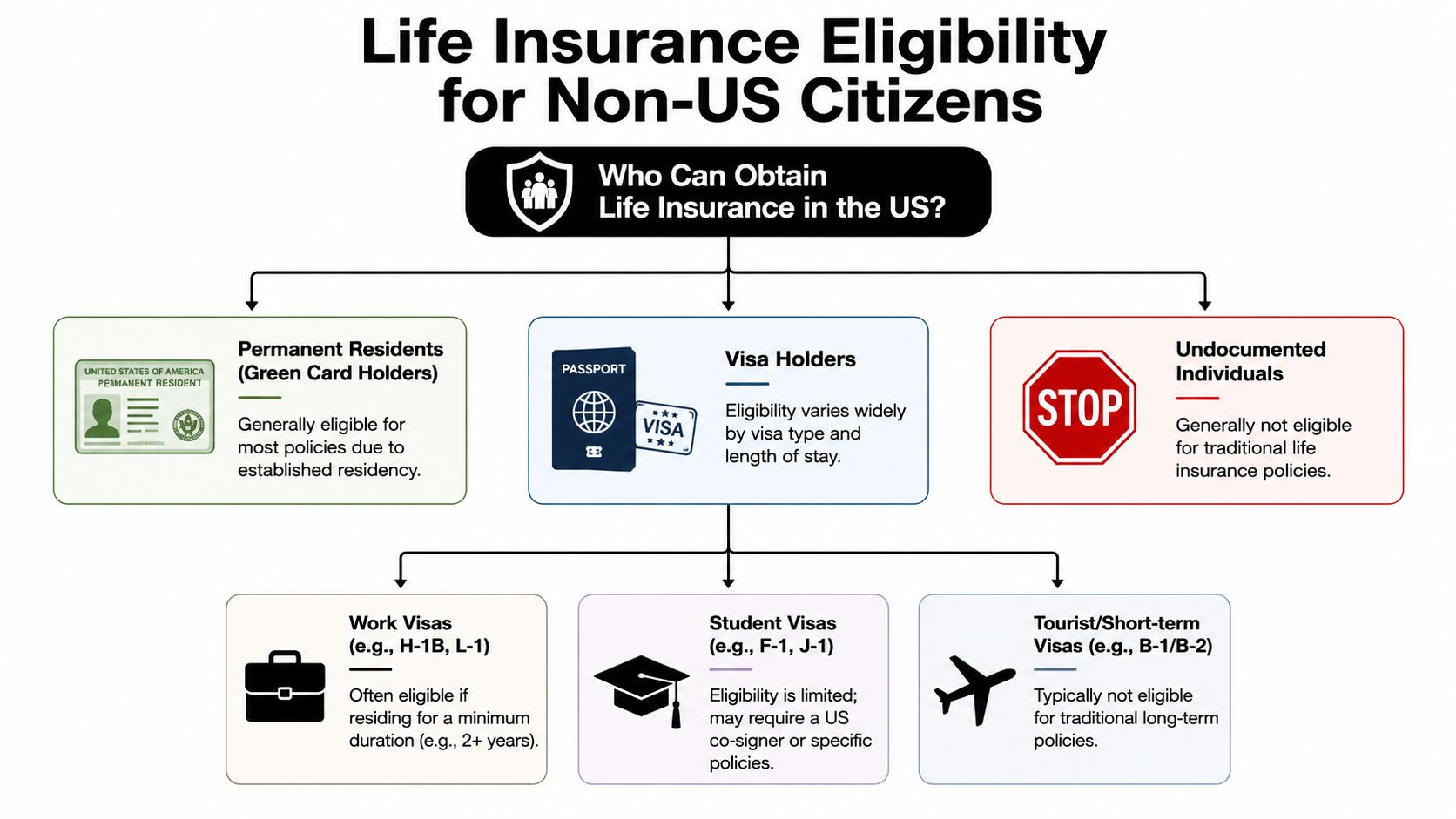
Eligibility usually turns on one thing first: your immigration status. Insurers use that as the starting point because it helps them judge how established your life is in the U.S. and how easy it will be to maintain the policy over time.
Start with your immigration status
Green card holders generally have the best access. They can qualify for the same coverage options and standard rates as U.S. citizens, while temporary visa holders such as H-1B, E-2, L-1, and O-1 usually face more limited options. Carriers often want to see 1 to 5 years of U.S. residence and a U.S. bank account because they prefer applicants with a stable financial and physical footprint, as explained in Guardian's guidance for non-permanent residents.
That difference matters in everyday terms. A permanent resident may shop broadly across carriers. A temporary visa holder may need to focus on insurers that specialize in foreign national underwriting, and may see fewer no-exam or simplified issue options.
Undocumented applicants generally face the toughest path. Traditional policies are often unavailable, and when coverage is possible, the choices can be narrow. This is one of the reasons broad online advice can be misleading. “Non-citizen” is not one category in underwriting.
If you want a plain-language look at how insurers review these risk factors, this guide to life insurance underwriting is a helpful reference.
What insurers mean by U.S. nexus
Insurers often use the idea of U.S. nexus. That's just a formal way of asking, “How connected is your life to the United States?”
A strong U.S. nexus often includes things like:
- A U.S. address: Insurers need a reliable place for legal correspondence.
- A U.S. bank account: Premiums are commonly expected in U.S. dollars from a U.S. account.
- An SSN or ITIN: This helps with identity and tax verification.
- Clear reasons for being in the U.S.: Work, family, property, or business ties matter.
There's also an important boundary. You generally can't just fly to the U.S. for the purpose of buying life insurance. Carriers usually expect existing ties to the country before they'll consider an application from a non-permanent resident.
A good way to think about it is this: insurers don't just insure a person. They insure a person whose legal, financial, and practical connection to the U.S. they can verify.
That's why two applicants with similar incomes can have very different outcomes. The one with deeper U.S. roots usually has the smoother path.
Understanding Your Coverage Options and Limits
Once you know you're eligible, the next question is usually, “What kind of policy can I get, and how much coverage is realistic?” For life insurance for non US citizens, the answer depends on both the policy type and the insurer's risk rules.
The main policy types you may see
The two names you'll see most often are term life insurance and whole life insurance.
Term life covers a set period. It's usually the product people choose when they want protection during working years, while children are young, or while a mortgage or business loan is still outstanding.
Whole life is permanent coverage that stays in force as long as premiums are paid and the policy remains active under its terms. It's more commonly discussed when someone wants long-term estate planning, business continuity, or high face amounts tied to major assets.
For non-citizens, the product menu may look familiar, but the underwriting rules are not always the same as they are for citizens. Some carriers narrow the available products for temporary residents or foreign nationals, especially when the applicant's ties to the U.S. are still developing.
Why country class changes the maximum amount
Insurers often sort countries into internal risk tiers such as Class A, Class B, and Class C. These tiers help determine the largest coverage amount available and which rate classes may be offered.
According to Prudential's foreign national underwriting guide, applicants from Class A countries can access jumbo policies up to $65 million, while applicants from Class B countries may be capped at $12.5 million. The same guide notes that the minimum policy for a non-resident is typically benchmarked at $250,000 because international underwriting is more expensive.
Here's a simple comparison:
| Applicant profile | What often changes |
|---|---|
| Green card holder with stable U.S. life | Broader carrier access and more standard product choices |
| Temporary visa holder with solid U.S. ties | Coverage may be available, but carrier choice is narrower |
| Foreign national from lower-risk country tier | Higher potential maximum face amounts |
| Applicant with minimal U.S. ties | Smaller set of options and more restrictions |
Another key detail from the same Prudential guide is that Attending Physician's Statements and a Data Verification Report are mandatory in all cases for non-U.S. resident foreign nationals, and applicants need a record of health maintenance with the most recent visit occurring within three years of the application date. For older applicants especially, missing medical documentation can derail approval.
That higher minimum can surprise people. U.S. citizens may be used to seeing small starter policies advertised online. Foreign national underwriting often starts at a much larger face amount because the insurer has more work to do before issuing the policy.
The Step by Step Application Process
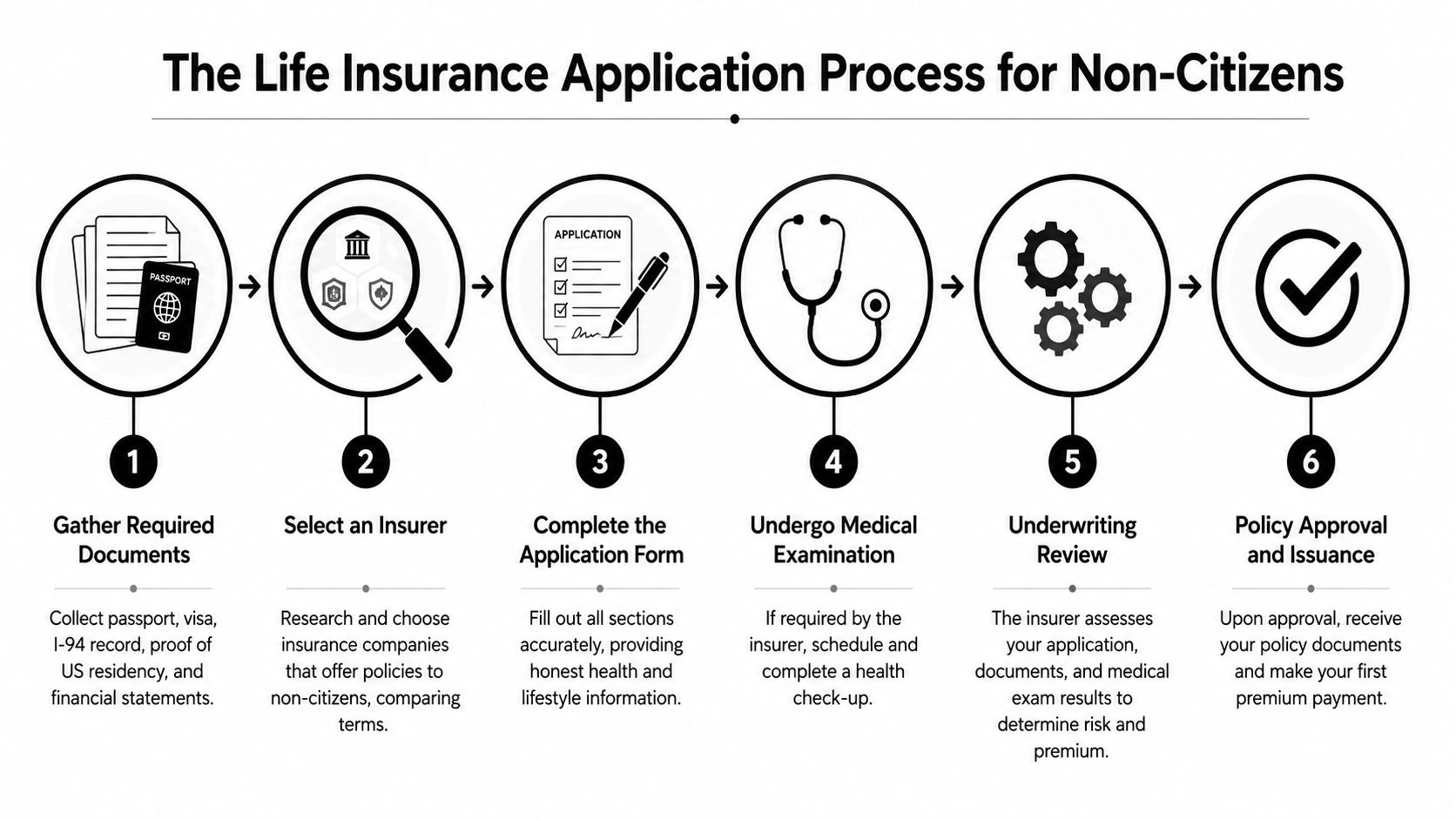
A good way to approach the application is to treat it like an airport security check. The insurer is confirming identity, legal presence, health, and your connection to the United States before they let the policy through.
What to gather before you apply
Start with your paperwork first. That saves time and helps you avoid a common problem for non-citizens: getting halfway through the process and learning one missing document pauses everything.
Insurers usually want a clear paper trail that answers four questions. Who are you. What is your immigration status. Where do you live in the U.S. What financial or family connection makes this coverage reasonable?
A practical file often includes:
- Passport and visa documents
- I-94 travel or admission record
- Proof of U.S. residence
- SSN or ITIN if available
- Evidence of U.S. assets or financial ties
- Medical records and doctor information
Physical presence in the U.S. also matters during the application. In many cases, key steps such as signing, the medical exam, and policy delivery need to happen while you are in the United States. If your schedule involves frequent international travel, plan your application window carefully so those steps do not get interrupted.
That detail matters more than many applicants expect.
How underwriting works for non-citizens
Underwriting is the insurer's review process. It works like a fact check. The company compares your application with your documents, medical history, and U.S. ties, then decides whether to offer coverage and at what price.
For non-citizens, underwriters often look closely at consistency. If your visa status, address history, travel pattern, and financial documents all point in the same direction, the case is easier to approve. If they conflict, the insurer may ask follow-up questions or request more records.
Medical review can also feel unfamiliar if you have never applied for individual life insurance before. If you want a plain-English explanation of the forms and extra proof insurers may request, this guide to an evidence of insurability form is a helpful primer.
One more step is easy to miss. Before you apply, tell the agent if there is any real chance you may return to your home country or accept an overseas assignment later. Many buyers focus only on approval, but globally mobile families also need to ask whether the policy remains valid after a move abroad and whether an expatriate rider is available. It is much easier to solve that issue at the application stage than after the policy is in force.
Organized paperwork makes the process feel routine. Disorganized paperwork turns a normal review into delays, extra questions, and repeated requests for documents.
Common Obstacles and Critical Pitfalls to Avoid
A common real-life scenario goes like this. Someone gets approved for a U.S. life insurance policy while working here, stores the paperwork away, then takes a job transfer or moves back home a few years later. Their family assumes the coverage still works the same way. In some cases, that assumption becomes the problem.

The policy can change meaning after you move
Many buyers focus on one question: can I get approved in the U.S.? Approval matters, but globally mobile families need to ask a second question at the same time. Will the policy still pay if I later live outside the United States?
Some policies include territorial limits or residency rules that affect coverage after a long-term move abroad. As explained in this guide on U.S. life insurance becoming void abroad, a family can run into claim problems if the insured relocates overseas without setting up the policy correctly first, including adding an expatriate rider when available.
That detail is easy to miss because the application process usually centers on identity, income, and medical review. But for a person on a visa, a green card holder who may retire elsewhere, or an employee who might accept an overseas assignment, this clause can matter as much as the death benefit itself. A policy is a bit like a contract with house rules. You want to know those rules before life changes, not after.
Questions to ask before you sign
If there is any realistic chance you may live abroad later, ask specific questions and get the answers in writing.
- Does living outside the U.S. change the policy's validity? Ask for the exact policy language, not a general summary.
- Is an expatriate rider available? Some insurers offer an added feature that helps keep coverage in place after an international move.
- How does the insurer define a move abroad? A few months of travel is different from establishing residence in another country.
- Can premiums still be paid easily from outside the U.S.? If payment depends on a U.S. bank account, make sure that setup will still work later.
- Do I need to notify the insurer before or after relocating? Some policies require notice, and missing that step can create trouble later.
A simple question can prevent a very painful surprise: “If I leave the United States in the future, what must I do now to keep this policy valid?”
Another obstacle is the basic financial setup around the policy. Insurers may hesitate if the application shows an unstable address, no U.S. banking relationship, or records that do not line up cleanly. Even after approval, those same weak spots can make billing, notices, and beneficiary claims harder to manage.
Coverage amount can also become a hidden mistake. Buyers sometimes choose a number that feels affordable today without checking whether it would support family members across two countries, two legal systems, or two households. A practical way to pressure-test the number is to use a life insurance needs calculator and then adjust for relocation costs, debt, and ongoing support for relatives abroad.
Tailored Advice for Your Stage of Life
The right policy depends on what, exactly, you're protecting. That's why general advice can feel thin. A newly married couple doesn't use life insurance the same way a parent or a business owner does.
A young family on a work visa
Take a couple living in the U.S. on a work visa with one or two young children. Their biggest concern usually isn't estate planning. It's monthly life.
If one parent dies, the surviving spouse may suddenly need help with rent or mortgage payments, childcare, school costs, and day-to-day expenses while also dealing with immigration and employment pressure. In that situation, term life insurance often makes intuitive sense because it's aimed at protecting the years when the family is financially vulnerable.
A simple way to think about it is replacement. What income would need replacing, and for how long? If you want a framework for thinking through the numbers, this life insurance needs calculator guide is a useful place to start.
A business professional with U.S. assets
Now consider a professional who has built clear ties in the U.S. through property, investments, or a business interest. For this person, life insurance may do more than protect dependents.
It can support loan requirements, protect a partner in a closely held business, or create liquidity if an asset can't be sold quickly. The insurance isn't just family protection. It's part of a broader financial structure.
That's why the underwriting questions around assets, residence, and legal ties matter so much for this group. The policy has to match a real economic purpose.
A newly married couple building a shared plan
For newly married couples, life insurance is often less about complexity and more about commitment. One spouse may be a citizen and the other may not. Or both may be non-citizens still finding their footing in the U.S.
In that stage, coverage can protect a shared apartment lease, a home purchase plan, family support obligations, or the simple reality that one person's income now matters significantly to the other's future. It's a quiet form of partnership planning.
Good coverage should fit the life you're actually building, not the generic profile an ad assumes you have.
When people buy too fast without asking mobility questions, they can end up with a policy that fits today and fails tomorrow. For globally mobile couples, that risk deserves special attention.
Key Takeaways and Frequently Asked Questions
Quick recap
Life insurance for non US citizens is possible, but the rules aren't one-size-fits-all. Immigration status shapes eligibility first. Green card holders usually have the broadest access, while visa holders often need stronger proof of stable U.S. ties.
Coverage limits can depend on country risk tier and foreign national underwriting rules. Application logistics matter too, especially when documents, medical records, and in-person steps must line up properly in the U.S.
Most important, don't stop at approval. If your life may become international again, check whether your policy remains valid after a move abroad and whether you need an expatriate rider before leaving.
Frequently asked questions
Can a non-U.S. citizen name beneficiaries in the U.S. or abroad
In many cases, yes. Insurers generally allow policyholders to name beneficiaries, but the insurer's forms and claim procedures still need to be followed carefully. If your beneficiaries live outside the U.S., it's smart to confirm what documentation they would need later.
Can I apply while visiting the U.S. for a short trip
Usually, insurers want more than a short visit. They often look for meaningful U.S. ties such as work, family, property, financial accounts, and a legitimate reason for being in the country beyond buying insurance.
Do I always need a medical exam
Not always, but foreign national cases often involve deeper underwriting than applicants expect. Medical records and foreign physician statements can be especially important when the insurer needs verifiable health history.
What should I ask before signing the policy
Ask whether moving abroad affects coverage, whether any territorial exclusion applies, whether an expatriate rider is available, and how premiums must be paid to keep the policy active.
What's the best next step
Gather your documents, make a list of your U.S. ties, and write down any future relocation plans before you shop. The more clearly you can explain your life in the U.S. and your possible plans abroad, the easier it is to find a policy that fits.
If you want a simpler way to shop for coverage online, Coveredly offers digital life insurance designed to be flexible and straightforward for real life. It's a practical place to compare options and start protecting the people who count on you.