
You're checking the rent due date while a childcare invoice sits unopened, and the emergency fund would cover only a short stretch of normal bills. As a single parent, your income, daily care, and household decisions all depend on one person. Life insurance can't replace you, but it can give your children housing, care, and time to adjust if you die unexpectedly.
The right policy isn't automatically the largest one or the most complicated one. It's the policy amount, term, ownership structure, and beneficiary arrangement that work together. This guide focuses on both sides of that decision, including coverage sizing, trusts, UTMA accounts, guardianship, underwriting, and digital application options.
Table of Contents
- Why Single Parents Need a Financial Safety Net
- How Life Insurance Actually Works
- Term vs Whole Life Insurance Compared
- How Much Coverage You Really Need
- Beneficiaries, Guardians, and Trusts Explained
- Underwriting Health, Cost, and Digital Application Options
- A Sample Single Parent Coverage Scenario
- Your Next Steps and Common Mistakes to Avoid
Why Single Parents Need a Financial Safety Net
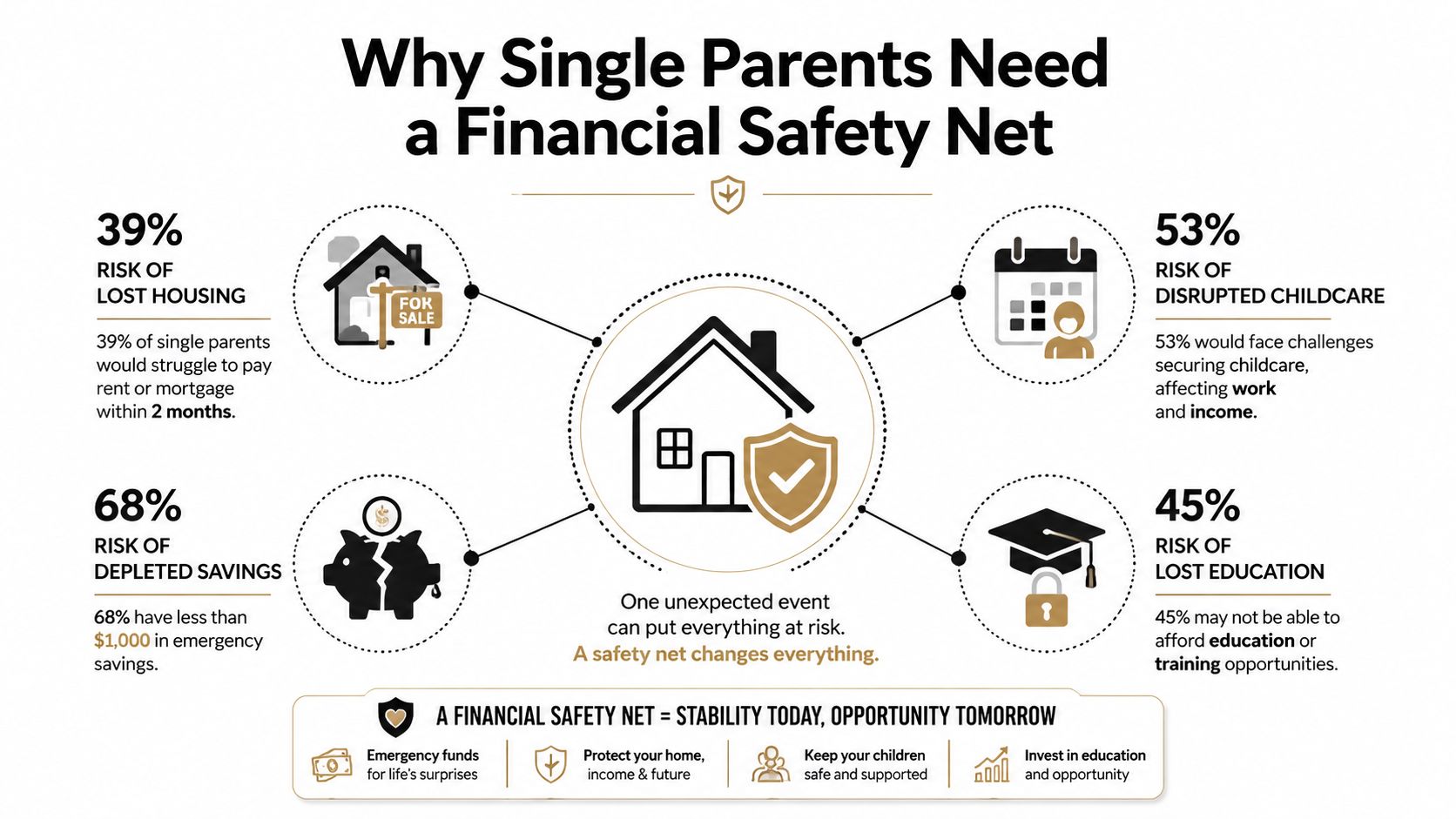
A single parent may manage rent or a mortgage, daycare invoices, groceries, transportation, school needs, and work obligations with one income and one emergency fund. That creates a single point of failure. If the parent dies, the household doesn't lose only a paycheck. It may also lose the person who organizes childcare, handles transportation, and keeps the children's routine functioning.
The FDIC reported more than 6 million single-parent households in the United States, including 2.7 million headed by Black or Hispanic parents. In 2019, almost half of single-parent households had annual income below $30,000, compared with 25% of households overall, and close to 15% were unbanked in 2021, compared with a much lower national average. These conditions make liquidity and affordability central to planning life insurance for single parents.
What the policy protects
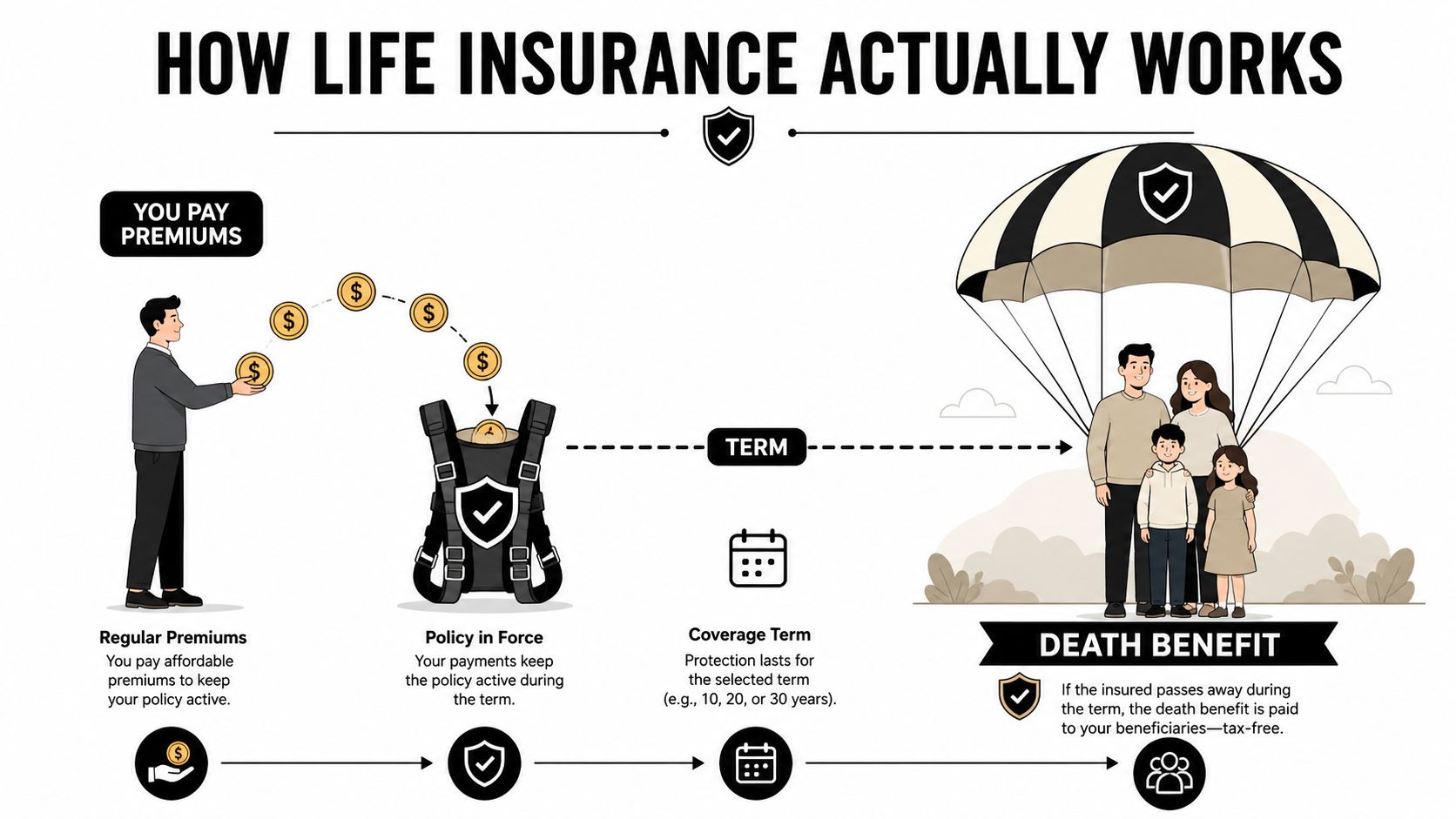
Life insurance is a financial parachute. You pay premiums while the policy is active, and the insurer pays a death benefit to the policy's beneficiaries after a covered death. That lump sum can help replace income, keep housing stable, fund childcare, pay debts, and give a guardian the resources to care for the children.
A savings account remains valuable, but it may be consumed quickly by housing, food, transportation, and care costs. Insurance is designed for a different problem: a large financial loss arriving at once. The purpose isn't to put a price on a parent's life. It's to prevent the surviving family from having to make urgent decisions while grieving.
For practical context about other forms of support that may affect a family's plan, review this guide to dependent benefits for Wisconsin families. Benefits, savings, and insurance can work together, but none should be assumed to replace the others.
How Life Insurance Actually Works
Think of a life insurance policy as a parachute packed before the jump. You pay the insurer to keep the parachute available for a defined period. If you die while the policy is in force, the insurer releases the agreed financial support to the people or structure named in the contract.
Four terms explain most of the mechanics:
- Premium: The ongoing price of the policy, often paid monthly. Insurers consider factors such as age, health, tobacco use, occupation, and the amount of coverage.
- Death benefit: The lump sum paid after a covered death. For a properly structured policy, beneficiaries generally receive the benefit without income tax.
- Beneficiary: The person, trust, or other eligible arrangement designated to receive the proceeds.
- Term: The period during which the policy remains active. Common choices include 10, 20, or 30 years, but the appropriate term depends on your family's timeline.
The term matters because children usually depend on a parent's income for a limited stage of life. A policy can be selected to cover the years when rent, mortgage payments, childcare, education, and daily expenses would otherwise depend on that income.
What happens when the term ends
If you outlive a term policy, the insurer typically doesn't pay a death benefit because the covered event didn't occur during the term. Coverage ends according to the contract, although some policies may offer renewal or conversion options.
That outcome isn't a failure. Term insurance is designed to protect a specific financial vulnerability. If your children are independent and major debts are paid, the need for income replacement may be much smaller. The important decision is choosing a term that doesn't end while your children still depend on you.
A short video can help visualize the relationship between premiums, the active policy period, and the death benefit:
Term vs Whole Life Insurance Compared
Term and whole life insurance solve different problems. Term life covers a defined period, while whole life is designed to remain in force for the insured's lifetime as long as its requirements are met. For a parent whose main concern is replacing income while children are dependent, that distinction can shape the entire budget.
Term coverage usually offers more death benefit for each premium dollar. Whole life can accumulate cash value, but its premiums are commonly five to ten times higher for the same death benefit, according to the planning guidance provided for this article. That additional cost may compete with rent, childcare, debt reduction, emergency savings, or retirement contributions.
| Feature | Term Life | Whole Life |
|---|---|---|
| Premiums | Generally lower for a similar death benefit | Generally much higher for a similar death benefit |
| Duration | Set period, such as 10, 20, or 30 years | Intended to last for life |
| Cash value | No traditional cash-value component | Builds cash value under the policy terms |
| Flexibility | Lets you match coverage to dependent years | Less flexible for a tight monthly budget |
| Best use case | Income replacement during children's dependent years | Lifelong coverage or more complex estate-planning needs |
Why term often fits first
A 20-year or 30-year term policy can align protection with the years your children may need housing, supervision, education, and financial support. The policy doesn't need to last forever if the financial obligation it's protecting also has an endpoint.
Whole life may make sense in specific circumstances, such as a lifelong dependent or an estate-planning objective. It shouldn't be selected only because cash value sounds attractive. A policy that consumes too much of the monthly budget can leave the parent underinsured or unable to maintain other essential protections.
Budget test: Choose the policy you can keep in force while still paying for the household's immediate needs. A simpler policy that remains active can be more useful than an expensive policy that becomes unaffordable.
How Much Coverage You Really Need
Coverage sizing works best as a household balance sheet rather than a slogan. Start by asking what the children and household would need if your income disappeared, then subtract resources that would still be available.
Build the household balance sheet
List the major obligations in separate lines:
- Income replacement: Estimate how many years the household would need support, rather than multiplying income by a shortcut without examining the children's ages.
- Debts and housing: Include a mortgage balance, other debts, and the cost of keeping or replacing the family home.
- Childcare and schooling: Account for care that would allow a guardian to work, along with schooling and future education costs.
- Final expenses and transition costs: Include a practical buffer for immediate arrangements and household changes.
- Available resources: Subtract liquid savings, existing individual coverage, and employer group life insurance that would remain available.
This method recognizes that two single-parent households with the same income may need very different policies. One may rent and have older children. Another may have a mortgage, young children, limited savings, and substantial care needs.
The popular shortcut of multiplying income by 10 to 12 times can provide a quick starting point, but it may overstate needs for a parent with significant assets or understate them when childcare and housing costs are high. The DIME approach, which considers debt, income, mortgage, and education, is more structured but still requires judgment about guardianship, cash flow, and available resources.
| Approach | What It Counts | Best For | Common Blind Spot |
|---|---|---|---|
| Household balance sheet | Income, debts, housing, care, education, assets, existing coverage | Single parents with varied obligations | Requires careful information gathering |
| Income multiple | A multiple of annual income | A fast preliminary estimate | Can miss childcare, debt, and asset differences |
| DIME method | Debt, income, mortgage, and education | A structured first calculation | May not reflect guardianship and cash-flow details |
Use a life insurance coverage calculator and sizing guide to organize the calculation, then check the result against your actual household budget. Your term should last until the youngest child is expected to become financially independent, not until a convenient renewal date.
Beneficiaries, Guardians, and Trusts Explained
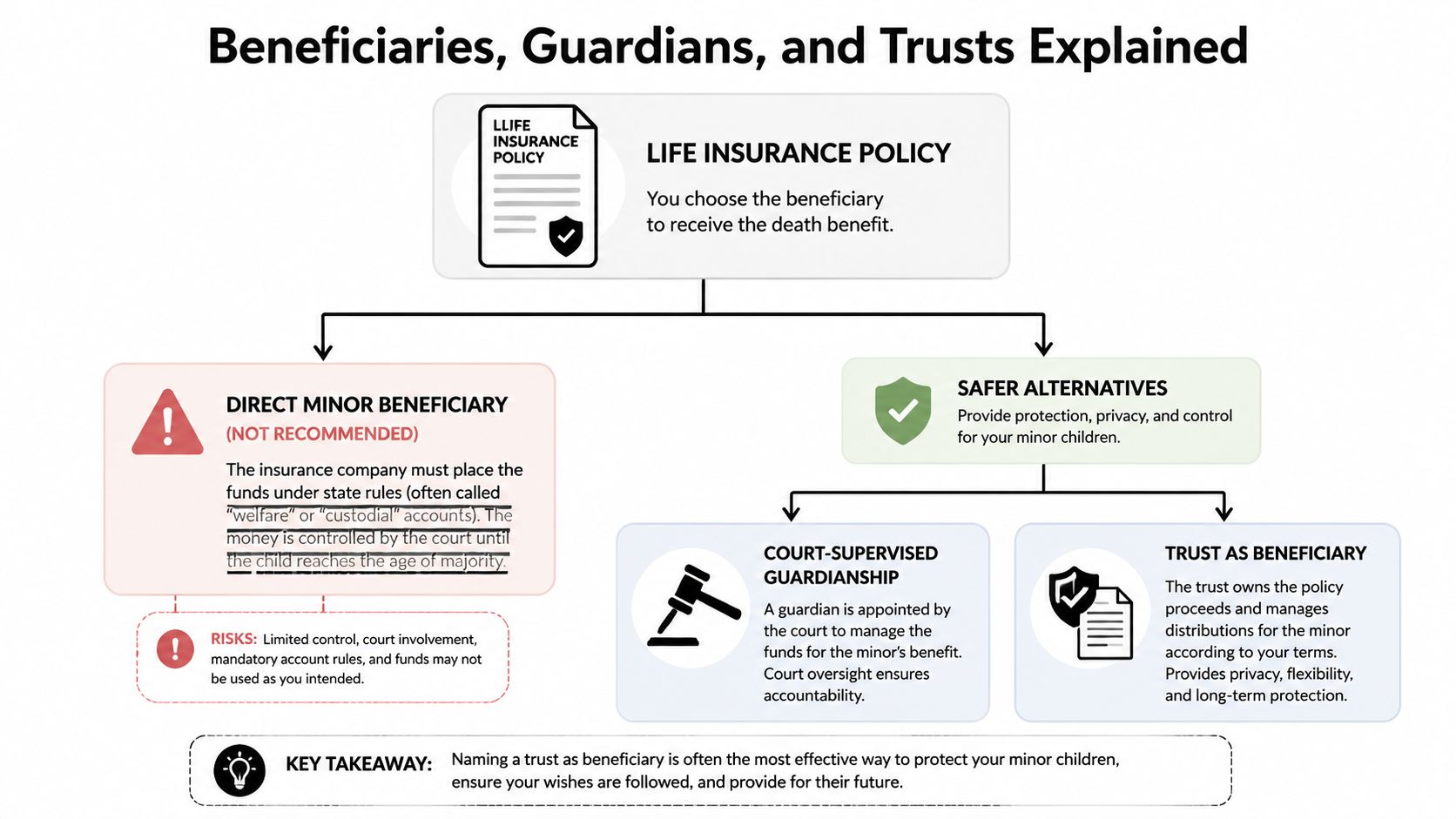
A beneficiary form answers one question: who receives the insurance proceeds? A will answers a different question: who should care for the children? A single-parent plan fails if it handles one question and ignores the other.
Insurers generally don't pay a death benefit directly to a minor child. The proceeds may instead go through a trust, a custodian, or a court-managed arrangement until the child reaches the applicable age of legal majority, often 18 or 21 depending on the state. Naming a child directly can therefore create delay, court involvement, and less control over how the money is used. The child may also receive access to a large sum without the spending boundaries you intended.
Trusts and UTMA accounts
A revocable life insurance trust can serve as the beneficiary and hold the proceeds for the children. The trust document can name a trustee, describe permitted uses, and distribute money according to a schedule. A trust may also help keep the proceeds outside probate when properly drafted and coordinated with the policy.
A UTMA account uses a custodian to manage assets for a minor. It can be simpler than a trust, but the custodian's authority and the child's eventual access follow state law. The right choice depends on how much control, flexibility, and administrative simplicity your family needs. A guide to creating a life insurance trust can help you identify the questions to take to an estate-planning attorney.
Coordinate the adults
The policy beneficiary, policy owner, trustee, and guardian should be reviewed as one plan. The person raising the children may not be the person best suited to manage a large financial account, and the trustee may need clear instructions about housing, childcare, schooling, and healthcare.
Guardianship also deserves its own legal documents. For a plain-language starting point, read about understanding legal guardian documents and then consult a qualified attorney in your state. Keep beneficiary designations current after divorce, remarriage, a move, or a change in family relationships.
Underwriting Health, Cost, and Digital Application Options
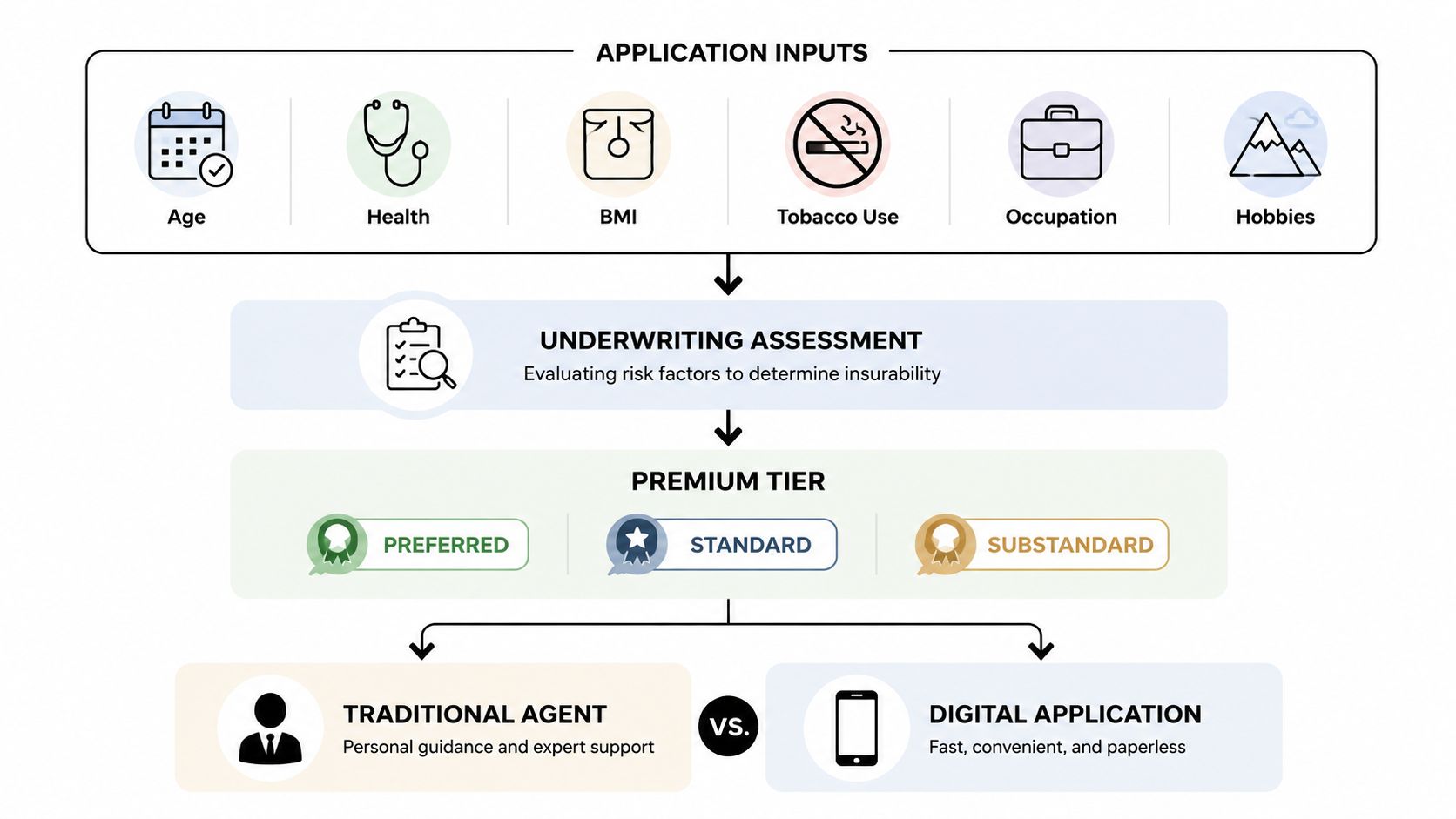
Underwriting is the insurer's process for estimating risk and assigning a premium category. It isn't a judgment about your worth or parenting. It's closer to an airline checking weather, equipment, and route conditions before deciding how to price a flight.
Insurers may review:
- Age and health history: Medical conditions, treatment, and family history can affect eligibility and pricing.
- BMI and tobacco use: These details can move an application between premium tiers.
- Occupation: Work involving unusual physical danger may receive additional scrutiny.
- Hobbies: Activities such as hazardous sports can change the risk assessment.
- Records: Depending on the carrier and application, health data, prescription history, and motor vehicle reports may be reviewed.
Traditional and accelerated paths
A traditional fully underwritten application may involve a paramedical exam, lab work, medical records, and a longer review period. That process can produce competitive pricing for healthy applicants, but it requires scheduling and follow-up that may be difficult for a parent with limited time.
Accelerated and no-exam digital underwriting uses available data to make a decision without a routine paramedical appointment in many cases. An algorithm may evaluate application answers and external records, then route the case for an approval decision or additional requirements. No-exam doesn't mean no underwriting. It means the insurer may assess risk through other information.
Coveredly offers online term life insurance, including up to $3 million of term coverage with no exams for most applicants, based on the publisher's product information. A parent can use a digital provider such as Coveredly to compare simplified-issue term quotes from multiple carriers in one session and complete the application online. Traditional fully underwritten coverage can still be less expensive for some healthy applicants, so comparing both paths is sensible. Learn more about how life insurance underwriting works before applying.
A Sample Single Parent Coverage Scenario
Consider Maya, a single mother of two who earns $58,000 annually, has a $220,000 mortgage, and holds limited savings. These figures describe a planning example, not a recommendation for every family.
Maya begins with income replacement. She considers the years during which her children will need household support, then adds the mortgage, anticipated childcare, schooling, and a buffer for final expenses. She subtracts the savings and any existing group coverage that would remain available. After reviewing the balance sheet, she chooses roughly $650,000 of coverage.
The amount is not produced by a universal formula. It reflects her particular combination of income, debt, children's ages, care needs, and available assets. If her mortgage, savings, or children's ages changed, her target could change too.
| Input / Decision | Value / Choice | Rationale |
|---|---|---|
| Annual income | $58,000 | Provides the income-replacement starting point |
| Mortgage | $220,000 | Protects housing or gives the guardian flexibility |
| Savings | Limited | Leaves less liquid support after death |
| Coverage target | Roughly $650,000 | Combines income, debt, care, education, and transition needs |
| Policy term | 20 years | Aligns with the younger child's age 18 milestone in this example |
| Child rider | Added for both children | Provides an optional child-related benefit under the policy terms |
| Spousal rider | Waived | No spouse applies to this household |
| Beneficiary structure | Revocable trust | Lets a trustee manage money for the children |
| Guardian planning | Sister named as trustee, with contingent guardian designation | Separates financial management from backup care planning where appropriate |
Maya compares a fully underwritten traditional policy with a no-exam option through Coveredly. The traditional path may offer stronger pricing if her health profile qualifies, but it could require an exam and more scheduling. The digital path may suit her limited evening hours because she can complete much of the process online and receive a faster underwriting decision when eligible.
If Maya dies while the policy is active, the trust can provide resources for housing, childcare, and education instead of forcing her sister to solve every expense from personal funds. The policy doesn't guarantee that every future cost will be covered, but it creates a defined pool of money and a management structure.
Your Next Steps and Common Mistakes to Avoid
You can make meaningful progress in one focused sitting:
- Gather the numbers: Write down income, debts, housing costs, childcare, education goals, savings, and existing coverage. This prevents you from treating income as the only obligation.
- Calculate a target: Use the household balance sheet, then test whether the premium fits your monthly budget. This reduces the risk of choosing an amount you can't maintain.
- Match the term: Compare each term with the youngest child's likely independence timeline. This helps prevent coverage from ending during a vulnerable period.
- Compare application paths: Request a traditional quote and an online no-exam quote. This shows whether convenience or potentially lower fully underwritten pricing matters more for your circumstances.
- Set up the beneficiary plan: Ask an estate-planning attorney about a trust or UTMA account, and name the appropriate trustee or custodian. Don't name a minor child directly without understanding the legal consequences.
- Update the will: Designate a guardian and a contingent guardian, then coordinate those documents with the policy. Insurance doesn't appoint the person who raises your children.
Avoid buying whole life solely for a cash-value pitch if the premium would reduce the death benefit you can afford. Avoid waiting for a health issue to force a less favorable underwriting outcome. Life insurance for single parents should be treated as a current household expense, not a project reserved for a future when money and time become easier to find.
Coveredly provides online term life insurance, including no-exam options for most applicants, so busy single parents can compare coverage without beginning with an in-person appointment. Visit Coveredly to review term options and take the first step toward protecting your children's housing, care, and income needs.