You've got a new child at home, a mortgage, a growing savings account, and maybe a life insurance policy you bought online in one sitting after bedtime. Then a harder question shows up: if something happens to you, who controls the money, when does your child get it, and how do you keep everything from turning into a court process your family didn't ask for?
That's usually the moment people start looking into how to make a trust.
For young families, newly married couples, and business owners, a trust is less about fancy estate planning language and more about control. You decide who manages assets, who benefits, and how distributions happen. Done well, a trust can simplify probate planning, protect beneficiaries, and coordinate with the assets you already own. Done poorly, it becomes a signed stack of paper that fails to control anything.
Table of Contents
- Introduction to Making a Trust
- Choosing the Right Trust Type
- Drafting and Executing Your Trust Document
- Funding Your Trust
- Selecting Trustees and Handling Filings
- Estimating Costs and When to Consult an Attorney
- Common Mistakes to Avoid and Final Checklist
Introduction to Making a Trust
A trust works best when it solves a real family problem. Parents often want to avoid leaving money outright to a minor. Newly married couples want a cleaner transfer plan if one spouse dies first. Business professionals want someone reliable managing assets if they become incapacitated.
Every trust involves three essential parties: the grantor, who creates and funds it; the trustee, who manages it; and the beneficiary, who receives the benefit. Under United States trust law, trusts are widely used for gifting to minors, tax and estate planning, and asset protection, with distributions structured either on a mandatory schedule or left to trustee discretion.
That flexibility is why trusts are useful, but it's also why families make mistakes. A trust can say “hold funds until age milestones” or “distribute for health, education, maintenance, and support.” Those are very different plans. One is rigid. The other gives a trustee judgment.
A good trust doesn't just name beneficiaries. It gives the right person the right powers at the right time.
Complexity for its own sake is not typically required. Instead, a trust should match a family's specific needs, coordinate with titles and beneficiary forms, and be able to function years from now when life looks different.
Choosing the Right Trust Type
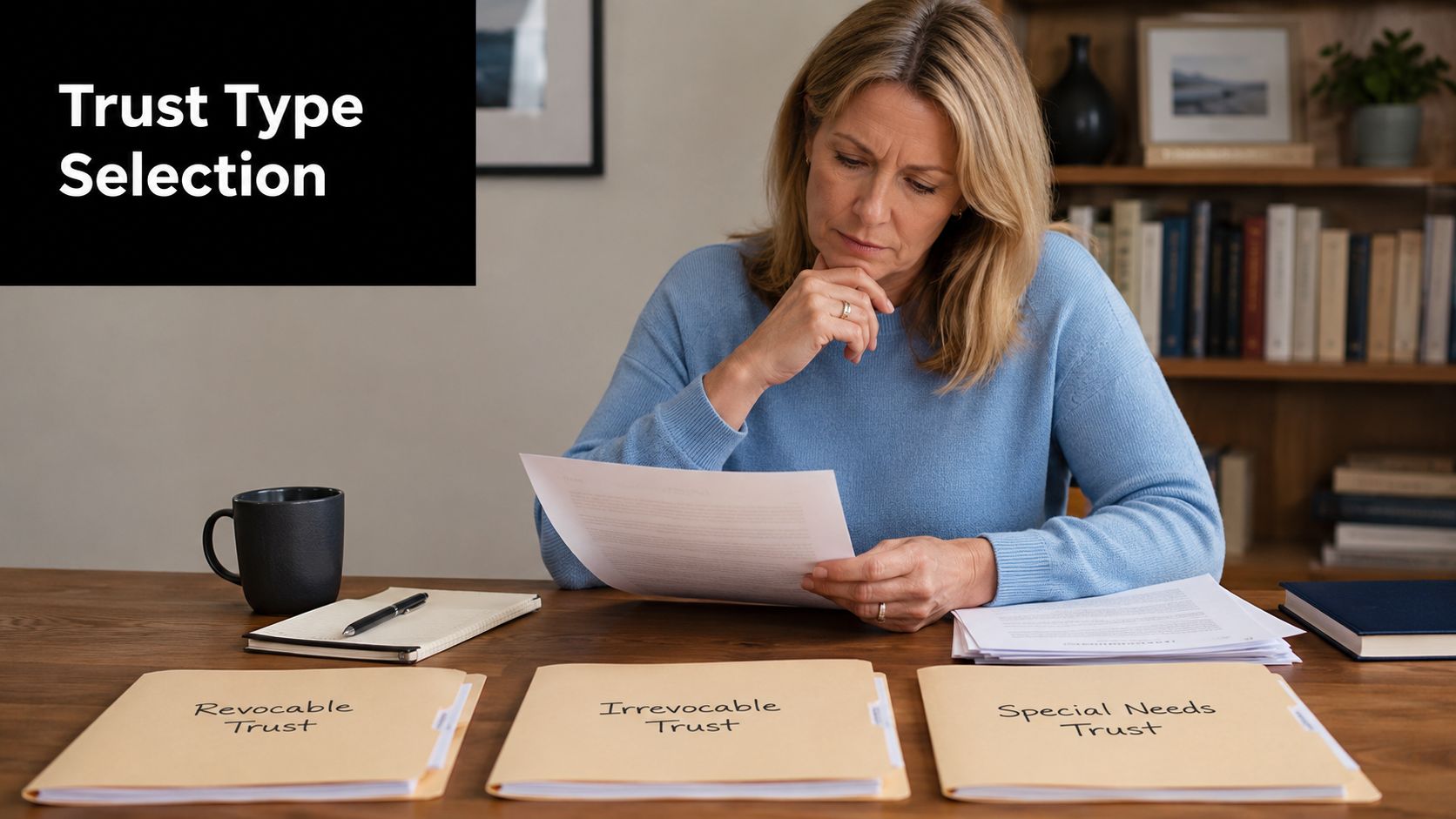
Not every trust solves the same problem. The mistake I see most often is choosing a trust because the label sounds familiar, not because the legal structure fits the goal.
A trust is legally established when a grantor demonstrates clear intent to create one, has the mental capacity to form that intent, and identifies a definite beneficiary. It can be created by transferring property to a trustee during the settlor's lifetime, declaring oneself trustee of identifiable property, or exercising a power of appointment in favor of a trustee, as summarized in this overview of United States trust law.
Revocable living trust
A revocable living trust is usually the starting point for young families. You keep control while alive and competent, and you can amend the terms as your family changes. That makes it practical when you're still building wealth, buying homes, changing jobs, and adjusting beneficiary plans.
It's often a strong fit when your goal is probate avoidance and management continuity. If you're also sorting out whether policy proceeds affect your broader estate plan, this guide on whether life insurance is part of an estate helps frame the bigger picture.
The trade-off is simple. Flexibility is high, but it isn't a magic shield. If someone wants creditor protection or a separate tax shelter strategy, a revocable trust usually isn't the final answer.
Irrevocable trust
An irrevocable trust works when the main goal is to move assets out of your direct control for a specific legal or planning purpose. That can make sense for asset protection planning or more advanced wealth transfer goals.
The trade-off is loss of control. If you transfer assets and later regret the terms, changing course may be difficult or impossible without formal legal steps. In such situations, people often get into trouble by copying documents they don't fully understand.
Practical rule: If your main priority is flexibility, don't start with an irrevocable structure just because someone told you it sounds more protective.
Specialty trusts
Some trusts are built for a narrow purpose.
- Special needs trust: Useful when a beneficiary needs support without disrupting benefit eligibility.
- Minor's trust: Useful when children are too young to handle an outright inheritance.
- Marital or family trust planning: Useful when spouses want staged control, remarriage protection, or clear rules for children from prior relationships.
The right trust type depends on what problem you're solving. If you're trying to make a trust for a toddler, that's one design question. If you're trying to hold business interests and coordinate multiple beneficiaries, that's another entirely.
Drafting and Executing Your Trust Document
A trust document fails in predictable ways. The names are correct, but the powers are vague. The beneficiaries are listed, but the distribution rules are incomplete. The signature block looks harmless, but execution was sloppy.
To create a legally valid trust, the donor must have legal capacity, show clear intent, provide actual funding of assets, and identify ascertainable beneficiaries, according to this summary of trust creation requirements. Those aren't drafting preferences. They're the baseline.
The clauses that matter most
Start with the people and the powers. Your document should identify the grantor, trustee, successor trustee, and beneficiaries in language that leaves no doubt about who does what.
Then draft the operating rules carefully:
- Distribution standards: Decide whether distributions are mandatory on a schedule or discretionary based on need.
- Successor trustee terms: Name backups. One trustee choice is rarely enough for a long-term plan.
- Trustee authority: Spell out powers to invest, manage property, pay expenses, and make distributions.
- Beneficiary contingencies: Say what happens if a beneficiary dies before full distribution.
Families with more than one child should think hard about fairness. Equal shares don't always mean equal outcomes if one child receives a house and another receives cash, or if one child already benefited from earlier support.
Execution details people miss
Some technical points feel minor until they break the plan. One of the more important drafting benchmarks in practice is adding an equalization provision where multiple beneficiaries may receive different asset types, and making sure the trustee's signature is legally separate from the grantor's during notarization when execution requires that distinction, as discussed in this trust drafting and execution discussion.
For a living trust in the United States, signing in front of a notary public is required in most states, and the trust becomes effective only after funding through formal retitling of assets such as real estate deeds or vehicle titles, as outlined in this living trust checklist.
Don't rely on boilerplate language if your family has uneven assets, blended family issues, or a business interest. Generic drafting is where future disputes start.
What works and what doesn't
What works is specificity. “The trustee may distribute for health, education, maintenance, and support” is a real standard. “The trustee should do what seems fair” invites conflict.
What doesn't work is treating signing day like the finish line. A properly drafted trust is only half-built at execution.
Funding Your Trust
Many plans often break here. People sign a trust and think they're done. They aren't.
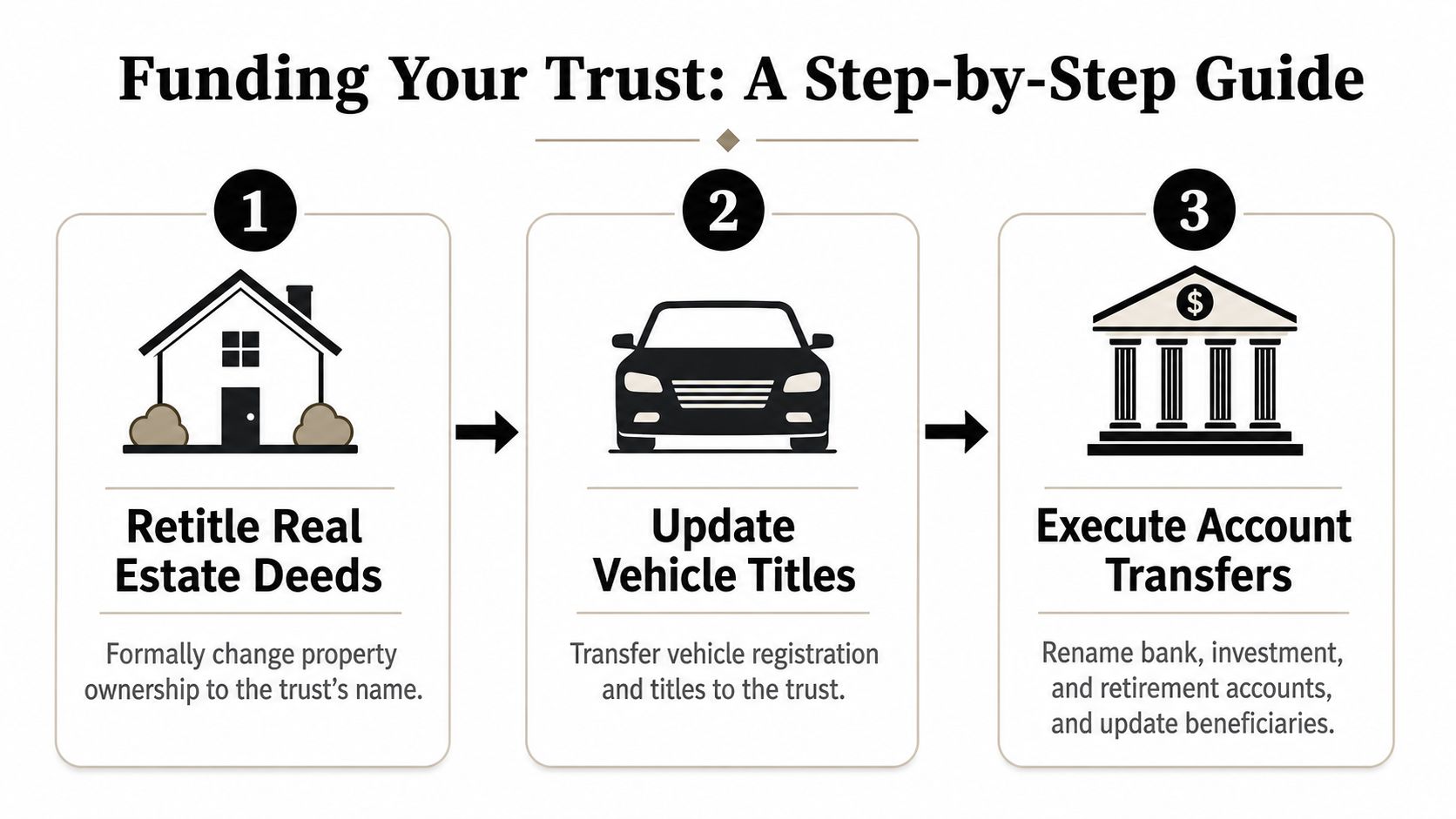
The most common technical failure is the funding gap. According to this guide on trust funding problems, approximately 40-50% of trusts drafted by individuals remain unfunded or partially funded because each titled asset needs separate paperwork. That means a signed trust may still fail at probate avoidance if the assets never move into it.
How to move assets correctly
Funding means changing ownership, not just making a list.
Real estate
Deeds need to be changed into the trust's name and recorded with the county.Bank and brokerage accounts
Financial institutions often want a Certificate of Trust instead of the full trust document before they'll retitle accounts.Vehicles
If your state allows trust ownership, title updates usually go through the motor vehicle agency.Business interests
Membership interests or shares may require assignment documents and updates to company records.
The process is administrative, but it's not optional. The trust only controls what it owns.
Here's a helpful walkthrough before you start account changes:
Life insurance and modern digital policies
This is the area many trust guides barely touch. Existing content rarely addresses how newer life insurance products interact with trusts, especially flexible coverage models where policy terms may change over time, as noted in this discussion of questions people miss when setting up a trust.
That matters because ownership, beneficiary designation, and policy administration don't always do the same thing. If a trust is going to own or receive proceeds from a policy, review both the trust language and the insurer's forms. If the beneficiary setup needs to change later, this guide on how to change a life insurance beneficiary shows the sort of coordination that matters.
Funding is where estate planning turns from theory into title work.
A practical funding checklist
| Asset type | Main action | Common snag |
|---|---|---|
| Home | Record new deed to trust | Deed never gets filed |
| Bank account | Retitle with institution | Wrong form submitted |
| Brokerage account | Provide trust certification | Advisor requests extra paperwork |
| Vehicle | Update state title if permitted | State-specific restrictions |
| Life insurance | Review owner and beneficiary setup | Trust terms and policy records don't match |
Selecting Trustees and Handling Filings
A trust is only as dependable as the person managing it. Families spend hours choosing guardians for children and sometimes only minutes choosing a trustee, even though the trustee may control distributions, tax reporting, and investment oversight for years.
Most make a trust guides focus on setup and skip the burden that comes after. But trustee work carries real liability and administration. This discussion of common trust questions notes that trustees face lifelong liability for mistakes and ongoing obligations such as filing tax returns, keeping records, and reviewing investments.
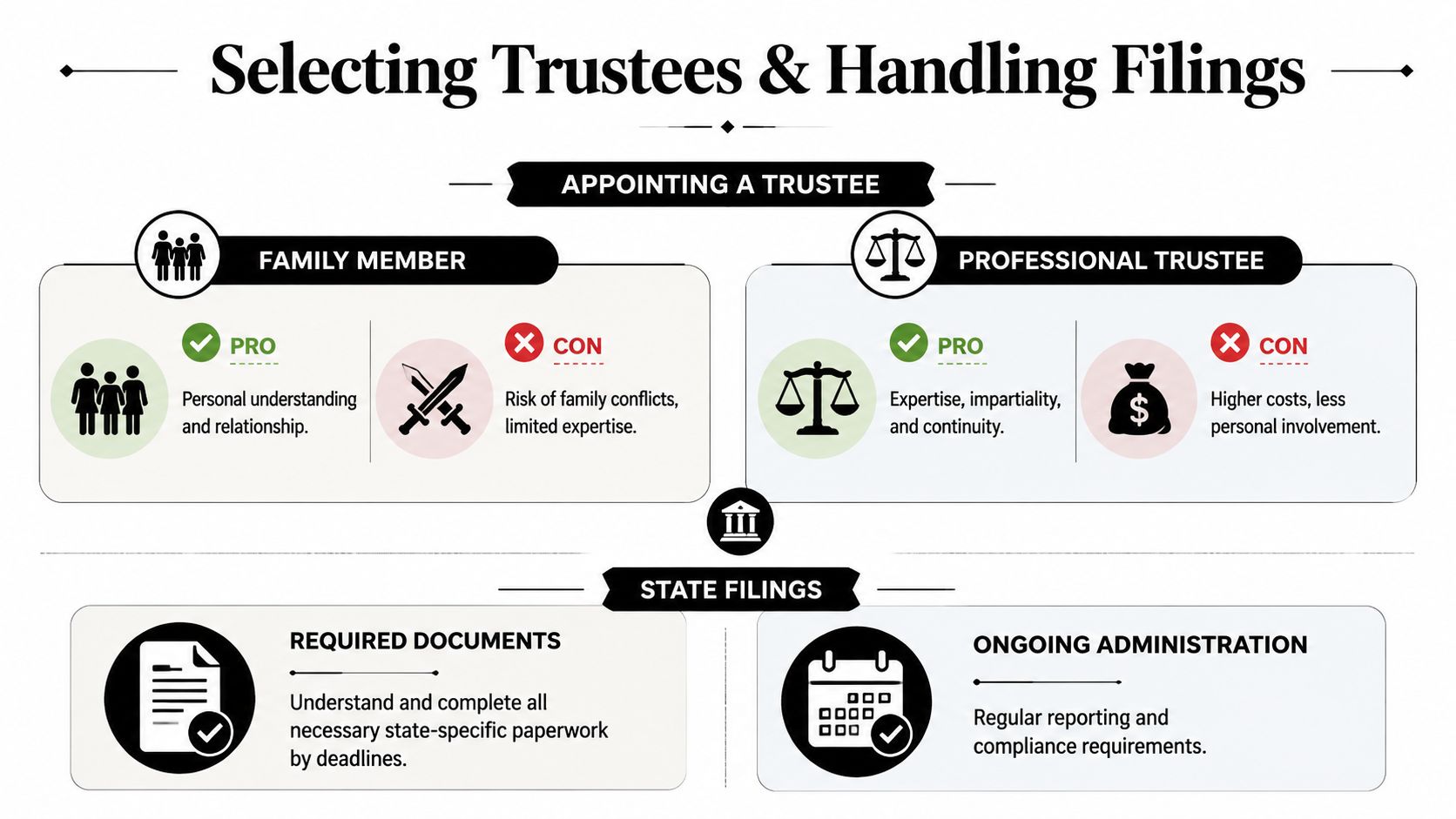
Family member or professional trustee
A family trustee can be a smart choice when the trust is simple and the person is organized, calm under pressure, and trusted by everyone involved. The benefit is context. They know the children, understand the family's values, and often communicate more naturally with beneficiaries.
A professional trustee brings distance and process. That matters when siblings don't get along, when a business is involved, or when the trust may last for years.
| Trustee option | Best use | Main drawback |
|---|---|---|
| Family member | Simple family trust, strong relationships | Conflict risk or inexperience |
| Professional trustee | Complex assets, beneficiary tension, long-term administration | Cost and less personal knowledge |
Filing and state details
State rules matter more than many families expect. In most U.S. states, a living trust document is signed before a notary, and funding steps like deed recording or title transfer happen at the local level, as covered earlier in the article. If your trust involves real estate, check local recording requirements before you sign transfer documents.
Some readers may also deal with cross-border family property. In India, for example, a trust deed must be printed on non-judicial stamp paper in the value prescribed by the relevant state, and registration is compulsory when immovable property is part of the trust corpus under this summary of trust deed registration requirements in India.
What works here is a simple screening test. Choose a trustee who can keep records, meet deadlines, communicate neutrally, and ask for professional help when needed.
Estimating Costs and When to Consult an Attorney
Cost matters, but cheap mistakes cost more than careful drafting. If you're trying to make a trust on a budget, the right question isn't only “What does the document cost?” It's also “What will corrections, transfers, and cleanup cost later?”
The projected 2026 cost of establishing a living trust in the United States ranges from $400 to over $5,000, with DIY options at $50 to $1,000 and lawyer-drafted agreements at $1,500 to $5,000+, depending on complexity, asset value, and state law compliance, according to LegalShield's 2026 living trust cost overview.
Trust setup cost comparison
| Service Type | Cost Range | Notes |
|---|---|---|
| DIY trust kit | $50 to $1,000 | Best for very simple situations. Risk rises if you own real estate, a business interest, or have blended family issues. |
| Basic trust setup | $400 and up | Often covers document preparation but may not include full funding help. |
| Lawyer-drafted living trust | $1,500 to $5,000+ | Better fit for families needing customized terms and state-specific compliance. |
Additional costs can matter just as much. The same LegalShield overview notes deed recording fees of $10–$300 for real estate, notary fees ranging from $2 in New York to $15 in California, and professional trustee fees averaging 0.5% to 2% annually of trust asset value.
When DIY stops making sense
DIY can work when your situation is narrow and clean. One state. Straightforward beneficiaries. No business ownership. No special needs planning. No concern about staged distributions beyond simple terms.
Call an attorney when any of these show up:
- You own real estate in more than one place
- You want asset protection, not just probate planning
- You have a blended family
- You need custom distribution rules for children
- You're coordinating trust terms with business or insurance planning
Some jurisdictions are also more trust-friendly than others. The same cost and trust jurisdiction overview identifies Alaska, Delaware, Nevada, New Hampshire, South Dakota, Tennessee, and Wyoming as favorable states for establishing trusts, with Delaware and South Dakota especially known for strong asset protection statutes and tax treatment.
Paying for drafting without paying for funding help is where many “affordable” trust plans go sideways.
Common Mistakes to Avoid and Final Checklist
Most trust mistakes aren't dramatic. They're administrative. A deed doesn't get recorded. A trustee never gets a copy. A beneficiary form still points somewhere else. Years later, the family finds out the plan was incomplete.
One common legal misunderstanding is treating a revocable trust like a tax shield. This analysis of trust pros and cons notes that while fully funded revocable trusts avoid probate effectively, they don't provide creditor protection or immediate income tax reduction. That distinction matters when families expect more from the structure than it can legally deliver.
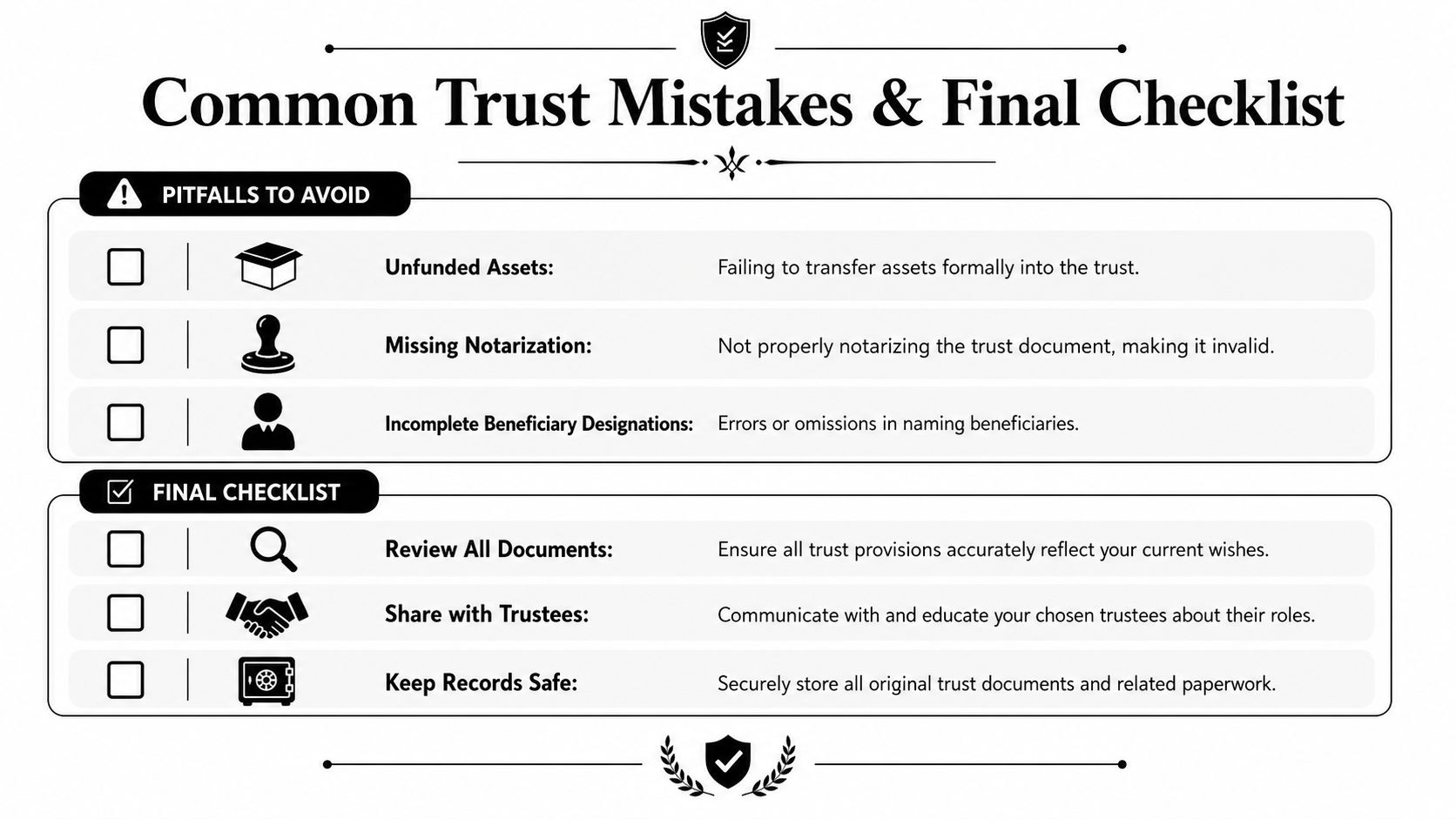
Mistakes that cause the most trouble
- Leaving the trust unfunded: Signing the document without retitling assets defeats the whole point.
- Missing execution formalities: Notarization and proper signatures need to match state rules.
- Choosing the wrong trustee: A kind person isn't always an effective fiduciary.
- Forgetting beneficiary coordination: Life insurance, retirement accounts, and trust terms need to work together.
- Ignoring administration: Someone has to keep records, monitor assets, and handle required filings.
If your estate also includes debts that could affect what family members receive, it helps to understand what happens to debt when you die.
Final checklist before you consider the trust finished
- Confirm legal names: Check the trust name, trustee names, and beneficiary names.
- Review distribution language: Make sure the terms fit actual family goals.
- Fund each titled asset: Deeds, accounts, vehicles, and ownership records must be updated.
- Store originals safely: Keep signed documents and transfer records together.
- Brief the trustee: They should know they've been chosen and understand the job.
- Revisit after major life events: Marriage, divorce, births, deaths, and major purchases often require updates.
A trust is finished only when the document, the asset titles, and the people involved all line up.
If you're building a trust plan around family protection, life insurance usually becomes part of the conversation. Coveredly offers a digital way to explore term life insurance, including flexible options and up to $3mm of coverage with no exams for most, so you can line up protection with the rest of your estate plan without adding more friction to the process.