You bought life insurance when things were simpler. Then life sped up. Maybe you got married, bought a house, or brought home a baby and suddenly that policy you barely think about now sits in a drawer like it belongs to an earlier version of you.
That's normal. Life insurance policy changes aren't a sign you made a bad choice the first time. They're usually a sign that your life has grown. A policy should support your family as your responsibilities change, not stay frozen while everything else moves.
Table of Contents
- Your Life Changes Should Your Insurance
- Common Policy Changes and What They Mean
- How to Actually Make Life Insurance Changes
- Underwriting and Financial Implications of Changes
- Smart Policy Changes for Your Stage of Life
- Policy Change Myths and Modern Solutions
Your Life Changes Should Your Insurance
A couple gets the keys to their first home on Friday. By Sunday, they're talking about mortgage payments, what would happen if one income disappeared, and whether the beneficiary listed on an old work policy is still a parent from years ago. That's how life insurance reviews usually start. Not with a spreadsheet. With a real life moment that makes the old setup feel too small.

Individuals do not require a brand-new insurance education when this happens. What they need is reassurance that updating a policy is common. It might mean changing a beneficiary, raising coverage, converting term coverage to something permanent, or checking whether ownership and estate planning still match the family's goals.
The policy you bought at 27 was built for your life at 27. It doesn't automatically fit your life at 33.
The market has moved in this direction too. Term life sales reached a record 1.2 million policies in 2020, driven by younger buyers under 40, and over 60% of new term policies were issued through online platforms by 2023, which helped cut issuance times dramatically, according to life insurance market statistics summarized here. That matters because younger families often need flexibility more than complexity.
Some changes are emotional. Some are legal. If you're also thinking about estate planning, a resource on understanding life insurance trusts in Texas can help you see when ownership structure matters, especially if you're trying to protect how proceeds are managed for children or other heirs.
Why this feels confusing
Life insurance looks fixed because the policy document is fixed. But your use of it often isn't.
A simple way to think about it is this:
- Your policy is the container. It holds the contract you bought.
- Your life creates the pressure. Marriage, kids, debt, and income changes test whether that contract still fits.
- Your updates keep it useful. Small edits keep paperwork aligned. Bigger changes reshape protection.
That shift in mindset helps. You're not “messing with” your policy. You're maintaining a piece of your financial foundation.
Common Policy Changes and What They Mean
Some life insurance policy changes are like updating the emergency contact on an important account. Others are closer to remodeling a kitchen. Same home, much bigger project. Knowing the difference helps you avoid surprise paperwork and delayed expectations.
The easy updates
A beneficiary change is usually the simplest. You're changing who receives the death benefit, not changing the insured person or rewriting the contract. This often comes up after marriage, divorce, a birth, or if the person you originally named is no longer the right choice.
A change of ownership is different. The owner controls the policy. That person can often make requests, depending on the policy terms, and may be the one handling premium decisions. Ownership changes can show up in divorce settlements, business planning, or trust planning.
You might also ask about the insured person. That one trips people up. You can't change the insured person after the policy is issued. If you want coverage on a different person, you need a new policy, as explained in this discussion of what can and can't be changed on a life insurance contract.
Practical rule: If the change affects paperwork around the policy, it may be simple. If it changes the risk the insurer is covering, expect more review.
The bigger changes
A coverage increase sounds straightforward, but insurers often treat it like a fresh risk decision. If you ask for more death benefit, the company may want updated health details and new underwriting. A coverage decrease is usually easier, though you still need to confirm the new amount fits your family's needs.
A term conversion can be one of the most valuable features in a policy. Many term life insurance policies include a built-in conversion option, allowing policyholders to switch to a permanent policy during a specified period without a new medical exam, which gives you flexibility as needs change, according to Amica's explanation of life insurance policy updates. If you want a deeper look at how that works, this guide to term policy conversion options is useful.
Then there are riders, which are optional add-ons. You might add one when your priorities change, or remove one if it no longer makes sense. Think of riders like features on a car package. Helpful when they match your life, unnecessary when they don't.
Some policies are built for more flexibility from the start. Adjustable life insurance, also called universal life, allows policyholders to adjust premiums, death benefits, and cash value allocations over time, while whole life is generally more fixed, as described in Guardian's overview of adjustable life insurance.
Quick Guide to Life Insurance Policy Changes
| Type of Change | What It Does | When to Consider It |
|---|---|---|
| Beneficiary update | Changes who receives the death benefit | Marriage, divorce, birth of a child, death of a prior beneficiary |
| Ownership change | Transfers policy control to another person or entity | Divorce, trust planning, business planning |
| Increase coverage | Raises the death benefit | New mortgage, new child, higher income dependence |
| Decrease coverage | Lowers the death benefit | Debts reduced, children grown, budget pressure |
| Convert term to permanent | Keeps coverage in force in a permanent form if eligible | Long-term dependents, estate planning, health concerns |
| Add or remove riders | Adjusts optional benefits | Family changes, budget review, changing priorities |
| Add supplemental coverage | Keeps current policy and layers on more protection | Temporary need, business obligation, growing family |
A broad industry summary is that policyholders usually have three options when they want change: switch companies, modify the current policy, or add supplemental coverage. Minor changes are often free, while bigger changes may require new underwriting, based on MoneyGeek's breakdown of how people change life insurance.
How to Actually Make Life Insurance Changes
Most policy changes feel harder before you start than while you're doing them. The process is usually less about legal drama and more about gathering the right documents, asking the right questions, and confirming the insurer processed the request correctly.
Start with the kind of change you need
Before you call anyone, decide whether your request is administrative or structural.
Administrative changes are things like a beneficiary update, address correction, or contact details. Structural changes affect the coverage itself, such as increasing the death benefit, converting term to permanent, or changing ownership. The first category is usually faster. The second often needs more review.
If you're specifically updating who receives the proceeds, this guide on how to change a life insurance beneficiary lays out the details that commonly get missed, such as naming contingent beneficiaries and checking exact legal names.
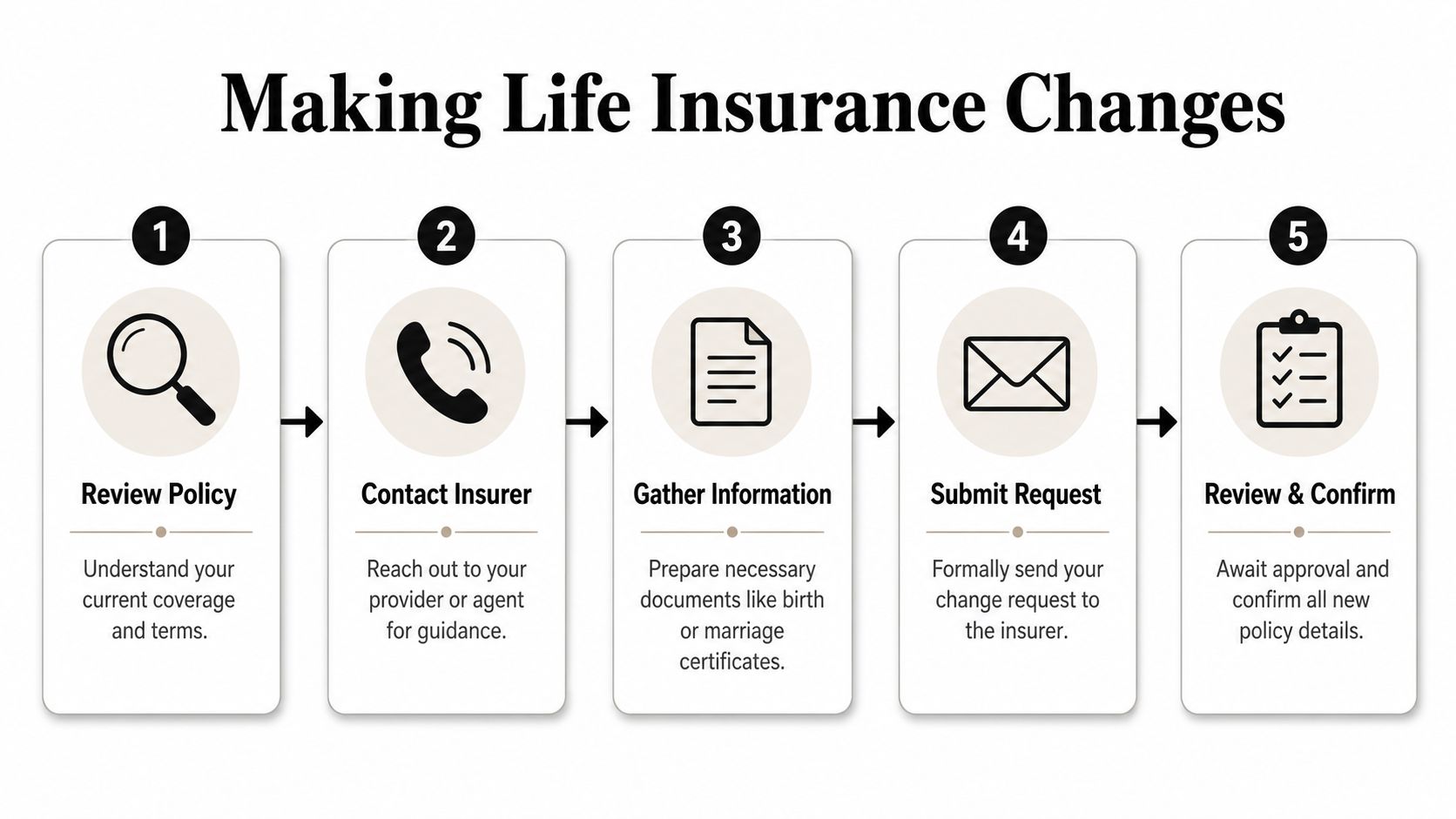
A practical five step process
A simple request usually follows this sequence:
Review your current policy
Find the declarations page or policy summary. Look for the owner, insured, beneficiaries, coverage amount, rider list, and any conversion deadlines.Contact the insurer or agent
Ask one direct question first: “Can this be done as a policy change, or does it require new underwriting or a new application?”Gather supporting documents
Marriage certificates, divorce decrees, trust documents, or business paperwork may be needed depending on the change.
Here's a walkthrough that shows the process visually:
Submit the request in writing
Many insurers now accept digital forms and signatures. For more formal product updates under certain state filing frameworks, insurers may only need a new specification page with a new form number, a redline showing changes, the original tracking number, and certification that the core policy form remains unchanged, as outlined by the South Carolina Department of Insurance filing procedures.Get confirmation and read it
Don't stop when you hit submit. Wait for written confirmation, then verify the names, dates, percentages, and policy details.
Don't assume a requested change is complete until the insurer sends confirmation and the updated record matches what you intended.
The biggest mistake young families make here is treating the process like a casual customer service tweak. A beneficiary typo, an incomplete trust name, or an unsigned form can leave an old designation in place. Slow down at the last step. That's where the protection becomes real.
Underwriting and Financial Implications of Changes
The most overlooked part of life insurance policy changes isn't the form. It's the consequence. A request can look small from your side and still trigger a larger review on the insurer's side.
Why some changes trigger new underwriting
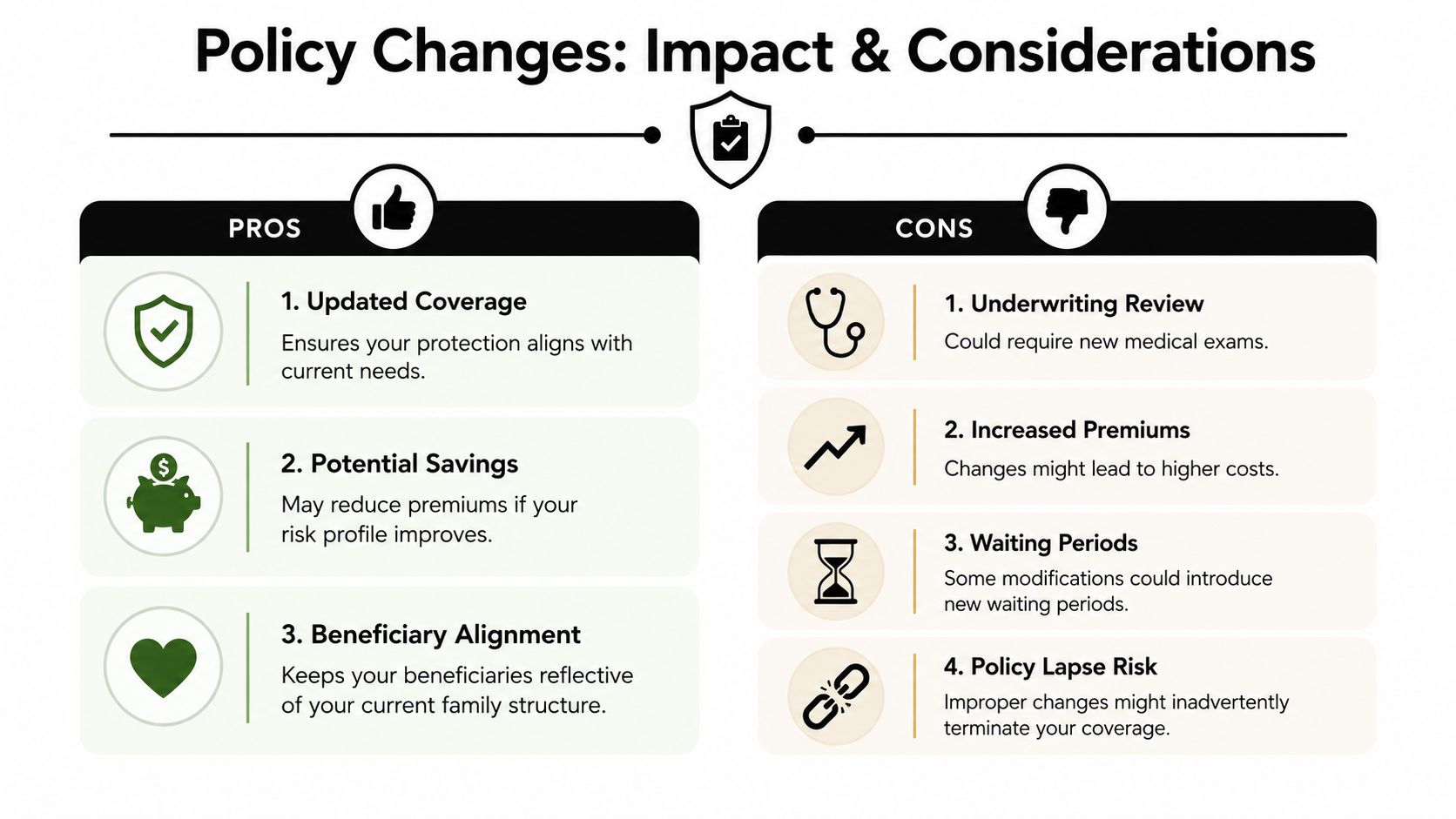
If you want more coverage, the insurer may ask a basic question: has the risk changed since the policy was issued? That's why an increase can lead to fresh health questions, medical records, or a full underwriting review. It's not the same as editing a mailing address. You're asking the company to take on more risk.
If you're comparing replacement policies, be careful. One hidden risk is that a new contract may not cover your situation the same way your old one did. Guidance discussed in this article about switching insurers and checking exclusions before you move highlights a problem many shoppers miss. A cheaper premium can come with new exclusions or a narrower approach to pre-existing conditions.
That's why underwriting isn't just about price. It's also about what the new policy promises to pay for.
If you want a fuller picture of the mechanics behind medical review, application review, and approval timelines, this overview of the life insurance underwriting process helps connect the paperwork to the pricing.
Ownership taxes and permanent policy funding
Changing ownership can create legal and tax questions. The moment you transfer control of a policy, you may be doing more than moving a name on paper. You could be affecting estate planning, family control, or gift treatment. That's a strong moment to slow down and get legal or tax guidance before signing.
Permanent life insurance has another layer. Legislative changes to IRC Section 7702 in 2021 reduced the guaranteed insurance rate for cash value policies, allowing policyowners to pay higher premiums for smaller death benefits without creating a Modified Endowment Contract, which increased funding flexibility for permanent life insurance, according to this explanation of Section 7702 changes and policy funding. For families using whole life or indexed universal life as part of a broader plan, that matters because premium structure and tax treatment can interact in ways that aren't obvious at first glance.
A practical example helps. If a family wants to pre-fund more value inside a permanent policy, the rules around how much can go in relative to the death benefit have shifted. That doesn't mean every permanent policy is better. It means the funding design deserves a fresh look.
Review the cost, the coverage, and the legal effect together. A policy change that looks smart on one page can create a problem on another.
This also applies to end-of-life planning choices. If your family is considering alternatives to traditional burial, a piece on understanding life insurance for green disposition can help you think through how policy proceeds may fit those preferences.
Smart Policy Changes for Your Stage of Life
The right change depends less on your age and more on your responsibilities. Two people can both be 32 and need completely different updates. One just got married. The other signed a business loan. Same age, different risk.

Newly married couples
Marriage is often the first moment people realize an old beneficiary form is still naming a parent or sibling. That's usually the first update to make. It's simple, but it has to be done correctly.
Newlyweds should also revisit ownership, especially if one spouse handles household finances and the other has most of the income. If you're trying to decide whether your current amount is still enough, this guide on calculating your life insurance needs gives a helpful framework for thinking through income replacement, debts, and family obligations.
Young families
A new baby changes the conversation quickly. It's no longer only about replacing one income. It's about preserving the home, paying for childcare, and giving the surviving parent breathing room.
Parents often focus on the face amount and forget the timing. If you need more coverage, ask early, before health or budget changes make the process harder. If one parent already has term insurance with a conversion option, that feature may deserve attention if long-term protection is becoming more important.
A few checkpoints matter here:
- Check beneficiary structure: Name primary and contingent beneficiaries thoughtfully.
- Revisit coverage size: A new child usually increases the financial impact of a loss.
- Look at riders carefully: Some families want extra flexibility, while others prefer to keep the policy clean and straightforward.
Professionals and business owners
Business life creates a different set of policy changes. You may need to assign policy value in connection with a loan, update ownership to fit a business agreement, or add separate coverage rather than altering a personal policy.
Often, many people force one policy to do too much. A clean structure is often better. Keep personal protection for family needs and use separate business planning tools where appropriate.
A few situations that often justify a review:
- New debt: A mortgage or business loan can expose the household to more risk.
- Income concentration: If one person produces most of the family income, the coverage burden grows.
- Partnership changes: Buy-sell planning and ownership alignment can turn into legal issues if the policy details lag behind the business reality.
One more note for anyone considering a replacement because your health has improved. Don't assume your current insurer will lower your rate inside the old policy. That misconception deserves its own warning.
Policy Change Myths and Modern Solutions
The biggest myth in this area is the re-rating myth. People quit smoking, lose weight, or improve their health and assume one phone call will lower the premium on the policy they already own. In reality, that usually isn't how it works.
A common myth is that insurers will easily re-rate your policy for a lower premium after health improvements like quitting smoking. Such re-rating is rare, and realizing savings almost always requires applying for a new policy and going through a new evaluation process, according to this explanation of how major health changes affect life insurance options.
That matters because it changes the decision tree:
- If your current policy still fits well, keeping it may be smarter than chasing a small perceived win.
- If your health has improved meaningfully, shop carefully and compare a new offer against what you already have.
- If someone pushes you to switch fast, slow down and read the exclusions, waiting periods, and definitions.
The second hidden problem is churn risk. A lower premium can distract you from weaker coverage. If a new policy excludes something your old one handled better, the “savings” may cost your family much more later.
Digital-first life insurance has made this easier to evaluate because online applications, clearer workflows, and faster processing can remove some of the mystery from shopping and updating coverage. Transparency doesn't solve every insurance problem, but it does make it easier to compare what you're buying and to act before a life change becomes a crisis.
If your life looks different than it did when you bought your policy, it's probably time to review it. Coveredly makes that process feel less like paperwork and more like planning, with digital life insurance designed to fit real life, from newly married couples to growing families and busy professionals.