You're probably here because life insurance moved from a “someday” task to a real decision. Maybe you just got married, had a baby, bought a home, or realized that other people now depend on your income. Then you started looking into it and ran straight into forms, health questions, underwriting jargon, and conflicting advice about exams.
That reaction is normal. The desire to protect one's family typically isn't a source of struggle. Instead, the challenge often arises from life insurance requirements that seem unclear until the process has been experienced once.
This guide is built to make that process feel manageable. We'll walk through what insurers evaluate, how the application works, why some people get declined or charged more, and how no-exam policies really work behind the marketing language.
Table of Contents
- Why Understanding Life Insurance Requirements Matters
- The Core Eligibility Factors Insurers Evaluate
- Navigating the Application and Underwriting Process
- Common Reasons for Denial or High Premiums
- How to Improve Your Application and Lower Costs
- The Rise of No-Exam Policies A Modern Alternative
- Actionable Checklists for Your Life Stage
- Frequently Asked Questions About Life Insurance Requirements
Why Understanding Life Insurance Requirements Matters
A common scene goes like this. One partner says, “We should probably get life insurance.” The other agrees, then asks the question that stalls everything: “What do they even need from us?”
That hesitation matters because waiting has a way of turning into another month, then another year. Meanwhile, the need doesn't disappear. It usually grows with every new bill, child, and shared financial obligation.
The bigger picture shows why this isn't just a personal to-do item. As of January 2024, the U.S. protection gap affects 102 million adults, including 75 million people with no life insurance and 27 million who are underinsured, according to MoneyGeek's life insurance statistics roundup.
Practical rule: Life insurance requirements feel intimidating mainly because they're unfamiliar, not because they're impossible.
For most applicants, the process becomes easier once you understand two things. First, insurers aren't looking for perfection. They're looking for a clear, consistent picture of risk. Second, many of the most confusing parts of the process come from half-explained advice online, especially around health conditions and “no-exam” offers.
If you know what insurers want to verify, you can prepare before you apply. That puts you in a much better position to answer questions accurately, gather the right records, and avoid surprises that slow things down or raise costs.
The Core Eligibility Factors Insurers Evaluate
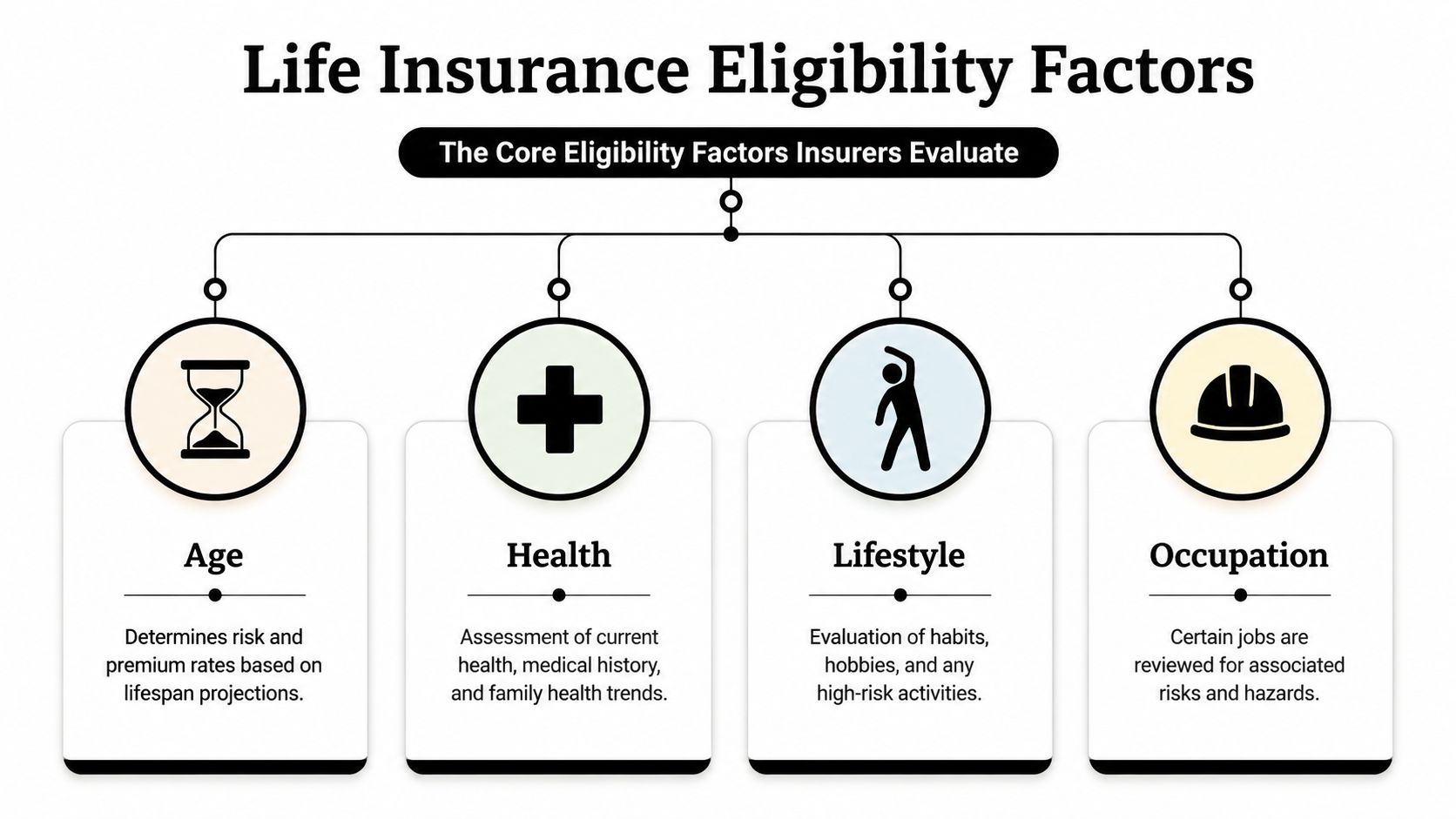
Most life insurance requirements boil down to a few core questions. How old are you? What does your health history show? Do your habits or job increase risk? Does the coverage amount make sense for your situation?
Insurers use those answers to place you in a risk class. That classification affects whether you're approved, what extra information they request, and how much you'll pay.
Age and timing
Age is one of the simplest factors, and also one of the most important. In general, applying earlier gives insurers a longer expected coverage window with fewer age-related health concerns to price in.
That doesn't mean older applicants can't get coverage. It means timing affects both eligibility options and pricing flexibility. A healthy person in their thirties and a healthy person in their fifties may both qualify, but the underwriting conversation often looks different.
A useful way to think about age is this: it doesn't work alone. It works alongside health, lifestyle, and coverage amount. Someone who applies earlier often has more room for favorable outcomes because fewer variables have had time to stack up.
Health is about the full story
Many people find this confusing. They assume a diagnosis by itself decides everything. In practice, insurers often care more about whether a condition is stable, documented, and managed than whether it exists at all.
According to MyInsure's explanation of life insurance health questions, insurers prioritize stability and control over the mere presence of a condition, and 68% of applicants with pre-existing conditions are denied because of incomplete medical history disclosure rather than health severity. That's an important distinction.
If you have asthma, diabetes, high blood pressure, or another chronic condition, underwriters want the full story. They look for regular follow-ups, medication consistency, recent labs when relevant, and evidence that the condition hasn't been ignored.
A controlled condition often looks less risky than an uncontrolled one with missing details.
This is especially important for applicants with a family history of heart issues. If that's part of your concern, resources on managing heart concerns with Qaly can help you understand how to organize and discuss your health history more clearly before applying.
Lifestyle and occupation
Lifestyle risk can change your application even when your health looks strong on paper. Tobacco or nicotine use is a classic example, but insurers also pay attention to driving history and certain hobbies.
A few common lifestyle and work-related factors include:
- Nicotine use: If an insurer finds a mismatch between your application and your records, trust drops fast.
- Hazardous hobbies: Activities like scuba diving can trigger more scrutiny.
- Driving record: Repeated serious violations can make you look riskier overall.
- Occupation: Jobs with high physical danger may require closer review.
Financial health also plays a role, especially for larger policies. Insurers want to confirm that the amount requested fits an income replacement, family protection, or estate-planning need instead of being disconnected from your circumstances.
Navigating the Application and Underwriting Process
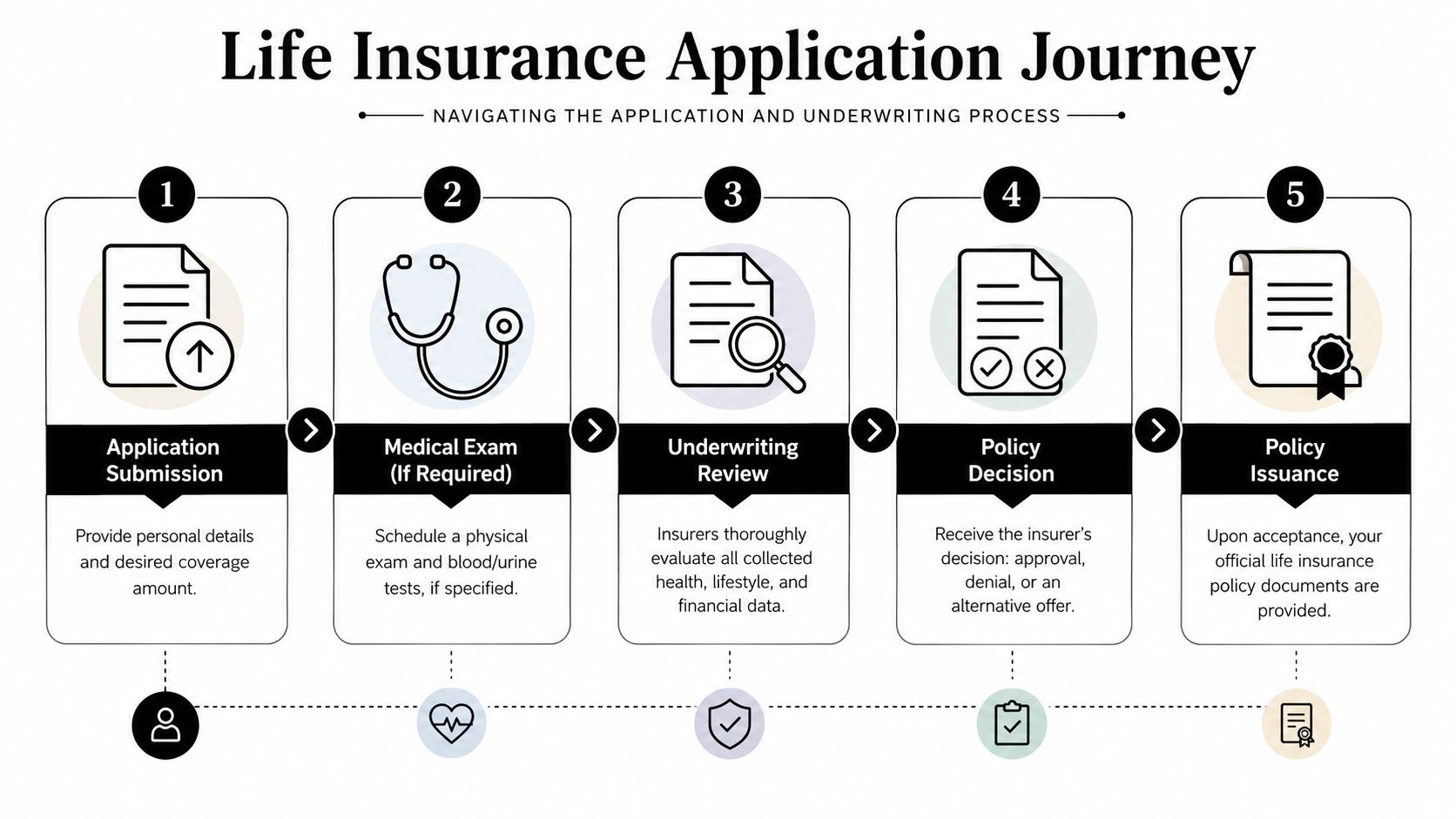
The application process feels less stressful when you see it as a sequence instead of a black box. You apply, the insurer verifies what you shared, underwriting reviews the findings, and then you receive a decision.
That review can follow a traditional path or a faster digital path, depending on your profile and the coverage amount.
What happens first
Most applications begin with basic personal and financial information. You'll usually provide your age, address, job, desired coverage amount, beneficiary details, and answers to health and lifestyle questions.
After that, the insurer may ask for clarification. That can happen through follow-up questions, a phone interview, a records request, or a medical exam if your case needs more evidence.
Applicants often get tripped up here by treating the form like a quick survey. It's closer to a legal and financial disclosure. If your answers are rushed or incomplete, the insurer has to spend time reconciling gaps.
Traditional underwriting versus accelerated underwriting
Traditional underwriting usually involves a paramedical exam. That can include measurements, plus blood or urine collection, along with medical records review if needed. This route can make sense when the policy is larger, the health picture is more complex, or the insurer can't confirm enough through digital data.
Accelerated underwriting works differently. For term life policies up to $3 million, it can replace the exam with data checks from clinical databases, prescription history, and motor vehicle reports. That shift reduces average approval time from 30 to 45 days to 3 to 7 days, according to Guardian's overview of life insurance underwriting.
If you want a fuller explanation of how risk review works behind the scenes, this guide to underwriting for life insurance gives a useful breakdown.
What underwriters are trying to confirm
Underwriters aren't trying to catch you on technicalities. They're trying to answer a few practical questions:
- Is the application accurate
- Does the medical and lifestyle evidence support the answers given
- Does the requested coverage fit the applicant's situation
- Is more documentation needed before the insurer can price the risk
The smoother your records match your application, the faster underwriting usually feels.
That's why honest specificity helps. If you take medication, list it. If you had a diagnosis years ago but it's controlled, say so and be ready for follow-up. Clean, consistent information is what moves an application forward.
Common Reasons for Denial or High Premiums
People often assume denials happen only because of severe illness. In reality, insurers can also hesitate when they see mixed signals, missing records, risky patterns, or a coverage request that needs stronger justification.
Some issues lead to a flat denial. Others place you into a higher-risk category with a more expensive offer.

Unclear or inconsistent risk signals
One of the most common problems is inconsistency. An application says one thing, but prescription records, driving history, or medical notes suggest something else. Even when the issue is explainable, that mismatch can slow the file or make the insurer more conservative.
Other common trouble spots include:
- Undisclosed habits: Nicotine use and hazardous hobbies create problems when they appear in verification checks but not on the form.
- Poor condition management: A diagnosis with sparse follow-up can look riskier than a more serious condition that's carefully managed.
- Recent instability: Ongoing unresolved medical questions often lead insurers to pause or price cautiously.
- Large unexplained coverage requests: If the requested amount doesn't match your income, family needs, or planning goals, the insurer may ask for more proof.
Why larger policies face more scrutiny
When the requested death benefit goes above $1 million, the requirements tighten. Underwriting guidelines can mandate a 12-lead EKG and a 5-year Attending Physician's Statement, and applicants with blood pressure above 140 mmHg or abnormal EKG findings have a 2.1 to 2.8 times higher chance of landing in a substandard risk class, which can raise premiums by 40% to 60%, based on North American's underwriting guidelines.
That sounds harsh until you view it from the insurer's side. A very large policy creates a bigger financial exposure, so the company wants more medical evidence and stronger financial justification before issuing it.
Higher premiums aren't always a rejection. Sometimes they're the insurer's way of saying, “We can offer coverage, but not at the best class.”
How to Improve Your Application and Lower Costs
You can't control every underwriting decision, but you can influence how your application presents you. The best applicants aren't flawless. They're prepared, accurate, and easy to verify.
That means doing basic cleanup before you apply instead of hoping underwriting sorts everything out for you.
Preparation beats guesswork
Start by gathering your information before you open an application. Know your doctors, medications, diagnoses, and treatment dates as clearly as you can. If you guess and later correct yourself, that can create avoidable friction.
A few practical moves help:
- Review your history: Make sure you can describe conditions consistently.
- Stay current with care: Regular appointments help show stability.
- Be honest about habits: It's better to disclose a detail than have it discovered later.
- Choose the right coverage amount: Ask for an amount you can reasonably justify.
If affordability is your main concern, it helps to understand how policy structure affects cost. This overview of a cheap life insurance policy can help you think through tradeoffs without guessing.
Small improvements that matter
Timing can work in your favor. If you're in the middle of a medical workup, waiting until results and treatment plans are documented may give underwriters a clearer picture. The same goes for a recently improved driving record or a period of healthier routine.
What lowers cost isn't gaming the system. It's reducing uncertainty. Insurers price uncertainty aggressively. They price stable, documented risk more favorably.
The Rise of No-Exam Policies A Modern Alternative
No-exam coverage is popular for a simple reason. It removes the dreaded part of the process. No scheduling a paramedical visit, no blood draw at your kitchen table, and often a much faster decision.
But “no exam” doesn't mean “no underwriting.” It means the insurer is verifying you through records and data rather than an in-person medical test.
What no-exam really means
For many healthy applicants seeking up to $1 million in coverage, accelerated underwriting can waive the medical exam. In fact, 75% of healthy applicants in that category may avoid the exam, but 30% of no-exam applications are still declined because data checks uncover hidden eligibility issues such as undisclosed nicotine use or recent hazardous hobbies, according to this overview of the life insurance application process.
That's the part most quick guides leave out. No-exam policies are convenient, but they're often strict in quiet ways. The insurer may rely on prescription databases, motor vehicle reports, and your disclosures to decide whether you fit its preferred digital profile.
If you're comparing policy types, it can help to compare no medical life cover alongside traditional options so you can see where convenience and stricter screening intersect.
The hidden thresholds most people never hear about
Many applicants think they qualify because they feel healthy. Underwriting may define healthy more narrowly. A clean prescription history, no recent nicotine signals, and no risky hobbies can matter a lot in no-exam approval.
That's why no-exam life insurance works best when your digital paper trail is simple. If it is, the process can feel refreshingly fast. If it isn't, a traditional route may be the smoother path because it gives you more room to explain the full story.
A dedicated resource on life insurance without a medical exam can help you sort through those differences before you apply.
Here's a quick visual overview to make the no-exam model feel more concrete:
Actionable Checklists for Your Life Stage
The right next step depends a lot on where you are in life. A newly married couple usually needs a different checklist than a family with children or a professional balancing income protection and estate planning.
Use the list that sounds most like your current life.
Newlyweds
For newlyweds, the focus is usually foundation. You're building shared financial commitments, even if you don't have children yet.
Checklist:
- Confirm who depends on your income: A spouse may already rely on your paycheck for rent, mortgage, or shared debt.
- Choose beneficiaries carefully: Make sure designations match your current wishes.
- Gather core documents: ID, address, employer details, income info, and a list of doctors and medications.
- Estimate the protection need: Think about housing costs, debt, and how long your spouse would need support.
- Apply before life gets busier: Early action often means simpler underwriting.
Young families with children
This stage usually creates the clearest need for life insurance. Children turn a vague goal into a concrete responsibility.
Checklist:
- Map your monthly obligations: Include mortgage or rent, childcare, groceries, and debt payments.
- Think beyond immediate bills: Future education costs and income replacement matter too.
- Organize your health history: If either parent has a chronic condition, stable records help.
- Review both parents' need for coverage: Stay-at-home parents may need coverage too because their labor has real financial value.
- Keep paperwork accessible: If one person usually handles finances, make sure the other knows where policy details live.
A good policy amount should help your family maintain stability, not just cover final expenses.
Established professionals
Professionals often need a more layered review. Higher income, larger debts, and more complex planning goals can increase both the need for coverage and the level of underwriting review.
Checklist:
- Document income clearly: Larger policies usually require stronger financial support.
- List business obligations: If others rely on your leadership or earnings, note that.
- Review existing employer coverage: Workplace life insurance may not be portable or sufficient.
- Prepare for extra scrutiny on larger requests: Big policies may require more medical and financial documentation.
- Decide what the policy is for: Income replacement, debt protection, estate planning, or a mix.
Application Document Checklist
| Item | Why It's Needed |
|---|---|
| Government-issued ID | Confirms identity and basic personal details |
| Beneficiary information | Tells the insurer who should receive the death benefit |
| Employment and income details | Helps justify the coverage amount |
| Medical provider list | Makes follow-up record requests easier if needed |
| Medication list | Helps underwriters compare application answers with records |
| Existing insurance details | Shows current coverage and overall protection picture |
| Financial documents for larger policies | Supports higher benefit requests when justification is required |
Frequently Asked Questions About Life Insurance Requirements
Can I get life insurance if I'm unemployed or a stay-at-home parent
Yes, often you can. Insurers may still approve coverage if there's a clear financial purpose, such as covering childcare replacement, household responsibilities, or protecting a spouse from financial strain. The key is whether the coverage amount makes sense for your household.
Does my credit score affect my life insurance application
Life insurance underwriting is mostly centered on health, lifestyle, and financial justification for the coverage amount. People often confuse life insurance with lending. They're different decisions, even if both ask for personal information.
What happens if I develop a health condition after my policy is approved
If your policy is already in force, later health changes typically don't change the premium on a level term policy you already own. What matters most is that your original application was accurate and complete.
Do I always need a medical exam
No. Some applicants qualify for accelerated underwriting with no exam, while others are asked for exams or records based on the coverage amount and overall risk picture. The absence of an exam doesn't mean the absence of review.
If I have a pre-existing condition, should I wait to apply
Not always. What matters is whether the condition is documented and stable enough for an underwriter to assess. In some situations, waiting for follow-up records can help. In others, applying now is reasonable if your treatment history is clear.
Coveredly makes life insurance feel less like paperwork and more like a practical step you can finish. If you want a simpler way to explore coverage online, compare options, and see whether you may qualify for fast no-exam term life, visit Coveredly.