
The most popular advice about life insurance return on investment is also the most misleading: “Buy a policy, watch the cash value grow, and compare the result with the stock market.” That treats life insurance like an investment account when its primary job is different. A policy transfers the financial risk of your death to an insurer. The return may be a cash value, a surrender payment, or a death benefit, depending on the product and the event that ends the contract.
A stock or mutual fund can be sold while you're alive at a market price. Life insurance usually creates value through protection first, then through cash accumulation in permanent policies. The right question isn't “What percentage will this policy earn?” It's, “What does each premium dollar buy, when does the policy break even, and what does my family receive if I die at a realistic point in the plan?”
Table of Contents
- What Return on Investment Actually Means for Life Insurance
- Term, Whole, and Universal Life Compared Through an ROI Lens
- How to Estimate ROI and Break-Even on a Cash-Value Policy
- Opportunity Cost and the Hidden Numbers Most Buyers Miss
- Matching Policy Structure to Your Life Stage
- Your Action Plan to Buy Coverage That Fits Your Life
- Common ROI Questions Buyers Ask After Reading the Guide
What Return on Investment Actually Means for Life Insurance
Life insurance is a financial seatbelt, not automatically a financial engine. A seatbelt may produce no visible profit during a safe journey, but it can prevent a devastating financial loss when something goes wrong. Term insurance works mainly this way. You pay for a defined period of income protection, and your beneficiaries receive a death benefit if you die while the policy is active.
That means term coverage may deliver an enormous protection value even when it produces no cash refund. Term life insurance generally has no cash-value buildup and no remaining benefit when the term expires. Calling that outcome a poor investment misses the product's purpose. You bought a transfer of mortality risk, not an account designed to grow.
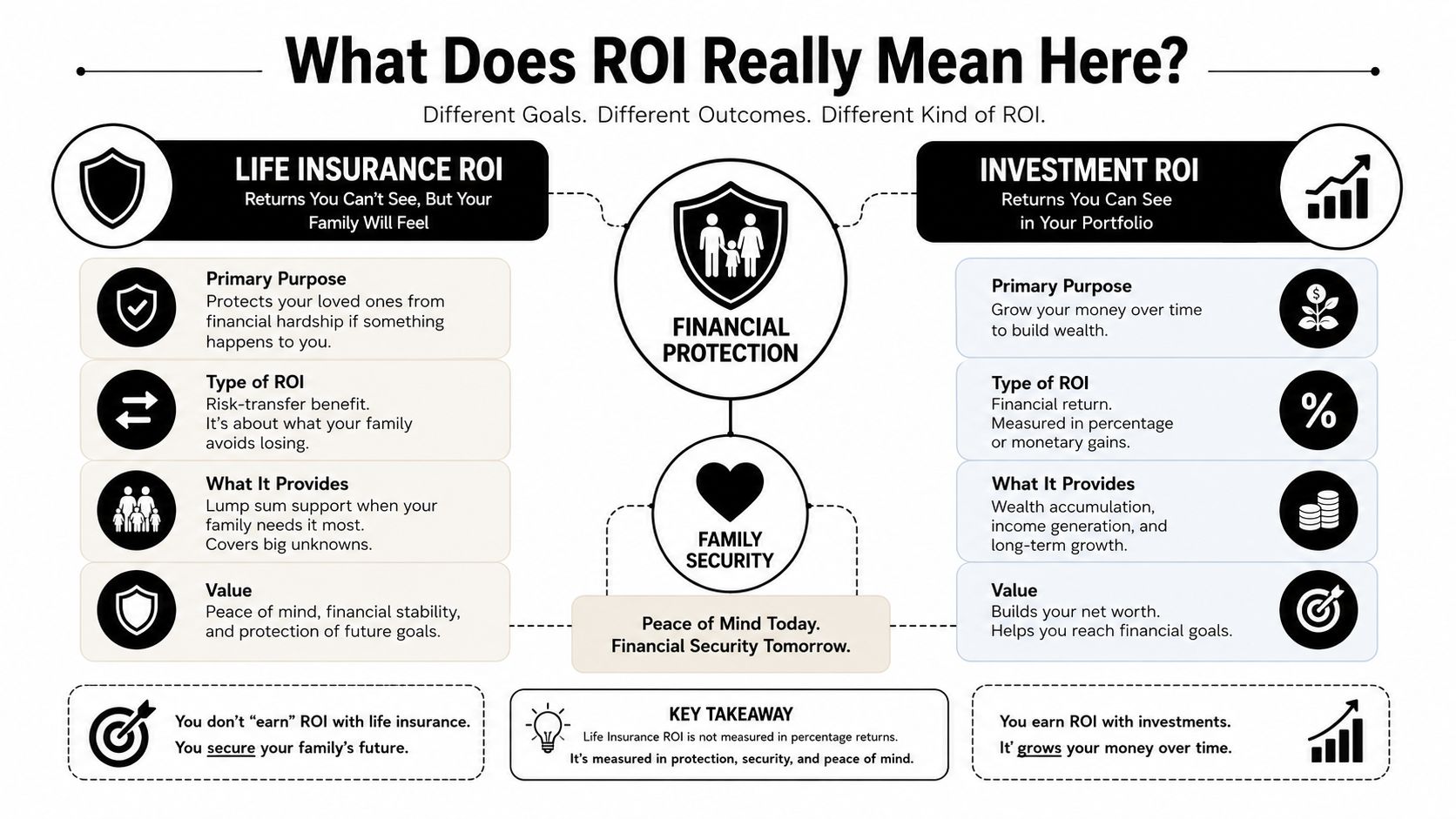
Three ways a policy can return value
Term life returns value through protection. If you survive the term, the financial result is usually the coverage you had during the years your family needed income replacement, not a cash balance.
Whole life can provide permanent insurance and cash value under the policy's guarantees and non-guaranteed assumptions. Its return depends on premium design, policy duration, dividends if applicable, loans, surrender charges, and whether the policy remains in force.
Universal life also combines permanent coverage with cash value, but its performance depends heavily on funding, policy charges, credited interest or investment performance, and the policy's assumptions. A weakly funded policy can become a problem even when the original illustration looked attractive.
The technical measure is internal rate of return, or IRR. IRR converts premium payments and a later cash value or death benefit into one annualized figure. That lets you compare different holding periods and exit events, although the comparison must account for taxes and the value of insurance protection.
Practical rule: Calculate at least two returns, the cash-value IRR if you surrender and the death-benefit IRR if you die. One number cannot describe the entire contract.
The Society of Actuaries' individual life persistency study recorded overall lapse rates of 4.3% on a policy basis and 5.2% on a face-amount basis, while whole life recorded lower rates of 3.4% and 4.1%, respectively. Persistency matters because permanent insurance can only deliver its long-term value if the owner keeps paying and keeps the policy active.
In one sentence, life insurance returns money either by protecting beneficiaries against an early death or by building policy value over time. Term does the first. Whole life and universal life may do both, but only under the right structure and holding period.
Term, Whole, and Universal Life Compared Through an ROI Lens
The phrase “term is cheap, whole life is expensive” is incomplete. The better comparison asks what each premium dollar is buying. Term directs most of its economic purpose toward temporary protection. Whole life allocates premium toward permanent coverage, guarantees, expenses, and cash value. Universal life gives you more flexibility, but that flexibility creates more responsibility.
| Policy Type | Premium Level | Cash Value | Death Benefit | Typical ROI Profile |
|---|---|---|---|---|
| Term life | Usually the lowest for temporary coverage | None under standard term design | Protection during the selected term | Protection ROI, with no investment-style value if the term ends while you're alive |
| Whole life | Usually higher because coverage is permanent and cash value is included | Builds according to guarantees and non-guaranteed elements | Permanent benefit if the policy remains in force | Long-horizon cash-value and death-benefit IRR, often modest early and more meaningful over time |
| Universal life | Varies with funding and policy design | Flexible, but sensitive to charges, credited performance, loans, and premium discipline | Can remain level or change according to the contract | Potentially useful for permanent planning, but harder to manage and easier to misjudge |
Term is the default choice for most young families because their largest risk is temporary. A mortgage, childcare costs, and income replacement needs are concentrated in the working years. If the family survives the term, the policy may have done exactly what it was designed to do, even though the owner receives no cash value.
Whole life makes more sense when the need for a death benefit is permanent. Examples include a lifelong dependent, a planned estate-liquidity need, or a business obligation that won't disappear when a mortgage is paid. It's a poor substitute for ordinary retirement saving when the buyer hasn't funded more flexible, tax-advantaged options or hasn't secured adequate protection.
Universal life deserves extra scrutiny. Its appeal often comes from adjustable premiums or death benefits, but the owner must monitor the policy's funding and assumptions. A policy loan, missed premium, rising charges, or weaker credited performance can alter the expected result.
A useful term versus whole life comparison should therefore include more than premium quotes. Ask for guaranteed and current values, the planned premium schedule, surrender value, policy debt treatment, and results at different exit ages. Illustrated cash value isn't the same as guaranteed cash value. If an agent only shows the favorable projection, you haven't seen the ROI case yet.
The Society of Actuaries' more recent term and whole life lapse and surrender study analyzed about 135.9 million policies, 5.4 million surrenders and lapses, $30.6 trillion in face amount exposed, and $1.4 trillion in surrendered or lapsed face amount. The scale of that experience reinforces a simple point: product structure matters, but persistence determines whether the structure has time to work.
How to Estimate ROI and Break-Even on a Cash-Value Policy
Start with the money that leaves your account, not the projected value that appears in an illustration. Add every premium by policy year. Then compare that cumulative outlay with the policy's cash surrender value, not merely its gross cash value.
IRR is the annualized rate that makes the present value of your premium payments equal to the value you receive at the exit point. For a surrender calculation, the basic inputs are:
- Premiums in: every premium paid, including planned supplemental payments.
- Value out: the net cash surrender value at the chosen year.
- Alternative exit: the death benefit at a selected mortality age.
- Timing: the exact year each payment and benefit occurs.
A practical break-even test
Suppose an illustration shows $32,000 in total premiums paid and $35,000 in cash value at year 10, with a stated break-even point in year 9. Those figures appear in the required visual for this calculation example. The apparent cash-value gain is not the complete analysis because you still need to verify whether the displayed amount is guaranteed, whether surrender charges remain, and whether the policy has debt.
For your own worksheet, create a row for every policy year:
- Record cumulative premiums.
- Record guaranteed cash value.
- Record current or illustrated cash value separately.
- Subtract surrender charges and policy debt.
- Calculate the first year in which net cash value exceeds cumulative premiums.
That year is the cash break-even point. It isn't necessarily the investment break-even point, because you also gave up the opportunity to invest the premium difference elsewhere and received valuable insurance protection during the period.
The cash-value life insurance calculator can help organize those inputs, but don't treat a calculator as a substitute for the policy illustration. Demand the guaranteed ledger, the current ledger, the surrender schedule, and loan assumptions.
Ask for this before applying: “Show me the net amount I can receive if I surrender in every early policy year, and show me the death-benefit IRR at several realistic ages.”
The technical literature shows why the exit event changes the answer. One academic sample of 30-year-old policyholders found whole life life-rate-of-return figures of about 2.43% for males and 2.10% for females, while retirement-oriented policies produced higher returns. That analysis is available through the Financial Planning Association's life insurance investment review. The lesson is more useful than the percentages: design and timing drive results more than the product label.
If you're reviewing old policies, look for forgotten refunds or overpayments before making a decision. A resource such as find refunds with Compass+ may help identify money you didn't realize was recoverable, but it doesn't replace a policy review or tax advice.
Opportunity Cost and the Hidden Numbers Most Buyers Miss
A cash-value policy can look respectable in isolation and still be the wrong use of your money. The missing comparison is opportunity cost. Every premium dollar committed to whole life or universal life is a dollar you can't place into a taxable brokerage account, debt repayment, emergency reserves, or another financial priority.
A taxable brokerage account offers liquidity and market exposure, but it also carries market risk and potential capital-gains taxes. Permanent insurance offers a death benefit and tax-deferred policy growth, but it can carry higher early costs and less liquidity. The right choice depends on the goal, not on which illustration has the prettier line.
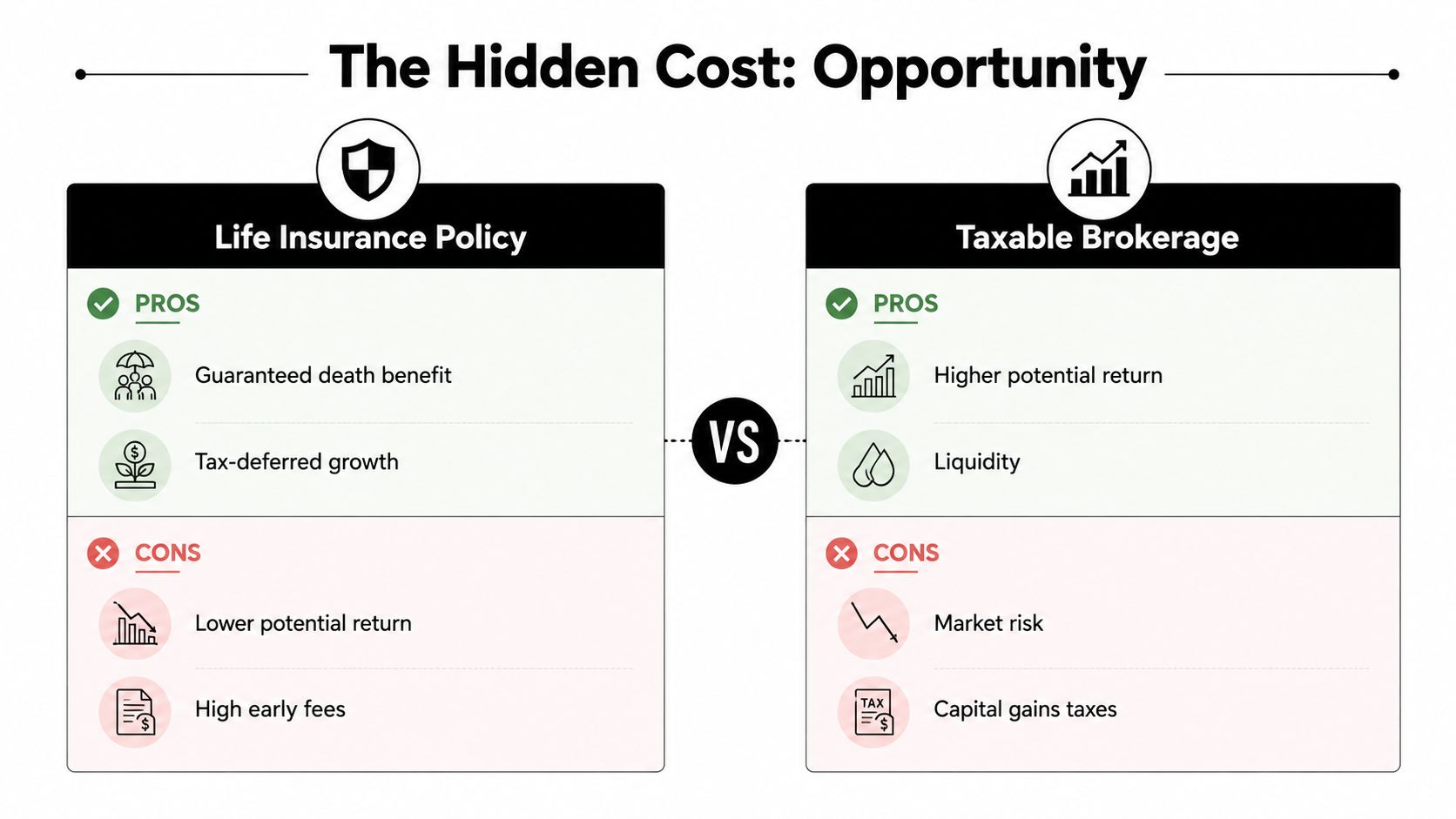
Exit risk changes the ROI
The biggest hidden threat is buying a policy you won't keep. The Society of Actuaries' historical persistency data shows why lapse behavior belongs in every ROI conversation. A policyholder who exits early may receive less than the premiums paid, particularly when surrender charges and front-loaded expenses reduce the amount available.
The cash surrender value is not the death benefit. It's the amount paid when you cancel, and surrender charges can reduce it. In universal life, policy debt can reduce net cash surrender value further. Review how surrender charges work before assuming the displayed cash value is the amount you can take home.
The IRS explanation of life insurance proceeds states that surrender proceeds above the policy's cost are generally included in income. Cost usually reflects premiums paid, adjusted for items such as refunded premiums, rebates, dividends, or unpaid loans already excluded from income. Tax treatment depends on the contract and your circumstances, so get qualified tax advice before surrendering.
Watch this short visual explanation before comparing a policy with an outside investment account:
The practical test is brutal but fair. If you can't commit to the premium schedule, don't buy a cash-value policy for its projected ROI. The policy's internal return matters only if the contract survives long enough for the assumptions to become relevant.
Matching Policy Structure to Your Life Stage
Most households should protect first and invest separately. That recommendation isn't anti-insurance. It recognizes that a family's largest financial risk often occurs before its long-term assets have matured, which makes adequate death-benefit protection more urgent than early cash-value accumulation.
Young families with income-replacement risk
A young family with dependent children, a mortgage, and one or two incomes usually needs a death benefit that exceeds the years of highest financial exposure. Choose a term length that reaches beyond the period when children depend on your income and the household carries major debt.
Term is usually the cleanest fit because it delivers substantial protection without forcing the family to redirect too much cash into a permanent contract. Keep the premium savings available for emergency reserves, retirement accounts, education goals, and debt reduction. A policy that leaves the family underinsured because the permanent premium is unaffordable fails the first test.
Professionals with stronger savings capacity
A professional who has already built adequate emergency reserves and used available tax-advantaged savings may have a legitimate reason to consider permanent insurance. The reason must be specific. “I want another investment account” isn't enough.
Permanent coverage may fit an estate plan, a business succession need, a lifelong dependent, or a desire for a particular conservative asset structure. Ask an independent advisor to compare the policy with the actual alternative, using equal premium outlays and matching the insurance benefit rather than pretending the death benefit has no value.
Newly married couples
A newly married couple shouldn't buy a complex policy just because marriage feels like a financial milestone. First identify shared debts, income dependence, future children, and employer coverage. If one partner couldn't maintain the household after the other's death, term coverage may be appropriate even before children arrive.
The decision checklist is straightforward:
- Income replacement: How many working years would the surviving partner need to replace?
- Dependents: Who relies on the insured's income or unpaid care?
- Debt: Which obligations would remain after death?
- Existing coverage: What employer or individual policies are already active?
- Policy discipline: Can the household maintain premiums through job changes, illness, and other disruptions?
Cash value should be reserved for a named permanent need, not sold as a vague promise of superior wealth building. If the need is temporary, buy temporary coverage. If the need is permanent, investigate permanent insurance with a full guaranteed ledger and an exit analysis.
Your Action Plan to Buy Coverage That Fits Your Life
Start with the protection gap. Calculate the death benefit your household needs, then test that amount against your income, debts, dependents, savings, and existing coverage. This gives you a protection ROI target before any agent discusses cash value or projected growth.
Use this worksheet:
- Annual income to replace: ______
- Years of income replacement: ______
- Debts and final obligations: ______
- Savings and existing coverage: ______
- Number of dependents: ______
- Recommended death-benefit range: ______
Choose a term lasting through your highest-risk years. Compare exam and no-exam underwriting according to your health history, application speed, and the insurer's requirements. No-exam coverage still involves underwriting, including application information and other available data.
For healthy adults seeking a digital application, Coveredly offers online term life insurance with no exams for most applicants and coverage up to $3 million, according to its product description. Prepare income details, beneficiaries, medical history, medications, and current policy information before applying.
Before choosing permanent insurance, calculate the break-even year, premium opportunity cost, and death-benefit IRR at realistic mortality ages. If the policy cannot justify its cost through a permanent need and a credible protection return, buy term coverage instead.
Common ROI Questions Buyers Ask After Reading the Guide
How does a lapse affect ROI? A lapse ends the policy and can destroy the long-term cash-value plan. The policy must remain funded and active for its projected values to matter.
Is surrendered cash value taxable? Generally, the amount above your policy basis may be included in income. Policy loans, dividends, refunds, and contract details can change the calculation, so consult a tax professional.
What does no-exam mean? It means the insurer may approve coverage without a traditional medical exam for eligible applicants. It doesn't mean automatic approval or the absence of underwriting.
What happens when term expires? Standard term coverage usually ends without cash value or a remaining death benefit. You paid for protection during the selected period, and the contract may have fulfilled its purpose even without a payout.
Coveredly offers online term life insurance with no exams for most applicants and up to $3 million in coverage, giving young families, professionals, and newly married couples a way to address protection needs without treating insurance like a speculative investment. Visit Coveredly to review your options, estimate the coverage your household needs, and apply for a policy structure that matches your actual time horizon.