You're probably here because life finally got expensive. The mortgage is real, the daycare bill stings, and the idea of leaving your spouse to cover everything alone feels irresponsible. That's exactly where a million dollar term life insurance policy starts to make sense, not as a luxury, but as a clean way to replace income, protect the house, and keep a family stable if the worst happens.
Table of Contents
- Why a Million Dollar Term Life Insurance Policy Makes Sense
- How Much Does Million Dollar Term Life Insurance Cost
- Who Needs a Million Dollar Life Insurance Policy
- No Exam Versus Fully Underwritten Million Dollar Policies
- How to Qualify and Apply for Coverage
- Choosing the Right Term Length for Your Family
- Smart Buying Tips and Next Steps
Why a Million Dollar Term Life Insurance Policy Makes Sense
A couple in their early 30s can look at their finances and think they're fine, until they add everything up. A mortgage, child care, student loans, future college costs, and the income that keeps the lights on can stack up fast, and a small policy won't carry that load for long. A million dollar term life insurance policy is a practical way to replace income and cover real obligations. It is built for everyday families, not fancy estate plans.

Term life is simple on purpose
Term life insurance is a contract. You pay premiums for a set period, and if you die during that period, the insurer pays the death benefit. That structure keeps it focused and practical, which is why it works well for families who need protection during specific years of dependency.
The numbers back up how mainstream this has become. The U.S. had about 134,193,000 individual life insurance policies in force in 2023, and the median face value of in-force policies was $150,000 in 2022, while the median face value among term policies was $162,000 (Forbes Advisor life insurance statistics). That makes a $1 million policy above the typical level of protection, but it remains a normal planning tool when a family needs more coverage. For a broader look at pricing and coverage trade-offs, see this cost guide for million dollar life insurance policies.
Practical rule: If your family would need years of income replacement, not just a burial check, think in terms of a larger term policy.
The right question is not whether one million is “a lot”
The better question is whether your household's obligations add up to that much. For many young families, they do. A family with a home, two incomes, and children often needs protection measured against the cost of replacing earnings, clearing debt, and giving a surviving spouse time to adjust.
That is why this coverage level is common among young parents and new homeowners. It is about buying enough time and money for your family to stay steady, not about chasing a bigger number for its own sake. If the policy is structured well, it does that job efficiently.
How Much Does Million Dollar Term Life Insurance Cost
The price of million dollar term life insurance depends on age, sex, term length, and underwriting. The biggest mistake people make is waiting too long and assuming the cost will stay close to what they saw online in their 20s. It won't.
What the market looks like by age
For a 20-year, $1 million term policy, a healthy 30-year-old woman may pay about $30 per month and a 30-year-old man about $37 per month, while the same coverage for a 40-year-old woman rises to about $47 per month and for a 40-year-old man to about $58 per month (WSJ Buyside life insurance policy pricing). By age 50, those averages jump to roughly $110 per month for women and $150 for men, which is why buying earlier matters.
A second rate comparison makes the age gap even harder to ignore. For a 20-year term, Aflac reports average monthly premiums of $67 for a healthy 30-year-old man versus $771 for a 60-year-old man, and $54 versus $545 for women at the same ages (Aflac million-dollar policy cost). That's the economics of mortality risk, not marketing.
Average monthly premiums for $1 million term life insurance
| Age | Gender | 10-Year Term | 20-Year Term | 30-Year Term |
|---|---|---|---|---|
| 30 | Woman | $34 | $48 | $96 |
| 30 | Man | $42 | $61 | $119 |
| 40 | Woman | $47 | ||
| 40 | Man | $58 | ||
| 50 | Woman | $110 | ||
| 50 | Man | $150 |
The 10-year and 30-year figures above are based on the public rate examples in the market guidance for a healthy 30-year-old, while the 20-year numbers reflect the broader cross-age estimates cited above. That spread matters because longer terms cost more and older applicants pay more because the insurer's chance of paying a claim rises over the contract period.
Bottom line: If you're healthy and young, you're buying time at the lowest price you're likely to see.
Use this million-dollar life insurance cost guide if you want to compare your own age bracket against other term lengths and coverage amounts.
Why premiums jump
Insurance pricing isn't mysterious. The carrier is estimating how likely it is to pay a death benefit while the policy is active, and that probability gets worse with age. Underwriting also matters because the insurer is trying to classify your risk correctly, which is why two people the same age can pay very different amounts.
Who Needs a Million Dollar Life Insurance Policy
A million dollar term life insurance policy serves households that would take a serious hit if one paycheck disappeared. The question is simple, would your family still be financially steady if you died tomorrow? If the answer is no, the coverage amount deserves serious attention.
The people who usually need it
Young families are the clearest fit. One death can wipe out income, add childcare costs, and leave education expenses untouched. A stay-at-home parent can justify the same level of protection, because the unpaid work they do has clear economic value, and replacing that help costs real money.
Homeowners with large mortgages also belong in this group. If the surviving spouse wants to keep the house after one income disappears, the policy needs enough room to pay down debt or make the monthly payment manageable. Parents with children headed for college should also plan ahead, since tuition, room, and board do not get cheaper after a death in the family.
Practical rule: If the policy has to cover income, housing, childcare, and education at the same time, smaller coverage gets thin fast.
A simple way to think about need
Start with the income that would need to be replaced, then add debts that should be cleared, then add the expenses that continue even after death. That framework gives you a realistic target. A $1 million policy often fits when a surviving spouse would otherwise face hard choices about the house, work, or school plans.
Business owners and professionals with major obligations can fit here too. If your income keeps a business running or supports a partner's finances, the death benefit has to be large enough to preserve continuity. That is why million-dollar coverage shows up in the middle market, not only among wealthy households.
For families handling estate questions in Texas, a useful legal overview is life insurance and probate in Texas. Beneficiary setup matters as much as policy size.

Don't confuse wealth with need
A policy is useful at any size, and term coverage is valuable when it matches a real financial gap. The cheapest short term can look attractive, then fail when the surviving family still has years of bills ahead. If your family depends on your paycheck, the policy should reflect the size of the disruption your death would create.
That same logic should guide the decision between no-exam and fully underwritten coverage. Healthy applicants who qualify for no-exam term life insurance options can sometimes get speed and convenience without giving up too much. Applicants with more complicated health histories should take the exam and let the insurer price the risk properly, because the better rate often comes from full underwriting.
No Exam Versus Fully Underwritten Million Dollar Policies
Buyers get misled here. No-exam million dollar term life insurance sounds effortless, but speed and convenience usually come with trade-offs. If you are healthy, the medical exam can save you money. If your health is less straightforward, the no-exam route may be the only practical option.
What no-exam really means
No-exam options do exist, but they are not universal. Independent industry guidance says access depends on the carrier, your age, and your health history, and some policies still use accelerated underwriting instead of a true hands-off approval. A healthy applicant may get a faster decision, but the insurer is still evaluating your risk.
The market also shows the pricing gap can be large. One rate comparison puts a 20-year, $1 million policy at about $37 per month for a 30-year-old male, but around $442 per month for a 60-year-old male (Best Life Rates no-exam million-dollar term life insurance). That is why no-exam convenience should never distract you from the underwriting reality.
If you want a broader look at how simplified issue coverage is positioned, read more about no-exam term life insurance options.
Side by side, the trade-off is obvious
| Path | Speed | Medical evidence | Pricing tendency | Best fit |
|---|---|---|---|---|
| No exam / simplified issue | Faster | Health questionnaire only | Usually higher | Buyers who value convenience or have limited health issues |
| Fully underwritten | Slower | Questionnaires, and often blood and urine testing | Usually lower for healthy applicants | Healthy buyers who want the best price on a large policy |
For a $1 million term policy, underwriting is the main price separator. Industry guidance says exam-free approval can take about a week or less, while fully underwritten cases often take four to six weeks because the carrier is using more data to price the policy (Choice Mutual million-dollar life insurance cost). That slower path is often worth it if your health profile is solid.
Direct advice: If you are healthy and can wait, take the exam. You are usually buying a better price, not just a policy.
Who should skip the exam
Choose the no-exam path if you need speed, hate medical testing, or expect your health profile will not support an attractive fully underwritten offer. Choose full underwriting if you are healthy, price-sensitive, and comfortable waiting for a more complete review. The wrong move is assuming no-exam means best-rate coverage.
How to Qualify and Apply for Coverage
Start with a clean application and full honesty. Insurers do not stop at a simple yes-or-no health question. They review your medical history, prescriptions, occupation, driving record, and lifestyle habits because all of that affects the chance they will have to pay a claim.
What the insurer asks first
The process usually begins with a health and lifestyle questionnaire. If the insurer wants more detail, expect questions about smoking, hazardous hobbies, travel, or work exposure. A pilot, a contractor, and a desk worker may be the same age, but they do not carry the same risk.
After that, the carrier places you into a health class. Preferred plus and preferred applicants usually get better pricing than standard or substandard applicants, and more complete medical evidence gives the insurer a clearer basis for that decision. That is why fully underwritten policies often give healthy buyers a better deal.
What happens if a medical exam is required
The exam is usually simple. A nurse collects basic measurements and may take blood and urine samples, then the insurer reviews those results along with the rest of your file. If you want a better shot at a strong rate class, schedule the exam in the morning, avoid heavy meals beforehand, and do not try to work the system.
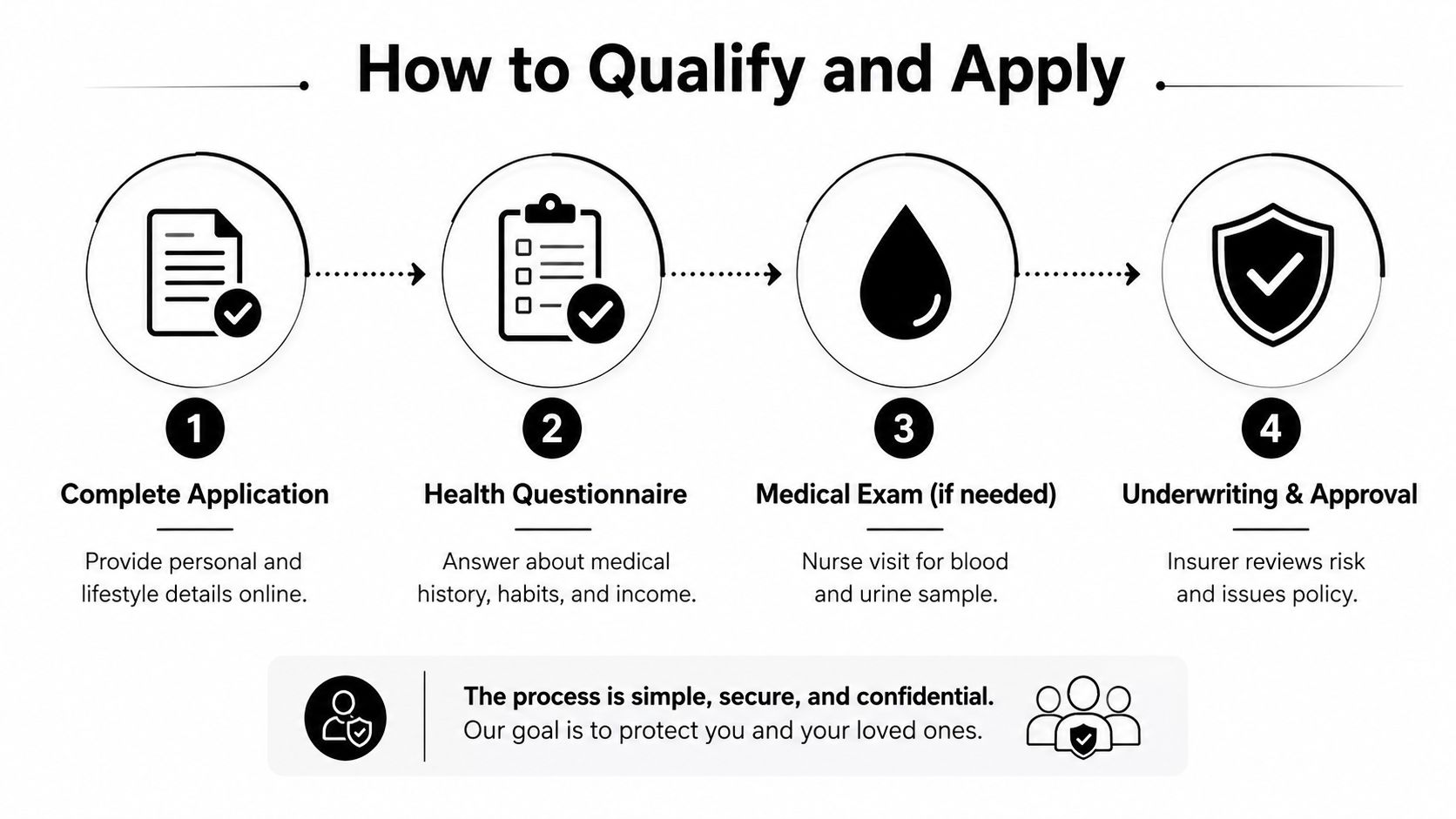
The review can still take time. Independent guidance says exam-free approval can move quickly, while fully underwritten cases often take four to six weeks because the insurer is checking more evidence before it issues the policy. That delay is annoying, but it is also what gets you a more accurate rate if your health profile is strong.
Learn how underwriting works in life insurance if you want a clearer look at the review process before you apply.
How to improve your outcome
- Answer everything honestly: A small omission can become a bigger problem later.
- Apply before your next birthday: Age changes pricing fast.
- Keep your records ready: Medication lists and doctor contact details speed up file review.
- Be realistic about hobbies: Cliff diving and private pilot activity are not minor details.
If you can qualify cleanly, take the time to go through the exam. The cheapest shortcut is often the wrong one for a million dollar term life insurance policy.
Choosing the Right Term Length for Your Family
A cheap monthly premium can hide an expensive mistake. If your policy ends while the mortgage is still there, the kids still depend on your income, or tuition bills are still ahead, you bought too little time. That is the hidden risk in million dollar term life insurance.
The danger of buying too short
A 10-year policy works when your mortgage is close to being paid off and your children are almost self-sufficient. It is the wrong fit when you are still paying for daycare, carrying a long mortgage, or facing several more years of tuition. Chasing the shortest term just to cut the payment can leave your family exposed right when the bills are highest.
Public rate examples make the trade-off plain. For a healthy 30-year-old woman, a $1 million policy can cost about $34 per month for 10 years, $48 per month for 20 years, and $96 per month for 30 years (Guardian Life million-dollar policy guidance). The cheapest term is a poor deal if it leaves a coverage gap later.
Match the term to the longest obligation
Use the longest financial responsibility as your guide. That usually means the mortgage term, the years until your youngest child is financially independent, or the period until your spouse can comfortably manage without your paycheck.
If you are stuck between two term lengths, I usually recommend the longer one. A slightly higher monthly bill is easier to handle than finding out your coverage ended five years too soon. Conversion options can help later, but they do not replace buying enough time from the start.
What happens when the term ends
When term coverage expires, the policy stops protecting your family unless you renew, convert, or buy a new policy. That is the part many buyers overlook because the premium looks manageable today. They focus on the monthly bill and miss the hole it can leave later.
My rule: Buy term for the life stage you are in now, not the budget you wish you had.
Smart Buying Tips and Next Steps
Start with need, not price. Decide how much income your family would lose, what debts should disappear, and how long the protection has to last. Then compare quotes for both no-exam and fully underwritten paths, because the cheapest quote isn't helpful if it doesn't fit your health profile or your timeline.
Look hard at whether you really need a million dollars, or whether a smaller amount fits better. Some households are overbuying, and others are gambling with too little coverage. Both mistakes are easy to make when you shop by monthly premium alone.
A few practical moves matter right away.
- Lock in coverage before your next birthday: Age drives price, and waiting rarely helps.
- Review after major life changes: A new child, a refinance, or a paid-off mortgage can change the right amount.
- Choose the underwriting path that fits you: Healthy and patient usually points to full underwriting, while speed and simplicity may justify no-exam coverage.
- Revisit beneficiaries: A strong policy with stale beneficiary designations still causes problems.
If you want the clearest possible answer, get a quote and test your numbers against real offers, not guesses. That's the only way to know whether million dollar term life insurance is the right fit for your family.
Coveredly makes it straightforward to compare term coverage without wasting time on a confusing process. If you're weighing a million dollar term life insurance policy, visit Coveredly to see how a digital-first application can help you move from guesswork to a real quote.