A lot of people start shopping for life insurance with the same thought in mind, “If I'm paying for coverage I might never use, can't I at least get the money back?” That question usually leads them straight to Return of Premium term insurance, a product that sounds like a compromise between protection and savings. It is a real policy, but the refund feature is paid for up front, and that trade-off is where most buyers get surprised.
If you're comparing policies after a mortgage approval, a new baby, or a marriage, the pitch can feel especially appealing. The challenge is that return of premium term is still term life insurance, just with a refund feature attached, so the details matter more than the slogan. For a plain primer on the base product, it helps to start with a straightforward term life insurance policy overview, then layer the refund mechanics on top. If you also want a broader consumer view of coverage disputes and policy questions, the Law Office of Bryan Fagan insurance articles are a useful place to look at how insurance language affects real families.
Table of Contents
- What Return of Premium Term Really Is
- How the Refund Actually Works
- ROP Term vs Standard Term and Permanent Insurance
- The Real Cost Trade-Off and the Break-Even Math
- Who ROP Term Is Built For
- Common Misconceptions and Hidden Pitfalls
- Smart Alternatives Worth Comparing First
- Decision Framework and Quick Answers
What Return of Premium Term Really Is
A parent sits down to buy coverage, sees the phrase “money back,” and thinks the decision is obvious. It's easy to understand why. Return of premium term sounds like term life insurance with a built-in rebate, and that's close to the truth, but not the whole story.
ROP term is still term life insurance, but with a refund feature. If the insured survives the policy term, the insurer returns the premiums paid, while standard term policies normally do not refund those payments. The policy usually follows a 20- or 30-year level-premium design, so the monthly payment stays steady for the length of the term rather than changing every year. That steady structure makes the policy feel simple on the surface, even though the refund feature changes the economics underneath. Return of premium life insurance overview
The plain-English definition
Think of standard term insurance as renting protection. You pay for the right to have a death benefit in force during a fixed period, and if nothing happens, the premiums are gone. With ROP, the insurer adds a contractual promise to send back the premiums if you make it to the end of the term alive.
That refund is not investment growth. It's a built-in policy promise funded by higher premiums, which is why the product feels like a hybrid but still behaves like term insurance rather than a savings account. If the policy is structured properly and remains active through the full term, the insurer fulfills that refund obligation at the end.
Practical rule: if the marketing pitch makes ROP sound like “free insurance,” stop there. You're usually paying for the refund through the premium itself.
If you're trying to understand the broader insurance vocabulary that surrounds this product, it helps to compare it with classic term and permanent coverage side by side in this term vs whole life insurance guide. ROP sits between those worlds in feel, but not in structure.
How the Refund Actually Works
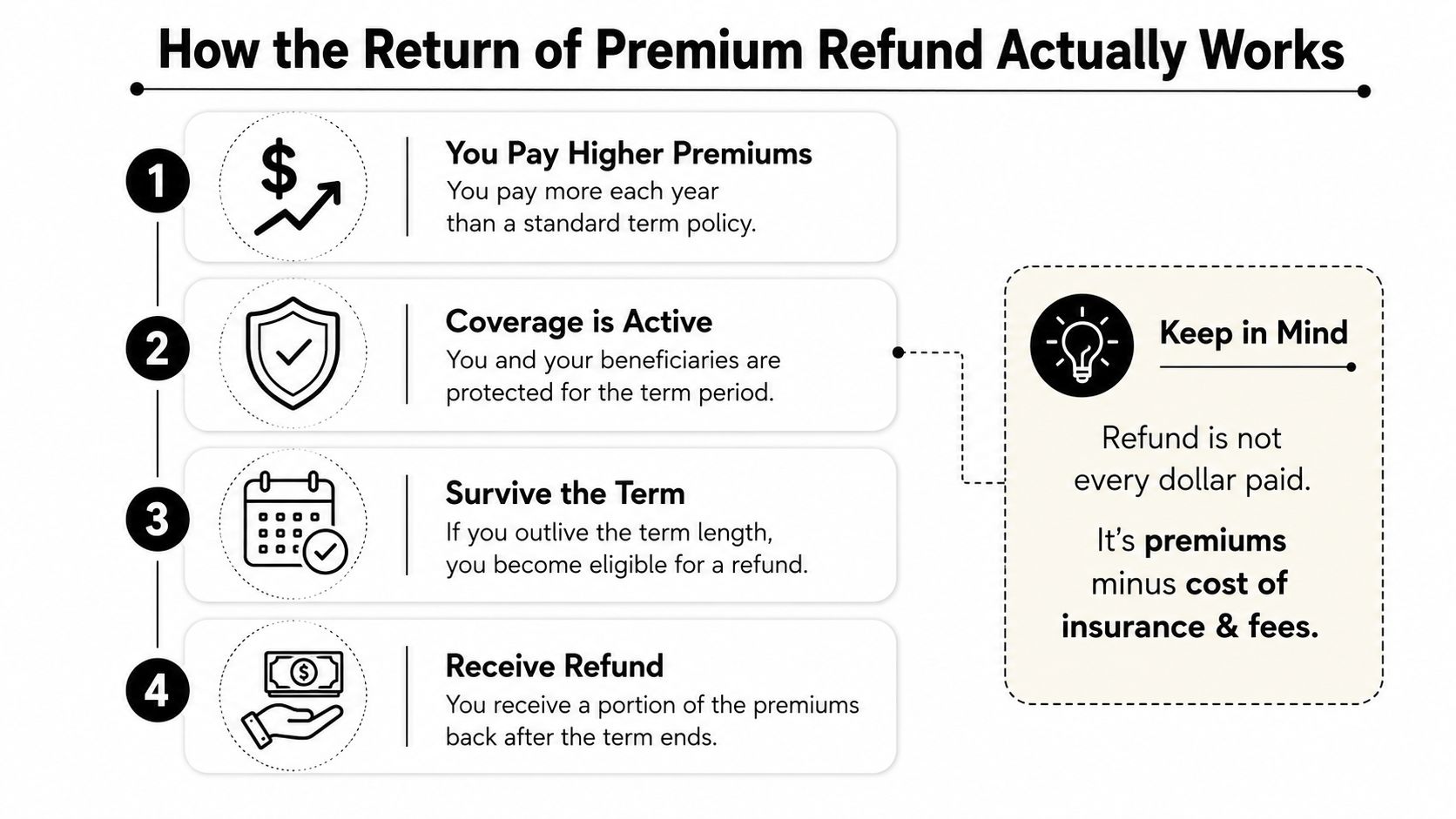
The refund usually feels bigger in the brochure than it does in real life because buyers picture every dollar they ever paid coming back untouched. That's not how the contract usually works. A typical ROP setup is a 30-year plan with fixed premium payments, and one common example uses a minimum face value of $100,000, with only the base policy premiums returned, not rider fees or modal expense factors. Farm Bureau's ROP explanation
A simple example
Suppose you buy a 30-year policy and keep it active the whole way. Each year you pay the same premium, and the policy stays in force as long as you keep paying on time. If you outlive the term, the insurer sends back the refunded portion at the end of the coverage period.
What matters is the definition of “refund.” In many contracts, the payout is tied to base premiums, not every extra charge that may appear on the bill. That means modal loadings, rider premiums, and similar add-ons may stay outside the refund calculation. In plain English, the refund can be smaller than your total out-of-pocket cost, even though the headline sounds like a full payback.
What has to happen for the refund to trigger
The policy has to stay in force through the full term. If it lapses or is surrendered early, the refund feature usually disappears or changes according to the contract. That's one reason people who compare ROP to ordinary term often miss the biggest practical issue, the refund is conditional, not automatic.
The refund works more like a contract settlement at the end of a long runway than a cash-back reward on a credit card.
The process is simple once you separate the premium bill from the refund promise. You pay the higher term premium during the coverage period, the insurer keeps the policy active, and only if the policy survives to the end does the refund arrive.
ROP Term vs Standard Term and Permanent Insurance
When buyers compare policies, they usually want three answers. What does it cost, what happens if I die during the term, and what happens if I outlive it? That's where the differences between standard term, ROP term, and permanent insurance become easier to see.
| Feature | Standard Term | ROP Term | Permanent (Whole Life) |
|---|---|---|---|
| Monthly cost | Lowest | Higher because of refund feature | Usually highest |
| Death benefit during term | Yes | Yes | Yes, if policy stays in force |
| Refund if you outlive the term | No | Yes, premiums are returned under the contract | Not a term refund, value is built differently |
| Best fit | Pure protection at lowest cost | Protection plus refund preference | Long-term coverage with a permanent contract structure |
If you're trying to sort through permanent coverage too, a whole life comparison page helps frame why these products are often discussed together even though they solve different problems.
Where standard term wins
Standard term wins on price and simplicity. If your main goal is to protect income, a mortgage, or young children for a limited period, plain term usually gives you the most death benefit for the lowest premium. That matters because every extra dollar spent on insurance is a dollar not going toward debt payoff, emergency savings, or investments.
Where ROP fits
ROP sits in the middle. It keeps the same death-benefit structure as term, but adds a refund condition if you survive the term. That makes it feel more comforting to buyers who dislike the idea of “losing” premiums, even though the comfort comes from a higher price tag.
Where permanent insurance differs
Permanent insurance solves a different problem. It's built for lifelong coverage and a very different long-term structure, so it can't be judged only by whether premiums are refunded at the end of a term. The important point is that ROP is still a term product, not a permanent policy in disguise.
The Real Cost Trade-Off and the Break-Even Math
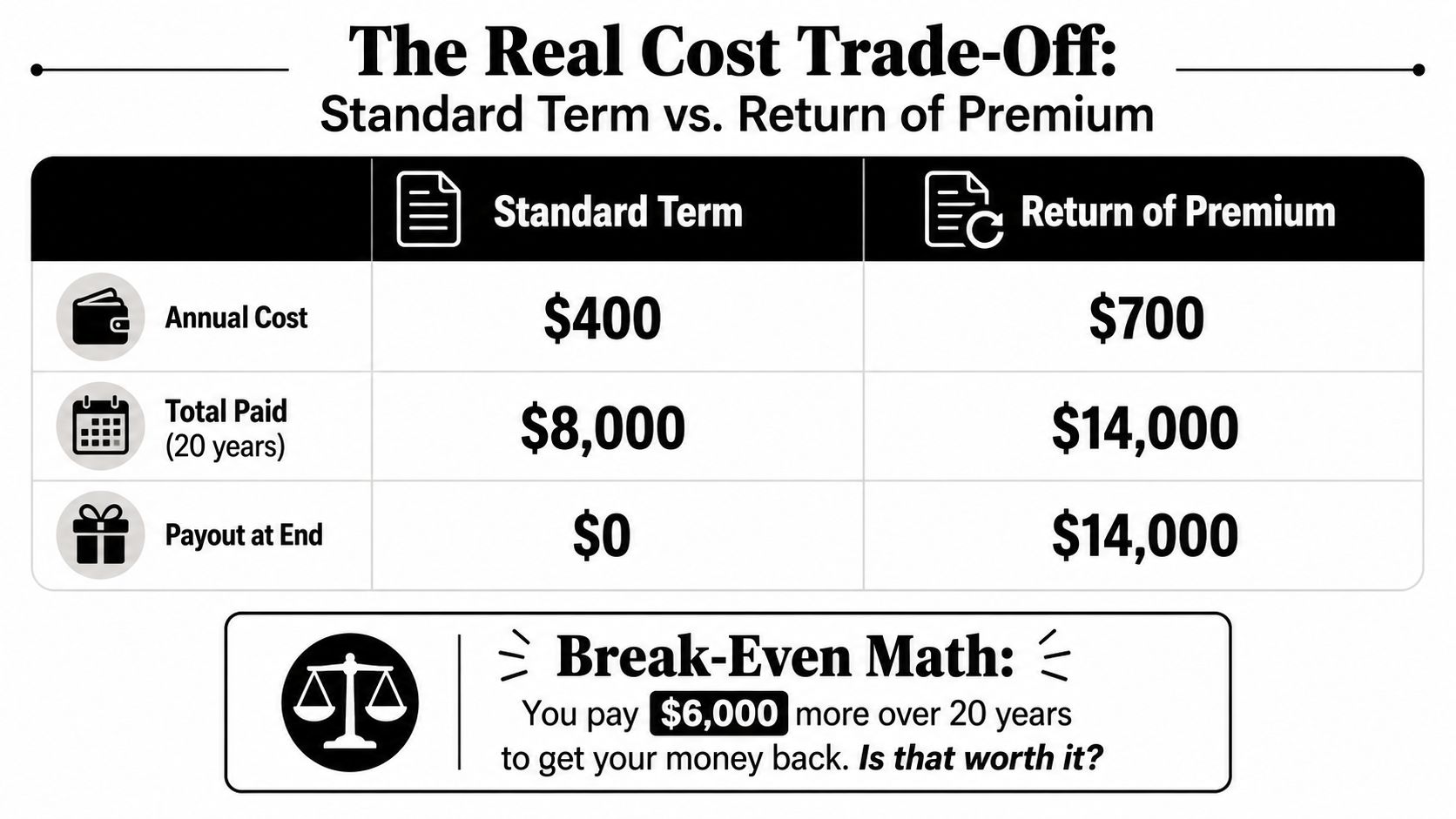
The price difference is the whole story behind ROP. Independent industry analysis says ROP-term premiums are more than twice regular term for a 20-year plan and about 50% to 60% higher for a 30-year plan, while the guaranteed return to the policy owner is generally at least 4% if the policy is held to the end of the level-premium period. Milliman's analysis of ROP term
What that means in practice
The refund isn't free money. It's a future payout funded by a larger premium today. That's why the right question isn't “Do I get my money back?” The right question is “What am I giving up to get it back?”
If a buyer pays substantially more every month for years, the contract has already collected the money that makes the refund possible. The refund can still be valuable, but it should be viewed as a guaranteed contractual return, not a growth engine.
A break-even way to think about it
The simplest break-even test is to compare the extra premium paid on ROP with what could have been done instead. If standard term costs less, the difference can be kept in cash, put in a savings account, or invested in a diversified portfolio. If you're disciplined, the cheaper policy plus the savings habit can leave you with more flexibility than the refund built into ROP.
That said, the built-in return has one advantage. It's automatic if you keep the policy in force to the end. Some people value that certainty more than the possibility of higher long-run growth from investing on their own.
Decision shortcut: choose ROP only if the refund itself is the feature you value most, not because the phrase “money back” sounds better than “invest the difference.”
The comparison is not ROP versus “nothing.” It's ROP versus cheaper term plus a plan for the premium savings. That's the framework that makes the trade-off visible.
Who ROP Term Is Built For
ROP tends to appeal to buyers who want protection and also dislike the feeling of paying for something they might never use. That emotional preference matters, because insurance decisions are rarely purely mathematical. People often want a policy they can explain to themselves in one sentence, and “I get my premiums back if I outlive it” is a very easy sentence to remember.
The profile that usually fits
State Farm's ROP term design uses a 20- or 30-year level premium period, which matches the structure most U.S. insurers follow. That tends to line up with buyers who have a long runway of financial obligations, like raising children, paying off a mortgage, or covering a spouse's income gap. The product also fits people who are willing to pay more today for a guaranteed refund later.
For families and couples who want a simple mental model, the refund can work like a forced-savings feature attached to term coverage. The key is that the premium tolerance has to be real. If a buyer has to stretch to afford the higher payment, the refund stops feeling like a perk and starts feeling like a constraint.
Who should pause before buying
People who need the lowest possible premium usually shouldn't start with ROP. The higher cost is not incidental, it is the mechanism that funds the refund. Anyone who already plans to save or invest the difference may find more control in a cheaper term policy.
The most useful question is simple, would you still buy the policy if the refund were described as a contractual payback, not a bonus? If the answer is yes, ROP may fit your budget and your temperament.
Common Misconceptions and Hidden Pitfalls
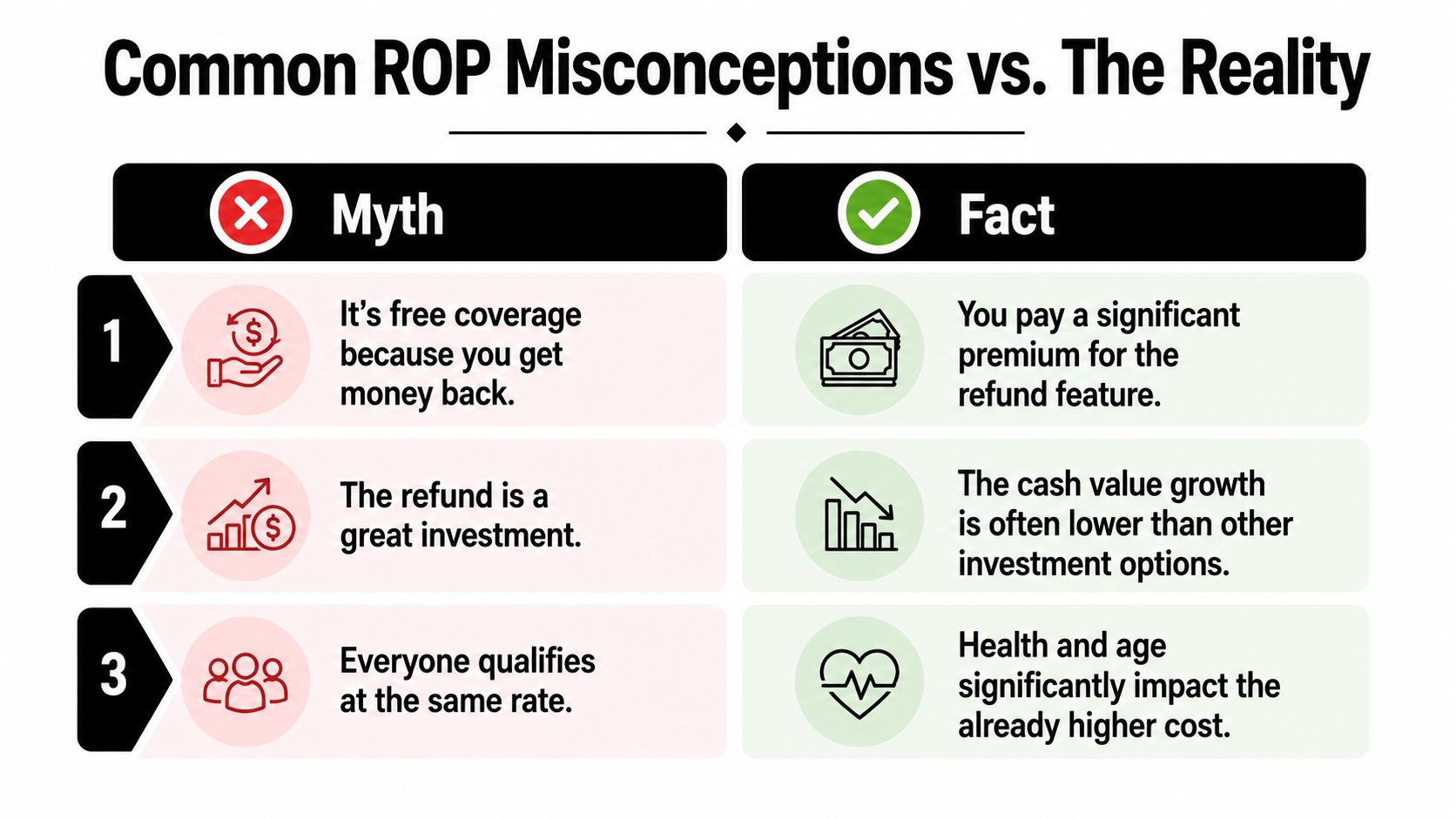
ROP has never been a mainstream term-life choice in the U.S. Industry reporting says it represented about 2% of term life sales overall, and at its 2009 peak it still reached only about 5% of sales. That small share lines up with the product's higher price, because most shoppers decide the refund isn't worth the added premium. TrustedChoice industry summary
Myths that lead buyers astray
- “It's free coverage because I get money back.” The refund feature is paid for through a higher premium.
- “The refund equals everything I paid.” The payout may exclude add-ons and certain charges.
- “ROP is just a better investment.” It's a contractual refund, not an investment account with market upside.
A lot of the confusion comes from the way ROP is sold. Buyers hear the comforting part first and the fine print later. That sequence creates a strong impression that the policy behaves like savings with insurance attached, when it really behaves like insurance with a refund condition attached.
The hidden pitfall most people miss
Early exit usually changes the deal. If you surrender the policy or let it lapse, the refund feature often disappears or becomes much less attractive. That's a serious issue for anyone who expects their income, family needs, or budget to change over time.
The other hidden pitfall is psychological. Because the refund feels tangible, buyers sometimes stop comparing the policy against cheaper term and a disciplined savings plan. That comparison is the one that reveals whether ROP is helping or just making the decision feel easier.
Smart Alternatives Worth Comparing First
Some buyers end up with ROP because it sounds safer than plain term. A better process is to compare it against three alternatives that solve similar problems in different ways.
Convertible term
Convertible term lets you start with a cheaper term policy and potentially switch to permanent coverage later, usually without new underwriting at the time of conversion if the policy allows it. That can be valuable if your health changes or you want to keep optionality open. It doesn't give you a refund, but it does give you more flexibility than a refund-focused design.
Investing the difference
This is the cleanest financial comparison. Buy a lower-cost term policy, then direct the premium savings into a diversified portfolio or another savings vehicle. The upside is flexibility, because you control the money and can stop or redirect it if life changes. The downside is that you have to stay disciplined.
Refundable or cash-value-oriented riders
Some policies and riders try to soften the feeling of “lost” premiums by building in a partial return feature. These can be appealing, but they still need to be judged on cost, exclusions, and liquidity. A policy with a cash-value element is not automatically better than a simple term policy, it just solves a different problem.
For readers who want a broader look at insurance structures that mix term protection with savings-like features, this cash value term life insurance overview gives useful context.
Decision Framework and Quick Answers
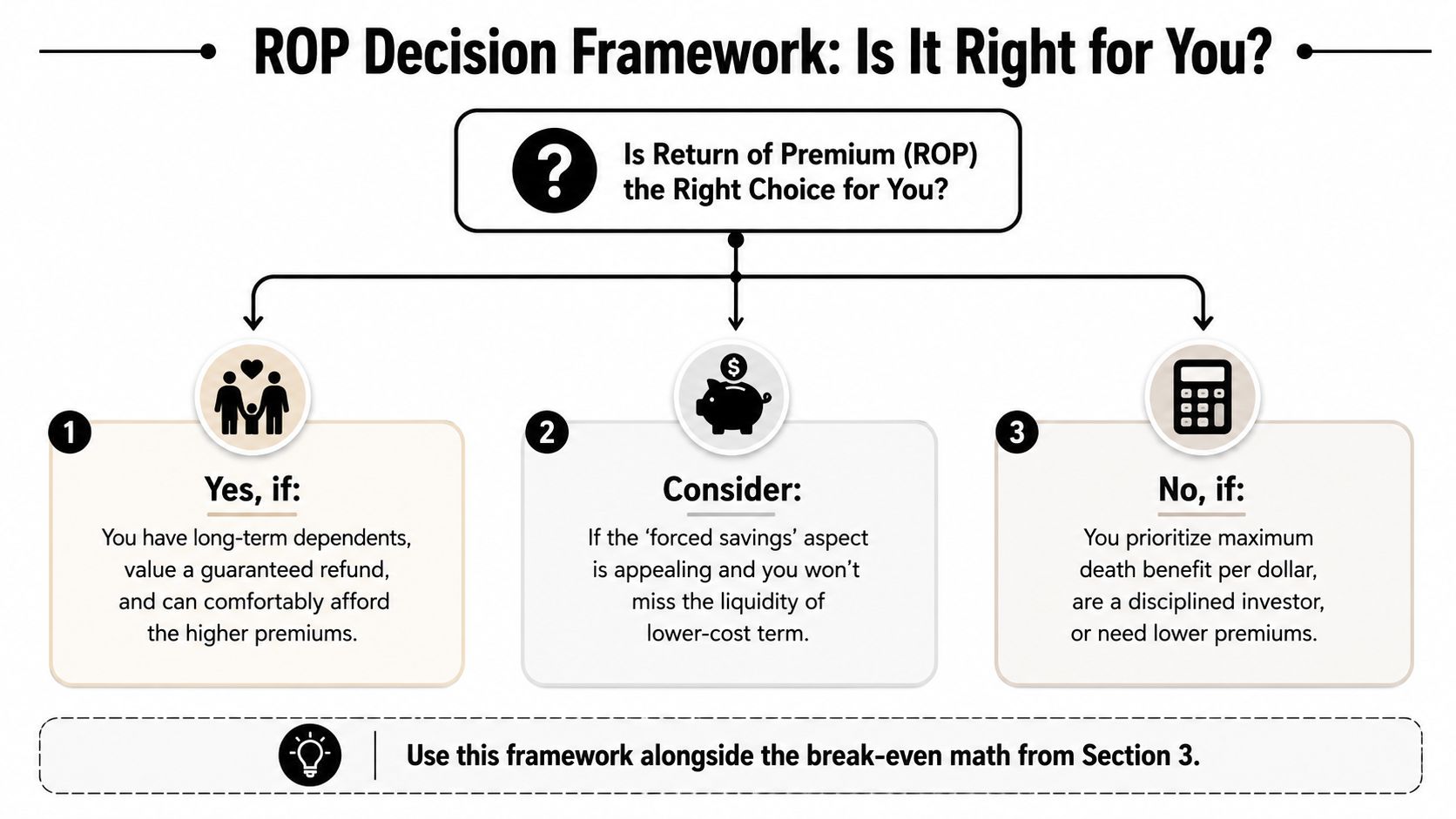
A good ROP decision starts with one question, do you want the certainty of a refund badly enough to pay extra for it? If the answer is yes, the policy may fit. If the answer is no, plain term usually does the job with more room in your budget.
Use this filter: buy ROP only if you expect to keep the policy for the full term and you value the refund more than the flexibility of investing the difference.
Quick answers
Is ROP term worth it at older ages? Sometimes the higher premium becomes harder to justify as the cost gap widens and the refund looks less attractive relative to the money you could keep in your pocket.
Is the refund taxable? Tax treatment can vary by policy design and jurisdiction, so that's a question to confirm with a qualified tax professional before buying.
What happens if you convert the policy? Conversion rules depend on the contract. Some policies keep the original structure intact only if the policy document explicitly allows the switch.
Bottom line. ROP works best for buyers who want the psychological comfort of a contractual refund and can comfortably afford the higher premium. If you want the most death benefit per dollar, standard term usually stays the stronger starting point.
Coveredly helps people compare life insurance without the guesswork, so you can see what fits your life instead of buying a policy because the refund sounds nice. If you're deciding between return of premium term, standard term, or a more flexible long-term option, visit Coveredly to explore coverage that's built around clarity, affordability, and the way you plan your money.