You've just left a sleep specialist's office with a diagnosis of obstructive sleep apnea. At home, your partner is relieved that there's finally an explanation for the snoring and restless nights. You're thinking about something else: “Will this stop me from getting term life insurance for my family?”
Usually, the answer isn't an automatic no. Insurers rarely treat sleep apnea as a simple yes-or-no checkbox. They look at severity, oxygen data, treatment, follow-up, and stability over time. A diagnosis may raise questions, but documented control can give an underwriter a much clearer and more favorable picture.
Table of Contents
- Introduction What Sleep Apnea Means for Your Life Insurance Plans
- Understanding Sleep Apnea and How Insurers View It
- How Life Insurance Underwriting Evaluates Sleep Apnea
- Severity Treatment and How They Change Your Rating
- How to Prepare and Improve Your Chances for Approval
- Real World Scenarios and What They Mean for Your Premium
- Your Next Steps to Affordable Coverage With Sleep Apnea
Introduction What Sleep Apnea Means for Your Life Insurance Plans
You have a young family, a new diagnosis, and a life insurance application waiting. The diagnosis may feel like a red flag, yet underwriters usually assess the details behind it. They look at severity, oxygen data, treatment, follow-up, and stability over time. A well-documented treatment history can make the application easier to evaluate.
Sleep apnea has shaped underwriting practice for years. A 2003 life-insurance medical review was written for medical directors and underwriters, while a 2024 review again examined the condition for life and disability underwriting, including its morbidity and mortality implications. Sleep apnea is now a recurring risk consideration rather than an unusual disclosure. The historical underwriting review is available through PubMed.
The condition also appears regularly among insured people. Diagnosed obstructive sleep apnea rose from 2.7% in 2013 to 3.9% in 2016, with an annualized mean of 3.2%. In 2016, 3.4% of the eligible insured population represented about 11.5 million insured people with OSA in the United States.
That scale helps explain the detailed questions on an application. Sleep apnea may overlap with hypertension, diabetes, obesity, and cardiovascular disease. The insurer is assessing whether your apnea is mild or severe, untreated or controlled, stable or changing, and whether related health risks are being managed.
The practical takeaway: Your diagnosis starts the underwriting conversation. Your records, treatment consistency, and current health profile shape the outcome.
The rest of this guide follows the information an applicant needs to gather. You'll learn how AHI and oxygen measurements describe severity, why CPAP compliance downloads can show treatment stability, and how underwriters may view different combinations of severity and adherence. You'll also find preparation steps and realistic examples to reduce surprises.
For a young parent, newly married couple, or professional with dependents, the goal is to present a complete, organized health story. Understanding severity and proving stable treatment are the strongest ways to pursue better life-insurance rates.
Understanding Sleep Apnea and How Insurers View It
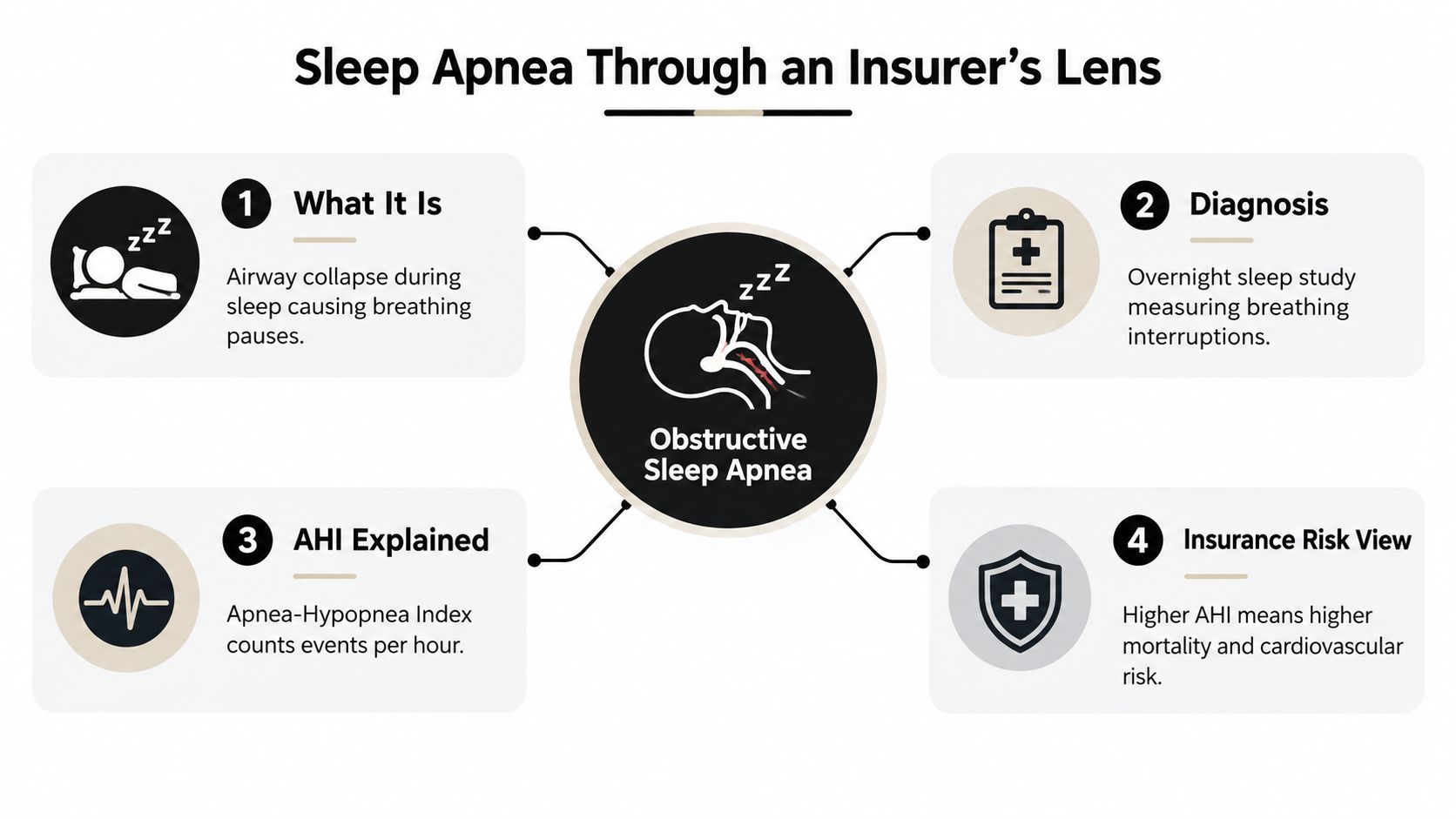
Obstructive sleep apnea happens when the upper airway repeatedly narrows or collapses during sleep. Breathing pauses or becomes shallow, then the body responds by briefly disturbing sleep. Many people don't remember those interruptions, but a sleep study can record them.
AHI turns breathing interruptions into a usable measure
The central number is the apnea-hypopnea index, or AHI. It counts the average number of apnea and hypopnea events per hour of sleep. A few slowdowns may be manageable, while repeated closures create a much more serious pattern.
Clinical classifications commonly divide OSA into these bands:
- Mild OSA: AHI from 5 to fewer than 15 events per hour.
- Moderate OSA: AHI from 15 to fewer than 30 events per hour.
- Severe OSA: AHI of 30 or more events per hour.
The clinical classification of OSA severity uses these AHI thresholds. An insurer uses the same general framework as a starting point, then considers the rest of the medical record.
Diagnosis doesn't always require dramatic symptoms. Clinical criteria can support an OSA diagnosis with an AHI of at least 5 events per hour when a symptom or related condition is present. An AHI of at least 15 events per hour can be sufficient even without symptoms. The diagnostic algorithm explains how AHI and symptoms are considered together.
Oxygen data adds context to the AHI
Two applicants can have similar AHI results but different oxygen patterns. Underwriters may review the lowest oxygen saturation, sometimes called the oxygen nadir, and the amount of sleep spent below 90% oxygen saturation. One insurer-facing summary says underwriters may look for oxygen saturation of 80% or higher, while cardiovascular guidance also highlights the nadir and time below 90% as useful measures. This life-insurance underwriting overview discusses oxygen saturation in the context of sleep apnea.
That's why sending only a diagnosis or prescription may leave important questions unanswered. The sleep-study report shows the pattern, not just the label. If the report includes AHI, oxygen measurements, physician interpretation, and treatment recommendations, the underwriter has stronger evidence for placing your risk in the right category.
Some people use an oral appliance rather than CPAP. If that's your route, a sleep professional or dentist can help document whether it controls the condition. Applicants researching a dental appliance for sleep apnea should also ask how follow-up testing will verify that the treatment works.
How Life Insurance Underwriting Evaluates Sleep Apnea
Underwriting works like a file review with several layers. The underwriter begins with the sleep study, then checks whether treatment is working, whether you're following it, and whether other conditions increase the overall risk. A clean, recent, well-organized file can answer those questions faster than scattered records.
The records that carry the most weight
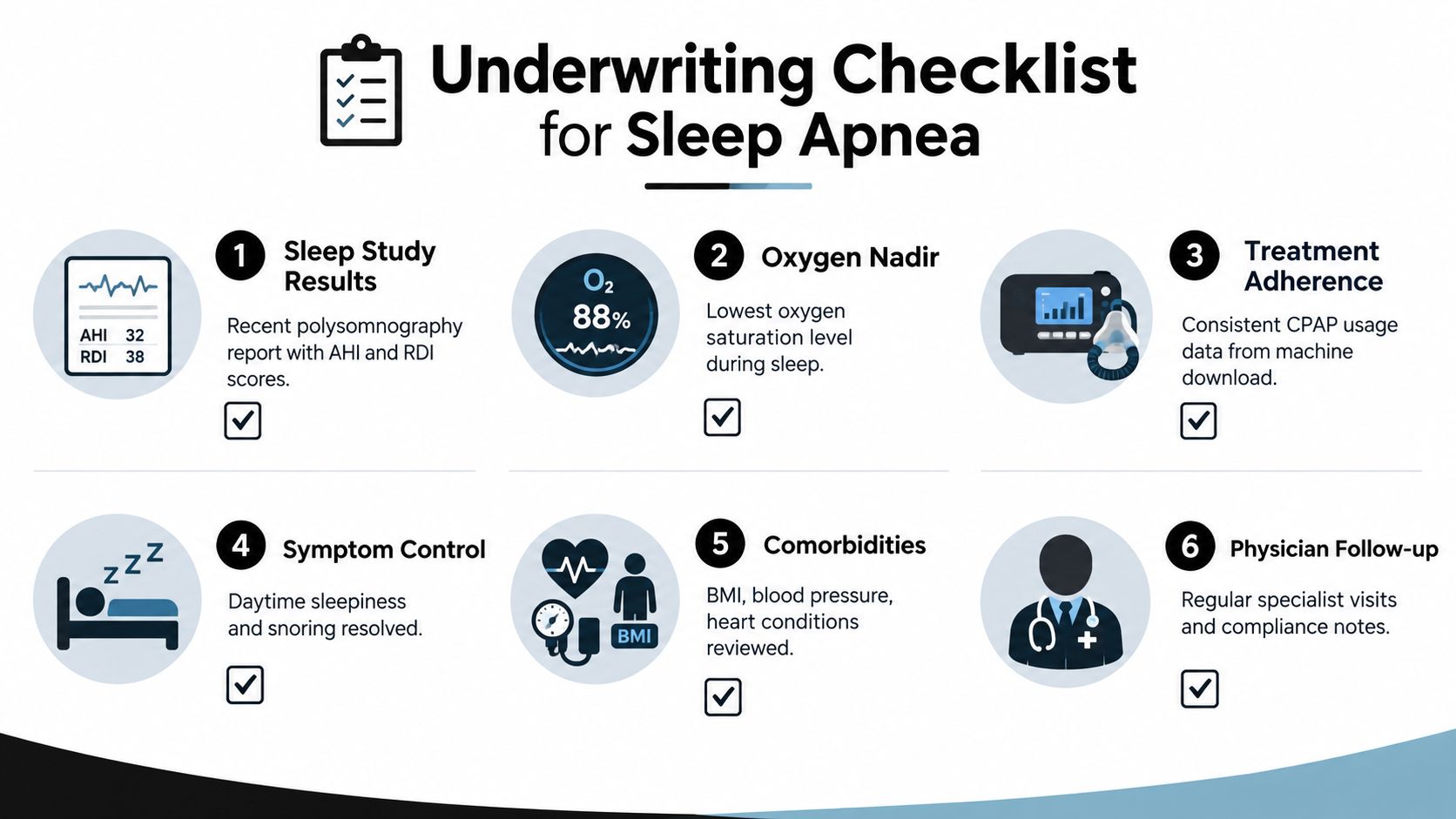
Start with the original sleep-study report. It may be a laboratory polysomnogram or a home sleep test. Underwriters commonly focus on the AHI or RDI, oxygen nadir, time below 90%, physician interpretation, and whether the result describes obstructive, central, or mixed events.
Treatment evidence comes next. A CPAP prescription shows that treatment was recommended. A downloadable compliance report shows whether you're using the device and whether the therapy is controlling the events. The report may include usage patterns, residual AHI, and mask-related information. For underwriting purposes, machine-generated evidence is often more persuasive than a general statement that you use CPAP regularly.
Follow-up timing matters too. A diagnosis with no established treatment history leaves uncertainty. A recent specialist note can show that the treatment remains effective, symptoms are controlled, and the clinician is monitoring the condition.
Practical rule: Ask your sleep clinic for the complete sleep study, the latest treatment note, and a CPAP usage download before you submit an application.
Health factors change the interpretation
Sleep apnea rarely gets reviewed in isolation. Underwriters may examine hypertension, diabetes, obesity, and depression, along with cardiovascular history and daytime symptoms. Blood-pressure control, weight management, and the absence of functional impairment can help create a more complete risk picture.
The underwriter is also looking for direction. Is the condition improving, stable, or poorly controlled? Are you attending follow-up appointments? Does the treatment plan match the severity shown on the study? Those details help distinguish a managed condition from an unresolved one.
For a broader medical perspective before applying, some applicants may find it useful to find a total health dentist in Ohio who can discuss oral health and possible sleep-related treatment pathways. That consultation won't replace a sleep physician's records, but it may help clarify which treatment documentation you need.
A useful overview of the broader underwriting process is available in this guide to life insurance underwriting. The same principle applies here: the insurer prices the documented risk, not merely the name of the diagnosis.
The following video can help applicants understand why treatment and follow-up records matter during review.
Severity Treatment and How They Change Your Rating
A sleep apnea diagnosis is only the starting label. Underwriters also score the condition's severity, treatment response, and stability over time. Mild OSA with reliable treatment creates a different file from severe OSA without treatment, even when both applicants use the same diagnosis on an application.
The sleep study supplies the first set of markers. AHI shows how often breathing is disrupted, while oxygen data shows how profoundly those events affect the body. An underwriter may also compare the original study with current records to see whether treatment matches the measured severity.
A 2022 survey of life insurance companies found that about 10 companies handled applicants using CPAP the same as healthy individuals, while many others still treated them differently. The survey and related underwriting discussion show the industry's move toward more individualized decisions.
Treatment records add the time dimension. A CPAP compliance download can show whether the machine is being used consistently, while follow-up notes can show whether symptoms and related health concerns are controlled. In a nationwide French database study, continuing CPAP was associated with lower all-cause mortality risk than stopping treatment, with a hazard ratio of 0.61, a 95% confidence interval of 0.57 to 0.65, and an approximate 39% relative reduction in death risk among continuers compared with terminators.
A separate cohort of 888,835 older adults with OSA linked PAP initiation with a lower all-cause mortality hazard ratio of 0.53 and a major adverse cardiovascular event hazard ratio of 0.90. The cohort findings are reported in PubMed. These results do not guarantee a particular insurance class, but they help explain why insurers request evidence of ongoing treatment.
Comparison table
| Severity and Treatment Status | Typical Underwriting Outcome |
|---|---|
| Mild, well-managed OSA with documented adherence | Preferred or standard-plus treatment may be available at some carriers. |
| Mild OSA without established treatment | The insurer may apply a rating or request more evidence before offering its best class. |
| Moderate OSA with consistent CPAP or effective alternative treatment | Coverage may be available, with the final class depending on compliance, oxygen data, and other health factors. |
| Moderate OSA without reliable treatment | Table ratings become more likely because the risk appears uncontrolled. |
| Severe OSA with strong treatment evidence and controlled related health | Coverage may still be possible after detailed review. |
| Severe untreated OSA or poor adherence with significant comorbidities | A rating of 150% to 250% or a decline may occur, depending on compliance and comorbidities. |
An oral appliance follows the same principle. Owning the device does not show that it controls OSA. A follow-up evaluation or sleep-study result can connect the treatment to measurable improvement. Information about dental sleep apnea treatment with insurance help may help you prepare questions for your dental and sleep-care providers.
How to Prepare and Improve Your Chances for Approval
Preparation gives the underwriter fewer reasons to pause your application. You can't change the AHI recorded in an old sleep study, but you can show how the condition is being managed today.
Build your evidence before applying
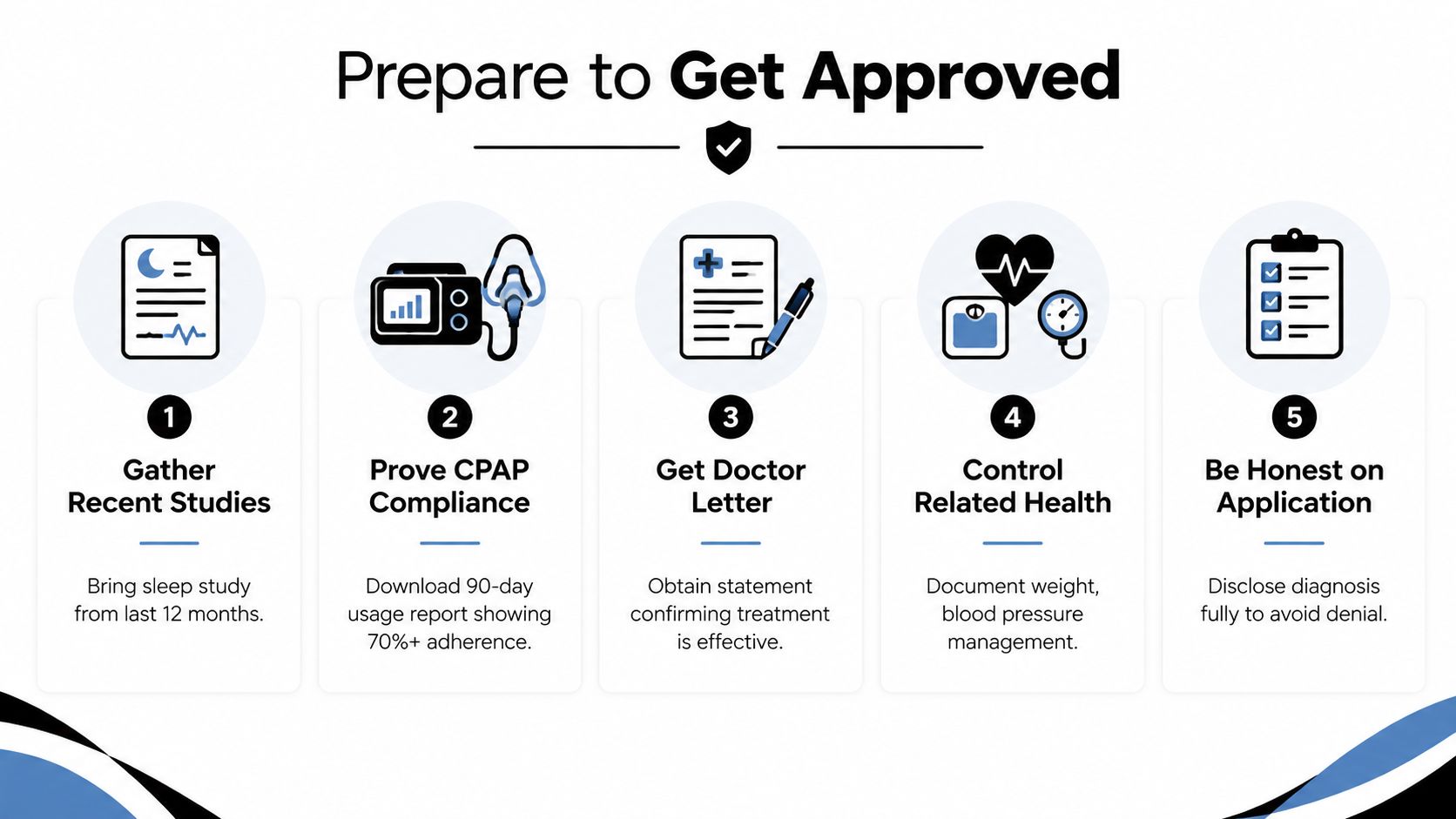
Collect the sleep-study report. Keep the pages showing AHI, RDI, oxygen nadir, time below 90%, and the physician's interpretation. A summary diagnosis alone may not answer the insurer's questions.
Request a CPAP download. Independent guidance commonly points to usage of at least 4 hours per night on 70% of nights as a proof point for adherence. This underwriting guidance describes that compliance benchmark. Ask the equipment provider or sleep clinic for a current machine report.
Document follow-up. A recent note can confirm that treatment is effective, symptoms are controlled, and you're following medical advice. If you use an oral appliance, ask whether a follow-up sleep study is needed to demonstrate effectiveness.
Organize related health records. Keep current information about blood pressure, diabetes, weight management, and any cardiovascular or mental-health conditions. Underwriters evaluate the combined picture, so improvements in related health can matter.
Answer every disclosure fully. Don't omit a diagnosis because symptoms feel minor. Incomplete information can create delays or problems with policy validity later.
Choose the application route thoughtfully
A digital or no-exam application can work well for some applicants with straightforward, well-documented histories. It may not eliminate health questions, and an insurer can still request records or additional evidence. Before choosing a product, understand the difference between a simplified process and a policy with full medical underwriting.
If a medical exam is part of the application, review this guide to life insurance medical exams so you know what information and records may be requested. If your case includes severe apnea, recent diagnosis, inconsistent treatment, or several comorbidities, an independent broker can help identify a suitable carrier before you apply.
Timing can matter. Applying after treatment has become stable gives the insurer a longer record to assess than applying immediately after diagnosis. Don't delay needed medical care just to pursue insurance, but do coordinate your application with your treating team and keep your documentation current.
Real World Scenarios and What They Mean for Your Premium
The same diagnosis can produce different underwriting results because insurers evaluate the surrounding facts. The examples below are illustrative profiles, not guaranteed quotes or promises from a particular carrier.

A mild diagnosis with consistent treatment
Maya is a young professional with mild OSA. Her sleep-study report includes the AHI and oxygen results, and her CPAP download shows regular use. Her follow-up note says daytime symptoms have improved, and she has no major related health concerns.
An insurer may view Maya's file as controlled and well documented. Some carriers could consider preferred or standard-plus treatment, while another may use a more conservative class. Her advantage isn't merely that the apnea is mild. It's that her records show stable treatment and a clear response.
Moderate OSA with no treatment history
Jordan received a moderate OSA diagnosis recently but hasn't started the recommended treatment. He feels functional during the day, so he assumes the diagnosis won't affect his application.
The missing treatment history creates uncertainty. An underwriter may postpone the decision, request more records, or offer a higher rating. Jordan's next best step is to follow the prescribed plan and build objective evidence of control before applying, unless his family's coverage needs make an earlier application necessary.
Severe OSA with strong adherence
Elena has severe OSA, but she uses PAP consistently and has current specialist follow-up. Her blood pressure is controlled, and her file includes a recent download and physician comments about treatment effectiveness.
Severe disease will still receive close review. However, Elena has addressed the factors that make the file harder to evaluate. She may be insurable, although her final class depends on oxygen data, residual events, comorbidities, age, tobacco history, and the carrier's rules.
Moderate OSA with additional health concerns
Chris has moderate OSA, inconsistent treatment, and poorly documented blood-pressure management. The insurer sees several unresolved questions rather than one isolated diagnosis.
Chris may face a more heavily rated offer or a postponement. Better records and consistent care can strengthen a later application, but no applicant should assume that documentation alone erases active medical risk. The insurer needs evidence that the overall profile is moving in a safer direction.
What these profiles have in common: Underwriters compare the medical label with the current evidence. Treatment stability can improve the story, while missing records and unmanaged related conditions can weaken it.
Your Next Steps to Affordable Coverage With Sleep Apnea
Affordable coverage may still be within reach when sleep apnea is treated and documented. The strongest files connect four facts: how severe the condition is, how well treatment works, whether the applicant follows the plan, and whether related health risks are controlled.
Before requesting quotes, prepare:
- Your sleep-study report with AHI, RDI, and oxygen information.
- A current CPAP compliance download, or follow-up evidence for an oral appliance.
- Recent specialist notes that describe treatment effectiveness.
- A list of related conditions and current medications.
- A clear timeline showing diagnosis, treatment, and follow-up.
If you need coverage quickly, ask how a simplified-issue life insurance application handles sleep-apnea disclosures and whether additional records could be requested. If your history is complex, an independent professional can help you compare underwriting approaches before submitting a formal application.
Don't describe your health only as “I have sleep apnea.” Explain the full story accurately: your severity, treatment type, adherence, recent results, and current follow-up. That gives the insurer the information it needs to distinguish a controlled condition from an unmanaged one.
Young families and professionals don't need a perfect medical history to protect the people who depend on them. They need a realistic coverage strategy and organized evidence. Sleep apnea can change the underwriting conversation, but it doesn't automatically end it.
Coveredly offers digital term life insurance designed to make applying simpler, with no-exam options available for most applicants seeking up to $3 million in term coverage. Visit Coveredly to explore coverage options and start with your sleep-apnea details, treatment records, and family protection needs ready.