Many middle-aged households carry life insurance that looks adequate on paper and falls short in practice, and the gap shows up most often for the spouse who does not earn a paycheck. Couples insure the income and skip the unpaid work, even though replacing childcare, transportation and day-to-day household management would cost real money every month.
The policy existed. The money was not enough.
That gap is the core question of spousal life insurance. Owning a policy and owning enough of one are different things, and the difference only surfaces after a death, when the survivor needs the payout to keep the same house, the same childcare and the same choices. Getting that number right takes a little arithmetic and an honest accounting of what each spouse contributes, paid or unpaid.
Table of Contents
- Spousal Life Insurance Options Side by Side
- Why a Non-Earning Spouse Still Needs Coverage
- Calculating the Coverage Gap for Your Household
- Joint Policies or Separate Policies for Couples
- Tax, Ownership and Beneficiary Rules to Check
- Confirm Your Spousal Coverage and Get Quotes
Spousal Life Insurance Options Side by Side
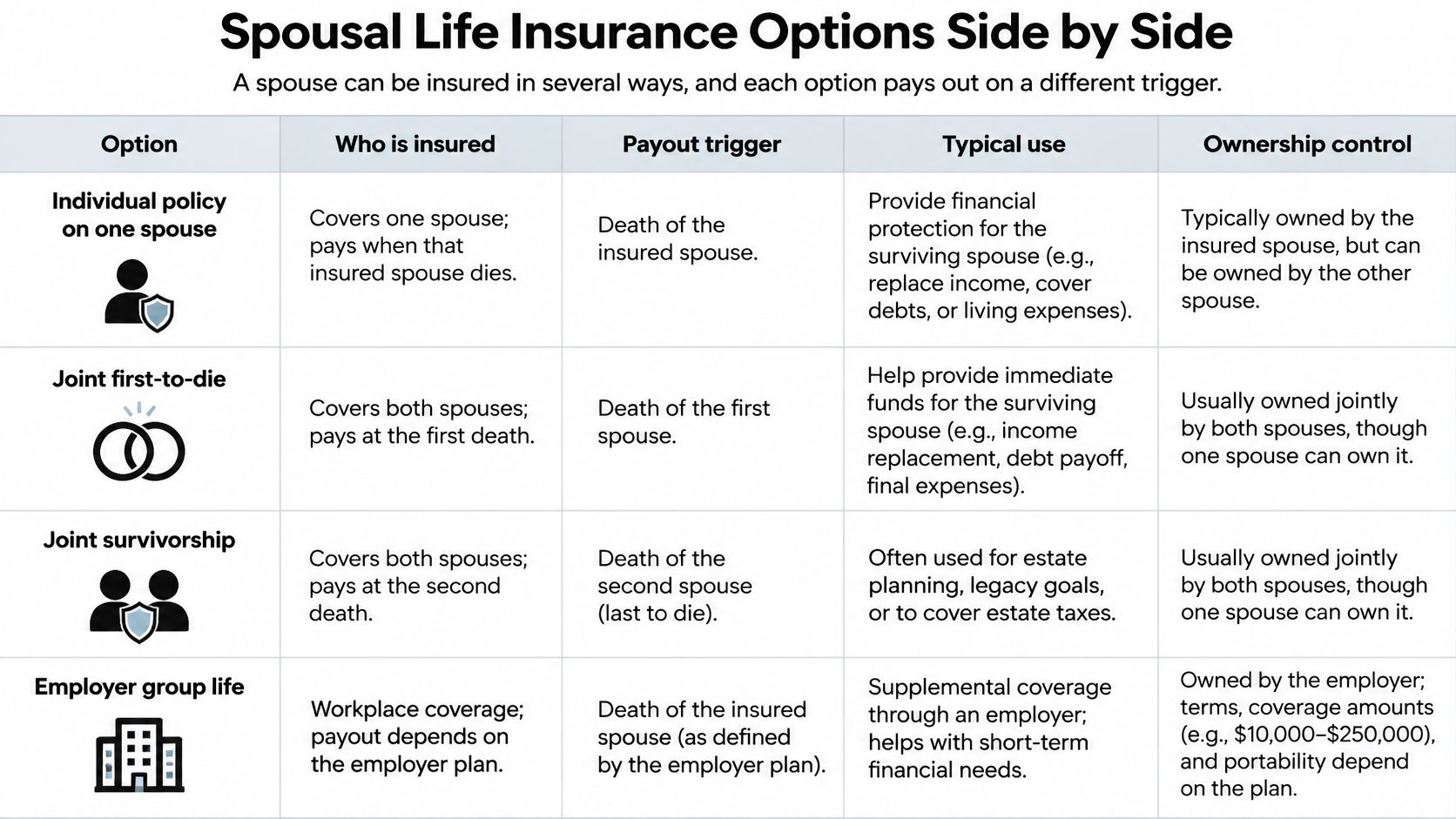
A spouse can be insured in several ways, and each option pays out on a different trigger. Getting that trigger right matters more than the name on the brochure, because the wrong structure can leave the survivor uncovered at the exact moment the money is needed.
| Option | Pays out when | Usual policy type | Best fit |
|---|---|---|---|
| Individual term on each spouse | The insured spouse dies | Term | Two earners with separate needs |
| Joint first-to-die | The first spouse dies | Usually permanent | One budget and one simple payout |
| Survivorship (second-to-die) | Both spouses have died | Usually permanent | Estate planning and final expenses |
| Spousal rider | The insured spouse dies | Added to the other's policy | Adding a non-earning spouse at low cost |
| Employer group coverage | The employee dies while employed | Usually term | A basic layer, not full protection |
Read the table with one habit: decide what you want the money to do before you compare prices. If both partners earn and each would need to rebuild income after the other's death, a separate term policy on each of you is the usual starting point, because each one pays on its own schedule and neither cancels the other. A joint life insurance policy pays once, at the first death, from a single premium, which suits a couple who wants one simple payout and understands that cover ends there. A second-to-die policy pays only after both partners have died, so it belongs in estate planning rather than income protection. A spousal rider attaches the non-earning partner to the other's policy, often for a modest extra premium, and group cover through an employer is a layer, not a plan, because it usually stops when the job does.
Term life insurance for couples versus permanent cover
Term life insurance runs for a set period, 20 years being the common example, and pays only if you die inside that window. It's the most popular and affordable type because it provides pure protection with no investment component. Permanent cover lasts your whole life and costs substantially more; couples choose it for specific reasons such as estate planning or a lifelong dependant, not as a default.
What the coverage is actually protecting
A National Bureau of Economic Research analysis of federal tax returns, W-2 wage records, Social Security data and retirement-income records from 1999 to 2011 found that household income fell by about $25,000 on average after one spouse died, or roughly $5,500 per person once adjusted for household size. Survivor benefits soften the shock without closing it: each additional $1 of Social Security survivor benefits was associated with about $0.93 in total household income, and those benefits don't cover childcare, a mortgage, education or the value of unpaid household work.
A quick test before you read on. If both partners earn, separate policies usually fit. If one partner runs the home, the right number may be larger than the paychecks suggest.
Why a Non-Earning Spouse Still Needs Coverage
Most guidance sizes a policy around the main earner's paycheck. That framing misses the biggest cost a family faces when a stay-at-home parent dies: buying the work that person was doing for free.
The gap shows up in who holds cover. LIMRA's 2025 U.S. data shows that only 48% of women report having life insurance, compared with 54% of men, and 40% of women believe their family would be barely or not at all financially secure if the primary wage earner died, according to the Coverage Gap 2026 analysis. Coverage decisions are still being made as though one salary is the only thing at risk.
The costs with no salary line
A stay-at-home or lower-earning spouse's death triggers expenses that never appear on a payslip. Childcare and after-school care, housekeeping, meal preparation, driving children to appointments, coordinating care for an ageing parent, and the survivor's own reduced hours all land at once. Price them the way you'd price a contractor's quote.
| Service | What it replaces | How to estimate the cost |
|---|---|---|
| Childcare and after-school care | Daily care while parents work | Weekly care hours times local hourly rate, or annual center or after-school fees |
| Housekeeping and meal preparation | Unpaid household work | Hourly cleaning rate times weekly hours, plus meal costs |
| Transportation and errands | Driving children and running household tasks | Mileage plus paid driving time per week |
| Elder-care coordination | Appointments and family care arrangements | Hours per month times local hourly rate |
| Survivor's lost work flexibility | Reduced hours or a career pause after the death | Annual income gap over the years the survivor works fewer hours |
Add the rows that apply to your family and you have an annual figure, not a lump sum. That distinction matters later.
Practical rule: anything the surviving partner would have to pay someone else to do counts as a need, whether or not the person doing it today earns a salary.
When the lower earner dies
Dual-income households run into the same trap from a different angle. The smaller salary looks replaceable until you notice the second income also funded the flexibility that made childcare work: the early finish, the sick day, the school pickup. Remove that person and the survivor often buys back the time with money, through paid care or lost hours. Model each spouse separately instead of buying one large policy on the breadwinner and hoping it stretches. If you want a deeper walkthrough of the stay-at-home case, this guide to life insurance for stay-at-home parents covers the same arithmetic.
Calculating the Coverage Gap for Your Household
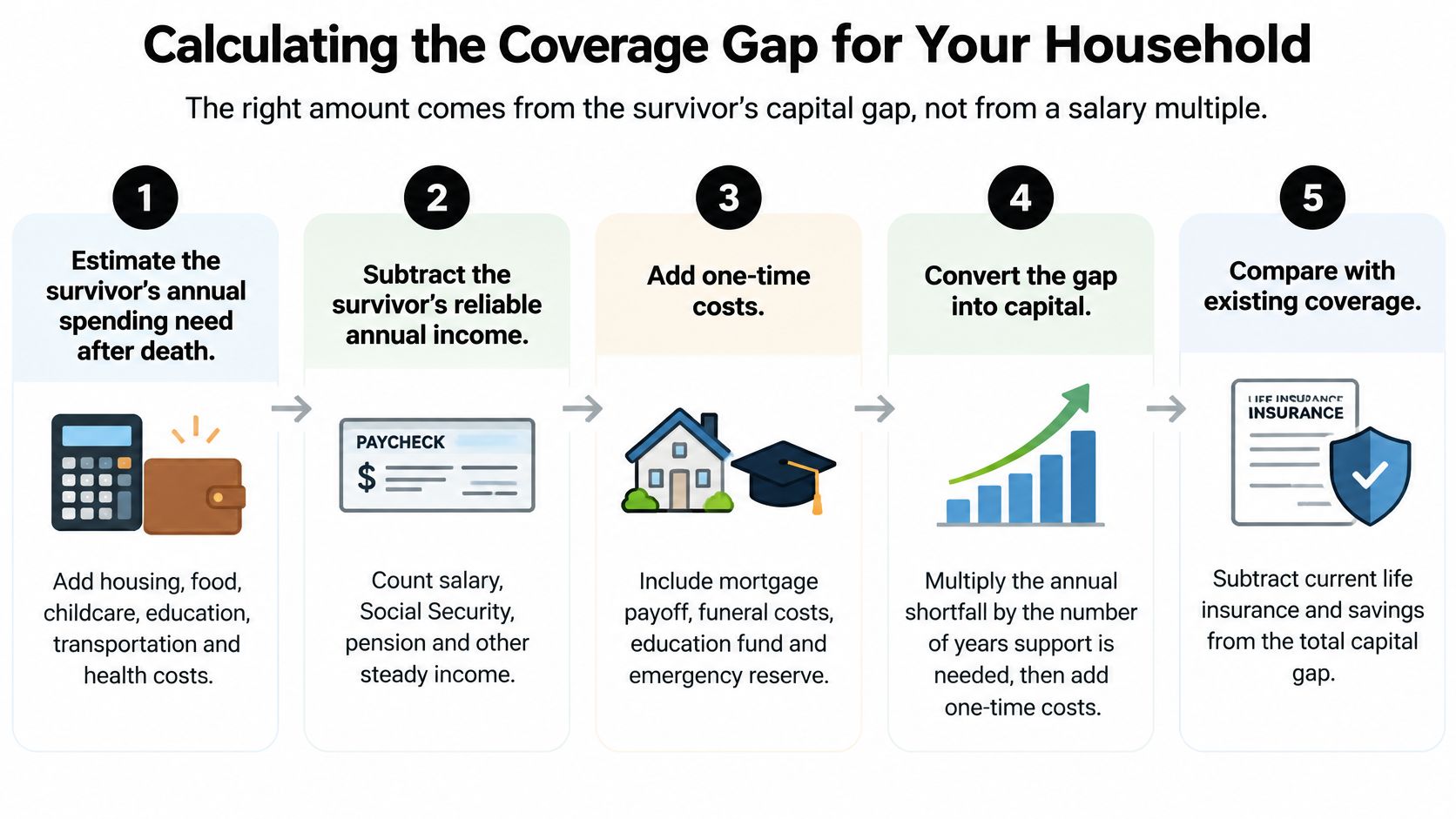
The right amount of spousal life insurance is a capital shortfall, not a salary multiple. You estimate what the survivor needs each year, work out how much capital would fund that spending, add the one-time obligations, then subtract what's already there, as this needs calculation framework sets out.
Six steps to the shortfall
- Estimate the survivor's annual spending need after the death, using the replacement costs from the previous section.
- Set the number of years that support is required. For young families the horizon can run through a child's dependency period or longer.
- Convert the spending stream into present capital with explicit assumptions for inflation and investment return.
- Add immediate liabilities and one-time goals, such as mortgage repayment, other debts and education funding.
- Subtract liquid assets, existing individual and employer policies, and Social Security survivor benefits.
- The remainder is your coverage shortfall. That's the number to insure.
Step five deserves care, because some obligations are fixed by formula rather than by choice. Where a court has ordered child support, the payment stream is a real line item, and the 2026 Texas support percentage guidelines show how one state converts income into a set monthly figure. Whatever your state's rules, treat ordered payments as a funded obligation rather than a loose end.
A worked example
Say the survivor needs $40,000 a year for 15 years and you assume a 3% real return. That spending stream needs roughly $477,000 of capital today. Add a $300,000 mortgage and $100,000 for education and the need reaches $877,000. Take away $250,000 of savings and a $100,000 group policy and you're left with a gap of about $527,000.
| Line item | Amount |
|---|---|
| Income replacement capital ($40,000 a year for 15 years at 3% real return) | $477,000 |
| Mortgage repayment | $300,000 |
| Education funding | $100,000 |
| Subtotal of needs | $877,000 |
| Less savings | -$250,000 |
| Less existing policy | -$100,000 |
| Coverage shortfall | $527,000 |
A multiplier gives you a number. A capital calculation gives you one you can defend, line by line, when someone asks why.
Cross-checking against the income guideline
The familiar guideline of 10 to 15 times annual income is a sanity check, nothing more. Run it after the shortfall so you can see whether your answer sits in the same neighbourhood; if it's wildly different, find out why before you buy. Coveredly helps tailor coverage to each situation when the two numbers disagree.
When to rerun the numbers
Rebuild the calculation after marriage, after a childbirth, after a home purchase, after a job change, and whenever liquid assets build up meaningfully. Each of those events moves at least one line in the table. A life insurance needs analysis run on a schedule beats a one-off guess made in your twenties.
Joint Policies or Separate Policies for Couples
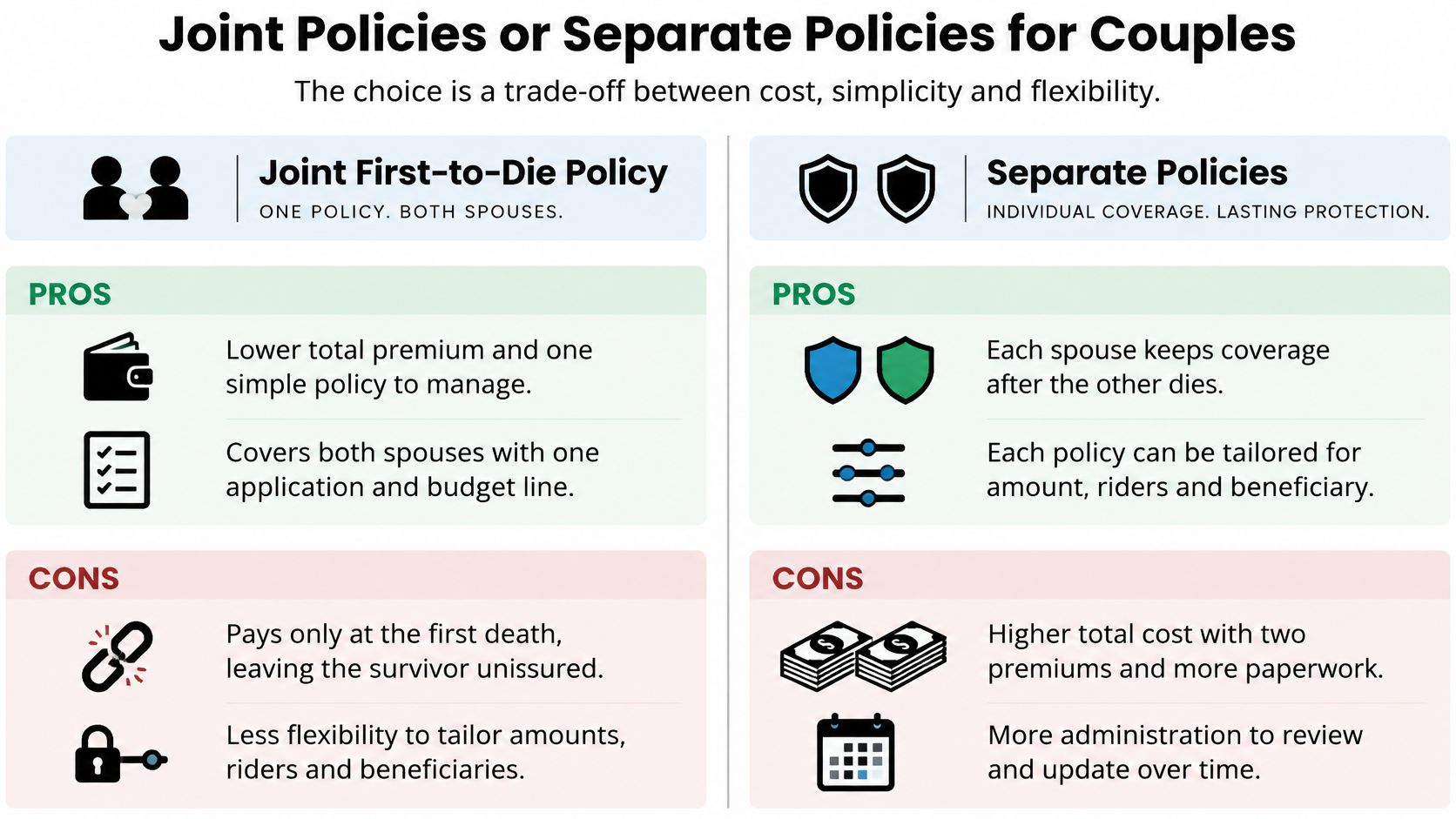
Knowing what each structure does leaves a simpler question: which one fits your household budget and your appetite for paperwork? The choice is a trade-off between cost, simplicity and flexibility.
What a joint first-to-die policy gives and takes
- One premium, one budget line: a single payment covers both partners and is easy to track.
- One payout only: the policy pays at the first death and then ends, leaving the survivor uninsured at an older age and a higher rate.
- Less room to tailor: one shared benefit amount makes it harder to size cover to each person's separate gap.
- Higher premiums than term: these contracts are usually permanent, and whole life insurance covers the insured for life with a cash value that grows over time at premiums significantly above term rates.
What separate policies give and take
- Cover survives the first death: the survivor's own policy stays in force, so there's no scramble to requalify.
- Each policy fits one person's gap: the non-earning partner can carry a large amount while the earner carries a smaller one.
- Cheaper for the same protection: term pricing on two individual policies is usually lower than one permanent joint contract.
- Two of everything: two applications, two premiums and two sets of beneficiaries to review.
Underwriting is where the comparison can flip. One partner's health history doesn't have to set the other's price, and many carriers offer flexible underwriting options for people with pre-existing conditions. A partner with a managed condition should get individual quotes before accepting that a joint policy is the cheaper route.
Three questions that settle it
- Price the same total cover both ways. Compare two term policies adding up to your combined shortfall against one joint contract with a matching benefit.
- Check each partner's individual shortfall. If the two numbers differ by a wide margin, a shared benefit will over-insure one person and under-insure the other.
- Ask about conversion before signing. A policy you can convert or adjust later is worth more than a slightly cheaper one you're locked into.
Two earners with different needs usually end up with separate term policies. A couple with a single budget who want one payout and no second decision tend to pick the joint contract, and should plan for the survivor's cover separately.
Tax, Ownership and Beneficiary Rules to Check
Start with the rule that makes the money usable. For a spouse named as beneficiary, the death benefit is generally excluded from gross income, whether the beneficiary is a family member or someone else, according to IRS Publication 559. The full face amount can go to the mortgage, childcare, education, debts or replacing income without being trimmed by ordinary income tax.

That treatment is why the coverage gap calculation treats the whole death benefit as deployable capital. It doesn't mean every insurance-related transfer escapes tax, and it doesn't settle who owns the policy.
Five checks before you sign
- Confirm the policy wasn't transferred for value. If it changed hands in a reportable policy sale, part of the benefit can become taxable. Bring the ownership history to your adviser.
- Compare a lump sum with installments. Interest earned when the insurer pays in installments can be taxable, so ask for both illustrations and compare them after tax.
- Match owner and beneficiary forms to your will and any trust. The insurer pays the person named on its own form, so an outdated designation can override what your will says.
- Review estate-tax exposure. The income-tax exclusion doesn't make every insurance transfer tax-free, and larger estates need a separate look.
- Confirm who owns the policy. Ownership decides what happens if the owner dies first or the couple divorces, so read that page of the contract rather than the sales summary.
If you'd rather hear the ownership question explained aloud before you sign anything, this walkthrough covers how the policy sits inside an estate.
These rules are U.S.-specific. Review them with a qualified tax professional, and read up on whether life insurance is part of an estate before you assume the payout sits outside it.
Confirm Your Spousal Coverage and Get Quotes
Three moves turn the arithmetic into a decision you can act on.
- Run the shortfall calculation separately for each spouse. Two numbers, not one, even if the second looks small against the first.
- Pick the structure that matches the results. Separate term policies for two earners with different needs, a joint contract for a single budget.
- Request quotes on identical terms. Same coverage amount, same term length, so the comparison is real rather than a headline monthly price.
Before you request anything, gather the inputs each quote depends on: annual spending need, years of support, mortgage balance, education goal, liquid savings, and existing individual and employer policies. Quotes move with age, health and coverage amount, so identical terms are the only fair test. Ask each provider whether the policy can be converted later, because that changes what you're buying.
In 2025, 60.4% of married couples surveyed reported having life insurance, according to Insurancy's Life Insurance Consumer Report. For most households the open question is no longer whether a policy exists but whether the amount matches the gap.
That's where we can shorten the process. Coveredly offers term life insurance with no medical exam for policies up to $3 million, and coverage can be raised or lowered as life changes without starting over. Bring both shortfall figures and your matched quotes to a licensed agent or adviser, then rerun the numbers at the milestones above: marriage, a new child, a home purchase, a job change or a jump in savings.
Two numbers, one for each spouse, are all you need to start: run the shortfall, then see what covering that gap costs. Coveredly offers online term life insurance for couples, with coverage up to $3 million and no medical exam for most applicants, and many policies start as low as $15 to $30 a month depending on age, health and coverage amount. Visit Coveredly to get quotes for both of you on identical terms and turn the arithmetic into a decision.