You've barely finished sorting wedding paperwork when another decision lands on the kitchen table: life insurance. Maybe you've signed a mortgage, started planning for a baby, or realized that your employer benefits wouldn't stretch far if either of you died. The difficult question isn't just who earns more. It's what the surviving partner would need to keep the household running.
Spouse term life insurance starts with that practical question. Think of it as a plan for replacing the money, care, and time each partner contributes, not just a policy for the person with the larger paycheck.
Table of Contents
- Why Spouse Coverage Deserves a Real Conversation
- How Term Life Insurance Actually Works
- Individual Policy vs Spouse Rider vs Joint Policy
- How Much Coverage Each Spouse Actually Needs
- What Drives the Cost of Spouse Term Coverage
- The Stay-at-Home Spouse Is Not a Free Coverage Slot
- Keeping Coverage Aligned as Your Life Changes
- Your Decision Checklist and Common Spouse Coverage Questions
Why Spouse Coverage Deserves a Real Conversation
The first useful conversation isn't about insurers. It's about an ordinary weekday: who earns the income, handles school pickup, manages bills, and helps relatives? If either spouse disappeared from that routine, the survivor would need both breathing room and a workable budget.
For a newly married couple, financial dependence can be easy to underestimate. You might still keep separate bank accounts while sharing rent, debt payments, or plans that depend on both of you. Separate finances don't necessarily mean separate financial consequences.
Start with the household, not the salary
Try answering these questions together before requesting quotes:
- What would stop coming in? Identify earnings and benefits the household relies on.
- What would become a purchased service? Consider care, transportation, cleaning, and household administration.
- What would the survivor change? Discuss whether they'd reduce working hours, move, or need time away from work.
Don't assume the answers will be symmetrical. A higher earner and a lower-earning caregiver may create different financial gaps, but both gaps deserve attention.
Practical rule: Size protection around what the household would lose, not around whose paycheck looks larger.
Understand the structural choices
You can consider individual term policies, a spouse rider attached to an existing policy, or joint coverage. Those labels describe different arrangements, not interchangeable ways to buy the same protection.
Individual coverage lets you evaluate each spouse separately. A rider connects spouse coverage to another policy. A second-to-die joint policy serves a different purpose because it delays payment until both insured people have died.
The reason to discuss this now is straightforward: your shared obligations already exist, even if your insurance plan doesn't. Until coverage becomes active, the household must rely on its current resources.
You don't need a perfect prediction of your future before making a decision. You need a clear picture of today's responsibilities, a reasonable protection period, and a commitment to revisit the arrangement when your lives change.
How Term Life Insurance Actually Works
Term coverage is like renting a financial safety net for a defined stretch of time. You're paying for protection during that period, rather than buying an asset intended to accumulate savings.
The NAIC's consumer life insurance guide defines term life insurance as coverage purchased for a particular term, with benefits payable to named beneficiaries only if the insured dies while the policy remains in force. An ordinary term policy doesn't build the cash-value component associated with permanent insurance.
The visual below separates the main parts of that arrangement.

Read a quote as a set of promises
A quote becomes easier to understand when you separate the amount of protection from the conditions for keeping it.
| Term | What it means for your household |
|---|---|
| Premium | The payment required to maintain coverage under the contract |
| Death benefit | The amount payable on a covered claim |
| Term length | The selected coverage period |
| In force | The policy is active, rather than expired or lapsed |
The death benefit isn't a household savings account you can assume will eventually be paid out. The insured person must die during the covered period while the policy is active, subject to its terms.
For couples, that makes the policy's end date as important as its face amount. A 20- or 30-year term can be considered alongside a mortgage or the years until a child becomes financially independent. The appropriate choice depends on your actual timeline, not the most familiar option on a quote screen.
Ask what happens at the end
When the selected term ends, don't assume protection continues unchanged. Review any renewal provisions, including future premiums, and any conversion rights, which may allow a move to permanent coverage under specified conditions.
Ask the insurer to identify the relevant deadlines and restrictions in writing. An option that exists in the contract may still require action before a particular date.
A useful quote review therefore asks more than “Can we afford this payment?” Ask how long that payment applies, when coverage ends, and what choices remain afterward. Those details help you distinguish affordable protection from a short-lived arrangement that leaves an important obligation uncovered.
Individual Policy vs Spouse Rider vs Joint Policy
Choose the structure by asking when your household needs money. A surviving spouse who needs help with living expenses has a different objective from a couple planning a benefit for heirs after both deaths.
Marriage has long been associated with term coverage. A Federal Reserve Bank of Chicago analysis found that married households were more likely to hold term life insurance than unmarried households, while overall household term-policy ownership fell from 58.1% in 1989 to 50.2% in 2013.
Comparing coverage structures for spouses
| Structure | What it pays | Best for |
|---|---|---|
| Individual term policies | Each policy provides its own benefit when its insured spouse dies during active coverage | Couples who need independently selected amounts, terms, and ownership arrangements |
| Spouse rider | A benefit covering the spouse under a rider attached to a base policy | Households considering administrative simplicity, provided the rider meets their needs |
| Joint second-to-die policy | A benefit after both insured people have died, subject to the contract | Estate or legacy objectives rather than immediate support for the survivor |
With individual policies, each spouse can own their own contract, or ownership can be arranged differently where permitted. Separate contracts also let a couple choose different face amounts and coverage periods.
A spouse rider may simplify administration, but examine its limits. Ask what happens if the base policy ends, whether the spouse benefit is sufficient, and whether any continuation or conversion option applies. Don't treat convenience as proof of adequate protection.
Don't confuse joint with second-to-die
Joint life insurance is a broader category that can include first-to-die and second-to-die arrangements. The second-to-die structure in the comparison above doesn't provide a death benefit to support the surviving spouse after the first death.
Use this guide to joint life insurance to frame questions about the specific payout trigger. Although combined pricing may look attractive, compare actual proposals rather than assuming a joint arrangement is cheaper or equivalent.
Consider a hypothetical household with a working parent and a full-time caregiver. Individually sized policies deserve consideration because each death would create a distinct immediate need. A rider could be an alternative only if its benefit and conditions adequately address the caregiver's contribution.
Now consider a couple whose survivor already has sufficient resources, but who want to leave money after both deaths. Second-to-die coverage may better match that objective, although it isn't a substitute for first-death income protection.
Business owners should separate household needs from business continuity needs. For that additional conversation, key person coverage advice from Bryan Fagan's, from Law Office of Bryan Fagan, PLLC, is a resource to discuss with a business adviser, not a replacement for evaluating personal coverage.
How Much Coverage Each Spouse Actually Needs
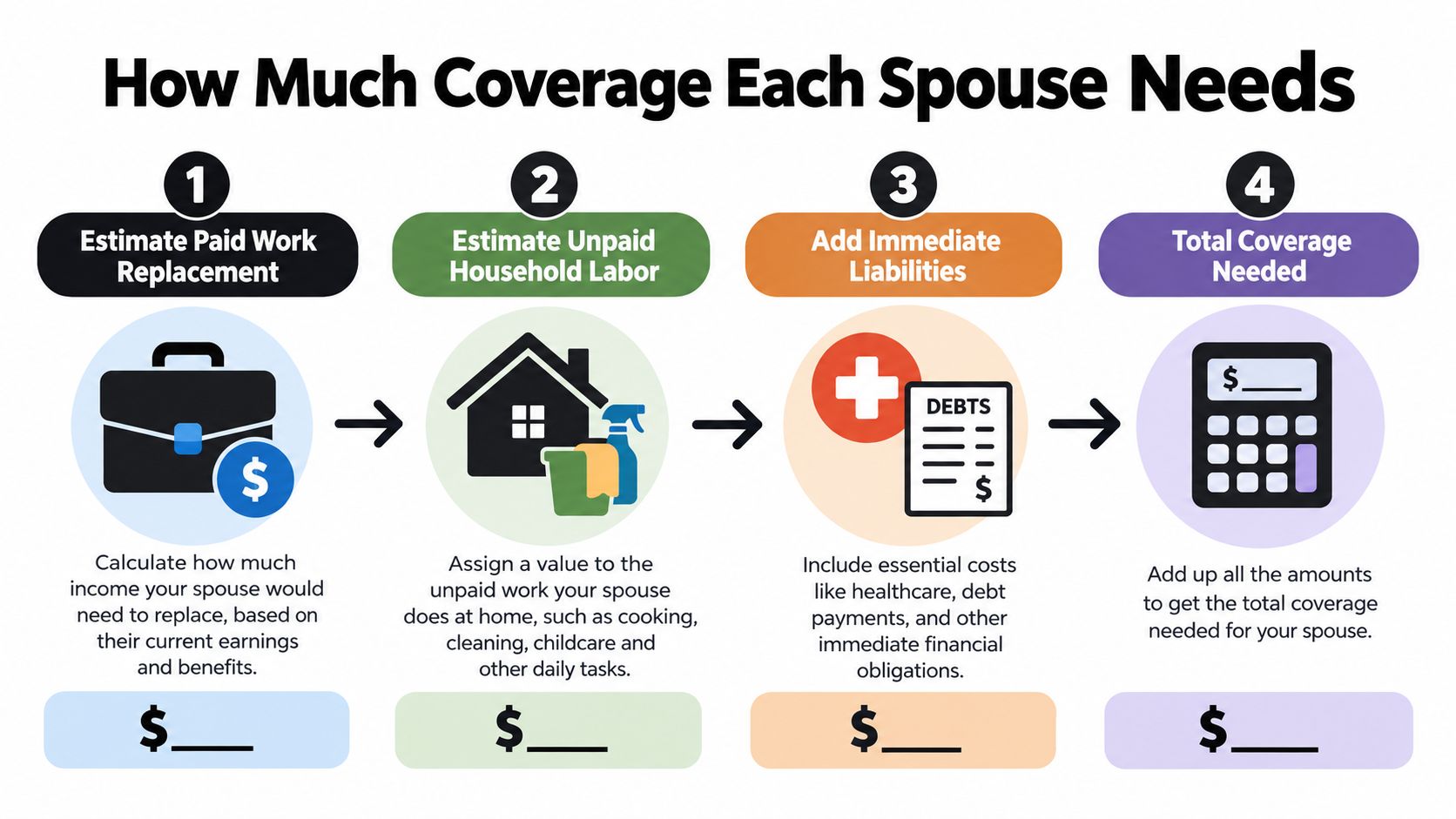
Build a worksheet for each spouse rather than dividing a household target according to earnings. The NAIC's life insurance guidance identifies relevant obligations including income replacement, continuing monthly expenses, childcare, medical and burial costs, debt, and education or housing needs.
Your task is to turn those categories into your household's actual funding gap. Use statements, benefits documents, and local service estimates instead of a generic salary multiplier.
Build the estimate from expenses
Start with the budget the survivor would need, not the deceased spouse's gross salary. Some expenses might disappear, while care costs or reduced earnings could add new pressure.
- Estimate the recurring gap. Compare expected household expenses with the survivor's sustainable income. Include the replacement services identified for the spouse being insured.
- Map the duration. Childcare, education support, and mortgage obligations may end at different times. Estimate each over its relevant period rather than extending every expense indefinitely.
- Add immediate needs. Include outstanding obligations, final expenses, transition costs, and an emergency reserve suited to the household.
- Subtract available resources. Count liquid assets and existing insurance that would be available for these purposes.
Avoid double-counting. If your plan pays off the mortgage immediately, don't also include the same mortgage payments throughout the income-replacement estimate.
Turn a rough total into a defensible target
A planning formula is:
Coverage target = present value of future household shortfalls + immediate obligations + transition reserve − usable assets − existing applicable insurance.
For a first pass, list future expenses in today's money. A financial professional can help refine the present-value calculation and test assumptions about inflation, investment returns, and the survivor's earnings.
Treat employer coverage carefully. Verify the benefit amount and what happens after a job change rather than assuming it will remain available throughout your chosen term.
For a more detailed worksheet, use this guide to calculating how much term life insurance you need. Keep your assumptions beside the result so you can update them without rebuilding the calculation.
Finally, choose a term that reaches the longest material dependency you're trying to protect. That might be the remaining mortgage period, a child's expected independence, or the survivor's planned retirement. A shorter term isn't a saving if it ends before the need does.
What Drives the Cost of Spouse Term Coverage
Don't judge affordability from someone else's premium. Ask for quotes based on each spouse's circumstances and the coverage you've calculated.
Bring your worksheet to the conversation so price doesn't become the only decision criterion.

Separate pricing factors from coverage needs
Underwriting considers factors such as age, health, tobacco use, occupation, and other risk information. The amount of insurance, term length, and contract features also affect the proposal. Answer application questions accurately, and ask which pricing assumptions remain subject to underwriting.
Applying while younger and healthier may offer more favorable pricing than applying later. But no universal waiting-cost estimate applies to every couple, and ownership statistics don't establish how much any applicant will save.
A LIMRA household study found that 71% of husbands owned life insurance compared with 63% of wives, and nearly 40% of Americans wished their spouse or partner had more coverage. That's a reason to check both partners' protection, not evidence for a particular premium.
Compare equivalent proposals
Use a short comparison sheet before deciding:
- Match the benefit and term. A smaller benefit or earlier expiration can explain a lower payment.
- Check premium guarantees. Distinguish the initial payment from what the contract may require later.
- Price the alternatives separately. Compare a rider with an independently sized policy rather than assuming either offers better value.
- Test the household budget. Choose a payment you can maintain through ordinary financial strain.
This video can accompany your review of the policy questions.
You can control the benefit requested, the term selected, and how carefully you compare offers. You can't guarantee future health or future underwriting results. The practical cost of waiting is therefore uncertainty as well as the possibility of a different price.
The Stay-at-Home Spouse Is Not a Free Coverage Slot
A spouse without a paycheck may still make paid employment possible for the other partner. If that spouse dies, the survivor may need to buy services while also taking time away from work.
Fidelity's discussion of term life insurance emphasizes dependence on a person's care or support, not only income, and notes that replacing unpaid work can require childcare and household services.
Use the categories below as prompts, then obtain estimates appropriate to your location and circumstances.
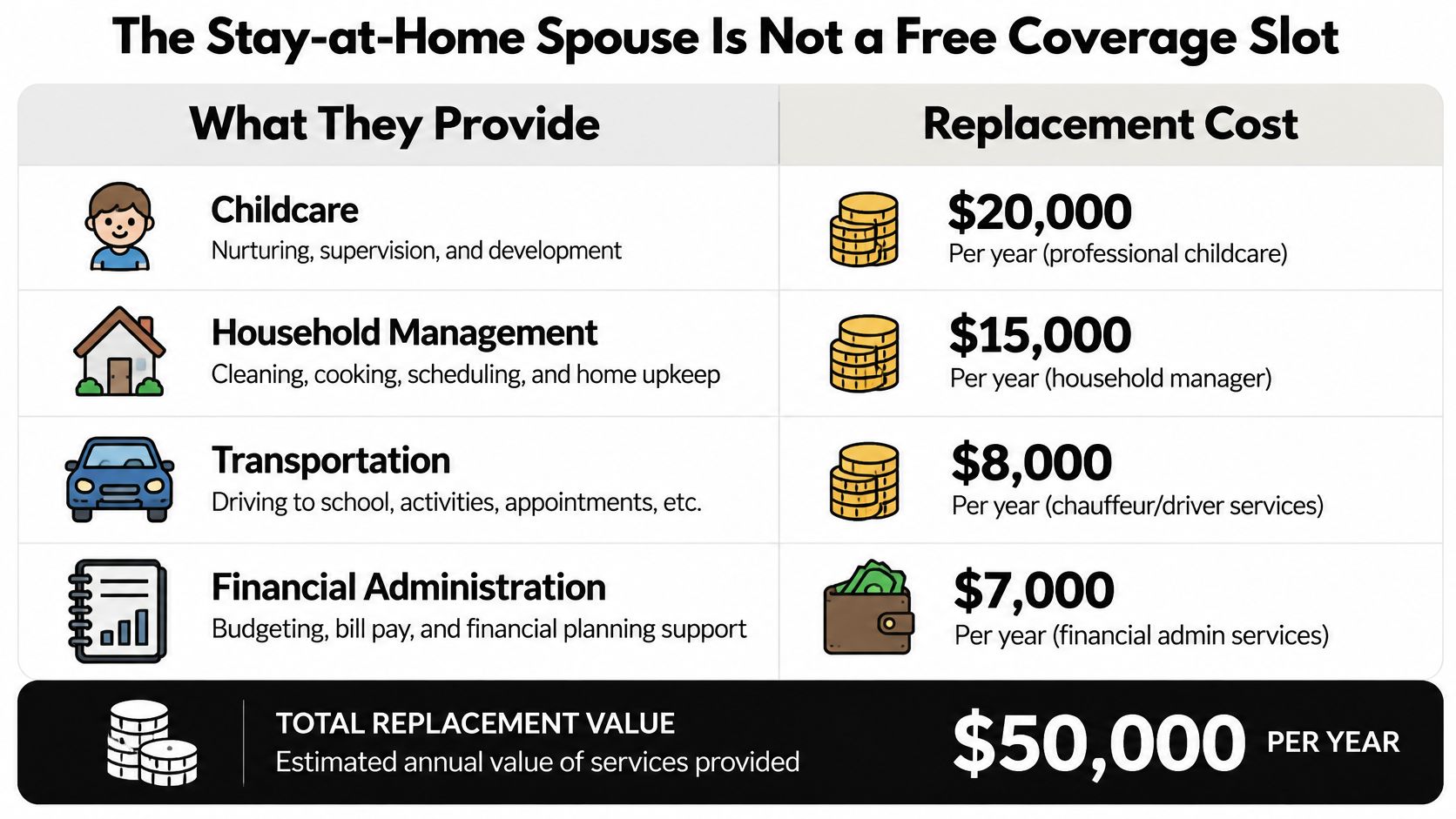
Price the replacement plan, not an imaginary salary
Walk through a normal week and identify work someone else would have to perform. Childcare may be the largest visible task, but school transportation, eldercare, meal preparation, and appointment management also need an answer.
| Contribution | Input for your worksheet |
|---|---|
| Childcare | Local care quotes matched to the survivor's work schedule |
| Household work | Services the survivor would realistically purchase |
| Transportation | Paid pickup, transport, or the earnings lost by handling it personally |
| Eldercare | Replacement support based on the relative's needs |
| Household administration | Time away from work or paid help where necessary |
For each service, multiply its quoted cost by the amount you'd use. Convert that into an annual total, then apply the relevant dependency horizon. Add transition expenses and any expected reduction in the survivor's earnings.
Family help belongs in the calculation only when someone has realistically agreed to provide it.
A grandparent's occasional availability isn't interchangeable with dependable daily care. Subtract sustainable support and usable savings, but don't budget around goodwill that may be difficult to maintain.
Account for the survivor's capacity
In a hypothetical household, the surviving parent might need after-school care and a reduced work schedule. Counting only the care bill would miss the income lost through shorter hours.
The guide to life insurance for stay-at-home parents can help organize those responsibilities. The resulting face amount could approach or exceed the working spouse's coverage need, depending on the household. The point isn't to make both policies equal. It's to value both contributions fairly.
Keeping Coverage Aligned as Your Life Changes
An adequate policy can become poorly matched to your household without anyone noticing. The benefit may stay unchanged while your dependents, employment, or intended recipients change.
LOMA reporting on changing family structures cites 74 million Americans who say they need life insurance and 25 million who say they need more, while only 37% are confident their loved ones could manage financially without them. A recurring review helps turn concern into specific administrative action.
Know who controls what
Couples often use “our policy” without distinguishing the roles:
- Owner. Holds contractual control, subject to the policy and applicable law.
- Insured person. The person whose life is covered.
- Premium payer. Supplies the payments, which doesn't necessarily establish ownership.
- Beneficiary. The designated recipient of the death benefit.
If you own coverage on your spouse, confirm who can change beneficiaries, who receives notices, and who can obtain policy information. If trust deteriorates, get professional advice rather than relying on an informal understanding.
Review the documents after the life event
Set an annual review reminder and reopen the file after marriage, childbirth, a home purchase, a job change, or a move from paid work into caregiving. Separation, divorce, and remarriage also warrant attention to ownership and beneficiaries.
During the review, check the current benefit, remaining term, payment method, contact details, and beneficiary designations. Coordinate the result with debts, emergency savings, employer benefits, and guardianship planning.
Divorce also raises insurance questions beyond life coverage. Miles Hansford Law Firm's resource on COBRA and ACA after divorce provides a related starting point for discussing health coverage.
Keep confirmation of completed changes with the policy records. A conversation about updating a beneficiary isn't the same as verifying that the insurer processed the change.
Your Decision Checklist and Common Spouse Coverage Questions
Before applying, confirm the essentials:
- Protect both contributions. Complete a separate needs estimate for each spouse.
- Match the timing. Select coverage that addresses the dependency you identified.
- Document responsibility. Record ownership, beneficiaries, payments, and the review date.
Common questions
Who can be a beneficiary? A spouse or another intended recipient may be appropriate, subject to policy requirements and applicable law. Ask about arrangements involving minors, trusts, or complex family circumstances.
What happens after divorce? Review the contract, beneficiary designation, ownership, and any settlement obligations with your insurer and attorney. Don't assume the intended outcome happens automatically.
Can we transfer ownership shortly before death? Obtain tax advice first. The IRS Form 706 instructions require certain life insurance transfers made within three years before death to be reported on Schedule G, even if no gift-tax return was filed.
For broader ownership and inheritance planning, bring common estate planning questions answered from The Law Office of Bryan Fagan, PLLC to your adviser discussion.
Visit Coveredly to explore digital term life insurance and an online application, with no medical exam for most applicants. Bring the coverage estimate and protection period you've worked out for each spouse, then evaluate whether an available policy fits your household's needs and budget.