You've just been diagnosed with diabetes, and your first thought may not be about blood glucose. It may be about your spouse, children, mortgage, or business, and whether a life insurance application will now come back with a higher price or a rejection. That fear is understandable, but diabetes doesn't automatically make you uninsurable.
The practical question is more specific: how do your A1C history, treatment, age at diagnosis, complications, tobacco use, and medical records shape a term life offer? This guide explains how insurers assess term life insurance for diabetics, including type 1 diabetes life insurance, type 2 diabetes life insurance, and no medical exam term life options.
Table of Contents
- When Diabetes Meets Life Insurance Applications
- How Underwriters Assess Diabetes Risk
- Type 1 Versus Type 2 Diabetes Coverage Paths
- Documentation That Strengthens Your Application
- Policy Options Through Digital Carriers
- Understanding Premium Impact and Pricing Examples
- Taking Confident Next Steps Toward Coverage
When Diabetes Meets Life Insurance Applications
A few weeks after her diagnosis, Maya opened a life insurance application on her tablet. She had a young family, a new diagnosis, and a policy review already on her calendar. Her concern was simple: if the insurer saw “diabetes,” would the rest of her application stop mattering?

That assumption is common, but underwriting rarely works as a single yes-or-no decision based only on the diagnosis. An insurer wants to understand how diabetes is managed, whether control is stable, what treatment is required, and whether complications have developed. Two applicants with the same diagnosis can receive different outcomes because their overall risk profiles differ.
A well-controlled type 2 applicant with stable laboratory results and no documented complications may receive standard or near-standard consideration from some carriers. An applicant with severe control problems, tobacco use, cardiovascular disease, or diabetes-related kidney, retinal, vascular, or nerve disease may face a higher rating or a decline. The diagnosis opens the underwriting discussion. It doesn't finish it.
The useful question isn't “Can diabetics get life insurance?” It's “Which carrier understands my specific diabetes profile?”
The market is large enough that insurers have built detailed processes around it. A CDC-based figure cited in industry and clinical summaries places the number of U.S. adults with diabetes at roughly 38 million, or about 10% of the population. The American Diabetes Association figure cited in the same industry discussion says about 1.2 million Americans are diagnosed each year. In Canada, estimates place diabetes at about 3.7 million people, or 9.4% of the population, while roughly 22.5% of adults aged 20 to 79 who met diagnostic criteria from 2007 to 2019 were unaware of their condition. These figures are discussed in industry analysis of diabetes underwriting.
Those facts help explain why applications may include prescription checks, laboratory history, disease-control questions, and sometimes an exam. They also explain why a digital application can still ask detailed health questions. The carrier isn't treating every diabetic applicant alike. It's trying to place each person in a risk class that reflects the available evidence.
How Underwriters Assess Diabetes Risk
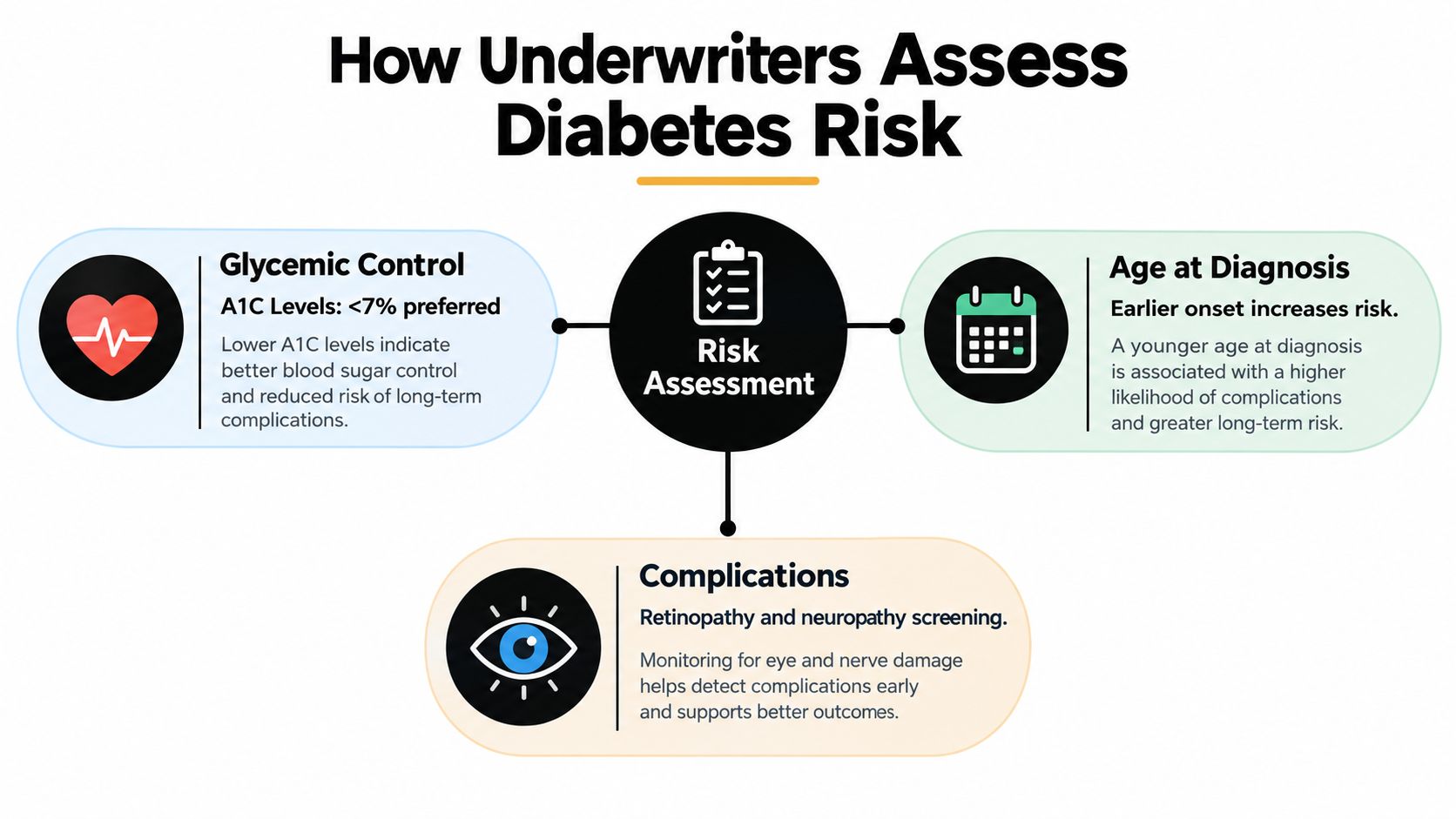
An applicant with a recent A1C increase, incomplete medical records, or a documented complication may receive a very different offer from someone with stable control and consistent follow-up. Underwriters assess the evidence behind the diagnosis, using A1C, age at onset, treatment intensity, and complications as major risk indicators, as described in this actuarial analysis of diabetes mortality and morbidity risk.
A1C history provides context
A1C acts like a series of dashboard readings rather than a single snapshot. One result may show current control, while several results reveal whether control is stable, improving, or worsening. Underwriters may request laboratory history, treatment notes, and follow-up records to determine whether the latest result represents a lasting pattern or a temporary change.
The actuarial guidance identifies A1C as a central predictor and notes that profiles with A1C around 10.0 or above, smoking, or coexisting cardiovascular disease are common decline triggers. This does not impose one rule on every carrier. It does show why both current and historical control can influence whether coverage is offered and which premium class applies.
Treatment intensity changes the risk picture
Treatment gives the underwriter another way to understand disease control. Diet and oral medication may indicate a different risk profile from insulin use, although insulin is not an automatic rejection. The review also considers diabetes duration, adherence, treatment response, and complications together.
Applicants can reduce delays by keeping medication lists current and explaining treatment changes accurately. A practical meal plan for diabetes may support everyday organization, but it does not replace advice from a clinician.
Complications can change the offer
Insurers ask specifically about vascular, renal, retinal, and neuropathic disease because these conditions can affect expected mortality. Kidney disease, retinopathy, neuropathy, or cardiovascular disease may shift an application from preferred or standard consideration toward a substandard class or decline.
The cited research found an overall actual-to-expected mortality ratio of 3.15 for diabetic applicants and applicants whose laboratory results were consistent with diabetes, measured against the Society of Actuaries 2008 Valuation Basic Table. A reduced cohort showed 2.56. The study also reported that the mortality gap narrowed with age, varied by treatment category, was considerably higher among insulin users, followed a J-shaped relationship with BMI, and declined as time since application increased. These findings are summarized by TruStage's explanation of life insurance and diabetes.
Documentation quality can affect how confidently an underwriter assigns a risk class. Applicants can review life insurance underwriting to understand how medical evidence, treatment history, and follow-up records enter the decision. Clear records may help distinguish a controllable profile from one that appears uncertain.
Type 1 Versus Type 2 Diabetes Coverage Paths
An applicant with type 1 diabetes may have used insulin since diagnosis, while an applicant with type 2 may manage the condition through lifestyle changes, oral medication, or insulin. Those starting points shape the review, but neither diagnosis decides the outcome by itself.
Underwriters assess the individual profile behind the label. They look at age at onset, treatment intensity, A1C history, complications, and the consistency of medical follow-up. A stable pattern with clear records can support a standard or near-standard offer. Gaps, worsening results, or documented complications can lead to a higher-risk class or a decline.
| Factor | Type 1 Diabetes | Type 2 Diabetes |
|---|---|---|
| Treatment pattern | Insulin is commonly central to management, so the insurer examines treatment intensity and response. | Management may range from lifestyle measures to oral medication or insulin, creating a broad range of risk profiles. |
| Age at onset | Earlier onset can mean a longer underwriting history and more time for complications to develop. | Later onset may receive more favorable consideration when control is stable and complications are absent. |
| A1C review | Underwriters examine long-term stability, treatment response, and documented control. | A1C history helps separate stable management from worsening or inconsistent control. |
| Complications | Retinal, renal, vascular, and nerve complications can narrow available offers. | The same complications matter, regardless of diabetes type. |
| Documentation | Continuous specialist and primary-care records can clarify long-term management. | Recent records, medication history, and consistent monitoring can support the application. |
| Possible outcome | Coverage may be available, although the full profile could place the applicant in a higher-risk class. | Well-controlled profiles may receive standard or near-standard consideration with some carriers. |
The practical underwriting question is not just, “Which type of diabetes do you have?” It is, “What does the evidence show about control and future risk?” A1C history, age at onset, treatment intensity, and complications are the main levers. As noted earlier, actuarial research links diabetes risk with factors beyond the diagnosis alone.
Documentation can change how clearly those levers appear. A current medication list, specialist notes, and regular laboratory monitoring may answer more questions than a lengthy explanation in the application. Applicants who track exercise, nutrition, or glucose response can discuss those records with their physician and review this guide to a blood test for athletes with diabetes.
Consider two applicants with different diagnoses. A person with type 1 diabetes and stable records may appear more favorable to one carrier than a person with type 2 diabetes and poorly documented complications. Type 2 diabetes is not automatically low risk, and type 1 diabetes is not automatically uninsurable. The carrier needs evidence that management is consistent and that major end-organ damage is absent. That evidence can help move an application from an uncertain review toward a standard or table-rated offer.
Documentation That Strengthens Your Application
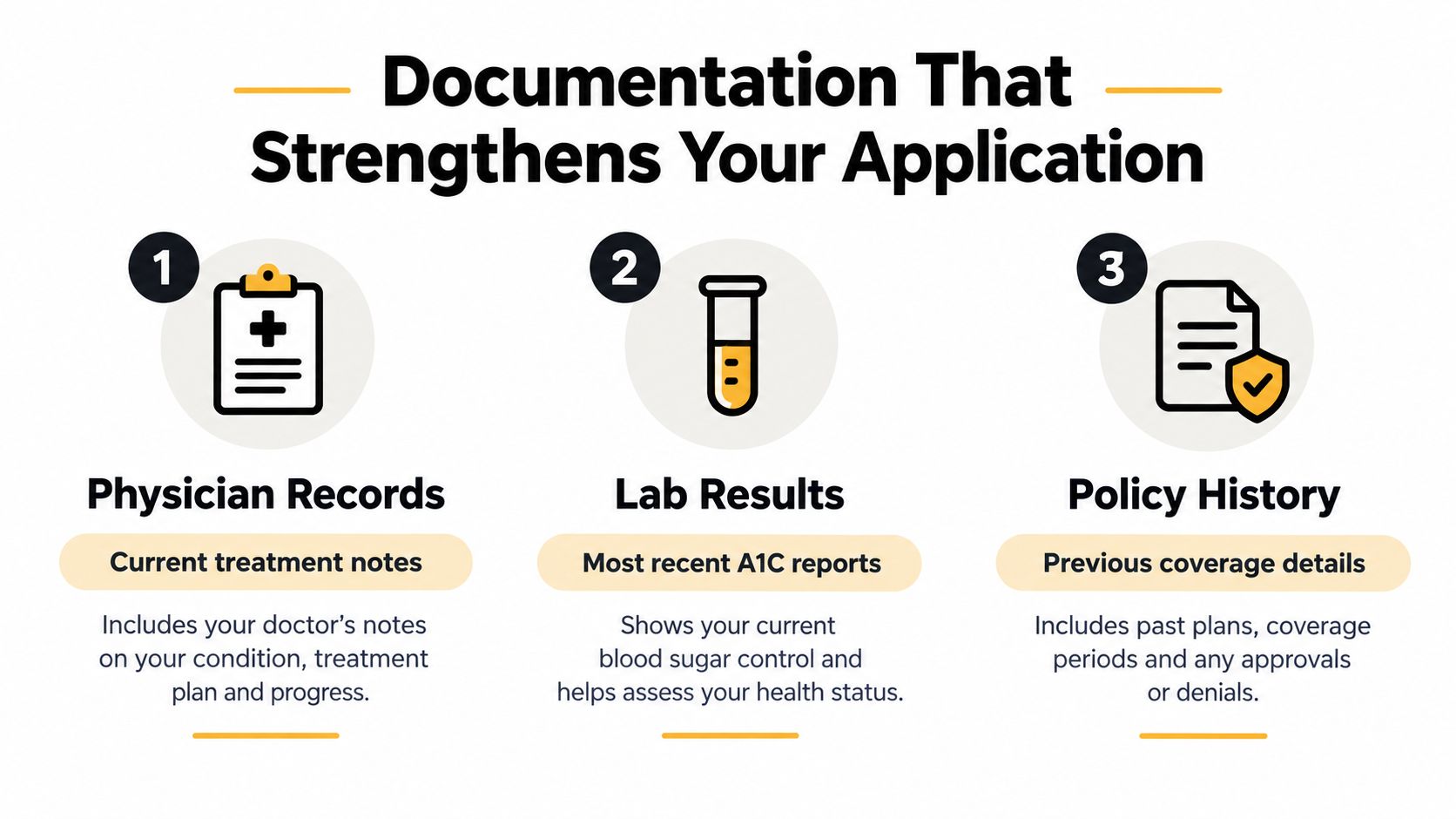
A recent A1C increase, a new medication, or an incomplete physician file can make underwriting feel uncertain. Clear records give the insurer a fuller picture, showing how diabetes has been managed over time rather than leaving the reviewer with isolated answers.
Build a useful records package
Organize the information most likely to affect the underwriting decision:
- A1C history: Provide earlier results when available, not only the latest test. The pattern can show stable, improving, or inconsistent control.
- Treatment details: List medications, dosages, insulin use, devices, and recent changes accurately.
- Physician records: Include primary-care notes and relevant specialist records that show monitoring, follow-up, and treatment decisions.
- Complication screening: Gather eye, kidney, nerve, cardiovascular, and vascular evaluations. Normal findings can support a stronger risk assessment.
- Diagnosis history: State when diabetes was diagnosed and how it was identified.
- Lifestyle and adherence context: Include physician-documented information about diet, exercise, glucose monitoring, or medication adherence. General assurances carry less weight than records.
These documents work like a timeline. They help explain why the current A1C has its present value and can resolve differences between prescription records, laboratory reports, and application answers. That clarity may support a standard or table-rated offer when the underlying evidence supports it.
Don't hide difficult information
A high result, treatment change, or documented complication does not automatically end the application. Give the insurer accurate context and, when appropriate, updated records from the treating physician. Omitting a condition can create a more serious problem than receiving a higher rating because the carrier may later question whether the application was complete.
Older actuarial and medical-insurance literature found that diabetes can affect mortality assumptions and pricing, particularly in declined or impaired-risk cases. One study reported up to 25 extra deaths and mortality on declined cases of about 3.0 times greater than expected, as documented in the Journal of Insurance Medicine study.
Before submitting, review this evidence of insurability form guide to see what information may be requested and how to keep answers consistent.
A strong application doesn't present perfect health. It presents reliable evidence, complete disclosure, and a clear record of management.
Policy Options Through Digital Carriers
Digital carriers have changed the application experience, but they haven't removed underwriting. A no medical exam term life application may use an online questionnaire, electronic data sources, prescription history, and available medical information to assess risk. For someone searching for no medical exam term life, that can mean a quicker first step, not guaranteed approval.
The right option depends on the amount of protection needed, the insurer's diabetes guidelines, and the quality of the information available. An exam-light process may suit an applicant with stable records who values convenience. A fully underwritten application may be more appropriate when the applicant needs a larger benefit or wants the carrier to review detailed medical evidence.
Match the process to the profile
Consider these paths:
- Fully underwritten term: More medical detail can give an insurer a fuller view of stable control and absent complications. It may be useful when your records support your case.
- Simplified underwriting: A shorter process can reduce friction, but the carrier still evaluates the answers it receives and may price uncertainty into the offer.
- No medical exam term life: This can be relevant for applicants who want an exam-light application, but diabetes questions and data checks may still apply.
- Guaranteed issue coverage: This is generally a fallback for people who can't qualify through more informative underwriting. It may provide less protection at a higher cost per dollar.
Coveredly offers online term life insurance applications, personalized rate comparison, and policies that may be issued without a medical exam, with coverage of up to $3 million described in its publisher information. Applicants should review the current application questions and eligibility rules because availability can vary by profile and may change over time.
A digital carrier can be useful when a young family wants to compare options without starting with a traditional paper process. It doesn't replace professional guidance, and it shouldn't encourage an applicant to guess at medical answers. If you want to understand the product structure before applying, read what direct term life insurance means.
Understanding Premium Impact and Pricing Examples
Diabetes can affect premiums, but age and the carrier's interpretation of your full profile also matter. A quoted price is never a universal rate for every diabetic applicant. It reflects the specific policy design, applicant details, underwriting class, and insurer.
One independent pricing source gives monthly examples for a $1 million, 20-year term policy. For a 35-year-old male with diabetes, the example is about $69.13 per month, while the example for a 35-year-old female is about $54.07 per month. The same source gives examples at age 50 of about $242.51 per month for a male and $179.13 per month for a female. These figures appear in the published diabetic life insurance pricing examples.
The comparison illustrates the effect of age within that source's examples. It doesn't isolate A1C, complications, treatment, or carrier differences, so it shouldn't be used as a personal quote. A younger applicant with well-documented control may receive a materially different offer from an older applicant, while a complication-free profile may be assessed differently from one involving kidney or cardiovascular disease.
Use examples as a budgeting reference, then compare actual offers. Ask whether the quotation assumes an exam, whether the policy is fully underwritten, how long the term lasts, and whether the displayed price reflects a particular health class. Those details matter more than a headline number viewed without context.
Taking Confident Next Steps Toward Coverage
A parent applying for term insurance may worry that a diabetes diagnosis will decide the outcome before the application is reviewed. Underwriters usually examine the full record instead. Your purpose for buying coverage, such as income replacement, family protection, a mortgage, or business continuity, helps determine how much protection your beneficiaries may need. Diabetes affects risk assessment, not the financial obligation itself.
Prepare the information that lets an insurer evaluate that risk clearly:
- Confirm your diabetes profile. Record your type, diagnosis history, current treatment, insulin use, and recent A1C results.
- Review complication records. Check whether physicians have documented retinal, renal, vascular, cardiovascular, or neuropathic conditions.
- Check for consistency. Medication lists, doctor details, application answers, and medical records should tell the same story.
- Compare carriers. Guidelines differ, so one decline or high offer does not establish what every insurer will decide.
- Choose the application route carefully. No-exam term insurance may reduce inconvenience, while full underwriting can give the carrier more evidence to assess.
- Ask about the policy after issue. Review renewal pricing, conversion rights, replacement rules, and the process for seeking additional coverage.
Underwriting often works like a file review: a stable A1C history and clear follow-up notes give the reviewer a more dependable picture than isolated answers. Favorable consideration may be possible when control is good and complications are absent, as noted earlier in the discussion of industry guidance for applicants with diabetes. Keep those records organized before coverage becomes urgent.
Existing term coverage deserves a separate review. A later diabetes diagnosis generally does not let an insurer cancel or reprice an in-force policy unless fraud was involved. A new application after a lapse, a conversion request, or a request for additional coverage can involve fresh underwriting. Read the policy before changing or canceling it, then ask how its conversion and renewal provisions operate.
Apply with evidence, not assumptions. A stable record and an honest application give the carrier the information it needs to assess you fairly.
A decline is a decision on one application, not a final verdict on your insurability. Ask which information drove the result, whether another carrier may assess the profile differently, and whether more documented follow-up could support a later application. A specialist can help you compare underwriting paths instead of applying randomly or accepting a more restrictive product too quickly.
Term life insurance for diabetics involves matching health evidence, coverage needs, and carrier guidelines. Good control and no complications may support a stronger offer, while a more complex history may still qualify for meaningful protection through a different underwriting class.
Coveredly offers online term life insurance applications, personalized rate comparisons, and options that may not require a medical exam, subject to eligibility and underwriting. Visit Coveredly to review coverage options and begin an application with accurate health information.