You're in your early thirties, you have a toddler, a mortgage, and a household budget still recovering from parental leave. One income may cover the essentials, but there isn't much room for a long interruption. If the primary earner died unexpectedly, the surviving parent would have to manage housing, childcare, groceries, debts, and work decisions while grieving. Savings might help with the first bills, but they rarely replace years of income.
That's why term life insurance for young families deserves attention before a crisis makes the decision urgent. It creates a temporary pool of money for the years when children depend on you, debts are large, and one income supports much of the household. The right policy won't remove the emotional loss, but it can keep that loss from becoming an immediate financial emergency.
Table of Contents
- Why Young Families Need a Different Kind of Safety Net
- How Term Life Insurance Actually Works
- The Coverage Gap Most Young Parents Don't Realize They Have
- How Much Coverage Your Family Actually Needs
- Choosing the Right Term Length for Your Family's Timeline
- What Term Life Insurance Really Costs in Your Twenties and Thirties
- Riders, Features, and Common Mistakes to Avoid
- Applying for Term Life Insurance the Simple Way
Why Young Families Need a Different Kind of Safety Net
A retirement account is designed to grow over time. An emergency fund is designed to handle shorter disruptions. Neither one is usually large enough to replace a parent's earning power for the full period when children need housing, supervision, education, and daily care.
Term insurance serves a different purpose. You buy a death benefit for a defined period, often matching the years until children become financially independent or a mortgage is substantially reduced. If the insured parent dies during that period, the policy can give the surviving family flexibility to keep the home, pay for childcare, reduce debt, or replace income.
The need is not theoretical. A major U.S. industry study found that 34% of households with children reported having no life insurance coverage, and it estimated that insured households with children could replace income for only about three years on average in 2016, down from 3.5 years in 2010. The same life insurance industry report explains why coverage is generally recommended for people with children or other dependents.
Why term usually fits this stage
A young family's largest financial obligations are often temporary, even though they're substantial. Children eventually become independent. A mortgage eventually declines or ends. Childcare costs change. Term insurance lets you protect that high-responsibility period without automatically paying for lifelong cash-value features.
Whole life and other permanent policies can have a place in specialized financial plans, but many young parents primarily need income protection, not a lifelong savings component inside an insurance contract. Paying for permanent coverage when the main need is temporary can put pressure on a budget that also needs emergency savings, retirement contributions, and debt repayment.
Age and health matter at application. Buying earlier can make it easier to qualify for favorable underwriting, and a level-premium policy can preserve the rate established at issue for the selected term. Families can start with the protection they need now and review it after major changes such as a new child, a larger home, or a significant income increase.
Parents who are adjusting to a new baby can also review guidance on life insurance for new parents. The practical question is simple: if one income disappeared tomorrow, how long would the household need help to remain stable?
How Term Life Insurance Actually Works
Term life insurance is a contract that protects your family for a defined number of years. You pay a premium, and if the insured person dies while the policy is active, the insurer pays the named beneficiaries a lump sum called the death benefit.
The structure has three parts.
Premiums
The premium is what you pay monthly or annually to keep the policy active. With a level-term policy, that price generally stays the same throughout the selected term. The insurer sets it when you apply, using factors such as age, health, tobacco use, coverage amount, and term length.
A missed payment can put the policy at risk, especially after any applicable grace period. The cost or terms can also change if you add optional features, increase coverage, or reach the end of the original term. During the level-premium period, getting older does not normally raise the initial price.
Term length
The term is the number of years the contract remains in force. Common choices include 10, 20, and 30 years, and this overview of life insurance mechanics explains that beneficiaries receive the death benefit only when the insured dies during the coverage period.
If the insured survives the term, the policy typically ends without a death-benefit payment. Some policies offer renewal or conversion provisions, but those options have their own rules and costs.
Death benefit
The death benefit goes to the beneficiaries named in the policy. They can generally use the money for the mortgage, childcare, education, household bills, or any other permitted purpose. Naming an adult beneficiary is usually more straightforward than naming a minor child directly. A minor may need a trust or court-supervised arrangement before receiving the funds.
Term insurance functions like a safety net rented for the years your family carries the greatest financial responsibility. Permanent insurance, by contrast, locks in lifelong coverage with a savings component. Whole life and other permanent policies serve specialized financial plans, while many young parents primarily need income protection during the child-rearing years.
That limited structure can make term coverage easier to understand and fit into a budget. The tradeoff is that the policy generally ends when the selected term does.
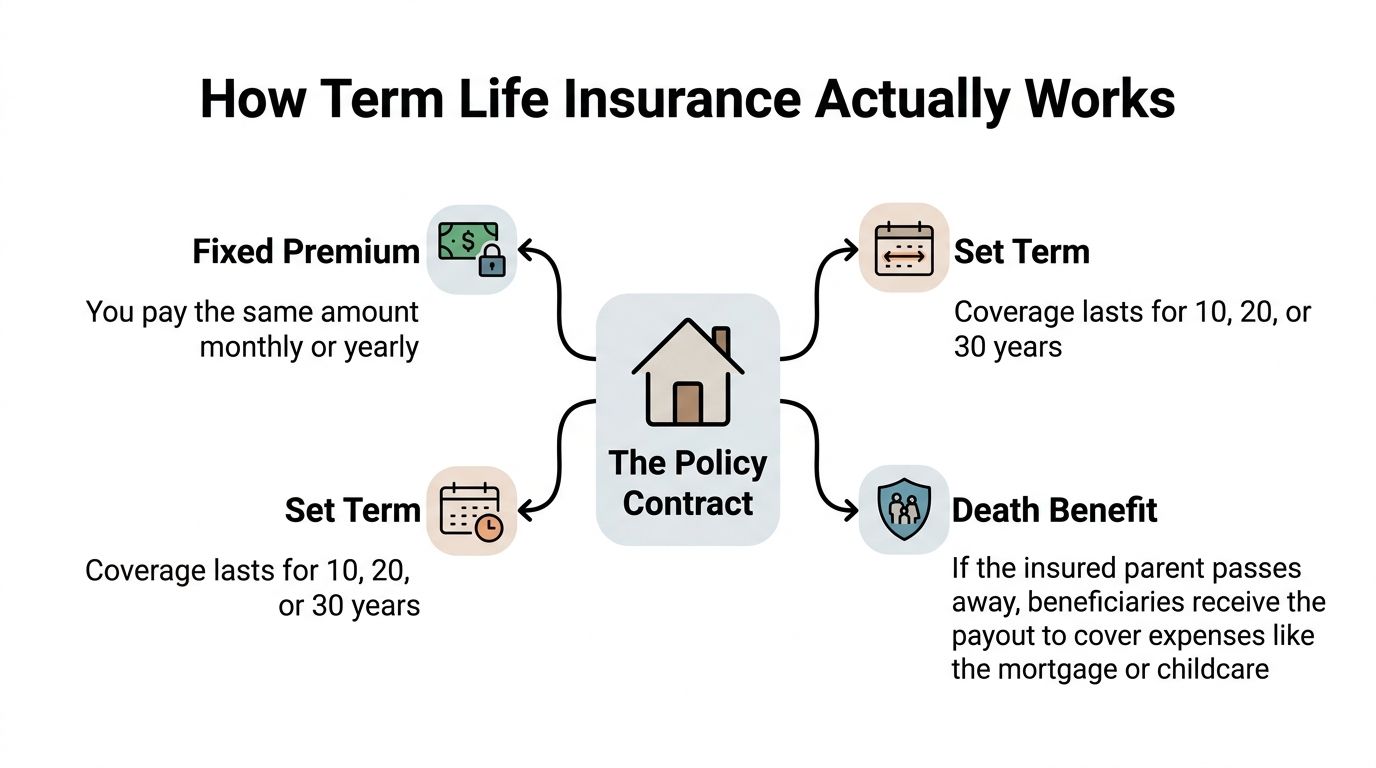
The choice comes down to three questions: how much protection your household needs, how long that need is likely to last, and who should receive the money.
The Coverage Gap Most Young Parents Don't Realize They Have
Many parents own some life insurance and still remain underinsured. LIMRA reported that 106 million Americans, or 41% of adults, say they have a life insurance coverage gap. The same LIMRA coverage-gap fact sheet found that 47% of Millennials and 49% of Gen Z adults say they need or need more life insurance.
Families with children face an especially large shortfall. A 2024 model estimated that households with children accounted for $22.0 trillion of a collective $33.2 trillion U.S. household coverage gap, and that 78% of households with children had a gap. Married or partnered households still had a 67% likelihood of being undercovered, according to the same analysis.
What the gap means on a family calendar
The financial exposure lasts longer than the first few months after a death. A surviving parent may need to cover years of rent or mortgage payments, childcare, food, transportation, medical needs, and education. Employer benefits can help, but a workplace policy may not follow you when you change jobs, and its benefit may not reflect the full amount your family would need.
Industry ownership data shows the tension clearly. Parents of minor children have a 59% ownership rate, compared with 52% overall, yet 47% of parents still say they don't have enough coverage. Among Gen Z and millennial parents, 56% report insufficient coverage, as documented in LIMRA's 2023 insurance barometer release.
| Coverage Source | Typical Benefit | Years of Income Replaced |
|---|---|---|
| Employer life insurance | Depends on the workplace plan | Depends on salary and benefit design |
| Personal term policy | Chosen by the household | Designed around the family's income-replacement period |
| Savings and investments | Whatever the household has accumulated | Limited by the available balance |
The table highlights why personal coverage deserves its own calculation. Savings are useful, but they're not a substitute for a death benefit selected to match the household's long-term obligations.
Practical rule: Treat employer coverage as one layer of protection, not automatically as the whole plan.
Single mothers face an even sharper need gap. Research reports that 41% own life insurance, 59% report a need gap, and that gap represents about five million households, according to the LIMRA and Life Happens barometer study. For a single-income household, the policy may need to protect both earnings and the cost of replacing unpaid caregiving.
How Much Coverage Your Family Actually Needs
A common starting point is 10 to 12 times annual income. It's a useful first estimate, not a final answer. A family with a large mortgage, several dependents, or limited savings may need more, while substantial assets or other dependable income may reduce the amount required.
Use a layered approach:
- Start with income replacement. Multiply annual income by 10 to 12.
- Add major debts. Include the mortgage balance, student loans, car loans, and credit cards that your family might otherwise have to manage.
- Account for childcare. Consider the cost of care until the youngest child reaches a less expensive stage of supervision.
- Add education goals. Include the amount you want the policy to contribute toward future education.
- Subtract reliable resources. Existing savings, investments, and suitable employer coverage may reduce the private policy target.
A worked family example
Consider a 32-year-old earning $75,000, with a $220,000 mortgage, $18,000 in student loans, two children under five, and a goal of funding half of four-year college. The income-only benchmark produces $750,000 to $900,000, because 10 to 12 times $75,000 falls in that range.
The mortgage and student loans add $238,000 before accounting for childcare or education. The final target won't be a precise mathematical answer because childcare, college funding, spouse income, and savings vary. For this household, a reasonable planning range might land around $1.1 million to $1.3 million, subject to a detailed needs review.
| Component | Calculation Basis | Amount Added |
|---|---|---|
| Income replacement | $75,000 × 10 to 12 | $750,000 to $900,000 |
| Mortgage | Outstanding balance | $220,000 |
| Student loans | Remaining balance | $18,000 |
| Childcare and education | Household-specific estimate | Refine with a budget |
| Existing resources | Savings and employer coverage | Subtract if dependable |
A stay-at-home parent also contributes economic value through childcare, transportation, household management, and other unpaid work. The surviving partner may need money to reduce work hours or pay for services, even if that parent doesn't earn the larger salary.
Use an online calculator before requesting quotes, then test the result against your actual budget and family timeline. A term life insurance coverage guide can help organize the income, debt, childcare, and education layers without treating the income multiple as a complete answer.
Choosing the Right Term Length for Your Family's Timeline
The right term isn't the one with the smallest premium. It's the one that stays active while your family still depends on the insured income.
A 10-year term
A 10-year policy can suit parents whose children are already school-aged, whose mortgage may be paid down within that period, or who want a lower-cost layer while building other assets. It can work when the household expects its largest obligations to decline relatively soon.
The trade-off is a shorter protection window. If the family still needs coverage when the term ends, renewing later may cost more, and new health issues could affect available options.
A 20-year term
A 20-year policy is a practical middle ground for many parents. It can cover the years when toddlers become teenagers, household income grows, and the mortgage moves closer to payoff. Families often choose it when the youngest child is still far from financial independence but a 30-year commitment feels unnecessary.
The policy should be aligned with the youngest child, not just the oldest. A family with children at different ages may need to measure the term against the last major dependency milestone.
A 30-year term
A 30-year policy can fit younger parents with newborns, a large mortgage, or a long education-funding horizon. It provides a longer period of locked-in protection and can preserve insurability while the family's responsibilities remain significant.
| Term | Often fits | Main trade-off |
|---|---|---|
| 10 years | Nearer-term debt or school milestones | May end before financial independence |
| 20 years | Child-rearing and mortgage years | Could still end before later obligations |
| 30 years | Newborns, large debts, long horizons | Longer commitment and potentially higher premium |
Some policies include convertibility, which allows you to switch to permanent coverage later without new medical underwriting, subject to the policy's rules. That feature can matter if your health changes or your need for lifelong coverage becomes clearer.
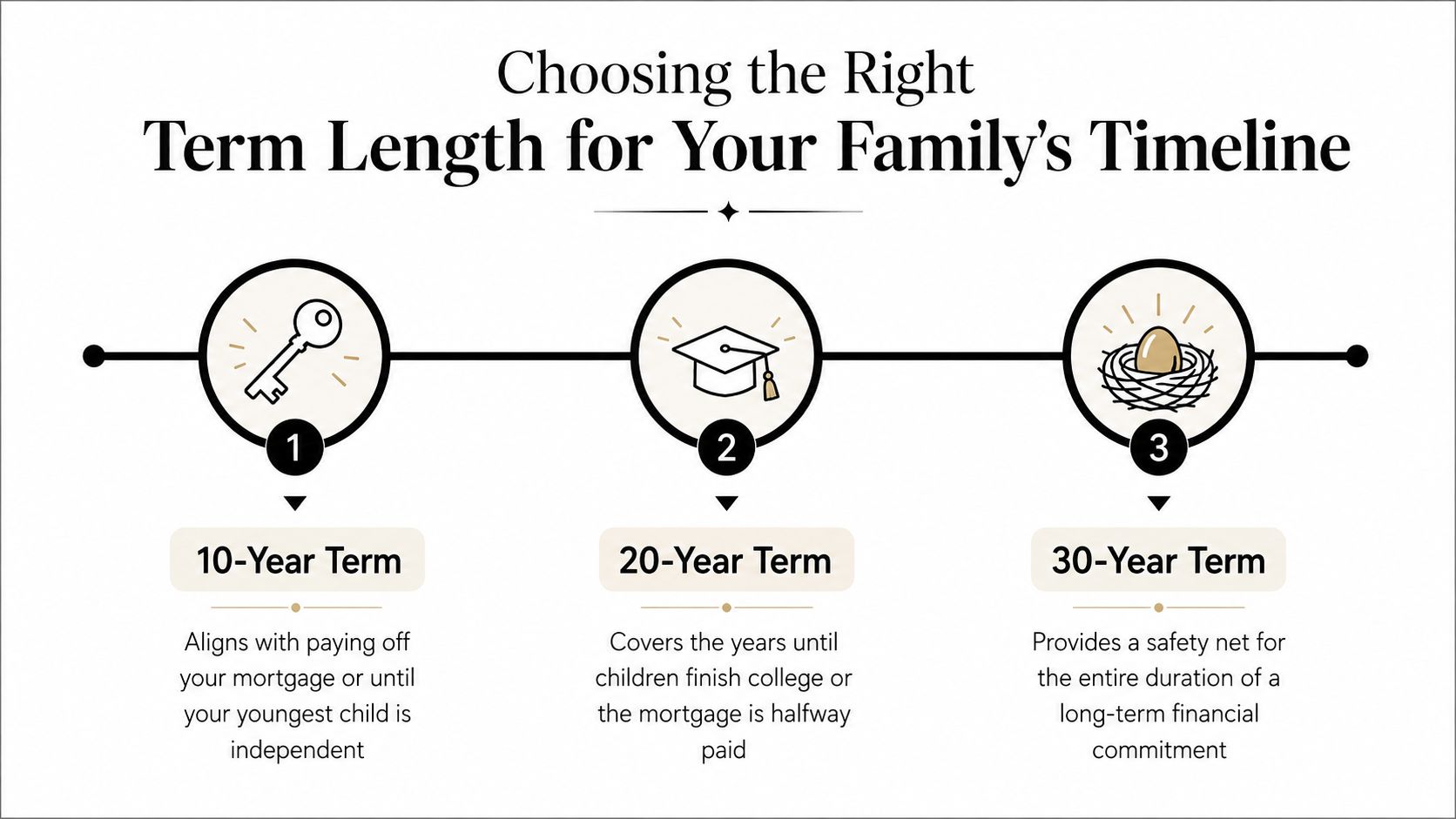
Draw a simple timeline with the youngest child's expected independence, the mortgage payoff target, and major education obligations. The term end date should sit beyond the period when your family would struggle most without your income.
What Term Life Insurance Really Costs in Your Twenties and Thirties
The biggest barrier may be misunderstanding, not the premium itself. LIMRA reports that 37% of Gen Z and 46% of Millennials cite cost as the main reason they haven't bought coverage, while healthy adults ages 18 to 30 overestimated the cost of a $250,000, 20-year term policy by roughly 10 to 12 times. Another study found that only 4% of consumers under 30 correctly estimated a basic term premium, according to LIMRA's cost-perception research.
That misunderstanding changes behavior. People postpone quotes because they expect a large monthly bill, then discover that the actual price depends on their individual underwriting profile.
What drives the premium
Insurers generally assess several factors:
- Age at issue: Younger applicants may receive more favorable pricing because the insurer is covering a longer expected period of lower mortality risk.
- Health classification: Medical history, current health, prescriptions, and lifestyle affect underwriting.
- Coverage amount: A larger death benefit costs more than a smaller one.
- Term length: A longer protection period changes the price.
- Tobacco use: Tobacco history can materially affect eligibility and pricing.
- Gender: Insurers may use sex-based actuarial classifications where permitted.
A healthy young applicant should compare actual quotes rather than rely on an online assumption. The age-based term rate guide can help you understand how age at issue affects the comparison, but only an application can determine your individual offer.
A level premium also provides budget clarity. Once the policy is issued, the contracted premium generally remains stable for the selected term, even as your age changes. That doesn't mean every feature is free. A return-of-premium rider can raise the cost substantially, and many families may prefer to direct the difference toward emergency savings, debt reduction, or retirement investing.
Request multiple quotes and compare the same coverage amount, term, riders, and underwriting class. Digital tools can show real options quickly, without requiring you to commit to a medical exam before you understand the likely price.
Riders, Features, and Common Mistakes to Avoid
A basic term policy may be enough, but a few optional features can address risks that ordinary income replacement doesn't cover.
Riders that deserve attention
The waiver of premium rider can keep the policy active if the insured becomes disabled and can't work, subject to its definition of disability and waiting requirements. For a young family, that protects the policy during the very period when paying premiums could become difficult.
A child rider adds coverage for dependent children under one policy add-on. It usually isn't meant to replace a parent's income. Instead, it can provide a modest amount for expenses connected with a child's death and may offer a future conversion option, depending on the contract.
An accelerated death benefit may allow a terminally ill policyholder to access part of the death benefit while alive. The amount available, qualifying diagnosis, and effect on the remaining benefit depend on the policy language.
Term conversion is another feature to inspect. It may allow a policyholder to move to permanent coverage without new medical underwriting, which can protect future insurability when health changes.
Mistakes that create avoidable problems
- Underinsuring: Choosing a benefit because the premium feels comfortable can leave the surviving parent with a large income gap.
- Naming a minor directly: A child may not be able to receive the money directly, so ask an estate-planning professional about a trust or appropriate adult structure.
- Ignoring conversion deadlines: A conversion privilege may have limits, so record the relevant dates with the policy documents.
- Forgetting life changes: Update beneficiaries after divorce, remarriage, a new child, or a major change in family structure.
- Treating guaranteed issue as a full solution: Guaranteed-issue products are a separate category and usually offer low face amounts intended for final expenses, not long-term income replacement. Accelerated underwriting may instead use application data, prescription checks, motor vehicle records, identity verification, and sometimes electronic health records, without a paramedical exam for eligible applicants, as described in this underwriting guide for young families.
For a healthy parent, a no-exam digital application can remove unnecessary friction. It may replace weeks of paperwork, scheduling, and follow-up with online health questions, electronic signatures, and a faster underwriting decision. No-exam doesn't mean no underwriting, and approval still depends on the insurer's rules.

Applying for Term Life Insurance the Simple Way
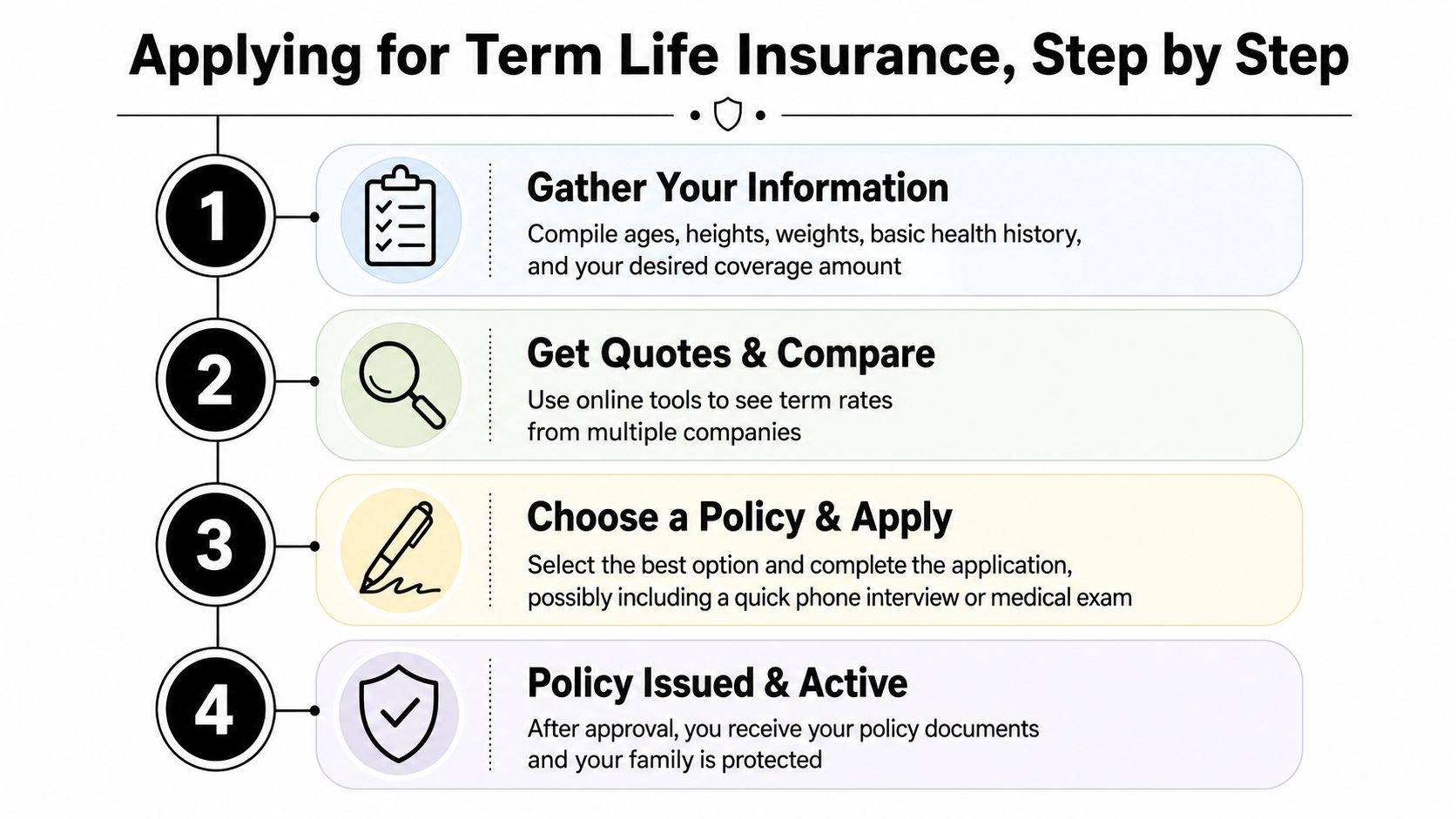
Start with information you already know. Gather each applicant's age, height, weight, basic medical history, prescription information, tobacco history, and desired coverage amount. Having those details ready makes the quote and application easier to complete accurately.
The application path
- Gather your information. Write down current medications, diagnoses, major procedures, and family medical history. Don't guess if the application asks for details you can verify.
- Compare quotes. Use online tools to compare the same benefit amount and term across insurers. A lower quote isn't useful if it has different exclusions, riders, or underwriting assumptions.
- Complete the application. Traditional underwriting may include a phone interview and a paramedical exam. Accelerated digital underwriting can use application data and third-party records instead, if you qualify.
- Review and activate. After approval, read the policy, confirm the beneficiaries, complete electronic delivery, and make the required payment. Coverage begins according to the contract's effective date, not when you first request a quote.
Traditional applications can take several weeks when interviews, medical scheduling, records, and insurer review all add time. A no-exam digital process can compress those steps dramatically, sometimes producing an instant or near-instant decision, but not every applicant receives that outcome.
Questions first-time buyers ask
Will I have to answer medical questions?
Usually, yes. No-exam coverage generally means the insurer evaluates you through application questions and electronic data rather than a needle or lab visit.
How do I pay?
Policies commonly support scheduled premium payments, with the available methods shown during application and delivery.
When does coverage begin?
Check the policy's effective date and any conditions tied to first payment or approval. Don't assume protection starts at the quote stage.
Can I change beneficiaries later?
You can often update beneficiaries, subject to the policy's ownership and beneficiary rules. Review them after major family events and keep the policy documents accessible.
A digital application is valuable because it makes the first step smaller. You can see the coverage amount, term, and underwriting questions before deciding whether the policy fits your household.
Coveredly offers online term life insurance, with no medical exams for most applicants and coverage options up to $3 million for eligible buyers. If you're comparing term life insurance for young families, visit Coveredly to review your options and start a digital quote.