3.16 million unintentional injury deaths happened in 2021, and that's why what is accidental death matters for families weighing life insurance, claims, and financial protection. In plain English, an accidental death is an unintentional, external event that directly causes death, and that distinction can decide whether a benefit gets paid.
A parent is in the emergency room after a sudden crash, a spouse is trying to find the policy folder on a phone, and nobody is sure which words the insurer will use. That confusion is common because accidental death can mean one thing in public-health records, another in forensic review, and a narrower thing in insurance contracts, especially when an AD&D claim is involved.
Table of Contents
- Why Understanding Accidental Death Matters for Your Family
- The Working Definition of Accidental Death
- How Accidental Death Differs From Natural, Suicide, and Homicide Deaths
- The Most Common Scenarios and Real-World Examples
- How Insurers and Authorities Determine an Accidental Death
- AD&D Policies and Accidental Death Riders Compared With Term Life Insurance
- Common Exclusions and What the Claim Process Looks Like
- Practical Safety Habits and Smart Coverage Choices for Young Families
Why Understanding Accidental Death Matters for Your Family
A family can do everything right, stay organized, keep premiums current, and still run into a denial if the policy wording and the cause of death don't line up. That's why learning the meaning of accidental death before a claim happens is less about morbid curiosity and more about reducing stress at the worst possible moment.
The same event can be read three different ways
A highway crash, a fall on ice, or a fatal workplace injury may look obvious to relatives, but reviewers don't stop at the headline. A public-health database may classify the death by injury mechanism, a coroner may classify it by manner of death, and an insurer may focus on whether the event was unexpected, external, and the primary cause of death, which is the core insurance question. That is also why claim disputes often come down to wording, not emotion.
Practical rule: if the policy pays only for a covered accident, the question is not just “Did something bad happen?” It's “Did the covered accident directly cause the death under the contract?”
This matters for young families because financial planning is usually built around ordinary life insurance, while accidental death coverage is narrower and often misunderstood. A spouse might assume any sudden death qualifies, then discover that the policy asks a very specific question about intent and causation.
Why the definition affects money, paperwork, and timing
The difference between a broad life policy and a narrower accident benefit can change how a beneficiary files, what evidence gets collected, and how long the review takes. It also explains why families sometimes hear one word from first responders, another from a death certificate, and a third from the claims department.
A clear understanding upfront helps you choose the right coverage and organize the right records. That's especially useful for working parents and newly married couples who want protection that fits real life, not just the label on the policy.
The Working Definition of Accidental Death
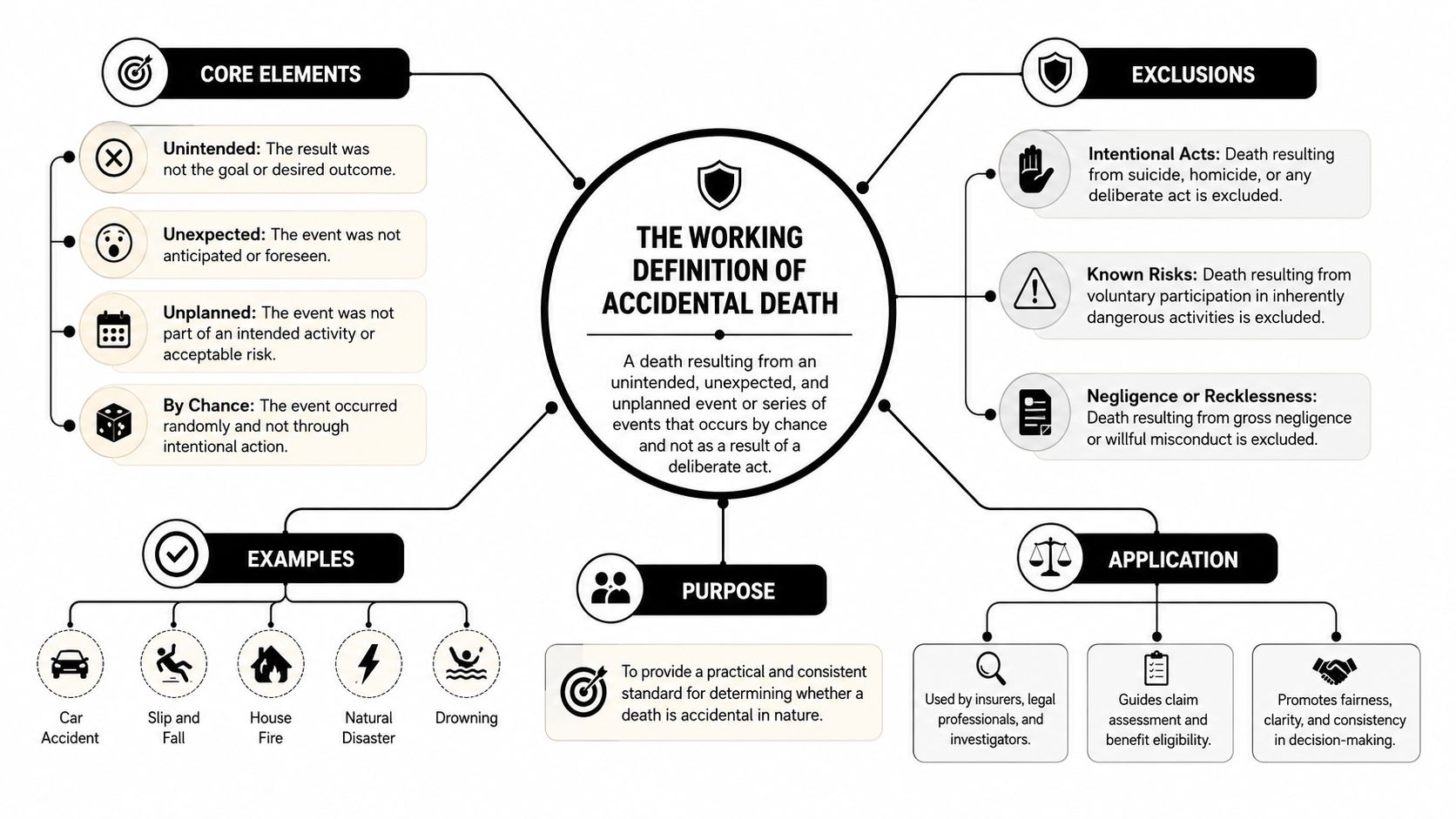
A practical working definition starts with what caused the harm. In public-health language, accidental deaths are treated as unintentional injury deaths caused by an acute transfer of energy, mechanical, thermal, electrical, chemical, or radiation, with no evidence of deliberate intent (scienceinsights.org).
What forensic language adds
Forensic and legal reviews narrow that idea further. They usually describe the death as the result of violent, external, accidental means that directly caused bodily injury and occurred independently of other causes. That is why examiners look closely at the chain of events, not just the final outcome. If you want a plain-English guide from a medical examiner perspective, the article on forensic pathologist explains death is a useful companion.
That chain matters because one event can start a long sequence. A fall may lead to hospitalization, then complications, then death, but the classification question still turns on whether the fall was the primary accidental event that set everything in motion.
Why timing also matters
U.S. Social Security guidance adds a practical timing rule. It uses a 3-month window between injury and death to support accidental-death classification, which shows that reviewers care about both the mechanism and the gap between the injury and the death (SSA POMS).
A useful shortcut is this, if the death came from an external event, not from disease, and the event drove the fatal chain on its own, reviewers are more likely to treat it as accidental.
Insurance and medico-legal reviews also rely on proximate cause, meaning the accident has to be the main driver of death even when other conditions exist (ScienceDirect topic overview). Once you understand that mechanism, the term stops feeling vague and starts functioning like a classification tool.
How Accidental Death Differs From Natural, Suicide, and Homicide Deaths
A family can hear three different labels for the same death and still feel more confused than before. That usually happens because they are asking one question, while the insurer, the coroner, and the legal system are each answering a different one.
Natural death is internal, accidental death is external
A natural death usually points to disease, organ failure, or another process that begins inside the body. A heart attack, aneurysm, or similar internal event can be natural even when it happens without warning, because the chain starts inside the person rather than with an outside force.
Accidental death starts with something external. A car crash, a fall, or drowning begins with an injury mechanism that comes from outside the body, even if the person dies later in a hospital. That outside trigger is the key difference families often miss.
Suicide and homicide turn on intent
Suicide means the death was self-inflicted with intent. Homicide means another person's act caused the death, even if that person did not mean to kill. Those categories work differently from accidental death because intent changes the legal and insurance analysis.
That boundary is where claims often become difficult. A fatal overdose, for example, can be classified differently depending on what investigators can prove about intent. A crash caused by another driver may still be accidental from the victim's point of view, because the victim did not intend the harm and the death still came from an external event.
Why insurers don't just copy a criminal verdict
Insurance contracts usually focus on proximate cause and whether the death resulted from an unexpected, unforeseen, external event rather than disease or intent. That is why a criminal case, a medical examiner's report, and an insurance claim can all use different lenses on the same death.
Families usually want a plain answer, but the review process is more exact than that. If the outside event was the main cause, the death may fit accidental-death language. If the death came from disease, self-harm, or intentional violence, it usually falls into a different category, even when the loss felt sudden and unexpected at home.
The Most Common Scenarios and Real-World Examples
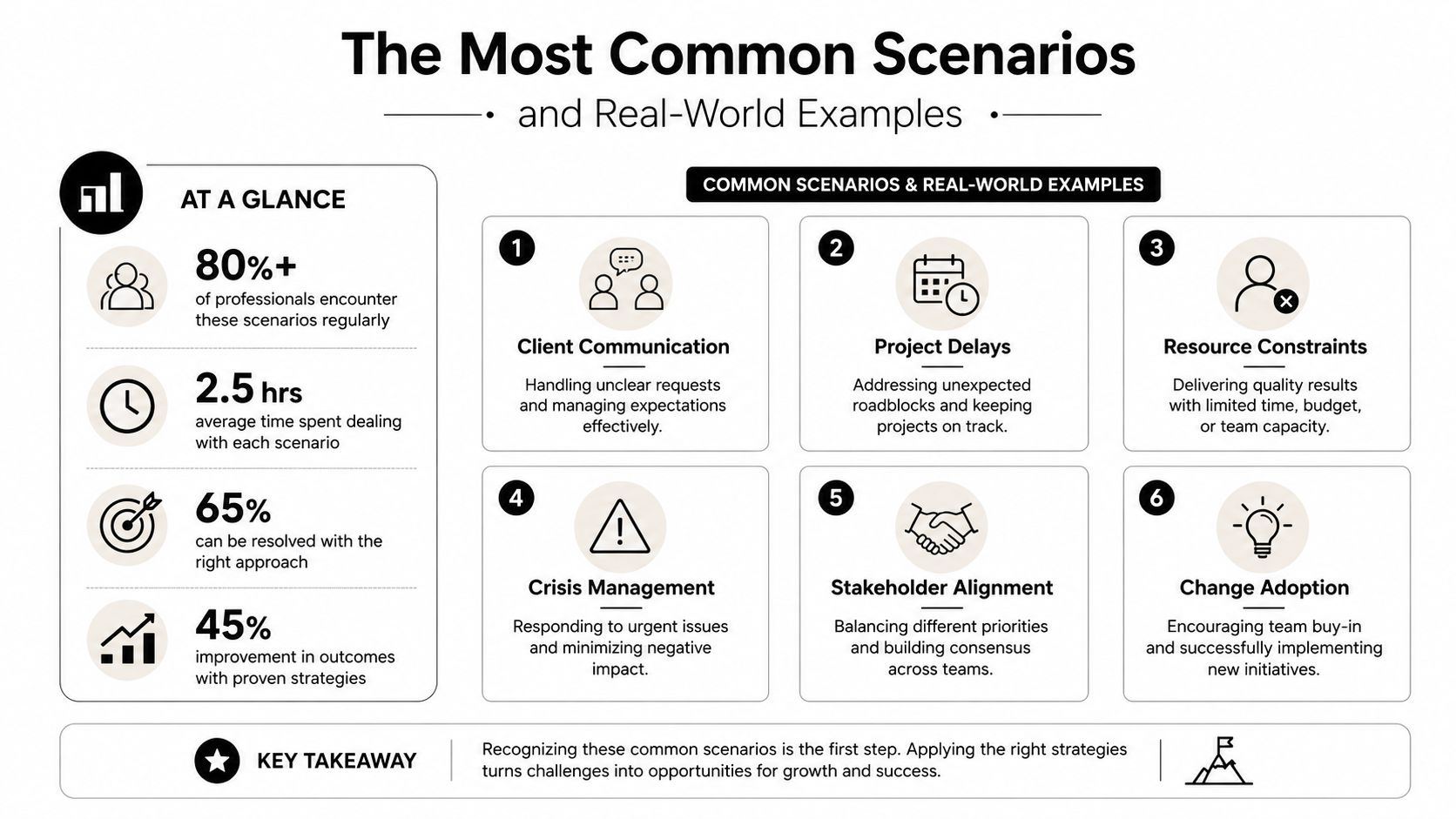
Accidental death is not one rare scenario, it's a broad category that shows up in everyday life. The biggest global bucket is motor-vehicle injuries, which account for nearly 1.2 million deaths, followed by falls at 739,089 and drowning at 300,250 (NSC international overview).
Transportation, home, water, and work
A parent in a multi-vehicle highway crash is the most familiar example of an accidental death claim. The event is external, sudden, and usually easy to trace to the injury that caused death.
Falls are just as important, especially for older adults and people recovering from illness. A fall at home can be fatal even when the surface looks harmless, because the injury mechanism, not the location, is what matters. Drowning is often tied to pools, lakes, or supervised recreation, which is why families with children pay close attention to layers of protection, not just one safety habit.
Workplace deaths belong in the same conversation. A contractor killed on a job site may have an accidental death under public-health and insurance language if the fatal event was external and unintentional.
Why age and setting change the risk picture
The global pattern matters because accidental death isn't spread evenly across life. The burden shifts by age, geography, and occupation, and that's why a young family, a construction worker, and a retiree don't need the same prevention plan or the same coverage emphasis.
The category is broad, but the family-facing question stays the same, what kind of external injury would your household struggle to absorb financially if it happened tomorrow?
That is where insurance planning becomes practical rather than abstract. If your daily life involves commuting, lifting, ladders, pools, or travel, you're already living near the risk categories that show up most often in real claims.
How Insurers and Authorities Determine an Accidental Death
A beneficiary usually sees the paperwork first, but the decision starts at the scene. First responders, doctors, medical examiners, and coroners record what happened, note the injury sequence, and pass that record into the death certificate and related reports that insurers later examine.
The chain of events matters more than the headline
A fatal fall that leads to a hospital-acquired infection can still be treated as accidental if the fall was the proximate cause of death. Claim reviewers focus on the first harmful event, not only the last medical complication. They want to know what started the chain, whether it came from outside the body, and whether it happened without intent or expectation under the policy language.
Documentation usually carries more weight than family recollection alone. Death certificates, autopsy or medical examiner reports, police reports, and witness statements help show how the event unfolded and whether the death fits the policy definition. A certificate may give the broad label, while the supporting reports explain the mechanics behind that label.
What families can do while the review is pending
The practical job for a beneficiary is to stay organized and answer requests quickly. Keep the policy number, the death certificate, and any requested reports together, then send them in without waiting for the insurer to track them down. That reduces the back-and-forth that can slow a claim.
The claim process is usually simpler when intent and causation are clear, and slower when intoxication, preexisting illness, or conflicting reports appear in the file. If the death also raises legal questions, Mattiacci Law's wrongful death insights can help readers separate insurance deadlines from lawsuit deadlines.
Practical rule: if the insurer asks for the medical examiner report, get it early. That report usually explains the injury sequence better than a one-line certificate.
Families filing a claim often run into the same paperwork rhythm. A plain walkthrough of how to file a life insurance claim helps because the same habits, gathering records, checking forms, and sending documents together, matter whether the benefit comes from standard life insurance or accident-related coverage.
A further point matters for people comparing policy types. AD&D claims often ask a narrower question than a regular life claim, and the file has to match that narrower definition. A clear explanation of AD&D coverage is available in Coveredly's AD&D coverage guide, which shows how an accidental death benefit rider fits inside a broader life policy. For employee-benefit examples, Duncan & Associates business insurance shows how some workplaces package life and accident protection together.
AD&D Policies and Accidental Death Riders Compared With Term Life Insurance
Accidental death and dismemberment coverage, often shortened to AD&D, pays only when a death or covered injury results from a qualifying accident. That makes it different from standard term life insurance, which generally pays for death from any cause during the term.
One insurer says accidental death insurance is available for people ages 18 to 70, that the policy is guaranteed if the applicant qualifies by age, and that some policies can pay higher benefits for fare-paying passengers on a common carrier such as a bus, boat, or plane (Mutual of Omaha).
Side-by-side comparison
| Coverage Type | Pays For | Typical Use Case |
|---|---|---|
| Term Life | Death from any covered cause during the policy term | Primary protection for families needing broad financial coverage |
| AD&D | Death or specific injury from a covered accident | Narrow, lower-cost accident supplement |
| AD&D Rider | Extra benefit if a covered accident causes death under the base policy | Add-on for people who already have term life and want accident-specific layering |
A plain explanation of AD&D coverage is also available in Coveredly's AD&D coverage guide, which is useful if you want to see how an accidental death benefit rider fits inside a broader life policy.
How to think about the choice
If your household needs broad protection, term life is the foundation. If you want a narrower layer tied to accidents, an AD&D rider can sit on top of that foundation. Business professionals with dependents often use both ideas together, one policy for general protection, and one rider for a narrower accident payout.
For employer context, a benefits summary like Duncan & Associates business insurance can help readers see how group life and AD&D are often presented at work.
The choice is less about which product sounds stronger, and more about whether you want broad death protection, accident-only protection, or both.
Common Exclusions and What the Claim Process Looks Like
A claim can look straightforward from the outside and still turn into a file review that takes patience. A policy may say it covers accidental death, but the contract usually narrows that promise with exclusions for suicide, intentionally self-inflicted injury, illegal activity, intoxication in some jurisdictions, war, and deaths that do not fit the policy's accident definition.
Why exclusions exist
These carve-outs protect insurers from paying for losses the contract was never written to cover. They also keep accidental-death benefits tied to external events rather than broader life risks such as disease or intentional self-harm.
Families often get stuck because they assume “unexpected” and “covered” mean the same thing. They do not. A death can be sudden and still fall outside the policy if the event does not match the contract's definition.
The claim path in plain English
- Notify the insurer quickly. The beneficiary or the policyholder's representative usually starts the claim.
- Gather the core documents. Death certificate, medical examiner or autopsy report, police report if one exists, and any witness statements the insurer requests.
- Wait for review. The insurer checks the chain of events, the policy wording, and any exclusions.
- Answer follow-up questions. If intent, intoxication, or an underlying illness is disputed, the file can stay open longer.
- Receive the decision. If approved, the payout follows the policy terms.
The legal side can move separately from the insurance side. That is why a wrongful death resource like Mattiacci Law's wrongful death insights can help when a family wants to understand claims, lawsuits, and deadlines without blending them together.
For a smoother insurance filing, keep the policy location, beneficiary details, and contact list current. A practical guide on how to file a life insurance claim helps because the same organization makes accident-related claims easier to handle.
Practical rule: if you are the policyholder, do not leave beneficiaries guessing where the paperwork lives. A saved policy PDF and one trusted backup contact can remove a lot of friction.
Practical Safety Habits and Smart Coverage Choices for Young Families
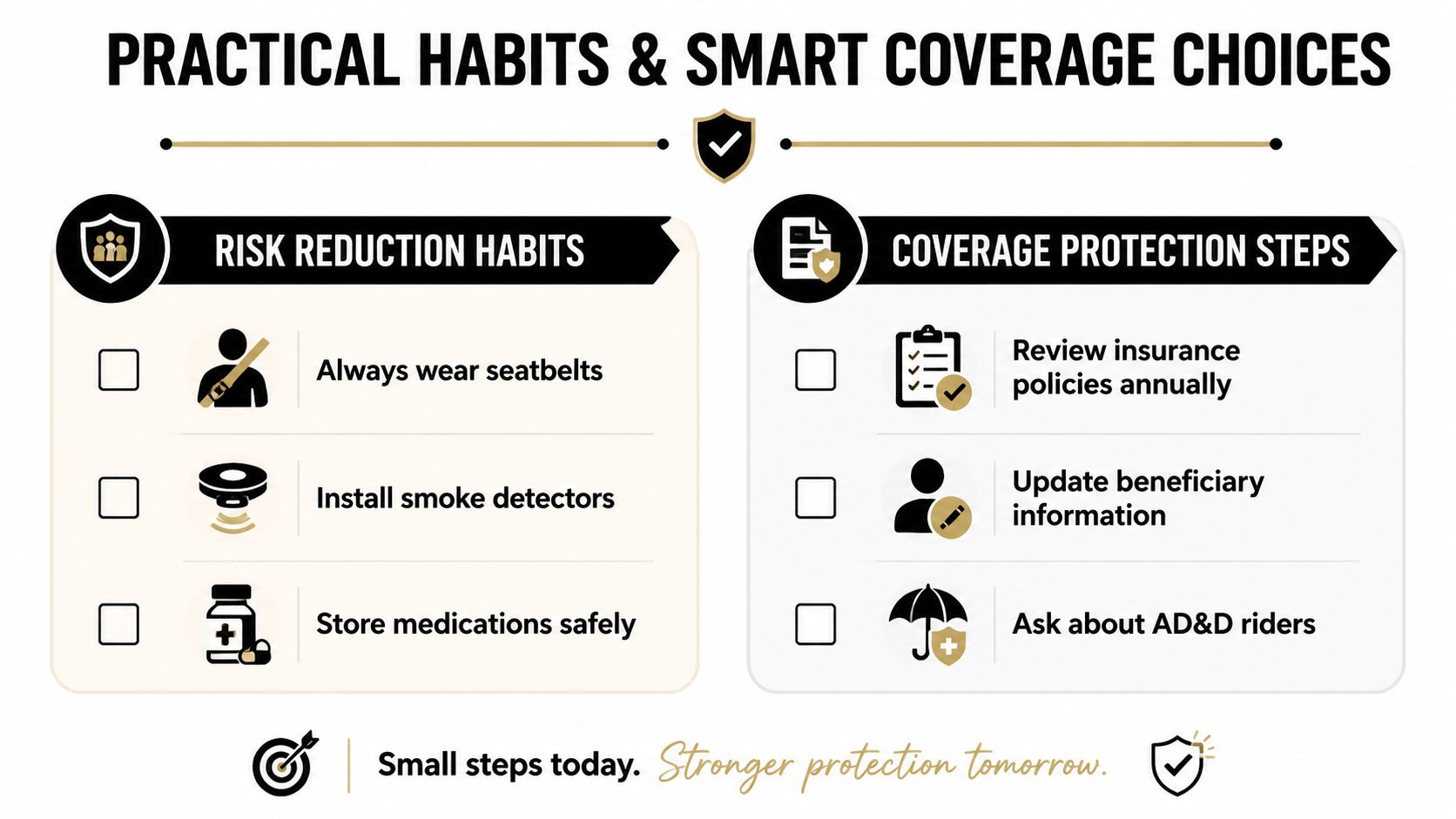
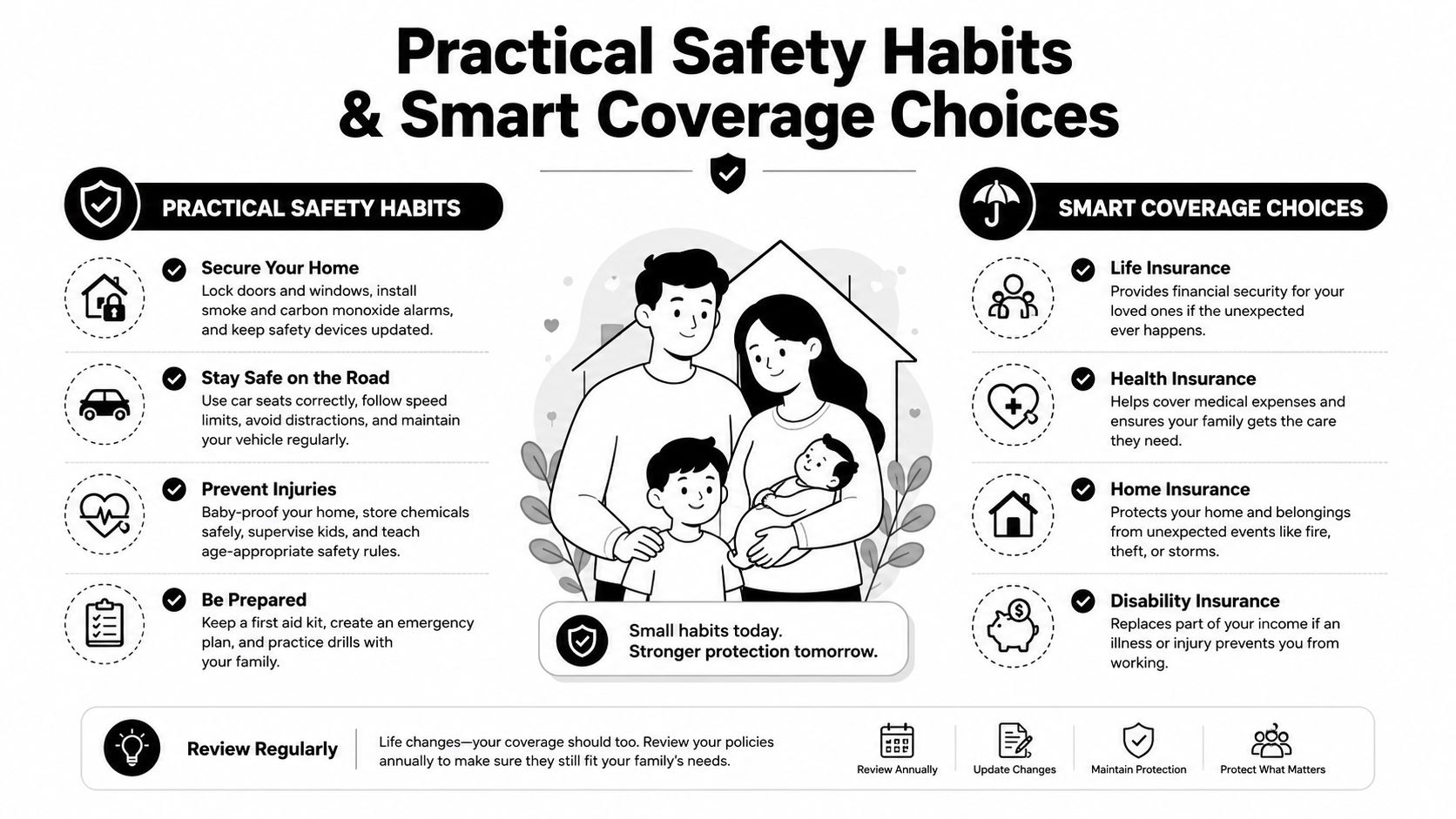
Prevention lowers risk, but it doesn't erase it. Seat belts, sober-driving plans, smoke detectors, safe medication storage, pool barriers, ladder awareness, and careful firearm storage all reduce the chance that a sudden external event turns into a family crisis.
Pair safety habits with coverage habits
Young families usually need two habits at the same time. First, they reduce day-to-day risk at home, in the car, and around children. Second, they make sure the financial backstop matches their life stage.
That means reviewing policies after marriage, a new child, a mortgage, a job change, or a move. It also means checking whether your term coverage is broad enough for the household and whether an AD&D rider is worth adding as a narrower supplement, not a substitute.
The planning side gets easier when you treat coverage like a household system, not a one-time purchase. A resource such as financial planning for young families can help connect insurance with the rest of the budget and long-term plan.
A simple decision framework
- Use term life first: when your main need is broad protection for income, debt, and dependents.
- Add AD&D when you want accident-specific layering: especially if your family wants extra protection tied to external injury events.
- Revisit both after major life changes: a new dependent, a new home, or a new commute can change the risk picture quickly.
Practical rule: if losing your income for one year would stress the household, your coverage review shouldn't wait until renewal season.
Coveredly offers digital term life insurance with optional accident-related protection, which makes it a practical place to compare broad coverage and narrower accident benefits in one place. If you want to see how accidental death fits into your own family plan, visit Coveredly and review your coverage with the same clarity you'd want for your beneficiaries.