Portable life insurance lets you keep your employer's group life coverage after you leave the job by paying the premiums yourself, usually for the same type of term coverage, within a limited amount and a short election window. You're likely reading this because you've resigned, accepted a new role, or opened an HR exit packet and found a form you don't remember signing up for.
Your first instinct may be to set that packet aside until you've started the new job. Don't. The decision isn't really whether coverage can follow you. It's how much you can keep, what it'll cost after the premium resets, and whether you act before the election window closes.
Table of Contents
- What Portable Life Insurance Means for Your Coverage
- Eligibility Rules and Caps That Limit What You Keep
- What Portable Coverage Costs and How Taxes Change It
- How Portable Coverage Works and How to Port It
- What to Do If the Election Deadline Passes
- Choose Between Porting, Converting and Replacing
What Portable Life Insurance Means for Your Coverage
Portable life insurance is employer-sponsored group life insurance that you may continue after losing eligibility, typically because of resignation, termination, retirement, or a job change, by paying the premiums personally. A Texas public-sector guide to portability versus conversion notes that portability can also apply when the employer's policy ends for your eligibility class, and that you, not the employer, become responsible for premiums.
Keeping your phone number when you switch carriers offers a useful comparison. The number follows you, but the new plan's price, length, and limits are set by the contract, not by you. Portability works the same way, and it's an optional plan feature, not an automatic right.
Your certificate of coverage controls eligibility, caps, and deadlines. That's the document to request first, because it answers what is portable life insurance in your specific plan, rather than in general.
Portability buys you continuity during a transition. It doesn't guarantee the same price, the same amount, or coverage for life.
How It Differs From Conversion and a New Policy
Conversion generally swaps your group term coverage for an individual permanent policy, such as whole life, while portability usually preserves the same basic type of group term insurance. A new individual policy is a third path, where you start fresh with your own amount and term, but you face new underwriting.
| Feature | Portability | Conversion | New individual policy |
|---|---|---|---|
| What it keeps | Group term coverage, usually the same type | Group term swapped for an individual permanent policy such as whole life | Whatever type and amount you choose |
| Medical exam | Usually none to continue, under group rules | Usually none within the conversion period | Usually required; may be declined or rated higher |
| Premium basis | Recalculated after employment ends and paid by you | Individual-policy rates, normally higher | Individual rates set by age, health and term |
| Typical deadline | Often a short window of about 31 to 90 days after coverage ends | Set by the conversion period in the certificate | No fixed deadline; you apply when you choose |
| Best fit | A short gap, or a fixed amount you still need | Permanent cover after a term policy ends | Long-term control over amount, term and price |
The National Association of Insurance Commissioners warns that employer-provided coverage may be insufficient and may not be transferable when employment ends. So treat portability as a bridge you check carefully, not as proof that your family is fully covered.
Eligibility Rules and Caps That Limit What You Keep
You leave a job on a Friday and assume your life insurance packs its bag and comes with you. It often does not. Portability works more like a transfer ticket with small print. The ticket says who can board, how much luggage is allowed, and how fast you must claim a seat.
The clearest example comes from a published group life portability form for employees under age 80 who were insured for at least 12 consecutive months and can perform the material duties of at least one gainful occupation. That source caps employee portability at the lesser of $500,000 or the amount in force when employment ends. Portability and conversion combined cannot exceed the amount in force immediately before termination under that provision, so you cannot stack the two options to end up with more than you had.
That is one form. Your certificate may set a different age limit, a different service period, a different cap, or different rules for spouses and children. The trap is reading one example online and assuming your plan matches.
Rules to Check in Your Certificate
Pull your certificate and look up each item by name. Do not rely on a summary email or a coworker memory of what was allowed last year.
| Rule | What to look for | Why it matters |
|---|---|---|
| Age limit | Maximum age for porting, plus any reduction schedule | Older workers may keep less or lose the option entirely |
| Length of prior coverage | Required months of participation before you can port | A recent hire may not qualify at all |
| Amount cap | Dollar ceiling or share of prior coverage allowed | The cap may fall short of a mortgage balance or income replacement need |
| Working capacity | Whether you must be able to perform gainful work when you elect | Illness or disability at the time of leaving can block the election |
| Election deadline | Number of days after coverage ends to file the election | Missing the deadline usually ends the option |
| Dependents | Separate continuation rights for spouse or children | Family members may need their own form and their own deadline |
A recent hire, an older worker, or someone currently unable to work may find the option closed or smaller than expected. It helps to picture a young family planning around an old group amount, then learning at claim time that only part of it carried over. That gap comes from the cap and the eligibility test, not from the premium.
If you are weighing a capped portable amount against buying your own policy, a clear comparison of group versus individual life insurance shows what control you gain and what you give up with each route. Check your exact age limit, service period, cap, and dependent rules in writing before you assume any amount will carry over. Write down the end date of coverage, the last day to elect, and the address for the form, then keep a copy of what you send.
What Portable Coverage Costs and How Taxes Change It
You leave the job, the employer share stops, and you pay the full premium yourself. The payroll deduction you remember was only part of the cost, so the new bill often feels like a jump even when the coverage amount stays the same. The rate may also be recalculated into an age band for portable continuation, which works like moving from a group discount to a list price.
A worker changing jobs in their 30s might see this clearly. The portable offer keeps $150,000 in force with no health questions, while a new 20-year term policy for the same amount requires an application and exam but quotes a lower monthly rate. Porting buys continuity without underwriting. A new policy buys a fresh price based on current health. Compare those two paths on amount, length, and health requirements before you choose.
Practical rule: Compare the portable quote and a new term quote side by side, for the same amount and period, before you decide which one is expensive.
The $50,000 Tax Threshold
While you are still employed, IRS guidance on group-term life insurance allows the first $50,000 of qualifying employer-provided group-term coverage to be excluded from taxable income under Internal Revenue Code section 79.
For employer-provided coverage above $50,000, the imputed cost from the IRS Premium Table is generally added to wages and subject to Social Security and Medicare taxes. Whether that tax applies turns on the employer providing coverage above that level and on how any employee contributions are treated under the rules, so review your plan documents rather than guessing from a general description.
That imputed-income tax applies only while the employer provides the coverage. Once you port and pay the full portable premium yourself, with no employer contribution, the section 79 imputed-income calculation stops. The pay-stub line for imputed income matters for the decision mainly while you are still employed, when you weigh taxable coverage at work against buying additional insurance on your own.
That $50,000 figure is a tax threshold, not a cap on how much insurance you may own.
Before you elect, ask these cost questions.
- Premium per unit: What is the premium per $1,000 of coverage, so unlike amounts can be compared fairly?
- Age steps: Does the rate step up at certain age bands, and when is the next increase?
- Employer share: Does the employer still pay any part after you leave, or is the full amount yours?
- Comparison quote: Have you checked a new policy price in a guide to life insurance cost per month?
Tax treatment varies by facts and jurisdiction. Confirm your situation with the plan administrator or a tax professional rather than guessing from a coworker's pay stub.
How Portable Coverage Works and How to Port It
The sequence matters more than the paperwork. Most gaps happen because someone confused the last day of work, the last day of coverage, and the last day to elect.
The Four Stages
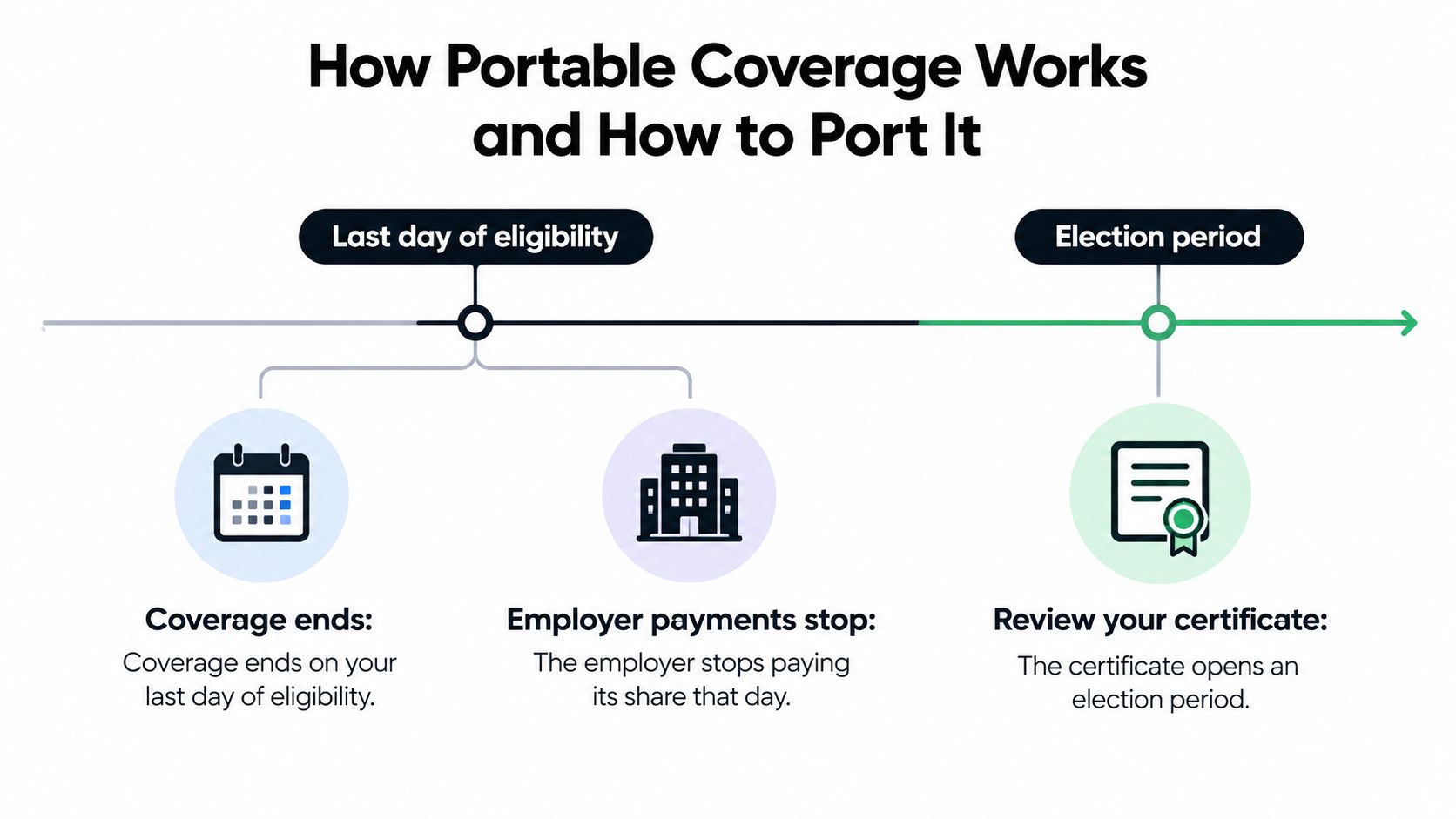
Stage 1, eligibility ends. Your group coverage ends on your last day of eligibility, and the employer stops paying its share that day. Your last day in the office and your last covered date may not match, so confirm both.
Stage 2, the election window opens. Your certificate sets a short period to apply, often about 31 days in public plans, as shown in one public-sector portability brochure, while other plan documents use 60 to 90 days, per that brochure's comparison of plan requirements.
Stage 3, ported coverage starts. In one public-plan example, ported coverage becomes effective on the 32nd day after group coverage ends. A late application can leave days with no coverage at all, even if you're eventually approved.
Stage 4, you pay personally. You pay the full premium, and the rate may be recalculated because group pricing tied to your employer no longer applies.
It's like a gym membership that moves with you to a new city. The membership continues, but the fee follows the new location's rules.
The timeline below shows where those dates sit in relation to each other.
Eight Steps to Port Without a Gap
- Request the documents early. Ask for the certificate of coverage and the portability notice before your last day, not after you've lost access to internal systems.
- Write down two dates. Note the coverage end date and the election deadline, and confirm the deadline in writing with the administrator.
- Check the amount against real needs. Compare the portable amount with your mortgage balance, income your family would need to replace, childcare, and education costs.
- Get the portable premium quote. Ask the plan administrator for the exact premium, how often it's billed, and when it can change.
- Get a comparison quote. Obtain at least one new individual term quote for the same amount, so you're choosing rather than defaulting.
- Submit before the deadline. Send the election form and first premium early enough to fix errors, and keep proof of delivery.
- Get written confirmation. Confirm the effective date, monthly premium, and benefit amount in writing before you rely on the coverage.
- Cancel backups last. Only after that confirmation should you reduce or cancel any other policy you were keeping as a safety net.
Don't ask only whether you can keep your life insurance. Ask exactly how much, for how long, at what price, and under which future events you can keep it.
Dependents may need their own election, so ask whether a spouse or children have separate forms and deadlines. Conversion is also a separate form with its own deadline, and filing one doesn't automatically file the other. Keep copies of everything, including envelopes or submission receipts, until your first premium has cleared and your confirmation letter matches what you elected.
What to Do If the Election Deadline Passes
If the window has already closed, act the same day. Some options may still be open, but they won't stay open while you wait.
First, reread your certificate for any other right that's still available, such as a conversion period. Conversion uses a separate form and its own deadline, so a missed portability date doesn't necessarily mean every path is gone.
Next, call the plan administrator and ask in writing whether the election window has closed and whether any exception applies. Don't plan around an exception, because you may not get one.
- Record the details: Write down every date, the name of the person you spoke with, and any reference number.
- Apply for new cover promptly: If portability is gone, apply for a new individual term policy right away, since delay can change your age and health rating.
- Expect new underwriting: A medical exam may be required, premiums may be higher, and a new policy may carry exclusions or waiting-period provisions.
- Keep existing cover: Don't cancel any coverage you still have until a new policy is issued, reviewed, and confirmed in force.
Name the gap plainly. The days between a lost election and a new policy's start date are unprotected, so decide quickly how much cover you need and how fast you can realistically get it in force.
Choose Between Porting, Converting and Replacing
Your health usually decides this faster than price does. If it's changed since you first got coverage, preserving what you have often matters more than chasing a lower quote.
The photo below captures the kind of unhurried, document-by-document review this decision deserves.

Under the NAIC replacement model regulation, if your health has changed, a replacement policy may cost more or you may be declined, and a new medical exam may be required, per that regulation. It also notes that claims under most new policies during approximately the first two years may be denied if based on inaccurate statements, and suicide limitations may begin again, according to the same regulation.
That's why you shouldn't cancel the old policy until the new contract is issued, reviewed, and confirmed in force. If you're considering the conversion route specifically, review how a life insurance policy conversion works before its separate deadline passes.
A Note on Tax-Free Exchanges
A Section 1035 exchange can sometimes move one life insurance policy into another, or into an annuity, without immediate federal income tax. FINRA's guidance on exchanging a life insurance policy explains that the transaction must meet statutory requirements, and cash value or an outstanding loan can affect the result, per that guidance. Get professional advice before any exchange.
The short video below walks through the choice in plain language if you'd rather listen than read.
| Situation | Likely path | Reason |
|---|---|---|
| Health has changed since you bought the policy | Port or convert | A replacement may cost more, be declined or need a new exam |
| Young, healthy and need cover for a set number of years | New individual term policy | Often cheaper than a portable premium of the same amount |
| Need coverage beyond the term, including lifelong dependents | Convert to permanent coverage, if the certificate allows | Keeps coverage without new medical evidence, at a higher premium |
| Policy has cash value or an outstanding loan | Get tax and professional advice before any exchange | A Section 1035 exchange may be tax-free, but only if all requirements are met |
| Need more than the portable cap or the plan's age limit allows | New individual term policy for the gap | Portability limits end the option; a new policy can fill the difference |
Compare the portable quote with a new term quote, keep the old policy active until new coverage is confirmed, and decide before the election deadline, not after it.
If your portable amount is capped, your deadline is tight, or you want a policy that isn't tied to any employer, Coveredly offers digital term life insurance you can compare and buy on your own schedule. Get a quote for the amount and term your family needs, then keep your employer coverage in force until your new policy is confirmed, so you never face a gap in protection.