Voluntary life insurance is optional employee-paid coverage you elect through work, usually by payroll deduction, that sits on top of any free basic group benefit. You're likely reading about it at open enrollment, right after a wedding or a first baby, when a benefits screen shows a small free amount already checked and a second amount you're asked to choose. The choice looks simple. It's worth slowing down, because the extra coverage can help your family, end when you change jobs, or both.
Table of Contents
- What Is Voluntary Life Insurance
- Voluntary Coverage Beside Basic and Individual Policies
- How Enrollment and Payroll Premiums Work
- What Happens When You Leave the Job
- How the Fifty Thousand Dollar Tax Rule Works
- When It Fits Newly Married Couples and Families
- Decide If the Workplace Election Is Enough
What Is Voluntary Life Insurance
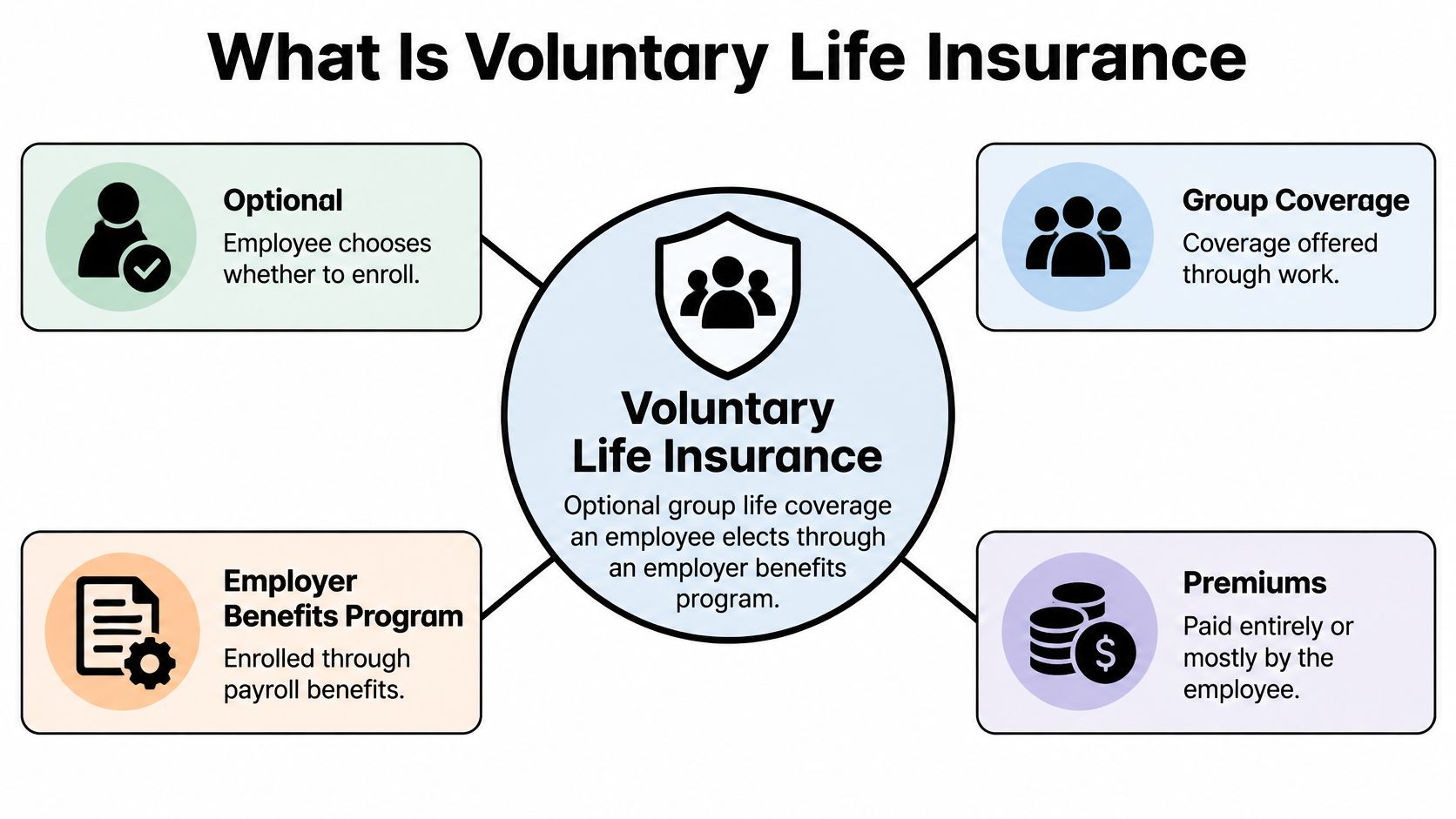
If you're asking what is voluntary life insurance, it's optional group life coverage an employee elects through an employer benefits program, with premiums paid entirely or mostly by the employee through payroll deduction. That's the whole definition. You choose it, you pay for it, and your employer is the place you buy it.
Basic employer-paid life insurance works differently. It's usually automatic, set at a specified amount, and free to you. Think of basic coverage as the spare tire that came with the car. Voluntary coverage is the extra tire you buy because one spare won't carry a mortgage, childcare and months of lost income.
Who relies on workplace coverage
In a 2024 LIMRA-reported survey cited by Guardian's guide to voluntary life insurance, 51% of respondents said they had some form of life insurance. Among those insured, 25% had workplace coverage only, 19% had both workplace and individual coverage, and 55% had only individual coverage. That mix tells the story. Workplace coverage is common, but most insured people don't rely on it alone.
The money goes to your named beneficiaries if you die while covered. They can use it for rent, debts or everyday costs. This is risk transfer, not a savings account. You're paying a small, steady amount so an insurer carries a large risk your household can't comfortably carry alone. Readers who want the longer view on how policies can fit a broader money plan can look at Blue Sage Tax & Accounting wealth strategies, but your first job here is simpler. Know what you're buying.
What can be covered
Some plans let you add a spouse or dependent children, usually for smaller amounts than your own coverage. That can be convenient, but it's separate coverage with its own limits, not a family pool you can draw from freely.
Practical rule: Read voluntary coverage as its own purchase, not as a bigger version of the free basic benefit. The amount, eligibility rules, underwriting, portability and treatment after employment ends all come from the plan documents.
Before you elect an amount, run three checks. First, what's already in force for free? Second, what does the extra election buy, and for whom? Third, does any of it last after this job? Voluntary life insurance is at its best when you can answer all three in writing, not from memory of a benefits meeting.
Voluntary Coverage Beside Basic and Individual Policies
These three layers get confused because they can all show up under the word life insurance. They're different products with different jobs.
| Feature | Basic employer-paid | Voluntary employee-paid | Individual policy |
|---|---|---|---|
| Who pays the premium | Employer | Employee, usually by payroll | Policyholder directly |
| How you get it | Often automatic at a set amount | You elect it during enrollment | You apply on your own |
| Typical size | Flat $20,000 or 1x salary | Chosen amount up to the plan maximum | Chosen to household need |
| Health questions | Usually none | Guaranteed issue up to a cap, then evidence of insurability | Age and health underwriting |
| After you leave the job | Often ends with employment | Sometimes portable or convertible, plan by plan | Stays in force if premiums are paid |
| Best role | Starter workplace benefit | Extra group protection | Core protection not tied to one employer |
What each layer is really for
Basic coverage is a starter benefit. A flat amount or one year of salary can help with immediate bills, but it usually won't replace years of income. Don't mistake a formula your employer picked for an amount matched to your rent, debts and dependents.
Voluntary coverage raises that starter amount inside the same workplace plan. You elect more, up to a plan maximum, and the premium comes from your paycheck. An individual policy is a contract you buy outside work. It's priced for your age and health, and it doesn't end because you resign. A side by side look at group coverage compared with an individual policy shows why many households end up with both. The workplace layer is easy to start. The individual layer is the one you control.
Guaranteed issue and evidence of insurability
Guaranteed issue means you can get coverage up to a stated cap during enrollment without a medical exam or detailed health questions. That's a real advantage if your health history would complicate a personal application.
Go above that cap and the insurer usually asks for evidence of insurability. You'll answer health questions and may face underwriting before the extra amount is approved. That's where people get tripped up. The amount you clicked isn't always the amount that's in force. Only the approved portion counts.
Access isn't the same as being insured, either. Smaller employers are less likely to offer workplace life insurance at all, so some households never see a voluntary option. If you're comparing how employers deliver these choices, this overview of standalone versus integrated benefits platforms explains why enrollment screens and plan rules vary so much between companies.
What to write down
For your own plan, record five things before you decide anything.
- Basic amount: what your employer already provides for free
- Voluntary maximum: the highest amount you can elect
- Guaranteed-issue limit: how much you can take without health questions
- Spouse option: whether a spouse can elect coverage, and up to what cap
- Portability: whether any of it can continue after you leave
The table sorts out what each layer is for. The practical question is how the election itself works, and that's a matter of timing, increments and payroll deductions.
How Enrollment and Payroll Premiums Work
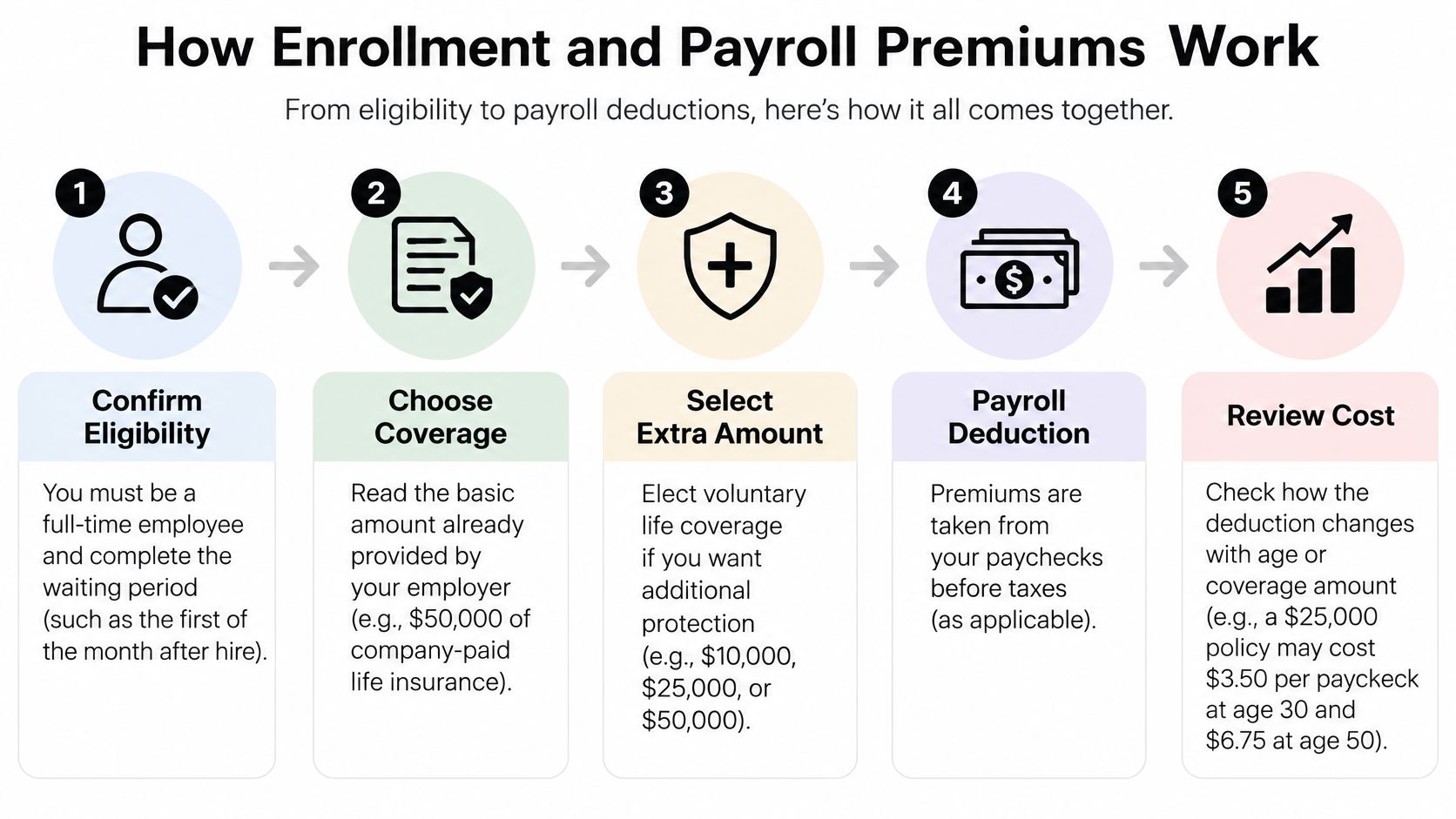
Enrollment is a short procedure, and each step exists for a reason. Skipping one is how families end up thinking they have coverage that was never approved.
The election, step by step
- Confirm eligibility. Plans often require full-time status and a waiting period, such as the first of the month after hire. You can't elect coverage before you're eligible, no matter how ready you are.
- Read the basic amount first. Voluntary coverage should be extra, not money spent replacing something you already get free.
- Choose an amount in the plan's increments. You'll usually pick multiples of salary or flat blocks. If avoiding health questions matters this year, stop at the guaranteed-issue amount.
- Price spouse or child coverage separately. Dependent coverage is usually a small add-on with its own cap and cost. Don't let a combined screen hide what each person's coverage costs.
- Submit during your window. New-hire enrollment and annual open enrollment are the normal times. Outside them, you'll commonly need a qualifying life event or evidence of insurability.
- Check how the premium is taken. Note whether your deduction is after tax or through a pre-tax cafeteria plan. That choice affects your tax result later.
- Name beneficiaries in writing. Don't assume a spouse is automatic. The names on file are what the insurer pays.
If you'd rather watch the process than read it, this walkthrough covers the same ground.
Why your deduction can rise
Group rates are often blended by age band. The same benefit amount can cost more when you move into the next birthday band, even if your health hasn't changed. That's not a penalty. It's how group pricing works, and it's why a cheap election at 29 deserves a fresh look at 35.
Save your confirmation. You want the face amount, who is covered, the deduction per pay period, how much is guaranteed issue versus medically underwritten, and the beneficiary names. That one page answers most questions a family would ask in a crisis.
What Happens When You Leave the Job
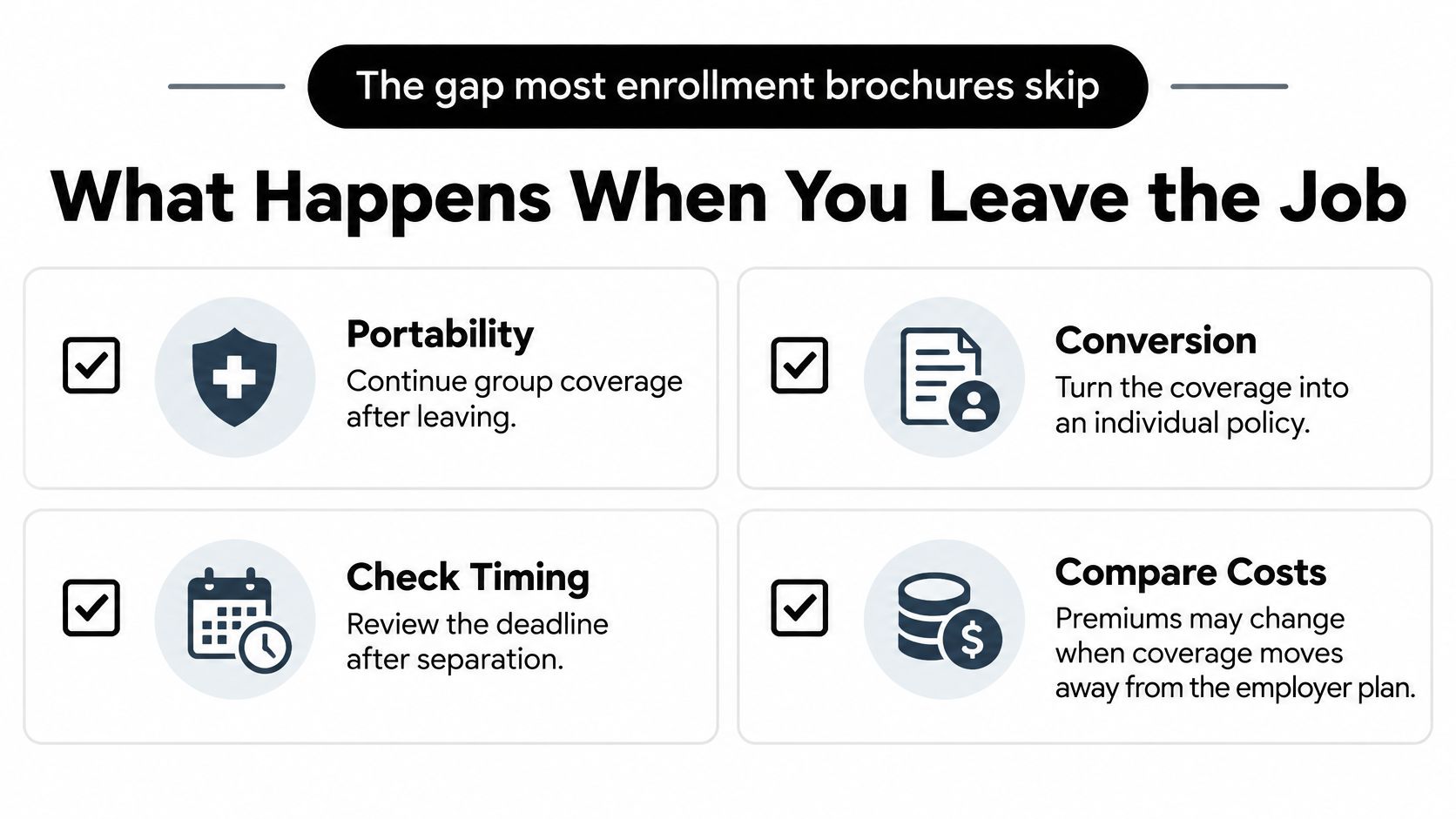
Many workers assume workplace coverage follows them. It often doesn't, and that's the gap most enrollment brochures skip.
Public benefits guidance in a Grand Traverse County voluntary life announcement puts the awareness problem plainly: 36% of U.S. workers are not fully aware that they have employer life insurance, while 43% of Americans incorrectly believe workplace coverage can typically follow them when they leave a job. If nearly half of people get this wrong, you shouldn't rely on a guess.
Porting is not converting
Portability generally lets you continue group coverage after leaving, paying the insurer directly. Conversion changes your group coverage into an individual policy. They're different products with different prices, deadlines and limits.
| Question | Port the group policy | Convert to an individual policy |
|---|---|---|
| What you keep | Group coverage continued after you leave | An individual policy, often permanent insurance |
| New medical evidence | Usually not required if you already qualify | Often waived |
| Premium after you leave | You may pay the full premium, and it can change | Often materially higher than the payroll rate |
| Dependents | Only if the certificate lets them continue | Only if the conversion offer includes them |
| Deadline | A plan-specific window after separation | A plan-specific window after separation |
| Risk if you miss it | Coverage can end with the job | The conversion right can expire |
Conversion without new medical evidence sounds like a gift, and sometimes it is. But depending on the policy type, coverage can be adjusted or converted to permanent insurance, which costs far more than term coverage. A conversion you can't afford to keep isn't protection.
Run a job-change stress test
Before you enroll, get answers to these questions from the certificate, not from a summary.
- Portable or not: can this exact coverage continue after separation?
- Dependents: can a spouse or child continue too?
- Deadline: how soon must you elect after your last day?
- New premium: what will you pay once payroll stops?
- Converted form: does it stay term insurance or become permanent?
A layoff, a move into your own business or retirement can end coverage on your last day of work. Replacing it later means new underwriting that looks at age, medical history and tobacco use. Life changes also affect who should be covered and who should be named, and deadlines around survivor benefits can be unforgiving, which is why Law Office of Bryan Fagan's divorce guidance is worth reading if a marriage is ending. If you want the mechanics in more detail, an explainer on how portable life insurance works is a useful next read.
Don't treat voluntary life insurance as your family's only policy unless the portability answers are in writing.
How the Fifty Thousand Dollar Tax Rule Works
There's a federal threshold for employer-provided group-term life insurance, and it's simpler than it sounds. According to the IRS guide to group-term life insurance, the first $50,000 of coverage is generally excluded from taxable income, while the imputed cost of coverage above $50,000 is generally included in wages and subject to Social Security and Medicare taxes.
The IRS doesn't use your actual premium. It uses age-based Table I rates. That surprises people who expect the tax figure to match their paycheck deduction.
The arithmetic
$150,000 of employer-provided group-term coverage minus the $50,000 exclusion leaves $100,000. That's 100 units of $1,000, multiplied by the applicable IRS age-based monthly rate, then annualized and reported as taxable compensation.
A smaller version makes the unit math obvious. Coverage $50,000 above the exclusion is 50 units before the monthly rate is applied. The taxable amount is usually modest, but it isn't zero, and it grows with the Table I rate as you age.
Who pays and how they pay
How the premium is paid matters as much as who pays it. Premiums run through a pre-tax Section 125 cafeteria plan or salary-reduction arrangement can be treated as employer contributions. That means coverage above the threshold may still create imputed income, even though you feel like you're paying for it yourself.
Coverage paid with after-tax dollars can reduce or eliminate the taxable amount, depending on the arrangement. Employee-paid premiums can reduce what's treated as taxable under the governing rules. Two employees with the same coverage can get different tax results purely because their payroll setup differs.
Check your year-end Form W-2 whenever basic plus supplemental group-term coverage exceeds the threshold. And keep one distinction straight. This tax applies to the cost of coverage while you're alive. It isn't a tax on the payout. The death benefit is generally income-tax-free to beneficiaries.
Ask benefits one question before you assume your extra coverage is tax-free: is my voluntary premium pre-tax or after-tax?
When It Fits Newly Married Couples and Families
Two households can look at the same enrollment screen and reasonably make opposite choices. It's about what would break if one income stopped.
Two households, two answers
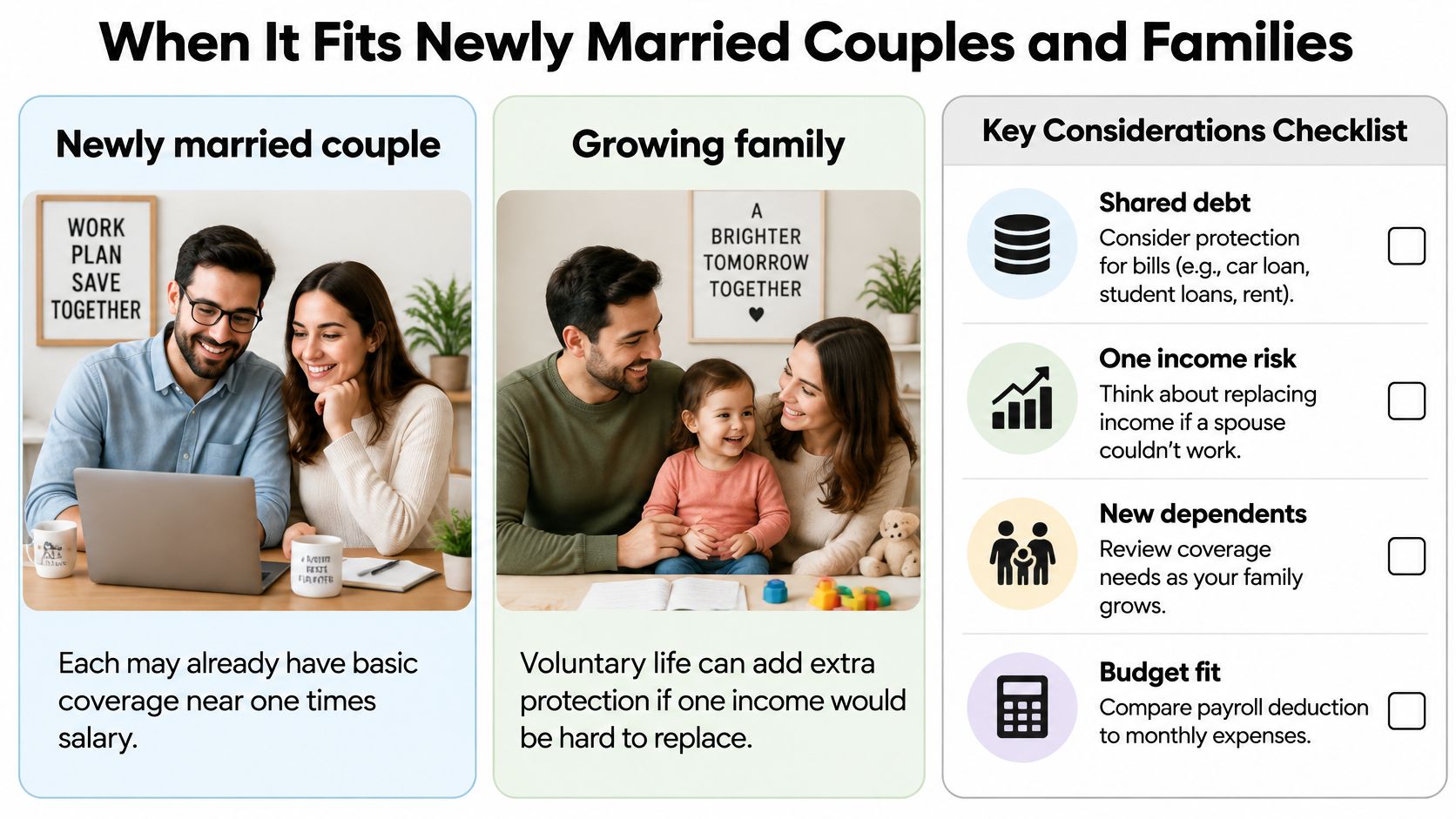
Say a newly married couple is renting, both working, with a small shared car loan. Each partner may already have basic coverage near one times salary. A voluntary election inside the guaranteed-issue window can cheaply raise that toward a year or two of the survivor's expenses. It's a reasonable first layer if both jobs are stable and they've noted the portability deadline.
Now say new parents have one income, a mortgage and childcare. A basic benefit won't replace years of income or clear a mortgage. LIMRA's 2025 facts about life insurance and workplace benefits reports that although 55% of U.S. workers report workplace life insurance, approximately 40% of Americans, about 100 million adults, say they need or need more coverage. Having something through work and having enough are different things.
A checklist that matches your real bills
- Start with survivor income. A common guideline is 10 to 15 times annual income, and Coveredly helps tailor coverage to each situation. Treat that range as a starting estimate, then trim it against your actual mortgage, debts and childcare.
- Subtract what you already have. Count liquid savings and any individual policy in force.
- Count workplace coverage carefully. Subtract only the amount that would still be in force if you died while employed. Don't subtract coverage that ends at resignation unless portability is confirmed.
- Price spouse and child coverage separately. A small rider isn't a substitute for insuring the income your household runs on.
- Name the hole. If the voluntary maximum, the evidence-of-insurability wall or a likely job change leaves a gap, that gap is the amount to place in an individual policy.
The verdict by situation is straightforward. Voluntary life insurance fits as a supplement during open enrollment, especially when it's guaranteed issue and the premium is comfortable. It doesn't fit as the only protection standing between a single income, a mortgage and a young child.
Decide If the Workplace Election Is Enough
Here's the verdict in three lines. Keep voluntary coverage when it's cheap, inside guaranteed issue and clearly extra on top of basic group life. Don't rely on it alone when the certificate is silent on portability, when your household needs 10 to 15 times income, or when a job change is likely in the next few years. Do both when the payroll plan is a good supplement and an individual term policy covers the gap that would remain after a layoff.
The trade-offs, once
- Pros: payroll convenience, possible guaranteed issue, and a chance to cover a spouse or child in the same enrollment
- Cons: coverage can end with the job, amounts are capped, rates can step up by age band, and pre-tax premiums can create imputed income above the federal threshold
If the gap after the stress test is real, an individual term policy is the layer that isn't tied to an employer. We offer term life insurance with no medical exams for policies up to $3M, and many policies start as low as $15 to $30 per month, depending on age, health and coverage amount. Coverage typically begins once the policy is approved and the first payment is processed. If you haven't sized the gap yet, a walkthrough of how much life insurance you need turns the checklist math into a number.
Use this order. Enroll in the voluntary plan if the guaranteed-issue window is open and the premium fits. Then apply for individual term for the remainder, so your family isn't uninsured between jobs.
Voluntary life insurance gives you an easy start through work, and Coveredly helps you cover the part that shouldn't depend on an employer, with term life insurance you can apply for fully online and no medical exams for policies up to $3M. Run the job-change stress test on your workplace election, size the gap, and get a quote for the coverage that stays with your family wherever you work next.