You've just welcomed a child, signed a mortgage, or combined finances with a partner. Your household depends on your income, yet you may have little time to decide what would happen if you died unexpectedly. The difficult question usually isn't whether protection matters. It's how much coverage you need, how long it should last, and which type fits your obligations without straining your budget.
That's the reason to ask why term life insurance belongs in your financial plan. Term coverage is designed around temporary financial responsibilities, such as income replacement, mortgage payments, childcare, education costs, and business obligations. It can provide substantial protection during the years your family has the most to lose, without requiring you to pay for lifelong coverage you may not need.
Table of Contents
- What Term Life Insurance Actually Is
- The Cost Advantage That Makes Term Life Affordable
- Term Life vs Permanent Insurance Which Fits Your Life
- Who Should Choose Term Life Insurance
- How Much Coverage Do You Really Need
- Common Myths About Term Life Insurance Debunked
- Your Next Steps to Getting Covered
What Term Life Insurance Actually Is
Maya and Daniel had a new baby, a mortgage, and two incomes supporting one household. They knew their family would need financial help if either parent died, but they didn't need an insurance policy designed to last forever. Their largest risks were concentrated in the years ahead, while their child was dependent and the mortgage balance remained significant.
Term life insurance addresses that kind of risk with a straightforward contract. You pay premiums for a defined period, such as 10, 20, or 30 years. If you die while the policy is active, the insurer pays the death benefit to your beneficiaries. Life insurance death benefits are generally received income-tax-free by beneficiaries, although individual tax situations can vary.
Think of term coverage as renting financial protection for the years you need it most. Permanent insurance is closer to buying a lifelong policy, usually with a cash-value component and more complex costs. Renting isn't automatically better than buying a home, and term isn't automatically better than permanent insurance. The right choice depends on whether your financial risk is temporary or lifelong.
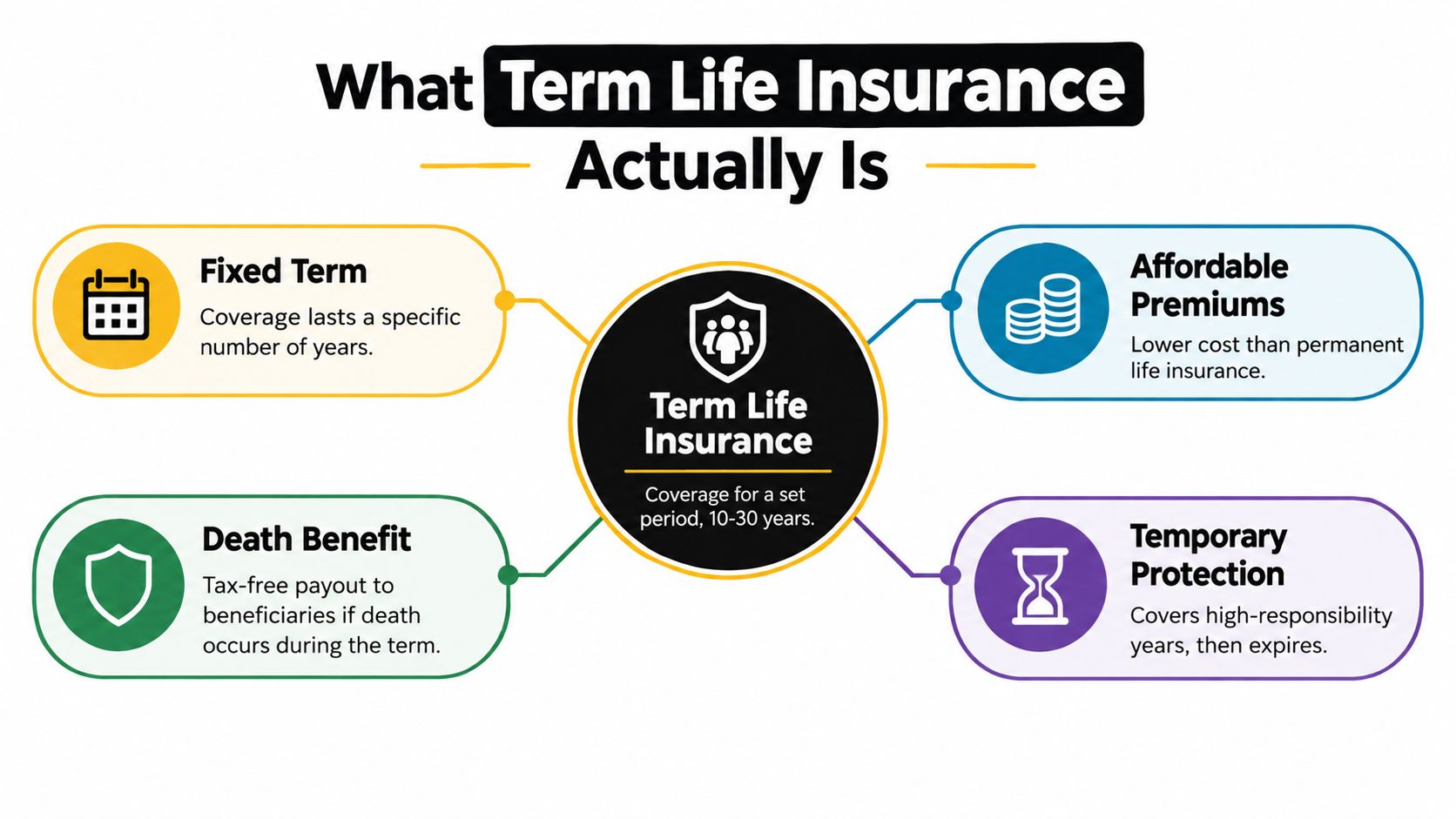
The responsibilities term coverage can protect
Term insurance is often matched to a specific financial window:
- Mortgage protection: The benefit can help a surviving partner keep the home or repay the mortgage.
- Income replacement: The policy can replace part of the earnings that support everyday household expenses.
- Child-rearing years: Coverage can help fund childcare and maintain stability while children depend on parental income.
- Business continuity: A professional or business owner can use coverage to protect a concentrated income stream or support a continuity plan.
Term life became a standard mass-market option because it offers a large death benefit for a relatively low premium over a fixed period. In 2022, 45.6% of U.S. households owned term coverage, compared with 16.9% holding cash-value coverage, according to LIMRA's 2024 life insurance fact sheet. If children would need a guardian, families should also understand the Texas guardianship and insurance implications before finalizing beneficiary arrangements.
For a plain-language explanation of the policy mechanics, see how term life insurance works. The central idea is simple: choose a benefit and term that match the period when your family's financial dependence is greatest.
The Cost Advantage That Makes Term Life Affordable
Term life insurance's strongest practical advantage is cost efficiency. A healthy applicant can often secure a substantial death benefit during working and child-rearing years without the higher premium associated with permanent coverage.
A quoted example illustrates how age affects pricing. For a healthy 30-year-old, a 20-year, $1 million term policy is quoted at around $37 per month for men and $29 per month for women, according to The Wall Street Journal's term life insurance guide. For the same coverage, the quoted monthly premiums rise to about $148 for men and $109 for women at age 50, and roughly $437 for men and $201 for women at age 60.
Those figures aren't a promise of what any particular applicant will pay. Insurers also consider health, tobacco use, occupation, coverage amount, policy length, and underwriting results. They do show the financial logic behind buying protection before the years when mortality risk becomes more expensive to insure.
Why age changes the premium
An insurer prices a policy according to the likelihood and potential cost of a claim during the coverage period. As people age, mortality risk generally rises. The insurer must account for that changing risk when setting premiums, so postponing a decision can make the same amount of protection more expensive.
For a young professional with a new mortgage, a lower premium can preserve cash for an emergency fund, retirement contributions, childcare, or debt repayment. For a newly married couple, early coverage can secure protection before health changes affect future eligibility or pricing.
Practical rule: Don't choose a benefit simply because it has the lowest premium. Choose coverage that would let the surviving household meet its obligations, then compare the cost of that protection across policy terms.
The value calculation also includes timing. A 20-year term may fit a household whose children will become financially independent within that period. A longer term may better match a later retirement date or a mortgage that extends further into the future. The cheapest policy isn't useful if it expires while your largest obligations remain.
You can review the factors that influence premiums in this guide to how much term life insurance costs. The goal isn't to predict a quote from a general example. It's to understand why term insurance can deliver a large death benefit while a family's budget is still limited.
Term Life vs Permanent Insurance Which Fits Your Life
Term and permanent insurance both provide a death benefit, but they solve different financial problems. Term coverage is built for a defined period. Permanent coverage is designed to remain in force throughout the insured person's life if premiums are paid and policy conditions are met, and it commonly includes cash value.
A side-by-side view makes the distinction easier.
Term vs Permanent Life Insurance Comparison
| Feature | Term Life | Permanent Life |
|---|---|---|
| Cost | Usually lower for a comparable death benefit during a selected term | Usually higher because coverage is designed to continue for life and may include cash value |
| Cash value | Typically no cash-value account | Usually includes a cash-value component with policy-specific rules |
| Duration | Ends at the conclusion of the term unless renewed or converted under the policy | Intended to last for life when policy requirements are satisfied |
| Flexibility | Lets you match coverage to a mortgage, dependent-care period, or income window | Can support lifelong needs but may involve more policy choices and conditions |
| Complexity | Relatively simple to understand and compare | Requires closer review of cash value, guarantees, charges, loans, and lapse risk |
| Typical use case | Income replacement, mortgage protection, childcare years, and business obligations | Lifelong estate needs, permanent dependents, or a deliberate cash-value strategy |
Choosing according to the obligation
Consider Jordan, a physician with a young family and a mortgage. His primary concern is replacing income while his children are dependent and while his household relies heavily on his earnings. Term insurance directly addresses that temporary exposure.
A different household may have a lifelong need, such as supporting a dependent who won't become financially independent. Permanent insurance may deserve consideration in that situation, particularly when the household understands the premium commitment and policy mechanics.
The phrase “buy term and invest the difference” is sometimes used to describe a strategy of purchasing affordable term coverage and directing available savings elsewhere. That approach can be sensible for some people, but it isn't a universal rule. Permanent insurance may fit specific estate or lifelong planning needs, while term is often the clearer choice for temporary protection.
Ask one question first: Will the financial need end, or will it continue for life? That answer narrows the field more effectively than comparing policy labels alone.
Who Should Choose Term Life Insurance
A young family can face a large financial shock if one parent dies, even when the household is otherwise stable. Rent or mortgage payments, childcare, daily expenses, and future plans may continue while one income disappears. Term life insurance often suits households whose financial responsibilities are high now but may change as children grow, debts decline, or careers develop.

Consider a newly married couple with a mortgage and student debt. If one salary is needed to keep the home and manage those obligations, coverage can protect the surviving partner during the years when that financial pressure is greatest. A professional with commission-based earnings, a specialized salary, or an ownership role may also need coverage if the household depends heavily on that contribution.
The need is widespread. Forty-two percent of U.S. adults reported in 2024 that they didn't have enough life insurance or had none at all, according to Bain's analysis of the life insurance protection gap. The same analysis estimates more than 100 million uninsured or underinsured people and a U.S. mortality coverage gap of about US$12 trillion. These figures point to a common problem: recognizing the need for protection does not automatically reveal the right policy amount.
The decision bottleneck is often confusion
People may understand that their family needs financial protection yet remain unsure how to turn income, debts, dependents, and future goals into a coverage decision. LIMRA reports that one-third of people with a coverage gap are unsure how much coverage they need or what type to buy, as described in its analysis of 92 million Americans with life insurance needs.
Term insurance can be a practical starting point for temporary responsibilities, but two questions still require attention: how long the protection should last and how large the death benefit should be. Someone supporting young children may need a different amount and duration from a professional whose debts are nearly paid. If your household would face serious disruption without your income, evaluating those two decisions is more useful than postponing coverage because the options feel difficult to compare.
How Much Coverage Do You Really Need
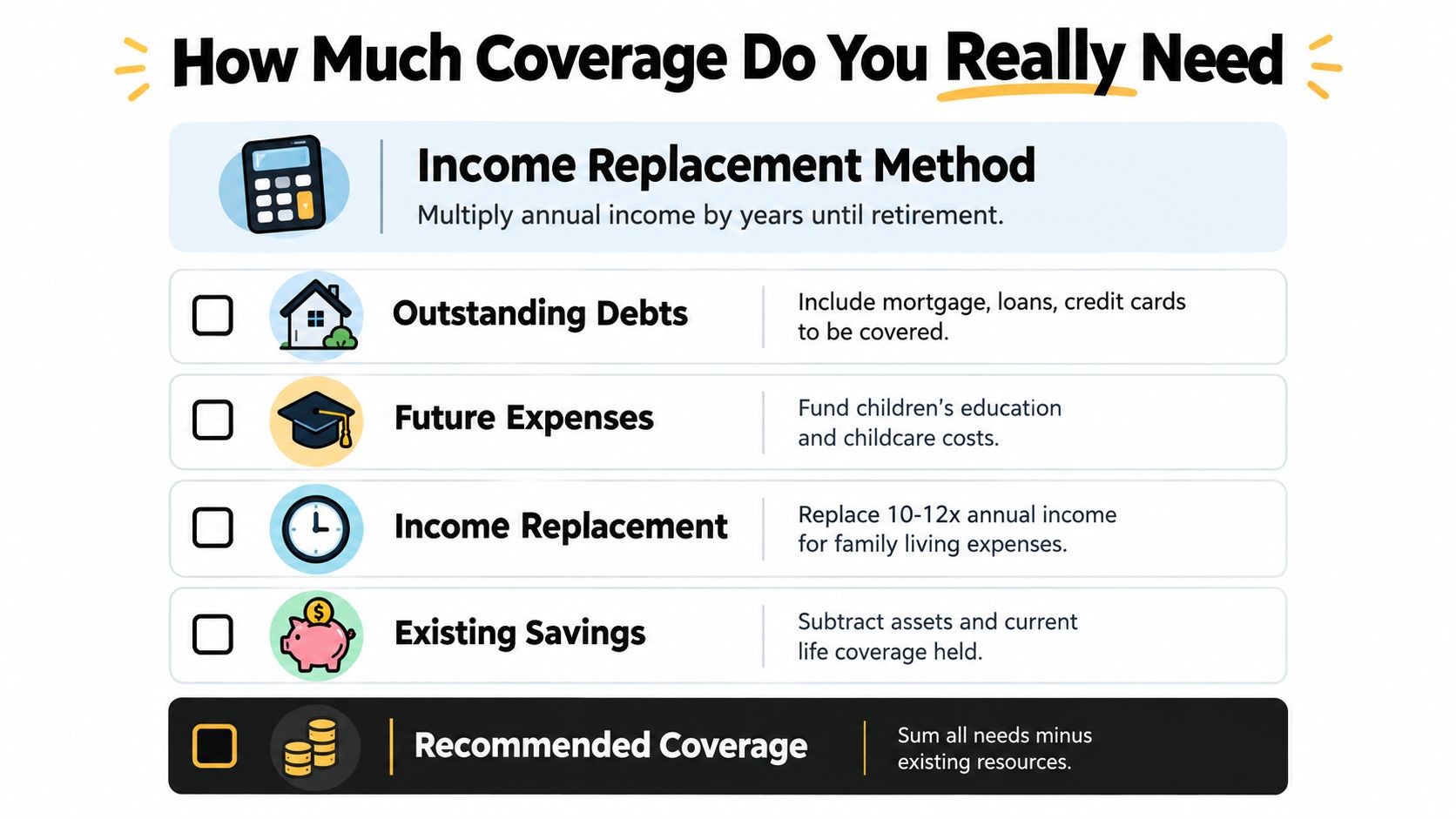
The most useful way to size life insurance is to calculate the financial responsibilities your death would leave behind. Don't start with a convenient policy amount. Start with the household's likely needs, then subtract resources that would already be available.
A practical calculation
Use this sequence:
- Estimate income replacement. Consider how much annual income your household would need and how many years the surviving family would need support. A young parent may need a longer income-replacement horizon than a professional nearing retirement.
- Add outstanding debts. Include the mortgage, personal loans, credit cards, and other obligations you'd want the death benefit to address.
- Add future expenses. Account for childcare, education goals, and the cost of maintaining the children's routine during a transition.
- Add final expenses. Include funeral and other immediate costs your family may face.
- Subtract existing resources. Deduct savings, investments, employer coverage, and individual life insurance already in force, but verify whether those resources are liquid and dependable.
- Review the result against your budget. A policy that fits the calculation but cannot be maintained isn't a durable solution.
Match the term to the timeline
Term length should follow the period of greatest dependency. A 30-year-old parent may choose a 20-year term if the main concern is covering the years until children become independent and major debts decline. At 40, the same term may still be appropriate, but the calculation should account for current income, remaining mortgage obligations, existing savings, and retirement timing.
A business professional should also consider how long the household depends on that income and whether a business partner would need time or capital to continue operations. Couples should calculate separately if their incomes and responsibilities differ.
For a more detailed framework, use this guide to how much term life insurance you may need. Your result is a starting point for comparing quotes, not a substitute for reviewing the policy with a qualified professional.
Common Myths About Term Life Insurance Debunked

Myth 1: Term insurance is wasted money if you outlive it.
Term insurance transfers financial risk during a defined period. It works much like car insurance: you pay for protection against a loss you hope never happens. If the term ends without a claim, the coverage still protected your household while the risk existed. A young parent, for example, may need income protection while children depend on that income, even if the family eventually reaches financial independence without filing a claim.
Myth 2: Young adults don't need coverage.
Healthy adults often underestimate how affordable term insurance can be. As noted in earlier coverage-gap research, many younger adults misjudge the cost by a wide margin. Waiting can also expose a future application to changes in age or health. A professional with a new mortgage or a growing family may find that applying while healthy gives them more predictable choices.
Myth 3: Permanent insurance is always better.
Permanent coverage can suit lifelong needs and cash-value planning. Its additional features do not automatically make it the right fit, however. If the main concern is temporary income replacement, term insurance may match that risk more directly and leave room in the budget for other priorities.
Read the policy carefully. Exclusions, conversion provisions, renewal pricing, and beneficiary designations can affect how the coverage works when your circumstances change.
Myth 4: Employer coverage is enough.
Group insurance can help, but it may depend on continued employment and may not equal the household's income-replacement need. Include it in the coverage picture, then check whether the remaining amount would support dependents, debts, and care responsibilities.
Myth 5: Applying is always complicated.
Digital applications and no-exam options can make the process easier for some applicants. Eligibility and underwriting rules still vary, so a simpler application does not remove the need to choose an appropriate benefit and term.
Your Next Steps to Getting Covered
Start with a household snapshot. Write down income, mortgage and other debts, dependent-care responsibilities, education goals, current savings, employer coverage, and any individual policies. Use those figures to estimate the amount your family would need, then choose a term that matches the years when those obligations are most concentrated.
Next, compare policies on more than the monthly premium. Check whether the policy is level term, whether renewal premiums can rise, whether conversion is available, what underwriting information is required, and whether the insurer's beneficiary and ownership rules fit your plan. If you're considering a no-exam application, confirm the coverage limits and eligibility criteria rather than assuming every applicant receives an instant decision.
Finally, apply while your health and finances support the coverage you want. Premiums generally reflect age and underwriting risk, so delaying can reduce your choices or increase the cost. Revisit your coverage after major changes such as marriage, a new child, a home purchase, a career change, or a substantial change in household income.
Estate documents matter too. A will and guardianship plan can help clarify who should care for children and how assets should be handled. For a separate resource on digital estate-planning tools, review the LegesGPT AI Legal Assistant will tools, then have important documents reviewed appropriately for your circumstances.
Coveredly offers online term life insurance with coverage up to $3 million and a digital application process with no medical exams for most applicants. Its platform is one option for people comparing term lengths from 10 to 30 years and matching coverage with income replacement, mortgage payoff, and dependent-care years.
Coveredly helps you compare and apply for digital term life insurance built around the financial responsibilities your family depends on. Visit Coveredly to review coverage options, estimate your protection gap, and take the next step toward securing a policy that fits your timeline and budget.