“Buy a multiple of your salary” is popular life insurance advice, but it can leave your family with the wrong amount. Your salary doesn't tell an insurer how much you owe, how long your children will need support, or how much your partner could manage without your income.
2 million dollar term life insurance should be a replacement amount, not a reassuring round number. Start with the obligations your family would inherit, subtract the resources they could use, and choose coverage that lasts through the years they need it. Then compare prices and underwriting options, because skipping a medical exam isn't automatically the best financial decision.
Table of Contents
- Who Really Needs $2 Million in Term Coverage
- How to Size a $2 Million Policy with the DIME Method
- What Drives the Premium on a $2 Million Policy
- Eligibility and Underwriting for Large Term Policies
- Policy Features to Compare Before You Buy
- Taxes and Ownership Rules Behind the Payout
- Confirm the Amount and Apply With Confidence
Who Really Needs $2 Million in Term Coverage
$2 million fits a particular financial situation, not a particular income level. A household with young children, a mortgage, and one main earner may need substantial protection. Another household earning the same income could need much less because its savings already cover most obligations.
The coverage gap is real: 42% of American adults, about 102 million people, said they needed life insurance or additional coverage, according to LIMRA's 2024 Life Insurance Fact Sheet. That finding supports doing a needs assessment, not choosing the same benefit for everyone.
A family's financial discussion should include both current bills and future responsibilities.

Household profiles and whether $2 million fits
| Household | Obligations that remain | Does $2 million usually fit? |
|---|---|---|
| Single adult, no dependents | Few or no debts; no one relies on the income | Usually more than needed; a smaller policy or none |
| Newlyweds, no children, two incomes | Shared mortgage; partner would need to cover costs | Fits only if the mortgage and debts are large; otherwise a smaller amount works |
| Young family, one main earner | Mortgage, childcare, future tuition, years of lost income | Often a strong fit for a 20 to 30 year term |
| Business owner with partner or loan obligations | Business debt, buy-sell funding, dependents | Can fit; confirm the structure with an advisor or attorney |
| High earner with substantial liquid assets | Savings and investments already cover most needs | Usually excessive; test against assets first |
These are starting profiles, not approval rules. A single adult may support an aging parent, while newlyweds may expect to have children or reduce working hours.
Match the duration to the obligation. For newlyweds, that might mean the remaining mortgage period. For a business owner, it might mean a loan maturity or ownership agreement; for an asset-rich household, an enduring estate-planning need may call for something other than temporary coverage.
Employer-sponsored insurance also deserves scrutiny. Check the benefit amount and what happens if you leave the job rather than assuming it will always be available.
First test: List the obligations that would still exist if you died tomorrow. Decide whether the proposed benefit covers them comfortably, falls short, or substantially exceeds the need.
How to Size a $2 Million Policy with the DIME Method
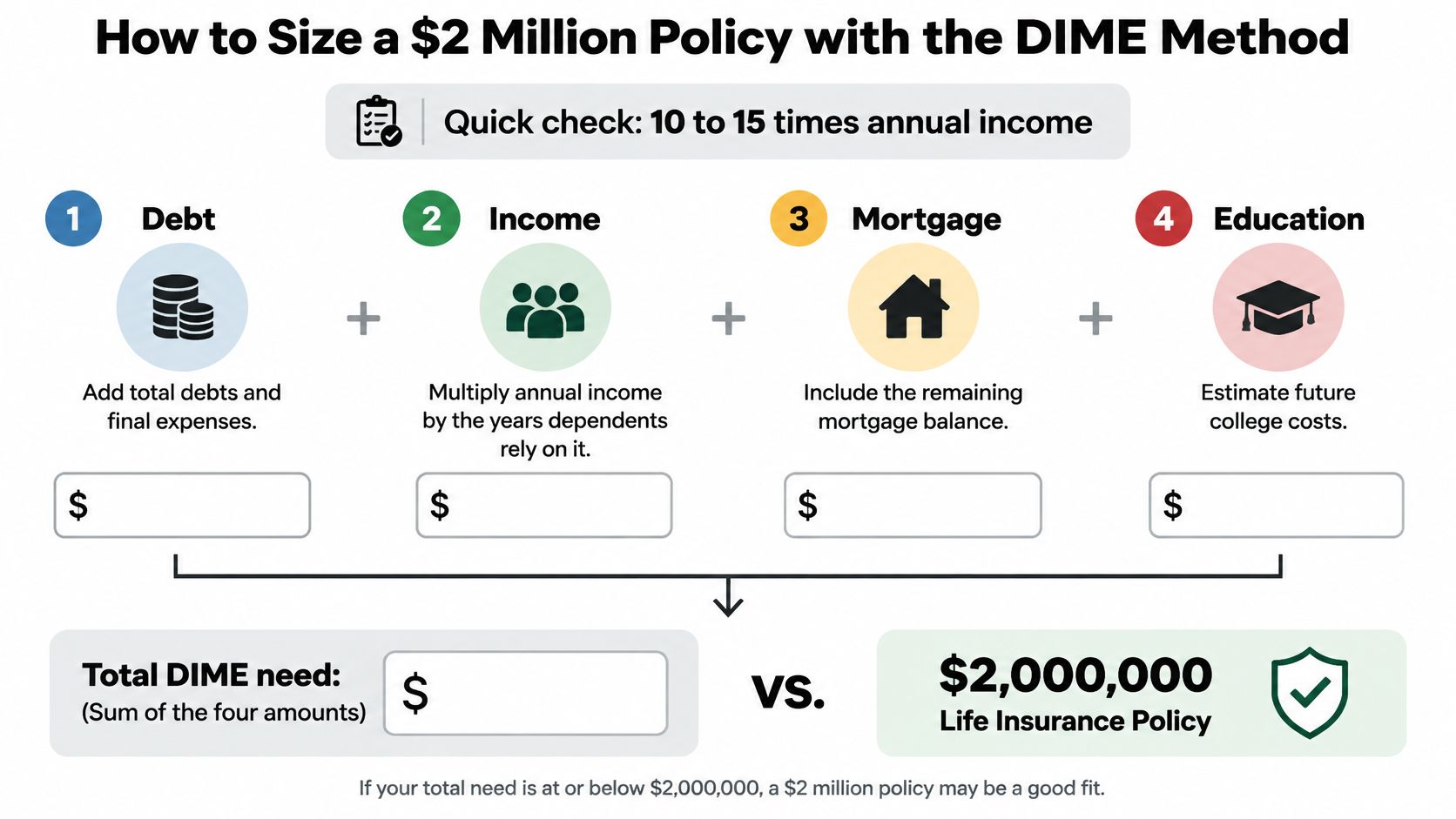
A common quick guideline is 10 to 15 times annual income, and we help tailor coverage to each situation. But a multiple is only an initial estimate: it doesn't distinguish a paid-off home from a large mortgage or account for unpaid caregiving.
The DIME method stands for Debt, Income replacement, Mortgage, and Education. Pacific Life's coverage-sizing guide explains how connecting coverage to obligations, then accounting for existing resources, produces a more useful estimate than a fixed income multiple.
Use this visual as a starting worksheet, then make the adjustments below.
Build the calculation from household expenses
Add nonmortgage debts. Start with credit cards, car loans, and personal loans that your plan should address. Include final expenses separately, and don't assume every debt automatically becomes a surviving spouse's personal responsibility.
Estimate income replacement. Calculate the annual household support needed and multiply it by the years dependents will need help. Use the actual spending gap, including replacement childcare, rather than automatically replacing your entire gross salary.
Add the mortgage balance. Include the payoff amount if keeping the home debt-free is part of the plan. If you do that, remove mortgage payments from the income-replacement budget so you don't count housing twice.
Estimate education funding. Set a goal for each child based on the education you intend to fund and the time until graduation. Treat this as a planning estimate, not a guaranteed tuition bill.
Subtract available resources. Deduct savings, investments, and existing life insurance, including employer coverage you reasonably expect to remain available. Don't count assets your survivor can't readily use or funds already committed elsewhere.
Compare the result with the proposed benefit. A shortfall means considering more coverage, revising goals, or identifying another funding source. A surplus needs an explanation, such as additional caregiving costs or a deliberate reserve.
DIME worked example for a $2 million policy
This hypothetical illustration uses planning assumptions, not average household costs. Suppose a family needs $50,000 annually for 15 years, has a $400,000 mortgage and $30,000 in other debt, wants $200,000 for two children's education, and has $150,000 available in savings.
| DIME item | Worked amount |
|---|---|
| Debts (credit cards, car and personal loans) | $30,000 |
| Income replacement ($50,000 a year for 15 years) | $750,000 |
| Remaining mortgage balance | $400,000 |
| Education for two children | $200,000 |
| Total obligations | $1,380,000 |
| Less savings and investments | -$150,000 |
| Less existing life insurance (none assumed) | $0 |
| Net need | $1,230,000 |
| Buffer left in a $2 million benefit after net need | $770,000 |
Under these assumptions, beneficiaries could allocate the new benefit toward the listed obligations after using the designated savings, leaving the buffer as a reserve. That reserve isn't automatically necessary: test it against inflation, final expenses, reduced survivor earnings, and caregiving before paying for it.
Our guide to how much term life insurance you need can help organize the decision. Recalculate after marriage, a birth, a home purchase, a raise, or new debt, and avoid assuming investment returns will make an otherwise inadequate benefit sufficient.
What Drives the Premium on a $2 Million Policy
Premium factors and how each one changes the price
| Premium factor | How it changes the price | What the buyer can do |
|---|---|---|
| Age at application | Premiums generally rise with each year of delay | Apply earlier while health is stable |
| Health and medical history | Sets the rate class; significant conditions can raise premiums | Answer every health question accurately and compare carriers |
| Tobacco and nicotine use | Smokers usually pay far more; carriers set their own look-back rules | Answer tobacco questions accurately and ask how the carrier treats recent quitters |
| Policy term | Longer terms generally cost more per year | Match the term to the years dependents or debts remain |
The face amount alone doesn't determine your premium. Insurers price the likelihood of paying a claim during the coverage period, so applicants seeking the same benefit can receive very different offers.
Age and health are especially important because you can't lock in today's eligibility indefinitely. Waiting may mean applying at an older age or after a new diagnosis. Still, an initial quote isn't a final underwriting decision, and a favorable estimate shouldn't be treated as a promised price.
Tobacco questions require particular care. Cigarettes, vaping, nicotine products, and recent cessation may receive different treatment across carriers, so answer the actual application questions rather than deciding for yourself which category applies.
A cheaper term can leave an expensive gap
For a hypothetical comparison, a 10-year term might look attractive beside longer coverage but end while children still rely on your income. Buying again later could require fresh underwriting when you're older or less healthy.
With most level-term policies, the premium stays fixed for the selected level-premium period. Confirm that guarantee in the contract, because a low introductory quote is different from a premium guaranteed throughout the period you need.
Whole life solves a different problem. It covers the insured for their entire life and includes a cash value savings component that grows over time, with premiums significantly higher than term life. Choosing permanent coverage for the same death benefit therefore requires a substantially larger ongoing budget.
Don't shorten the protection period simply to make the headline benefit affordable. Compare an appropriately sized policy that lasts long enough with a larger policy that expires too soon.
Request quotes from several carriers using the same face amount and term. We compare multiple carriers to find competitive pricing, but the comparison still needs matching assumptions.
For every quote, record:
- Monthly premium: The payment you would budget for.
- Term length: The period during which the death benefit applies.
- Assumed rate class: Whether the estimate assumes a health classification you haven't yet received.
- Premium guarantee: Whether the quoted rate remains fixed for the full selected term.
Eligibility and Underwriting for Large Term Policies
No medical exam doesn't mean no underwriting, and it doesn't automatically mean better value. A faster application can save time while still producing a higher premium, a different coverage limit, or an offer that doesn't match your needs.
Cost perceptions can discourage buyers before they obtain a real offer: 66% of prospects cite cost or competing financial priorities as reasons for not buying, according to LIMRA's analysis of the life insurance coverage gap. The useful response is to compare actual approved terms, not assume either traditional or digital underwriting must be cheaper.
What the insurer evaluates
Underwriting may use prescription history, medical records, driving records, lifestyle answers, and other authorized data sources. For a large policy, the insurer may also review income, existing insurance, and the financial purpose of the requested amount.
| Decision point | Full underwriting | Accelerated or digital underwriting |
|---|---|---|
| Approval speed | May take longer while evidence is collected | Can move faster when available information supports a decision |
| Evidence required | May include an exam, laboratory results, and medical records | Often uses application answers and electronic information; additional evidence may still be requested |
| Rate-class uncertainty | Detailed evidence may support a favorable class or reveal additional risk | Initial pricing may change after the insurer reviews information |
| Contestability | Application accuracy remains essential | Skipping an exam doesn't remove application obligations or contestability provisions |
A healthy applicant may benefit from fuller evidence if it supports a better rate class. Someone with a complicated history may prefer another route, but convenience alone doesn't establish which offer is suitable.
Many carriers offer flexible underwriting options for people with pre-existing conditions. A diagnosis shouldn't automatically end your search, although approval and pricing remain carrier-specific. Our explanation of the life insurance underwriting process can help you prepare accurate answers and relevant records.
Protect the application and the start date
Incomplete or inaccurate answers can trigger a claim review during the policy's early contestability period. Read each question carefully, disclose what it asks, and correct errors before accepting the policy.
- Establish a baseline: Identify an affordable amount that addresses the most urgent obligations.
- Compare the paths: Evaluate the final premium, evidence requirements, available benefit, and conversion provisions.
- Keep protection active: Revisit pricing and eligibility when circumstances change without canceling existing protection prematurely.
Coverage typically begins once the policy is approved and the first payment is processed, subject to its effective-date conditions. Don't mistake an application submission or preliminary quote for active insurance.
Policy Features to Compare Before You Buy
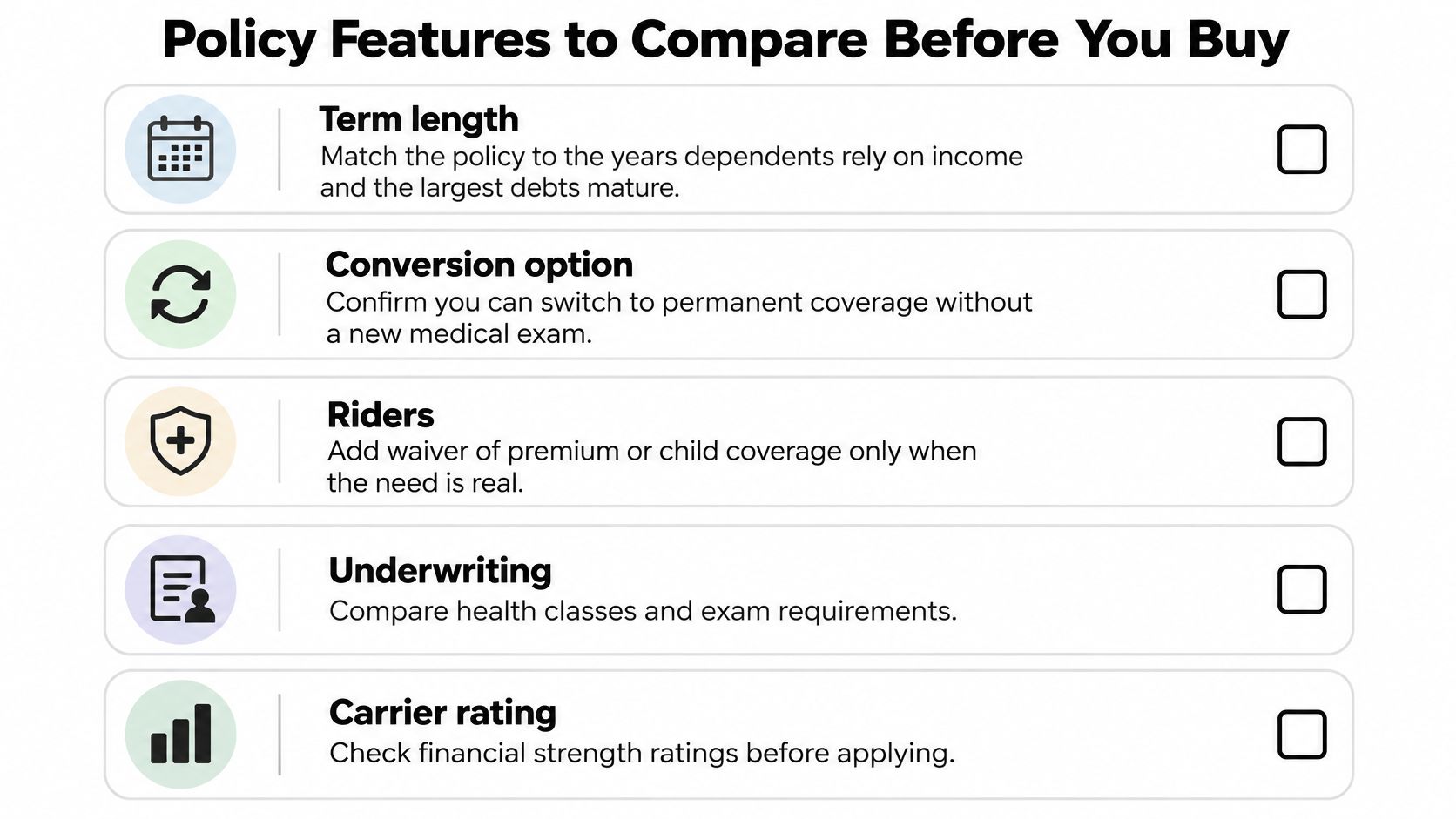
A premium tells you what you'll pay. The contract tells your family what they'll receive and under what conditions. Start with a term that extends through the relevant dependency period and major debt maturities, rather than selecting whatever duration the quote tool displays first.
Term life is the most popular and affordable type of life insurance because it provides pure protection without investment components for a set period. Permanent coverage serves a continuing need, while term coverage is designed around an obligation with an endpoint.
Use the checklist to compare features, then confirm the details in the actual policy.
Conversion and renewal aren't interchangeable
A conversion option may let you change eligible term coverage to permanent insurance without new medical underwriting. The right usually has an age limit, deadline, or restrictions on available permanent policies, so record the applicable date before filing the contract away.
Renewal is different: it may let you continue coverage after the original term, but the price can increase substantially. Check the renewal schedule rather than assuming your original premium continues.
Depending on the policy type, coverage can be adjusted or converted to permanent insurance. An increase may have different requirements from a decrease, so distinguish a contractual option from a change that requires a new application.
Payment protection and carrier reliability
Most policies include a grace period before coverage is affected by a missed payment. Know the exact window and reinstatement conditions, and use automatic payments with a backup reminder rather than relying on that window routinely.
Consider riders only when they address a genuine need. A waiver-of-premium provision or child rider may be useful, but its exclusions and cost matter more than its label.
For a structured approach to company comparisons, Comredix's guide to choosing a life insurer is a useful starting resource. Check the issuing carrier's current financial strength rating directly with the rating organization, and distinguish that carrier from the agency arranging the coverage.
Before accepting an offer, confirm:
- Term matched: The duration covers the obligations you intend to protect.
- Conversion deadline noted: You know the last eligible date and applicable conditions.
- Grace period known: You understand missed-payment and lapse rules.
- Beneficiaries named: Primary and backup designations reflect your wishes.
- Payment method set: The account and notification details are correct.
- Carrier rating checked: You've reviewed the issuing insurer, not just the application website.
Taxes and Ownership Rules Behind the Payout
Income tax and estate tax are separate questions. Life insurance proceeds paid because of the insured's death are generally excluded from federal gross income, but interest added to the payout is generally taxable, as Guardian's explanation of life insurance taxation describes.
Reviewing the beneficiary form alongside the ownership documents helps keep those questions separate.

The benefit and the interest receive different treatment
The underlying death benefit is ordinarily not taxable income to the beneficiary. If the insurer holds the proceeds or offers an interest-bearing settlement arrangement, the interest portion can create a reporting obligation even though the principal remains excluded.
Estate taxation addresses another issue: whether proceeds count toward the insured's estate. The 2026 federal basic estate-tax exclusion is $15 million per person, according to Blake Insurance Group's discussion of life insurance taxes, so most estates won't owe federal estate tax, although other estate-tax rules may still matter.
A named beneficiary and estate inclusion aren't opposites. Our guide to whether life insurance is part of an estate explains why direct payment to a beneficiary doesn't settle every ownership question.
Ownership powers can change the result
Under the federal regulation governing life insurance estate inclusion, proceeds may enter the gross estate when payable to the estate or when the insured retains incidents of ownership, and transferring an existing policy can leave the proceeds subject to inclusion under the three-year rule. Ownership powers include changing beneficiaries, canceling, assigning, pledging, or borrowing against the policy; naming a spouse doesn't remove those powers.
A properly structured trust may help address estate inclusion, but transferring a policy isn't a do-it-yourself beneficiary update. The Law Office of Bryan Fagan, PLLC's answers to common estate planning questions can help you prepare questions for qualified counsel.
Use the video as additional context before reviewing your documents.
- Name primary and contingent beneficiaries: Establish who receives the benefit and who serves as backup.
- Confirm ownership: Identify who holds the contractual powers.
- Update after major life events: Review marriage, divorce, births, and other material changes.
- Get transfer advice: Consult a tax or estate professional before changing ownership.
Confirm the Amount and Apply With Confidence
You don't need a perfect forecast of your family's future. You need a defensible estimate, an affordable payment, and a policy whose terms match the responsibility you're protecting.
Turn the calculation into an application
Finish the DIME worksheet. Use current statements for debts, mortgage balances, savings, and existing insurance. Replace guesses with documented figures wherever possible.
Confirm the duration. Identify the latest-ending obligation you intend to cover. Check that the selected term reaches that point rather than stopping at a convenient premium.
Request comparable quotes. Keep the benefit and term identical across carriers. Separate preliminary estimates from offers based on completed underwriting.
Read the policy features. Check the underwriting path, conversion deadline, grace period, and premium guarantee. Resolve discrepancies between the quote summary and policy documents before accepting.
Verify the people and ownership. Confirm the policy owner and primary and contingent beneficiaries. Make sure any business or trust arrangement matches the legal documents it supports.
Apply and confirm activation. Complete the application accurately, arrange payment, and obtain the effective date in writing. Save the issued policy where your beneficiaries can find it.
Decision rule: Let the household calculation set the coverage amount. Don't let a quote tool's default become your financial plan.
An online application is one route; an agent-assisted conversation or coordinated financial and estate-planning review may be more appropriate for complex needs. We're a licensed insurance agency that partners with carriers to issue policies, and our application process is fully digital from quote to policy issuance.
Whichever route you choose, check the carrier's terms, final premium, and start date before signing. Keep a copy of the assumptions behind your decision so future reviews begin with your family's needs, not another round-number guess.
We offer term life insurance with no medical exams for policies up to $3 million, including eligible applicants seeking $2 million in protection. Visit Coveredly with your completed DIME estimate to compare coverage options and begin a digital application, then confirm the final premium, carrier terms, and effective date before accepting.