You're comparing life insurance quotes after the kids are asleep, with a mortgage statement nearby and no clear idea which coverage amount to select. The cheapest quote looks tempting. But the key question is what your partner would have to pay for, stop doing, or earn differently if you weren't there.
Learning how to choose term life insurance starts with that financial shock, not an income multiple. Build the household's replacement budget first, then choose coverage you can keep in force.
Table of Contents
- Five Decisions to Make, in Order
- How Much Coverage Your Family Needs
- How Long Your Term Should Last
- No-Exam Versus Exam Underwriting
- Riders, Renewal Terms and Fair Price Comparisons
- Finalize Your Policy and Confirm Your Beneficiaries
Five Decisions to Make, in Order
Say a couple buys the cheapest policy without checking its expiration date. It ends before their mortgage does, and an older, smaller workplace policy is all that remains when one partner dies. The surviving partner receives a payout, but it can't clear the debts. The expired policy pays nothing.

The National Association of Insurance Commissioners' life insurance buyer's guide recommends considering coverage needs, duration, and affordability together. Term insurance protects against death during a defined period; it doesn't build cash value or function as a savings account.
Use this order:
- Set the coverage amount. Estimate lost income, debts, childcare, and other obligations, then subtract usable assets.
- Match the term length. Identify when those obligations end.
- Compare underwriting paths. Find out whether an exam changes the price for otherwise identical protection.
- Choose riders selectively. Check conversion rights first, then pay only for add-ons that close a named gap.
- Confirm the premium. Test affordability early, then make it the final approval gate. Could you keep paying through a hypothetical six-month income gap?
Coverage, term, and premium are decided together. A low price doesn't compensate for protection that ends too soon.
The five decisions and what each one depends on
| Decision | Question to answer | Where the answer comes from |
|---|---|---|
| 1. Coverage amount | How much money would the household need? | Debts, income replacement, and childcare worksheet |
| 2. Term length | How many years will those obligations last? | Child-independence and mortgage-payoff dates |
| 3. Underwriting path | Does no-exam cost more at the same face amount? | Side-by-side quotes with identical coverage and term |
| 4. Riders | Which add-ons close a risk you actually have? | Conversion rights first, then named protection gaps |
| 5. Premium | Could you pay through a six-month income gap? | Budget after essentials and emergency savings |
An oversized policy you can't maintain also fails the family. Write these answers on paper before opening a quote page.
How Much Coverage Your Family Needs
Start with the expenses your household would face, including services you currently provide without being paid. In its coverage-gap discussion, LIMRA reports that roughly 40% of U.S. adults, nearly 100 million people, lack life insurance or need more.
Use this checklist to collect the inputs before calculating.
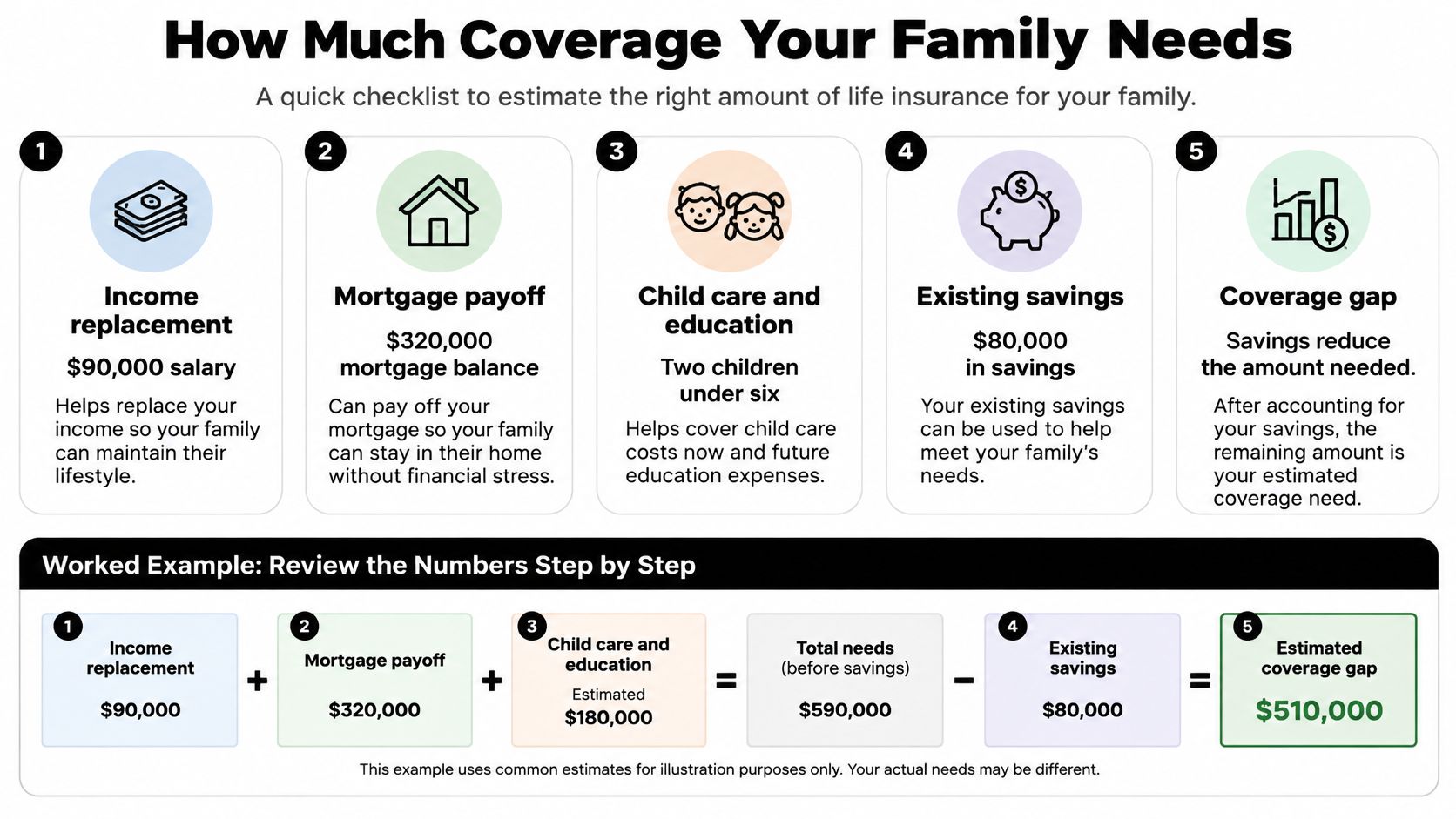
Work through the household's financial shock
Consider a hypothetical 32-year-old earner with a $90,000 salary, a $320,000 mortgage, two children under six, and $80,000 in savings. These are illustrative assumptions, not recommended spending allowances.
For this example:
- Replace income: $90,000 multiplied by 20 years equals $1,800,000 before investment returns.
- Add debt: The $320,000 mortgage brings the subtotal to $2,120,000. Add other debts separately.
- Add care and education: Assume $100,000 for both children's care and college, bringing the subtotal to $2,220,000.
- Add final expenses: An assumed $15,000 brings the total to $2,235,000.
- Subtract available assets: Deduct $80,000 in savings for an estimated coverage need of $2,155,000 before investment returns.
Replace every assumption with your own figures. A hypothetical final-expense allowance of $10,000 to $20,000 may be useful for testing the calculation, but obtain local estimates rather than treating that range as a price quote.
Coverage worksheet with a worked example
| Need | How to estimate it |
|---|---|
| Income replacement | Annual income times years until independence, adjusted for expected investment returns |
| Mortgage and debts | Current payoff balances from lender statements |
| Childcare and education | Annual care costs times years needed, plus planned college funding |
| Final expenses | Funeral estimates, estate administration, and unpaid final bills |
| Less assets and coverage | Subtract available savings, investments, and employer group life; recheck workplace coverage after a job change |
Adjust the arithmetic before buying
Don't replace gross salary automatically if the surviving household would need less. Equally, don't add a mortgage payoff while also including the same mortgage payments in the replacement-income budget.
Investment returns can reduce the starting capital required, while inflation can increase future costs. Model both conservatively rather than subtracting an arbitrary return percentage.
A common guideline is 10–15 times annual income, and we help tailor coverage to each situation. Use that guideline as a cross-check, not a substitute for a life insurance needs analysis.
For variable compensation, averaging three years of income is a practical starting method rather than relying on the best year. For a stay-at-home partner, price replacement childcare, school transport, meal preparation, and household management.
This video provides another way to approach the decision.
Often forgotten: Unpaid care work has a replacement cost, even when it doesn't appear on a pay stub.
How Long Your Term Should Last
Put the mortgage-payoff date and your youngest child's likely independence date on the same calendar. Those dates usually provide better anchors than your age alone.
The NAIC's consumer life insurance guide explains that term coverage pays a death benefit only if the insured dies during the selected coverage period. Outliving the term doesn't produce a payout under an ordinary term policy.
Match the obligation, not just the life stage
Common term options run from 10 to 30 years. For planning, consider a two-to-five-year buffer beyond the expected obligation where your budget allows; that's a cushion, not a requirement.
The examples below are starting scenarios, not promises that a particular term will suit everyone.
Typical term lengths by life stage
| Life stage | Typical term | Why this term fits |
|---|---|---|
| Newlyweds, no children | 20 years | Covers an assumed period of shared-income dependence and a first home loan |
| Young family, child under five | 20 to 25 years | Fits a planning assumption of financial independence around age 22 to 25 |
| First-time buyer on a 30-year mortgage | 25 to 30 years | Can match remaining payments; a shorter term needs a plan for the uncovered balance |
| Business partner with a company loan | Loan term or buy-sell period | Funds debt repayment or the agreed ownership transition |
| Mid-career professional, children nearly grown | 10 to 15 years | Matches a shorter remaining dependency period |
A newlywed couple expecting children later may need longer protection than the initial home loan suggests. A mid-career professional may need less if accumulated assets can already support the surviving partner.
Business owners should match coverage to the actual loan documents and buy-sell agreement. Don't assume a family policy also funds a business obligation.
A shorter policy with conversion rights can preserve access to permanent coverage later without a new medical exam, subject to its deadline and terms. Conversion isn't a free extension of the original term price.
Use the term-length planning guide to map the dates before choosing.
Buy through the end of the financial need, not merely through the cheapest available coverage period.
No-Exam Versus Exam Underwriting
No-exam life insurance doesn't always cost more. A healthy nonsmoker might receive competitive accelerated-underwriting terms without testing, while another applicant could get a better offer after an exam supplies more favorable medical evidence.
No exam describes the process, not the risk class. Insurers can still review prescription histories, medical information, and other authorized records.
Compare the actual underwriting offer
An initial quote isn't the same as an approved premium. Ask which underwriting path the quote assumes and whether the insurer can request an exam later.
Underwriting paths compared
| Path | How it works | Typical timeline | Pricing tendency | Best fit |
|---|---|---|---|---|
| Accelerated no-exam | Digital application with data and prescription checks | Often a decision within days | Can be higher than exam rates for very healthy applicants | You want speed without an appointment |
| Full underwriting with exam | Paramedical visit with blood and urine samples, plus records review | Several weeks | Often the lowest rates for healthy applicants | You're healthy and price matters most |
| Simplified issue | A few health questions without an exam | Days to a few weeks | Usually higher than exam rates | A minor condition or scheduling constraint makes testing unattractive |
| Guaranteed issue | No health questions | Immediate approval may be available, subject to eligibility | Highest premiums; often lower face amounts and a waiting period | Health rules out other paths |
These are process expectations, not carrier service guarantees. Missing records, inconsistent answers, or follow-up questions can delay a decision.
Guaranteed issue deserves particular caution. It's often permanent final-expense coverage rather than a comparable term product, and its limited benefit may not solve a family's income-replacement need.
Use the comparison below to separate convenience from underwriting depth.
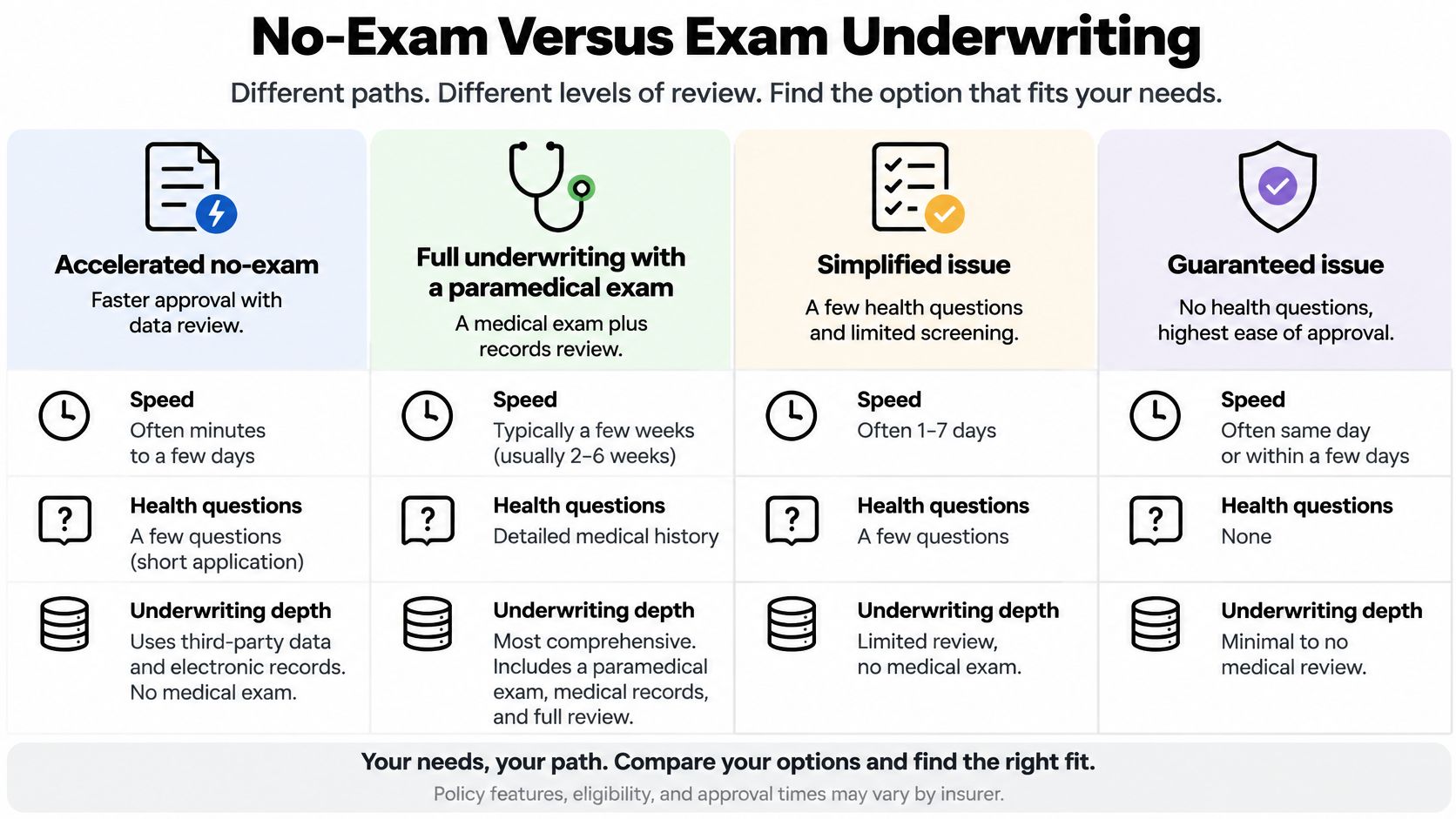
Decide what convenience is worth
A healthy applicant who can wait a few weeks should consider the exam route rather than assume avoiding a blood draw is always the better deal. Someone with urgent protection needs may reasonably accept a higher premium for faster issuance.
Many carriers offer flexible underwriting options for people with pre-existing conditions. In many cases, no medical exam is needed because policies are approved using digital underwriting and health data.
A diagnosis doesn't automatically make simplified or guaranteed issue your best option. Prepare a medication list, treatment dates, and relevant follow-up results so an underwriter can evaluate the condition accurately.
Answer questions about diagnoses, medications, tobacco or nicotine, hazardous hobbies, occupation, foreign travel, and family medical history completely. Omissions can trigger further underwriting, a rating change, or a claim dispute.
Compare offers at the same face amount, term, and conversion rights using the full policy-feature checklist below. Otherwise, an apparent underwriting discount may reflect less protection.
Our life insurance medical exam guide explains what to prepare if testing is part of your application.
Riders, Renewal Terms and Fair Price Comparisons
The lowest initial premium can hide a shorter price guarantee. Before selecting it, find the level-premium period, the guaranteed renewal schedule, and the conversion deadline.
Normalize each quote for face amount, term length, level-premium period, payment frequency, exclusions, conversion rights, and renewal pricing. Check the issuing insurer's financial strength through independent rating agencies, too. A familiar agency name isn't a substitute for evaluating the carrier that owes the benefit.
Read what happens after the initial guarantee
Renewal can preserve access to coverage but become expensive. Conversion may protect future insurability, although the new permanent policy can require substantially higher premiums.
Read the actual exclusions, including any restrictions related to activities or circumstances disclosed during underwriting. Ordinary term insurance doesn't replace disability income or pay routine medical bills while you're alive.
Policy maintenance matters as much as selection. The Society of Actuaries/LIMRA study of 2016–2022 experience found approximately 1.0%–1.5% lapse rates for 30-year term at attained ages 60 and older.
Use automatic payments and keep contact details current. Coverage can lapse when a missed payment remains unpaid beyond the contract's grace period.
Make each rider justify its price
Common riders and when they earn their cost
| Rider | What it adds | Worth considering when |
|---|---|---|
| Conversion option | Changes term to permanent coverage without a new medical exam | Your health may change before the term ends |
| Child term rider | Small coverage on children | You have young children and want a low-cost addition |
| Waiver of premium | Waives premiums for qualifying disability | You're a single-income household with limited savings |
| Accelerated death benefit | Pays part of the benefit during qualifying terminal illness | You want access to funds during a serious illness |
| Return of premium | Refunds eligible premiums at term end | You accept a much higher premium for the refund; usually expensive |
Check definitions rather than relying on rider names. Disability waiting periods, terminal-illness eligibility, and conversion deadlines determine whether the feature will help.
An accelerated benefit generally reduces what beneficiaries later receive. Waiver of premium keeps the policy funded; it doesn't replace your paycheck.
I would prioritize adequate base coverage over return of premium. Paying extra to recover premiums later is a poor trade if it forces you to reduce the death benefit your family needs now.
Finalize Your Policy and Confirm Your Beneficiaries
A signed application is not coverage. Confirm the effective date in writing before treating your family as insured, since a submission or preliminary quote proves nothing about active protection.

Complete the purchase deliberately:
- Obtain comparable quotes. Use the same coverage amount and term across several carriers, with matching policy features and financial-strength checks. Coveredly is a licensed insurance agency that compares multiple carriers to find competitive pricing.
- Complete the application accurately. Review every health and lifestyle answer before signing, including answers entered by someone helping you. A typical application asks for basic personal info, health history, and lifestyle questions, and a careless answer can delay or alter the approved offer.
- Review the approved offer. Confirm the final premium, risk class, exclusions, and effective date. Coverage typically begins once the policy is approved and the first payment is processed. The risk class on that offer is where your earlier underwriting choice shows its price.
- Record the grace period. Most policies include one before a missed payment affects coverage. Note the contractual deadline and what reinstatement requires if you ever pass it.
- Name primary and contingent beneficiaries. Confirm names, shares, and the payout method. A contingent keeps the payout moving if the primary cannot receive it. If children are minors, arrange a suitable trust or other legally appropriate structure rather than assuming they can receive funds directly.
- Resolve tax and ownership questions. Ask a qualified tax professional about installment payouts or any policy transfer before you sign.
- Schedule the review. Recalculate after marriage, a child, a home purchase, a career change, divorce, or a material debt reduction.
The IRS guidance on life insurance proceeds says death benefits are generally excluded from federal gross income, but additional interest, including the interest component of installments, is taxable. Transferring a policy for value can also limit the exclusion.
Coordinate beneficiaries with your broader estate arrangements. For homeowners weighing how a house passes to heirs, The Law Office of Bryan Fagan's explanation of transfer-on-death deeds in Montgomery County offers relevant local context, separate from the insurance beneficiary designation.
Coveredly offers term life insurance with no medical exams for policies up to $3M, and coverage can be raised or lowered as life changes without starting over. Request quotes once your worksheet and obligation dates are ready.
Annual review: Confirm the benefit still fits, the beneficiaries are correct, and the payment method still works.
Record the coverage start date and next review date in your calendar before closing the application.
Coveredly offers online term life insurance and guidance to help match protection to your household's obligations. Bring your coverage worksheet and target term to Coveredly to compare carriers and evaluate the underwriting options that fit your situation.