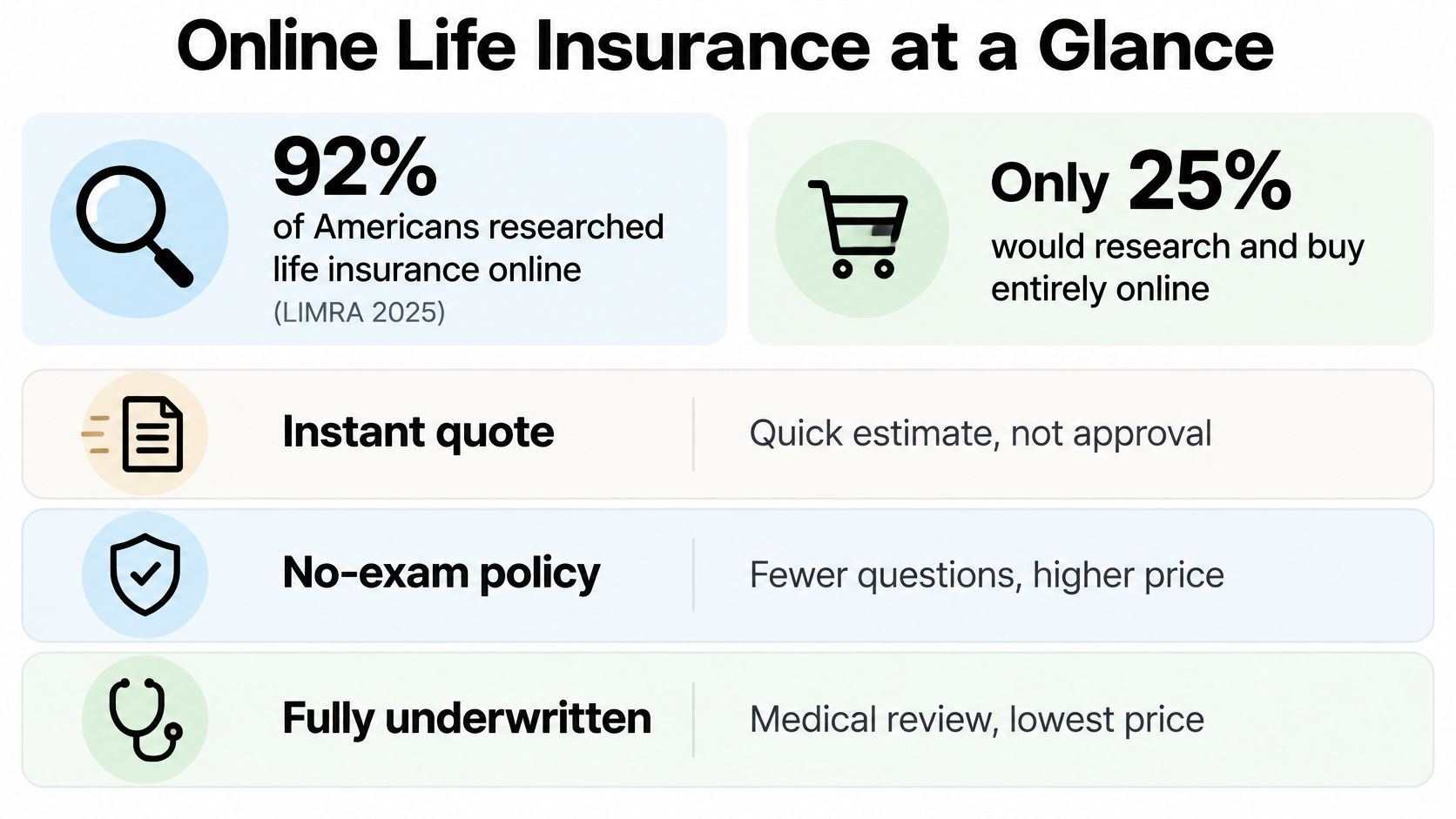
92% of consumers researched life insurance online in 2025, up from 71% in 2015, according to LIMRA's 2025 Insurance Barometer facts. Shopping for coverage is now a digital activity almost by default. Yet the quote cards consumers collect aren't comparable, because each one hides a different approval path, a different end date and a different answer to the question "is this price final?"
Two online quotes are comparable only when they share four fields: underwriting route, term length, renewal terms and price finality. Line those up and the cheapest premium usually stops being the obvious winner. Skip them and you're comparing a 10-year estimate against a 30-year guaranteed rate and calling the difference a saving.
Table of Contents
- Online Life Insurance Options at a Glance
- Matching Coverage Amount and Term Length
- How Underwriting Decides Your Price and Speed
- Application Steps and Insurer Strength
- Premiums, Renewals and Features That Change Total Cost
- Choosing the Right Policy by Household Situation
- How to Build a Fair Side-by-Side Quote Comparison
- Confirm Your Shortlist and Apply for Term Coverage
Online Life Insurance Options at a Glance
A useful online life insurance comparison starts with the job the policy needs to do. Choose between protection for a fixed period and coverage intended to last your lifetime before comparing monthly premiums. Many shoppers want a clear comparison and someone to answer questions before buying.
| Criterion | Term Life | Whole Life |
|---|---|---|
| Coverage period | A set period, such as 20 years | Entire life, as long as premiums are paid |
| Cash value | Pure protection without an investment component | Includes a cash value savings component that grows over time |
| Premium level | Lower, the most affordable option | Significantly higher than term |
| Best fit | Income replacement, mortgage and child-raising years | Lifelong needs and estate planning |
Why term belongs on your shortlist
Term life is the most popular and affordable type of coverage. It provides protection for a set period without an investment component. The NAIC Buyer's Guide published by Rhode Island's insurance regulator describes term insurance as lower-cost coverage for a specific period and notes that most term policies have no cash value.
Start with term when your priority is replacing income during the years your family depends on your paycheque. Keep the comparison focused on that purpose rather than treating a savings component as an automatic improvement.
Whole life serves a different need. It covers your entire life and includes cash value that grows over time, with significantly higher premiums. Choose it when lifelong protection is the goal. If your need ends with the mortgage or child-raising years, consider whether those additional features justify the higher cost.
The first test before you compare any prices
Use this numbered check to establish the term-length field in your comparison:
- Record the policy type. Keep term and whole life quotes in separate groups.
- Copy the exact coverage period. A shorter term's lower premium buys protection for fewer years.
- Record whether the premium stays level throughout that period. Coverage duration and price duration need to be checked separately.
Practical rule: if a quote omits the policy type, term in years or level-premium period, request those details before ranking it by price.
Give each item its own spreadsheet column. This establishes what coverage the quoted premium buys; underwriting route, renewal terms and whether the price is final still need their own checks. An attractive monthly figure alone cannot settle the choice.
Matching Coverage Amount and Term Length
Start with the guideline we use as a default: 10 to 15 times annual income, then adjust for debts, the mortgage balance, childcare, education costs and any employer coverage already in force. It's a starting point, not an answer, and we tailor it to each household rather than treating the multiple as a rule.
The urgency is real. 51% of consumers reported owning life insurance in January 2024, down from 63% in 2011, and among those who did own coverage, 22% said it was insufficient, per LIMRA's 2024 life insurance fact sheet. That 2024 ownership figure counts individual and employer-sponsored policies together, so plenty of people who tick the "insured" box are relying on a group benefit that disappears when they change jobs.
Sizing the amount before you request quotes
Work through the obligations, not the premium. Replace income for the years your dependants need it, clear joint debts and the mortgage, fund childcare and education, then subtract what your employer already provides. A structured life insurance needs analysis turns that into a single number you can hold constant across every provider, which is the only way a term life comparison means anything.
| Life stage | Typical term | Starting coverage point | Check before buying |
|---|---|---|---|
| Newlyweds without children | 10 to 15 years | 10 to 15 times annual income | Shared income and joint debts |
| Young family with children | 20 to 30 years | 10 to 15 times annual income plus childcare and education | Term until the youngest child is independent |
| Homeowner with a mortgage | Length of the loan | Outstanding balance plus income replacement | Term that ends with final repayment |
| Single professional, no dependents | 10 years | Debts and final expenses | Employer coverage and career changes |
These are planning guidelines for young families and other buyers, not quotes. Your own policy amount should come from your arithmetic, not from the nearest round number a quote engine offers.
Choosing a term that outlasts the need
Coverage should outlive the years someone relies on your income. For parents, that usually means until the youngest child is financially independent. For a homeowner, it means the final mortgage repayment date.
The trade-off is straightforward: a 30-year term costs more each month than a 10-year term for the same death benefit, because the insurer is on risk for three times as long and you're older and statistically riskier at the far end. Buying the cheap short term to save money now can leave a life insurance coverage gap opening exactly when your dependants still need the money and your health has changed.
Stretch the term to cover the need rather than trimming the amount to fit a budget. If the premium's too high, ladder two policies with different end dates instead of shortening both.
Run this three-step check before you request a single quote:
- Multiply your annual income by the multiple you've chosen.
- Subtract existing employer coverage and any individual policy already in force.
- Use the remainder, rounded to a common issue amount, as the figure you compare across every provider.
How Underwriting Decides Your Price and Speed
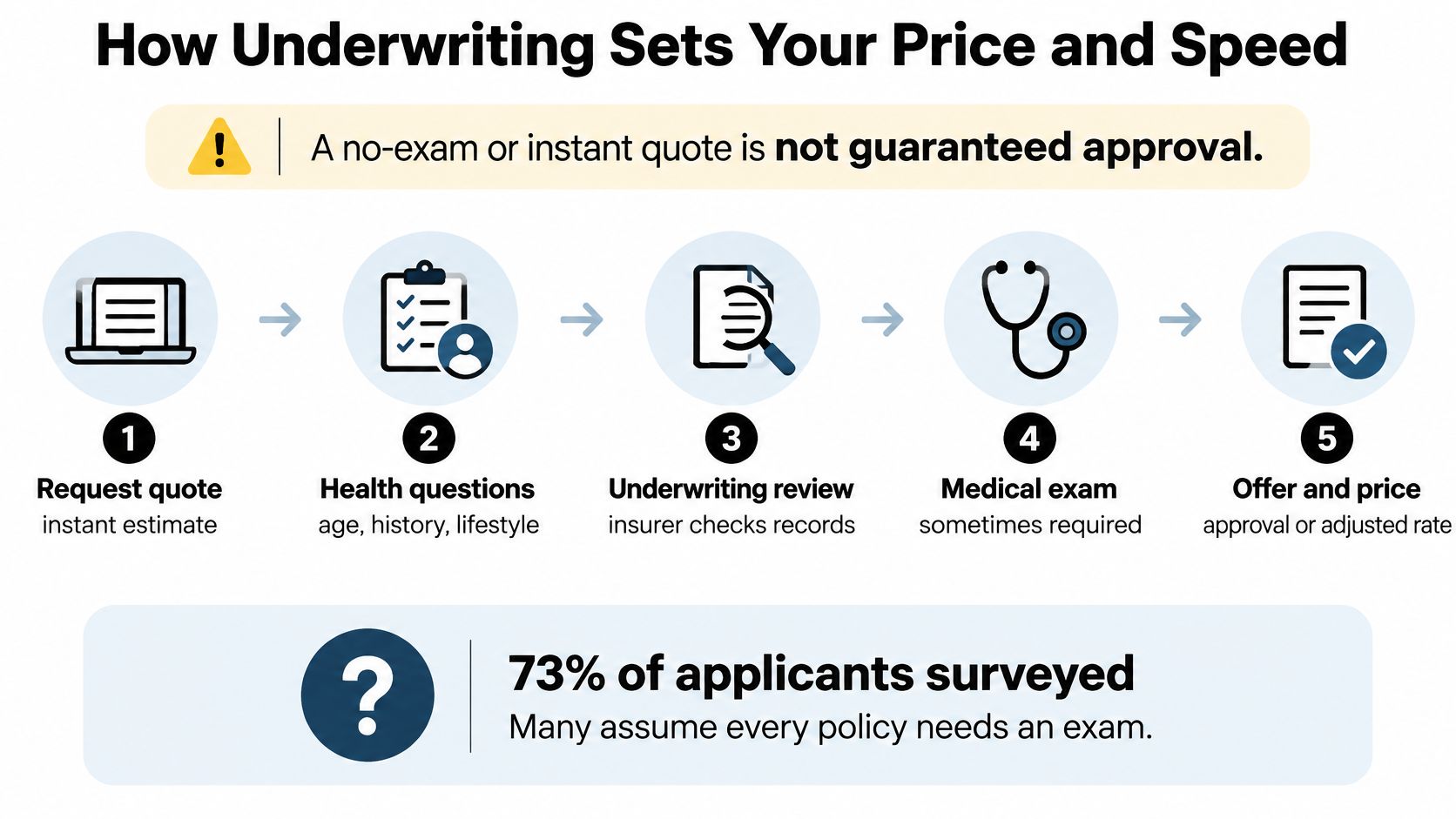
A no-exam quote isn't an approval, and an instant quote isn't a final price. In a 2025 survey, 73% of respondents said a 24-hour online approval process would make them more likely to buy, while 34% incorrectly believed medical exams and blood tests are required for every life-insurance policy, according to Corebridge Financial's life insurance insights. Both beliefs distort shopping: one chases speed that may not survive review, the other rules out policies the shopper would qualify for easily.
Four routes, four different levels of price certainty
LIMRA's 2017 Insurance Barometer study on transparent buying options defined simplified underwriting as using publicly available data for risk classification, potentially avoiding blood and fluid testing, and found 70% of Americans considering life insurance were interested in buying without a physical exam. In many cases no medical exam is needed today, because many policies are approved using digital underwriting and health data.
| Underwriting route | How it works | Medical exam | Typical decision time | Price can change |
|---|---|---|---|---|
| Instant or simplified | Uses public data and health questions | Often none, but conditional | Minutes to a few days | Yes, if more evidence is requested |
| Accelerated | Adds digital health data such as prescription records | Usually none | Days to a few weeks | Yes, if referred for full review |
| Traditional | Uses exam, labs and medical records | Yes | Several weeks | Final offer is set after review |
| Guaranteed issue | No health questions | None | Immediate | Higher cost, benefit often limited early on |
Accelerated underwriting sits in the middle and does most of the work in online sales. The insurer pulls prescription history and other digital records, matches them against your answers, and issues if nothing flags. A condition, a prescription or a high coverage amount can trigger more evidence, and that's where an estimate becomes an offer at a different rate. Many carriers offer flexible underwriting options for people with pre-existing conditions, so a flag isn't automatically a decline.
What the application asks, and what to ask back
A typical application asks for basic personal info, health history and lifestyle questions. Have your height and weight, diagnoses and dates, prescription names and dosages, tobacco and alcohol use, driving record, hazardous hobbies and travel plans in front of you before you start, because guessing produces the referrals that slow you down. Our guide to the life insurance underwriting process walks through what each stage checks.
Put three questions to any provider before you commit:
- Is no-exam eligibility conditional? Ask what specifically kicks an application into full underwriting.
- What's the expected decision time? Get the median, not the best case in the marketing copy.
- Can the final price differ from this estimate? If yes, ask how often, and by how much.
"Instant decision," "no exam" and "guaranteed issue" are three separate things. Only the last one skips health questions entirely, and you pay for that certainty.
Application Steps and Insurer Strength
The path from quote to coverage has five stages, and knowing them stops you treating an approval email as the finish line.
- Gather your details first. Identity, income, beneficiary names and relationships, plus the amounts and end dates of any existing coverage.
- Answer the health and lifestyle questions accurately. Misstatements give the insurer grounds to dispute a claim later, which is the worst possible time for a discrepancy to surface.
- Authorize the data checks your route uses. Prescription databases and driving records are standard on digital routes, and refusing them usually pushes you to an exam.
- Read the decision carefully. It may be an approval, a follow-up question, a postponement, or a referral to traditional underwriting. Only the first is an offer.
- Review the offer in writing and pay the first premium. Coverage typically begins once the policy is approved and the first payment is processed, so the days between applying and issuing are uninsured days.
Judging the carrier behind an unfamiliar name
Direct channels, including telephone and internet sales, accounted for only about 6% to 7% of global life-insurance premiums from 2013 to 2018, while the United States was an exception where direct distribution gained share, according to McKinsey's analysis of global life insurance distribution. Online, you'll meet carriers you've never seen advertised. That's normal, and it's why the checks below matter more than brand recognition.
- Financial strength rating: look up the issuing carrier with the independent rating agencies and compare grades on the same scale, since a 30-year promise is only as good as the balance sheet behind it. Our life insurance rating guide explains how to read those grades.
- Complaint records: your state insurance department publishes complaint data. Check the issuing carrier, not the website selling the quote.
- Who issues, who sells: note whether you're buying direct from the carrier or through an agency. We're a licensed insurance agency that partners with carriers to issue our policies, so the name on the policy will be the carrier's, not ours.
Premiums, Renewals and Features That Change Total Cost
Premium structure is where quotes look most alike and differ most. Level premiums stay fixed for the whole term. Adjustable premiums can move. Confirm which one you're looking at before you compare monthly figures, because a low adjustable rate and a level rate aren't the same promise.

The four events that change what you pay
The NAIC's consumer guide to life insurance defines term coverage as protection bought for a specified period, paying the death benefit to named beneficiaries only if the insured dies during that period, and notes the term can run one or more years. What happens at the end of that period is a pricing question, not an admin detail.
| Cost or feature | What to check | Effect on total cost |
|---|---|---|
| Premium structure | Level or adjustable, and whether it changes during the term | Level premiums keep the monthly cost stable for the term |
| Conversion option | Whether the policy converts to permanent coverage, and by what age | Permanent premiums are significantly higher |
| Renewal after term ends | Whether renewal is guaranteed and at what rate | Renewal premiums can be substantially higher |
| Grace period | Length of time after a missed payment before coverage is affected | A missed payment outside the grace period can end coverage |
| Start date | Coverage begins after approval and first payment | A gap between applying and starting can leave you uninsured |
Depending on the policy type, coverage can be adjusted or converted to permanent insurance, and conversion is often allowed without a new exam. That's valuable if your health changes, but the permanent premium is significantly higher, so treat conversion as an option you're paying for, not a free upgrade. Most policies include a grace period before coverage is affected by a missed payment, and its length differs by policy, so read it rather than assuming.
Questions that expose the real total
Ask these in writing and keep the answers with the quote:
- What does the premium look like in year 11 of a 10-year term?
- Is renewal guaranteed, and at what rate schedule?
- How long is the grace period, and what happens the day after it ends?
- By what age must a conversion be exercised, and is a new exam required?
Watch the renewal cliff: a 20-year term with a low first-year premium can look like the cheapest policy on your screen right up to the day it ends. If you're then older and less healthy, renewing annually or buying fresh coverage can cost multiples of the rate you were paying, which is why the renewal premium belongs in your comparison now, not in year 20.
Choosing the Right Policy by Household Situation
Four households, four different trade-offs. Find the one closest to yours and the decision usually gets easier.

Maya and Sam, two incomes, no children
They check employer coverage first, then buy a 10 to 15 year term sized to their joint debts rather than to a full income replacement multiple, because either salary alone covers most of the household budget today. Their trade-off is timing: if they refinanced into a longer mortgage, a term ending well before retirement leaves that joint debt uncovered in their fifties, when buying new coverage costs far more.
Priya, one income, children aged 4 and 7
Priya's gap is the largest of the four, because there's no second salary to absorb the loss. She sizes a 20 to 30 year term to the years until her younger child is financially independent and adds childcare and education costs on top of income replacement. The trade-off is monthly cost: protecting the household's standard of living at that amount and duration means a higher premium, and she'd rather trim discretionary spending than shorten the term to 15 years.
Tom, a professional with a partnership loan
Tom matches his term to the loan amortization schedule and insists on a conversion option, because a partnership obligation can be refinanced or extended past the original end date. His trade-off is that the conversion privilege and the longer term both cost more than a bare-bones policy, and he's paying for flexibility he may never exercise.
Dana, a homeowner with a falling balance
Dana picks a term that ends with final repayment, so she's only paying for debt that still exists. She could ladder a shorter policy over the steepest years of the balance, and her trade-off is that laddering saves premium but leaves less protection if she dies late in the term with income dependants still relying on her.
Beneficiary designations deserve the same attention as amounts, and they override a will in most cases. Households going through a separation should read Miles Hansford Law Firm's guidance on updating beneficiaries after a Georgia divorce before assuming an old designation still reflects their wishes.
Which household looks like yours, and which of those four trade-offs would you least like to live with?
How to Build a Fair Side-by-Side Quote Comparison
Do this once, in a spreadsheet, with one row per quote. It takes an hour and it's the difference between choosing a policy and choosing a price.
- Write down your amount and term. Take the number from your own calculation and treat it as fixed. Every quote gets measured against the same need.
- Request quotes for that exact amount and term. Different face amounts change the premium and can change the underwriting route too, so a quote for a smaller amount tells you nothing about the larger policy you need.
- Label each quote term or permanent. A low term premium isn't a substitute for lifelong coverage, and mixing the two in one column produces a false winner.
- Record the underwriting route and whether the price is final. An estimate that can rise after full review isn't a fixed quote, so mark it as provisional in your sheet.
- Compare total cost over the full term. Multiply the level premium across the term, then note the renewal and conversion terms beside it. First-year cost is the least informative number on the page.
- Check grace period, start date and riders. These decide what happens when a payment is missed or a claim arrives early, and they differ between carriers offering identical premiums.
- Delete anything that doesn't meet the criteria. A shortlist of two or three matched quotes beats ten unmatched ones.
The discipline is the same one buyers use in other markets: Maya's guide to comparing quotes before closing makes the point that identical coverage limits, not identical headlines, are what make two prices comparable.
Finish each row with three recorded values: the monthly premium, the total cost over the term, and the insurer's financial strength rating. When you can read those three columns across matched amounts and terms, you're doing a real online life insurance comparison, and the right choice is usually visible without a debate.
Confirm Your Shortlist and Apply for Term Coverage
For most young families and newlyweds, start with term coverage sized to income and debts, and move to permanent coverage only when a lifelong need is clear, such as a dependant who'll never be financially independent or an estate tax bill that won't disappear. Buying permanence by default is the most expensive mistake in this market.
Three actions get you to a decision:
- Shortlist two or three quotes that match your exact coverage amount and term, with the same premium structure.
- Confirm the underwriting route and price finality for each, including what would trigger additional evidence.
- Read the conversion and grace period terms in the policy document, not the summary page.
We offer term life insurance with no medical exams for policies up to $3M, and we compare multiple carriers to find competitive pricing. Applying is free and doesn't affect your credit score, so there's no cost to seeing where your real rate lands against your shortlist.
Get the final terms in writing before you pay the first premium: the death benefit, the term length, the level premium, the renewal schedule and the issue date. Coverage starts when the policy is issued and paid, not when a website tells you you're approved.
We built Coveredly to make this comparison straightforward: term quotes from several carriers side by side, no medical exam for policies up to $3M, and a fully digital application that's free and won't affect your credit score. Take the amount and term you calculated, then request your term life quotes at Coveredly and check the underwriting route and price finality on each one before you choose.