If life insurance doesn't require a medical exam, why might the insurer still ask you to take one? Accelerated underwriting life insurance removes some routine evidence collection, not the need to assess your health and other risks. Think of it as a sorting process: your application may receive a quick decision, need clarification, or move to a fuller review.
For families arranging financial protection, that distinction matters more than the promise of speed. Understanding the possible routes helps you prepare accurate answers, respond to requests, and avoid mistaking an application for active coverage.
Table of Contents
- Accelerated and Traditional Underwriting Side by Side
- How Accelerated Underwriting Reaches a Decision
- Who Qualifies for an Accelerated Decision
- What Insurers Assess Beyond the Medical Exam
- Why an Instant Approval Is Not Always the Outcome
- Privacy, Fairness and Your Rights as an Applicant
- Check Your Path Before You Apply
Accelerated and Traditional Underwriting Side by Side
Think of airport security. Traditional underwriting resembles a full check at every gate, while accelerated underwriting uses risk-based screening to clear eligible applicants quickly and direct others to additional checks. The fast lane is a possibility, not a guarantee.
Traditional underwriting relies on a paramedical exam and fluid tests; accelerated underwriting replaces some of that evidence with electronic records, such as prescription-drug histories and motor-vehicle records.

Say you're newly married and applying for protection against the loss of your income. Rather than immediately arranging a nurse visit, the insurer checks whether your application and available records provide enough evidence to assess you.
Accelerated versus traditional underwriting
| Feature | Traditional underwriting | Accelerated underwriting |
|---|---|---|
| Medical exam | Usually required, including a paramedical exam with blood and urine tests | Often waived, though an exam can still be requested |
| Core evidence | Exam results, fluid tests and medical records | Application answers, prescription history, motor-vehicle records and Medical Information Bureau activity |
| Typical decision time | Days to several weeks | Minutes to the same day for many applicants |
| Best-fit applicants | Large coverage amounts and complex health histories | Younger applicants, moderate coverage and straightforward health histories |
| Risk control | Classification based on exam results | Predictive models combined with ongoing mortality monitoring and audits |
These timing descriptions aren't service guarantees. Record retrieval, follow-up questions and scheduling can extend either route. Our life insurance medical exam guide explains what the physical assessment involves if you need one.
Why insurers still audit faster decisions
Accelerated underwriting developed during the 2010s, with many U.S. programs entering the market in 2017–2018, according to Munich Re's analysis published by the Society of Actuaries. That analysis covered 11 years of monitoring through the end of 2023, more than 33,000 insured lives and 30 U.S. programs, and estimated average mortality slippage at approximately 12% for random-holdout cases and 15% for post-issue audits, with a typical program expected to fall in the 10%–15% range.
Mortality slippage means additional expected mortality associated with misclassifying risk. It doesn't mean an applicant has that percentage chance of dying, or that their premium automatically rises by that amount.
Insurers need enough policy experience to judge whether their decisions perform as expected. This explains both the limited early evidence and the importance of continued validation, auditing and appropriate pricing. Accelerated underwriting is a distinct risk-selection system, not just the old process performed faster.
How Accelerated Underwriting Reaches a Decision
An accelerated decision comes from combining information, checking its reliability and assigning a risk segment. The insurer isn't looking for a blank medical history.
The Society of Actuaries predictive analytics survey identified vendor data, financial data, lifestyle data, application data and internal experience studies among common predictive-model inputs, with MIB checks and motor-vehicle records prominent among program evidence sources.
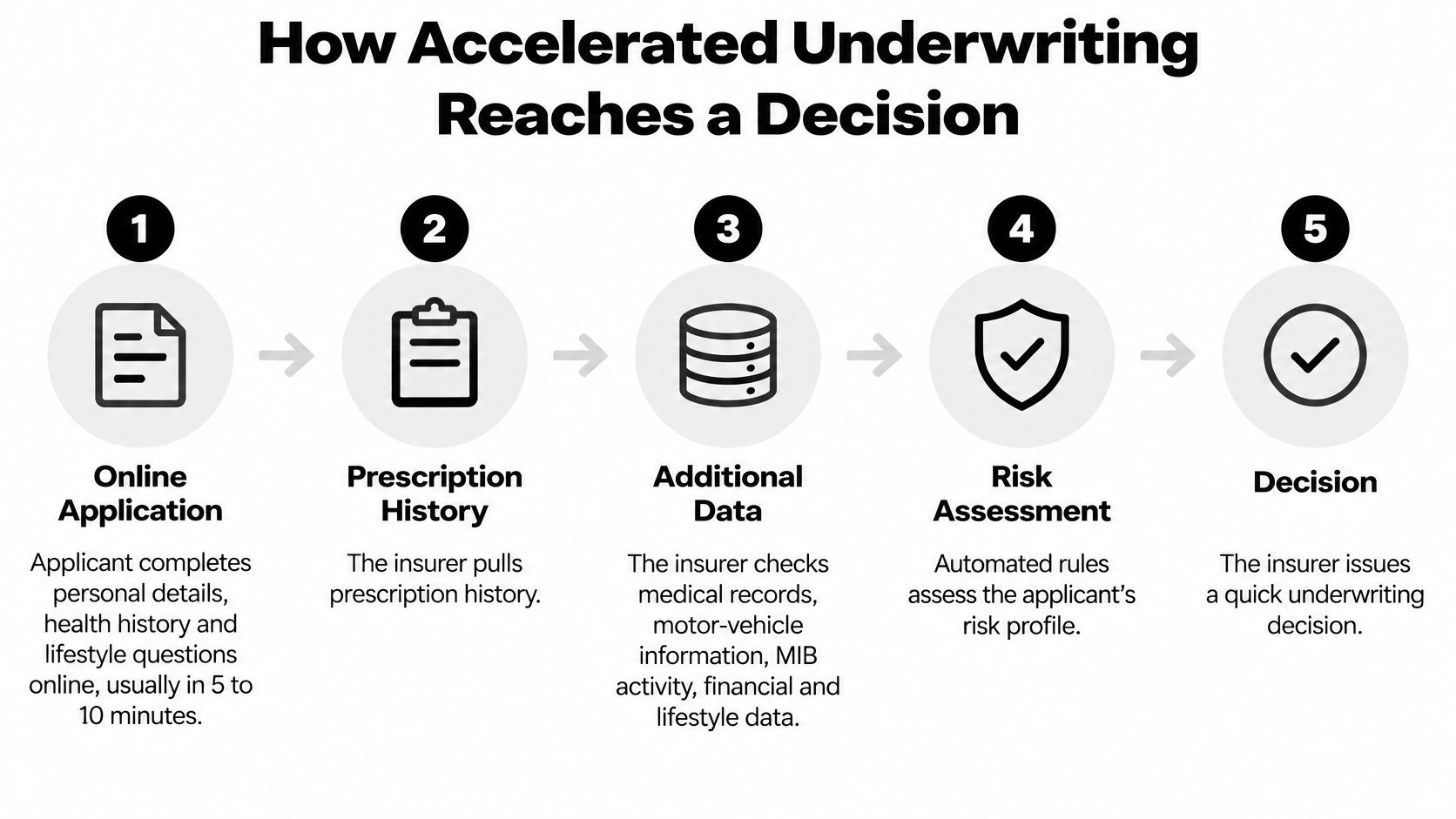
From your answers to a risk segment
Complete the application. You provide personal details, health history and lifestyle answers online. With our digital application, most applicants take 5–10 minutes. Keep medication details available rather than guessing a name or dose.
Authorize the relevant record checks. The insurer obtains prescription history and may check motor-vehicle records and Medical Information Bureau activity, commonly called MIB. The exact evidence collected follows the program's requirements and authorizations.
Combine the evidence. A predictive model evaluates your answers alongside available external information. Internal experience studies help insurers connect patterns in that information with expected mortality risk. This is a segmentation exercise, not a substitute diagnosis from a computer.
Check identity and consistency. Records must match the right person, be sufficiently current and make sense together. Missing information isn't automatically reassuring, and a conflicting record shouldn't be treated as a confirmed fact without appropriate review.
Assign a risk segment and route the application. The possible results are approval, more information, traditional referral or decline. The underwriting system determines which route the available evidence supports.
Application habit: If you're unsure about a health answer, check the record before submitting it. A precise answer is more useful than an optimistic guess.
What happens behind the screen
Insurers also need to check whether model predictions align with actual mortality experience. They should monitor results by risk segment and adjust models when applicant populations, medical practice or consumer behavior change.
For a broader explanation of evidence collection and review, the My Policy Quote underwriting guide offers context beyond automated screening. Our life insurance underwriting process guide also explains the broader application journey.
On your screen, this technical work may appear as an immediate decision or a request for further information. A short message doesn't necessarily reflect a simple assessment.
Who Qualifies for an Accelerated Decision
Only a share of applicants receive accelerated decisions. An actuarial analysis described in Swiss Re's accelerated underwriting overview reported acceleration rates among programs reinsured by RGA ranging from 10% to 70%, averaging approximately 40%–50%.
That range reflects differences in eligibility rules, products, available evidence and insurers' willingness to accept uncertainty. It isn't a prediction of your individual approval odds.
Qualification factors and their likely effect
| Factor | Usually supports an accelerated decision | Often triggers traditional review |
|---|---|---|
| Age | Younger applicants within program age limits | Older applicants or those above program age limits |
| Coverage amount | Moderate face amounts within program limits | Large face amounts above program limits |
| Prescription history | Clean or stable medication records | Recent new medications or dosage changes |
| Driving record | Clean motor-vehicle record | Recent serious violations |
| Health history | Minor or well-controlled conditions | Multiple conditions or recently diagnosed serious illness |
| Data completeness | Consistent records across all sources | Missing, conflicting or unmatched records |
Read these as directional indicators, not automatic rules. Taking medication doesn't itself establish that you're ineligible, and a record without prescriptions doesn't prove that you're healthy.
Why combinations matter
Consider a hypothetical 30-year-old requesting moderate coverage with straightforward health information and consistent records. That applicant fits the general accelerated profile. A hypothetical 60-year-old requesting a large face amount after recent diagnoses is more likely to need traditional review.
Neither example establishes an age cutoff. Insurers set their own age limits, face-amount limits and evidence thresholds, so the same person can receive different routing decisions at different carriers.
Insurers also assess how risk classification performs across coverage amounts, ages, sexes and risk classes. A model that works acceptably overall may still require tighter rules for a particular segment. Eligibility limits help insurers avoid applying an automated decision beyond the circumstances in which they can support it.
Before applying, make a practical self-check:
- Medication stability: Note recent prescriptions, discontinued medicines and dosage changes.
- Coverage fit: Choose an amount that addresses your household's financial exposure, not an amount selected only to avoid an exam.
- Record consistency: Confirm that your name, date of birth and health answers match the records likely to be checked.
- Recent health changes: Have the diagnosis date, treatment details and follow-up information ready.
You can anticipate likely friction without trying to diagnose your own underwriting outcome. The aim is to submit a clear application, not to make your circumstances look simpler than they are.
What Insurers Assess Beyond the Medical Exam
A medical appointment provides a snapshot. Electronic underwriting can assemble information from different points in your history: medical records, prescription history, a motor-vehicle record, MIB activity and, where used, financial or lifestyle information.
Insurers may also use their own experience studies to interpret those inputs. Your application supplies context that a database entry alone may lack, such as why a medication was prescribed or whether treatment has ended.

A useful signal needs a defensible explanation
The combination resembles a credit-scoring process in one limited sense: the model evaluates multiple signals rather than relying on a single encounter. That analogy doesn't mean every insurer checks credit or uses the same scoring formula.
NAIC guidance on accelerated underwriting describes traditional and non-traditional data analyzed through predictive models or machine learning, and calls for accurate, reliable, transparent inputs with a sound actuarial rationale linking variables to expected loss or expense.
A correlation alone isn't a sufficient explanation. For example, a purchasing pattern might coincide with a health outcome without showing that the individual has that condition. Treating the pattern as a diagnosis could produce an unjustified conclusion.
- Medical evidence needs clinical context, including treatment and control.
- External data needs a reliable identity match and a clear explanation of what it represents.
- Model variables need a defensible connection to the risk being assessed.
Our guide to life insurance health questions can help you prepare the context that records may not supply.
Stronger prediction isn't automatically better practice
A peer-reviewed mortality study using Framingham Heart Study data reported an area under the ROC curve, or AUC, of 0.732 for age and sex alone, 0.741 after adding vital signs, lipid measures and diabetes laboratory assessments, and 0.792 after adding epigenetic and diabetes-related markers.
AUC describes how well a model distinguishes outcomes in the studied population. Those findings suggest that certain biological signals can add predictive information, but they don't establish that routine applicants need epigenetic testing.
A new test must justify laboratory logistics, consent requirements, privacy risks, explainability and cost. Better discrimination also doesn't settle whether predictions are calibrated appropriately or whether a test is fair and acceptable for insurance use.
For applicants, the practical distinction is between evidence an insurer currently requests and experimental methods that might inform future model design. A promising study isn't a new application requirement.
Why an Instant Approval Is Not Always the Outcome
No exam doesn't mean guaranteed instant approval. NAIC consumer guidance explains that insurers may request a paramedical exam when available data isn't sufficient to evaluate risk.
Accelerated underwriting is a triage process. Age, coverage amount, medical history, prescription records and the insurer's evidence thresholds influence which route an application takes.
Accelerated underwriting outcomes and next steps
| Outcome | What triggers it | What to do next |
|---|---|---|
| Instant approval | Data is sufficient and within program thresholds | Review the policy and pay the first premium to start coverage, subject to its effective-date requirements |
| Information request | Answers are missing or unclear | Respond quickly to avoid delay |
| Paramedical exam referral | Available data is insufficient to evaluate risk | Schedule the exam and expect a later start date |
| Traditional underwriting | Risk factors or coverage amount fall outside program limits | Expect fluid tests and a longer timeline, and note that the price may change |
| Decline or rated offer | Risk falls outside program limits or records show a serious concern | Request the reasons and check the underlying data for errors |
A rated offer is an offer at a higher premium to reflect assessed risk, not a refusal to insure you. A referral, meanwhile, is a request for another assessment route, not necessarily a negative health judgment.
The same condition can lead to different routes
Consider a hypothetical 38-year-old with mild, well-controlled hypertension whose prescription information is ambiguous. The insurer might request an exam to clarify the evidence rather than approve immediately.
A hypothetical 45-year-old with controlled asthma and clear, consistent prescription information might receive an instant decision. These examples illustrate possible paths, not eligibility promises for either condition.
A request for evidence tells you what the insurer still needs. It doesn't, by itself, tell you the final price.
Protect your coverage while resolving questions
With our policies, coverage typically begins once the policy is approved and the first payment is processed. A referral can therefore move the start date. Most policies also include a grace period before a missed payment affects coverage, but that protection shouldn't be confused with temporary coverage during an application.
An adverse decision should come with reasons and information about the evidence used. Ask whether the issue concerns eligibility, missing evidence or a specific record, then address that issue directly.
A referral or decline at one insurer doesn't automatically prevent an application elsewhere. Prescription, driving and MIB information may recur in another review, however, so correct errors before submitting another application. Keep existing protection until you've confirmed that replacement coverage is in force.
Privacy, Fairness and Your Rights as an Applicant
Avoiding a physical exam can mean less visible scrutiny, not less scrutiny overall. You may never see the records or model inputs that contribute to an automated assessment.
The NAIC life insurance AI and machine learning survey report found that most surveyed life insurers using these technologies relied on external data and generally didn't disclose to consumers which external data they accessed and used in underwriting.
Know what you're authorizing
NAIC materials discuss possible inputs beyond medical records, including purchasing history, smartphone or wearable information, cell-phone behavior and social-media activity. Not every insurer uses these sources, and their appearance in regulatory materials doesn't establish that they're part of your application.
Read the authorization and privacy notice before agreeing. If the language leaves you uncertain, make the questions specific:
- Data categories: Which medical, financial, driving or behavioral information may be accessed?
- Consent: Which authorizations are required, and what does each permit?
- Alternatives: Can you decline a particular data source and still pursue coverage through another underwriting route?
- Correction: How can you identify and challenge the information behind an adverse decision?
Don't assume that refusing a data check guarantees access to an exam-based alternative. Establish the available route before withdrawing an authorization.
Fairness requires more than excluding sensitive labels
A model can produce disparate effects even without an explicitly discriminatory input. Behavioral information may act as a proxy for other characteristics, and correlation can be mistaken for a causal explanation of risk.
Privacy checkpoint: Before submitting sensitive information, understand who can access it, why it's needed and how you can raise a dispute.
Legal rights differ by market and jurisdiction. In the United States, applicable consumer-report rules can provide rights to obtain and dispute inaccurate information used in a decision; those protections shouldn't be presented as universal rules for every country or every data source.
If you challenge an error, keep the decision notice, identify the reporting organization and submit a specific correction with supporting documents. Ask how the insurer will reconsider the application after the underlying record is corrected.
Check Your Path Before You Apply
Prepare the details that are hardest to reconstruct from memory. A short checklist can prevent avoidable back-and-forth during a digital application.
- List your medications accurately. Write down current names and doses, plus changes during the past year. Include why each medicine was prescribed when the application asks.
- Check records for errors. Review available prescription and driving information, and dispute inaccuracies before applying where practical.
- Document recent diagnoses. Keep treatment dates and follow-up details handy so your answers are consistent with the medical record.
Consistent information reduces avoidable clarification requests, although it can't guarantee that you won't need an exam or further review.
Start with realistic expectations
We offer term life insurance with no medical exams for policies up to $3 million. Many policies are approved using digital underwriting and health data, but your application's route remains an underwriting result, not a promise.
Our application is fully digital, and many approvals happen the same day. Answer accurately, save any requested documents and reply promptly if more information is needed. Our team can guide you through the process and explain requests.
Don't cancel existing coverage just because you've received a quote or submitted an application. Confirm approval, first-premium payment and the new policy's effective date before making a replacement.
Coveredly offers online term life insurance with no medical exam for most eligible applicants, using digital underwriting and health data to assess applications. Visit Coveredly to start a quote with your medication details and health history ready, and get help understanding your next step if further review is needed.