Yes, you can cancel term life insurance anytime, but you'll generally get a full refund only during the 10 to 30-day free-look period. After that, standard term policies typically have no cash value, so premiums you've already paid usually aren't returned.
Maybe your family's budget has tightened, your mortgage is smaller, or you found a policy that fits your needs better. You're not alone in reconsidering coverage after a major life change. The important distinction is that ending coverage is usually easy, but getting your money back usually isn't.
Table of Contents
- Can You Cancel Term Life Insurance Anytime Explained
- What Happens to Your Money and Coverage When You Cancel
- How to Cancel Your Term Life Policy Without Mistakes
- Grace Periods Lapses and the Hidden Coverage Gap
- Smarter Alternatives to Canceling Your Term Life Insurance
- Final Checklist Before You End Your Term Life Coverage
Can You Cancel Term Life Insurance Anytime Explained
A young couple might buy term life insurance after getting married, then add more coverage when they have a child. Later, one partner changes jobs, household expenses rise, or the family discovers that its original policy no longer fits. In that situation, asking “can you cancel term life insurance anytime” is completely reasonable.
The short answer is yes. In many major markets, a policyholder can cancel term life insurance by notifying the insurer or by allowing the policy to lapse after missed payments. Germany, for example, allows cancellation at the end of the current insurance period, with no statutory minimum notice period under § 168(1) VVG, according to this legal guide to cancelling term life insurance.
The financial result depends on when you cancel. During the free-look period, which commonly lasts 10 to 30 days, you can usually receive a full refund of premiums. That period normally begins when the policy is delivered or received, although the precise rule depends on the jurisdiction and insurer.
After the free-look period, standard term insurance generally ends without a refund. Term coverage is designed as pure protection, not as a savings account. Because it usually doesn't build cash value or a surrender value, the premiums paid for the time you were insured typically aren't returned.
The practical distinction: You can usually cancel anytime, but you can't usually get your money back anytime.
Before ending an existing policy, review the policy documents and understand the replacement process. A useful starting point is your guide to term life insurance from Duncan & Associates Insurance Brokers, especially if you're reassessing how term coverage works. You can also review what happens when an insurance policy is cancelled before sending your request.
What Happens to Your Money and Coverage When You Cancel
Cancellation can produce three different outcomes. Treating them as interchangeable creates confusion, especially when a household is trying to recover money or avoid an accidental loss of protection.
Cancelling during the free-look period
The free-look period is the closest thing to a no-penalty exit. In many markets, it lasts 10 to 30 days, and a full or near-full refund is usually available if you cancel within that window. Some deductions may still apply, depending on the country, policy, and insurer.
For policies sold in India, the period has historically differed by sales channel, with 15 days commonly applying to offline purchases and 30 days to online or distance-marketing purchases. India's IRDAI rules expanded the free-look window to 30 days from April 1, 2024 for life and health policies, according to the SoFi explanation of cancelling a life insurance policy.
The refund may not equal every amount you paid. Possible deductions include stamp duty, medical-test expenses, administrative charges, and the cost of insurance cover already provided, as described in this free-look period guide from Bajaj Life Insurance.
Cancelling after the free-look period
Once the free-look window closes, a standard term policy typically has no refund and no surrender value. Your insurer stops the death benefit after the cancellation becomes effective, and the premiums paid for prior protection remain paid for that protection.
That differs from some permanent or savings-linked policies, where a surrender value may exist. Don't assume that a term policy offers the same exit value just because both products are called life insurance. For a related explanation of policies with return-of-premium features, see return-of-premium term insurance.
Stopping payments instead
If you stop paying, the insurer may keep coverage active during a grace period. After that period ends, the policy can lapse and coverage may terminate automatically. A lapse isn't the same as a carefully documented cancellation, and it can leave uncertainty about the exact end date, reinstatement terms, or any remaining payment obligation.
Money rule: Free-look cancellation may produce a refund. Post-window cancellation usually doesn't. Nonpayment can end coverage after the grace period, but it isn't the safest way to document your decision.
How to Cancel Your Term Life Policy Without Mistakes
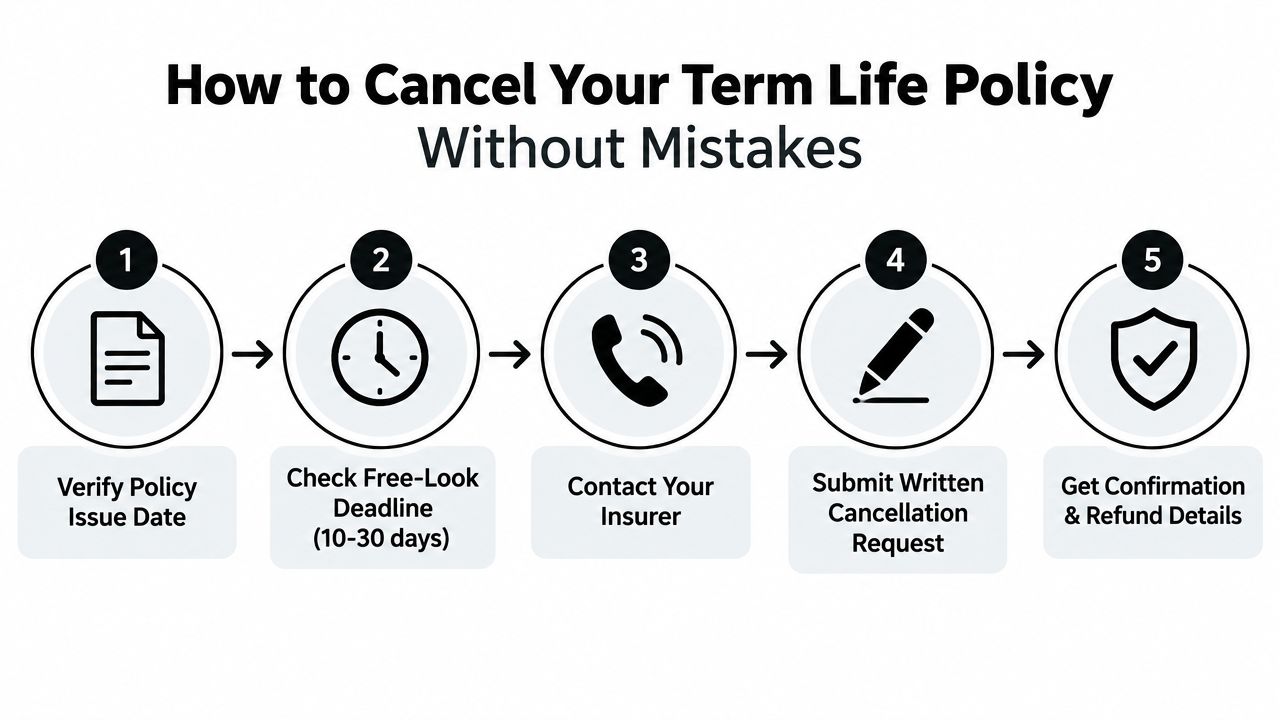
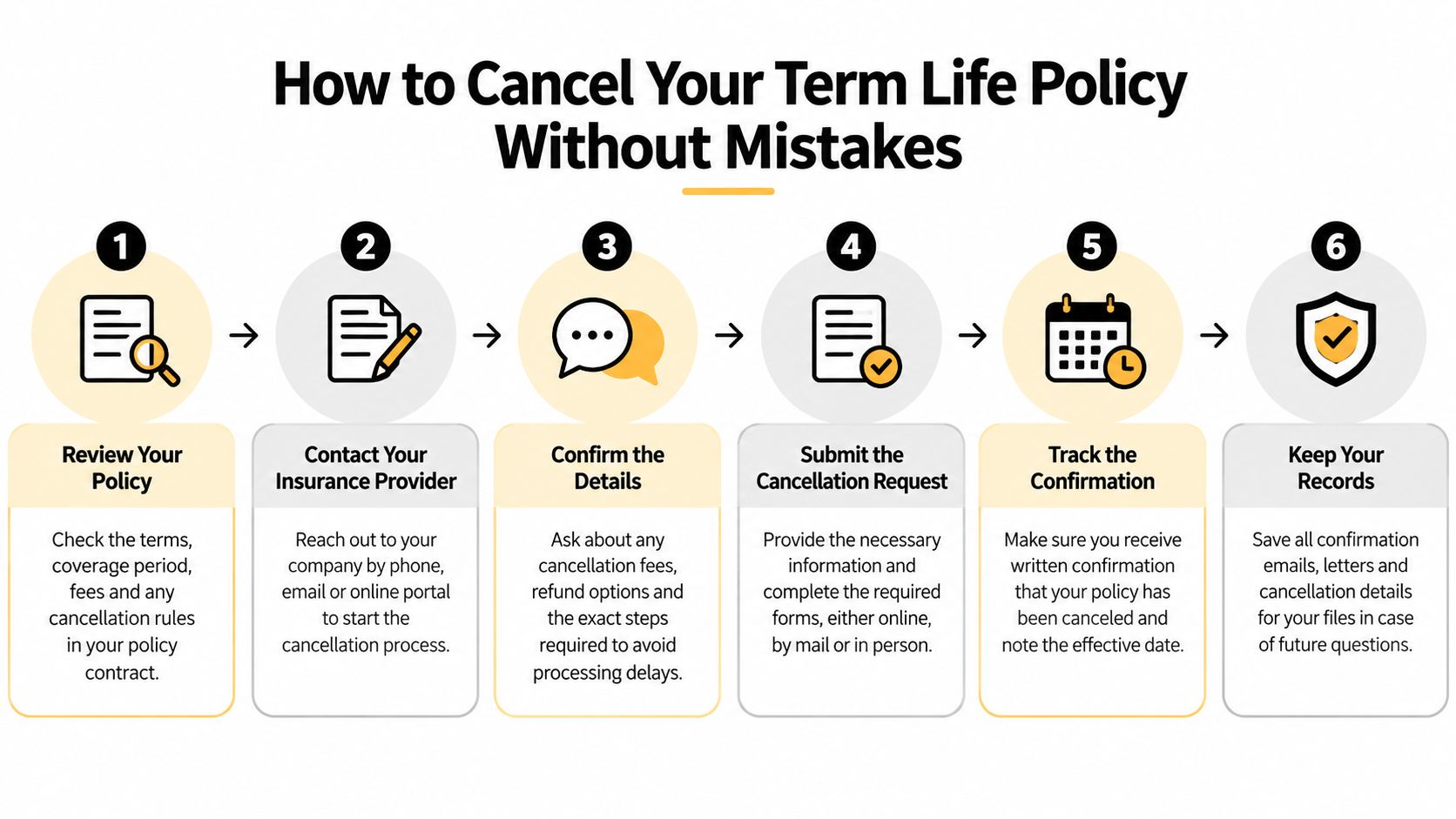
A clean cancellation starts with dates, not with an assumption that the insurer will process everything immediately. Find the policy issue date, delivery date, receipt confirmation, and the free-look deadline in your documents or online account.
If the policy was bought digitally, check the email or portal record showing when the policy became available to you. If you purchased through a broker, ask the broker to confirm which date the insurer uses. A missed deadline can change the outcome from a potential refund to a standard post-free-look cancellation with no refund.
Contact the insurer through a traceable channel
Call customer service or your licensed agent to learn the required procedure, but don't rely on a phone conversation alone. Ask whether the insurer requires a specific form, signature, policy number, identity verification, or original documents.
Then submit a written cancellation request through the channel the insurer accepts. Depending on the company, that may be an online form, secure message, email, or mailed letter. State clearly that you want to cancel the term policy, identify the policy, and ask for the effective cancellation date.
Request a written financial statement
Ask the insurer to confirm whether the request falls inside the free-look period. If a refund applies, request a statement that itemizes every deduction, including administrative costs, medical-test expenses, stamp duty, or the cost of coverage already provided.
Save the request, confirmation email, uploaded form, delivery receipt, and final statement. These records matter if an automatic payment continues or the insurer later asks when you submitted the request.
Protect your paper trail: Keep proof of submission until the insurer confirms both the cancellation date and the final payment outcome.
Don't cancel autopay before you understand the effective date. If you stop a payment too early, the insurer may treat the account as unpaid rather than as formally cancelled. After written confirmation arrives, check your bank or card account and verify that future premium drafts have stopped.
Grace Periods Lapses and the Hidden Coverage Gap
Stopping payments can feel like cancellation, but the policy may remain active briefly after a missed premium. A major consumer guide describes the grace period for term coverage as usually 30 to 31 days, after which the policy may terminate automatically if the missed payment isn't made, as explained in this guide to cancelling life insurance.
That timing matters for a family that assumes one missed bill means immediate cancellation, or assumes the opposite, that coverage will continue indefinitely. The insurer's policy wording controls the precise process, including when the grace period begins, whether a claim could be payable during it, and what happens if payment is restored.
A cancellation is a deliberate request to end the policy. A lapse normally follows nonpayment after the grace period. A surrender generally relates to ending a savings-linked or permanent policy in exchange for a surrender value. Standard term insurance typically doesn't have that cash-value feature.

Why lapses deserve attention
Lapses are common across life insurance products. A U.S. actuarial study cited by the American Economic Association found that 29% of permanent insurance policyholders lapsed within 3 years, while 57% had lapsed within 10 years. In India, approximately 86 lakh individual non-linked policies lapsed in FY 2024–25, representing about ₹8.7 lakh crore in sum assured. LIC alone accounted for 68.6 lakh lapsed policies worth ₹5.84 lakh crore, according to the American Economic Association study and supporting material.
Term policies also experience significant early exits. One actuarial analysis of MIB in-force data found overall lapse rates above 9% in policy year 1, while a Society of Actuaries study covering about 135.9 million policies and 5.4 million lapses or surrenders demonstrates that lapse behavior is a measurable part of the market, as discussed by RGA's analysis of early lapse behavior.
For practical guidance on how missed payments affect protection, Coveredly's explanation of insurance grace periods is a useful reference. Local advice can also help if policy language or state rules are unclear, such as this ISU Insurance Services Victorville life insurance guide.
Smarter Alternatives to Canceling Your Term Life Insurance
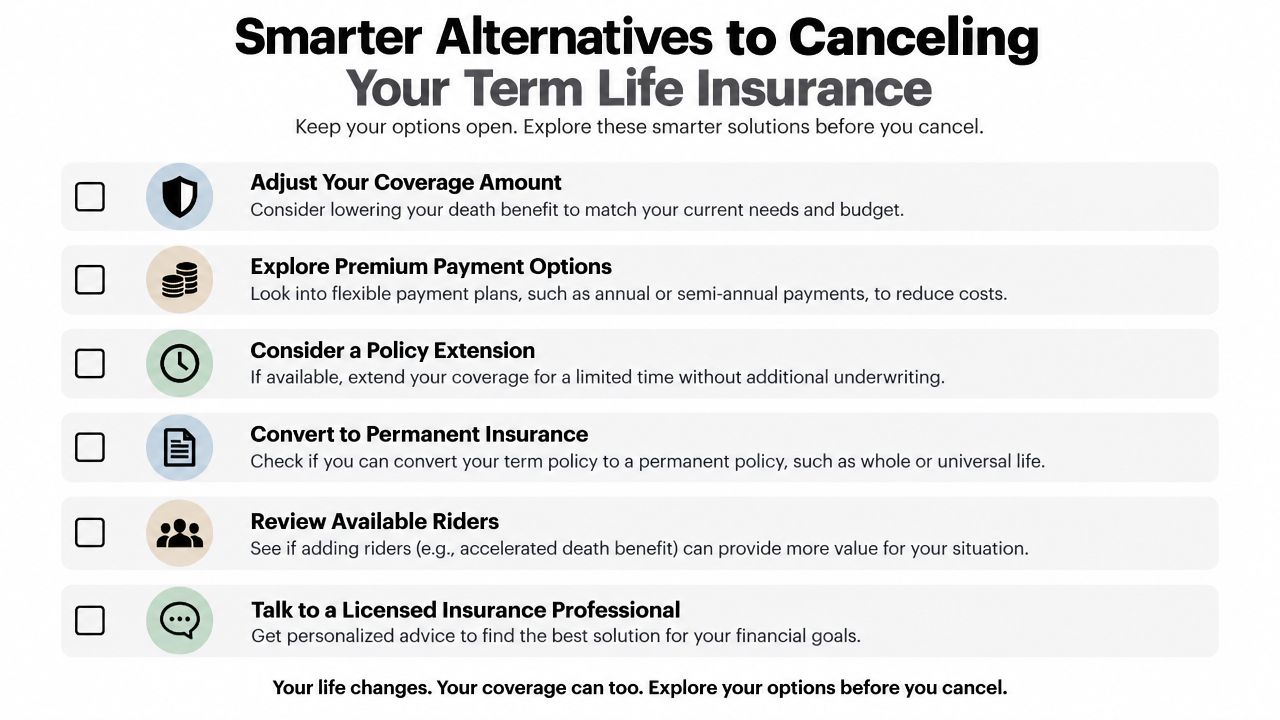
Cancellation may be appropriate, but it isn't always the best response to a changing budget or family situation. Before ending coverage, ask what has changed. If the problem is affordability, reducing the amount may preserve some protection. If the problem is policy fit, a different term length or insurer may work better.
You may also have a conversion option, depending on the contract. Conversion rights can allow a policyholder to move from term coverage to a permanent product without repeating the same underwriting process, but availability, deadlines, and product choices vary. Read the policy rather than assuming conversion is included.
Match the solution to the problem
| Your concern | Possible direction |
|---|---|
| Premium feels too high | Ask whether reducing coverage changes the cost |
| The policy term no longer fits | Compare a replacement policy with a different term |
| Your family's needs increased | Reassess income replacement, debts, and dependents |
| You still need protection during a switch | Keep the existing policy until the replacement is active |
| You want flexible management | Check whether the insurer permits coverage adjustments |
| You aren't sure how much coverage is appropriate | Recalculate the household's current need |
The safest replacement workflow is replace first, cancel second. Apply for the new policy, wait until it has been fully issued, confirm the active date, and complete any contestability or underwriting requirements before ending the old policy. If the replacement insurer declines the application or delays the decision, cancelling first can leave your family uninsured.
Coveredly's digital term life platform offers coverage management through a laddering feature that lets users adjust coverage up or down anytime, according to the publisher's product information. It's one example of why flexibility can matter when family responsibilities change. For a broader framework, use this resource to determine your coverage amount with Liberty Insurance before making a final decision.
Final Checklist Before You End Your Term Life Coverage
You can usually cancel term life insurance whenever you choose. The key question is whether you're still protected during the transition and whether you understand the refund result. A free-look cancellation may return premiums, while a post-window cancellation usually ends coverage without returning them.
Before submitting anything, check these items:
- Review the dates: Confirm the policy delivery date, issue date, and free-look deadline.
- Confirm the policy type: Make sure you're dealing with standard term insurance, not a permanent or savings-linked policy with different value rules.
- Compare the alternatives: Ask whether reducing coverage, changing the term, or using a conversion feature could solve the problem.
- Secure replacement coverage first: Don't cancel the old policy until the new one is fully issued and its active date is confirmed.
- Submit the request in writing: Use the insurer's required channel and include the policy number and requested effective date.
- Get confirmation: Save written proof that the insurer accepted the cancellation and state when protection ends.
- Check the refund calculation: Request an itemized statement showing any deductions.
- Stop future payments at the right time: Change autopay only after the insurer confirms the cancellation process.
Young families often need coverage that changes with income, children, debt, and housing. A careful review is better than a rushed cancellation, especially when a policy can be adjusted or replaced without creating an uninsured window.
Coveredly helps young families and professionals explore flexible digital term life insurance options and review coverage as life changes. Visit Coveredly to compare your next step before cancelling an existing policy.