Your life insurance policy was priced for a version of you that no longer exists. Maybe you bought it while renting a one-bedroom, maybe you've changed jobs since, maybe daycare now costs more than the premium ever did. The draft still leaves your account every month, and the quietest fix looks like making it stop.
Pausing that payment feels like canceling. It isn't. A canceled contract has an end date the insurer agrees to in writing, and your family's protection stops exactly there. A stopped payment usually leaves the policy running for a while, then drops it on a schedule you never chose. Learning how to cancel life insurance policy properly means choosing a real end date and keeping coverage in place until you reach it.
Table of Contents
- What Happens When You Cancel by Policy Type
- Free Look Windows Refunds and Grace Periods
- Documents and a Cancellation Letter That Sticks
- How to Cancel a Life Insurance Policy Step by Step
- Surrender Charges Loans and Taxes on Cash Value
- Replace Coverage Before You Cancel
What Happens When You Cancel by Policy Type
Say a parent starts a new job in March with a 90-day wait before benefits begin, and by April the household budget is tight enough that stopping the life insurance draft looks like the easy win. The draft stops. No confirmation email ever arrives. For six weeks nobody in that house knows whether the mortgage is protected, and the answer changes depending on whether the policy was term or permanent. Nothing about the coverage changed. Only the payment did.
Name your exit before you take it. Five exist, and they end in five different places.
| Path | When it fits | Typical cash result | Coverage after |
|---|---|---|---|
| Free-look return | New policy, usually 10 to 30 days after delivery | Full premium refund, no penalty | Ends on the confirmed return |
| Stop paying a term policy | Term contract past free look | Usually none | Ends after the grace period, not the day the draft stops |
| Written cancellation of term | You want a set end date | Unused premium may be prorated; confirm in writing | Ends on the date the insurer confirms |
| Surrender a permanent policy | Whole or universal life with cash value | Net cash surrender value after charges and loans | Ends; gain above basis may be taxable |
| Reduce, convert, or paid-up | You still need some protection | Little or no cash out | Smaller or different coverage stays in force |
Term life insurance cancellation is the least complicated path and the least generous one. There's no cash value to hand back, so leaving after the free-look window usually means you stop paying and the coverage ends at the close of the grace period. Permanent life insurance cash value behaves differently. Whole life and universal life build a balance, and the policy values table in your contract shows what's available in each policy year, before charges and loans are applied.
The NAIC life insurance buyer's guide draws that same line, noting that most term policies don't build cash value and that permanent policies may accumulate it gradually. The guide also points to alternatives many owners never hear about, including reduced paid-up insurance and extended-term coverage, which can keep a smaller amount of protection alive when stopping payments would end it.
Read three lines on the declarations page first
Your policy type, your policy number with its issue date, and the date the policy was delivered to you decide which row applies. The delivery date matters because it usually starts the review clock, and the issue date alone won't tell you that.
One more distinction trips up young families constantly. Employer group life is not an individual contract. It usually ends when the job ends, it rarely has a cash value, and canceling it runs through your HR benefits portal rather than an insurer's surrender form. If the policy in question came from a job you've already left, the coverage may already be gone.
Whatever row you land in, the rest of the work changes with it.
Free Look Windows Refunds and Grace Periods
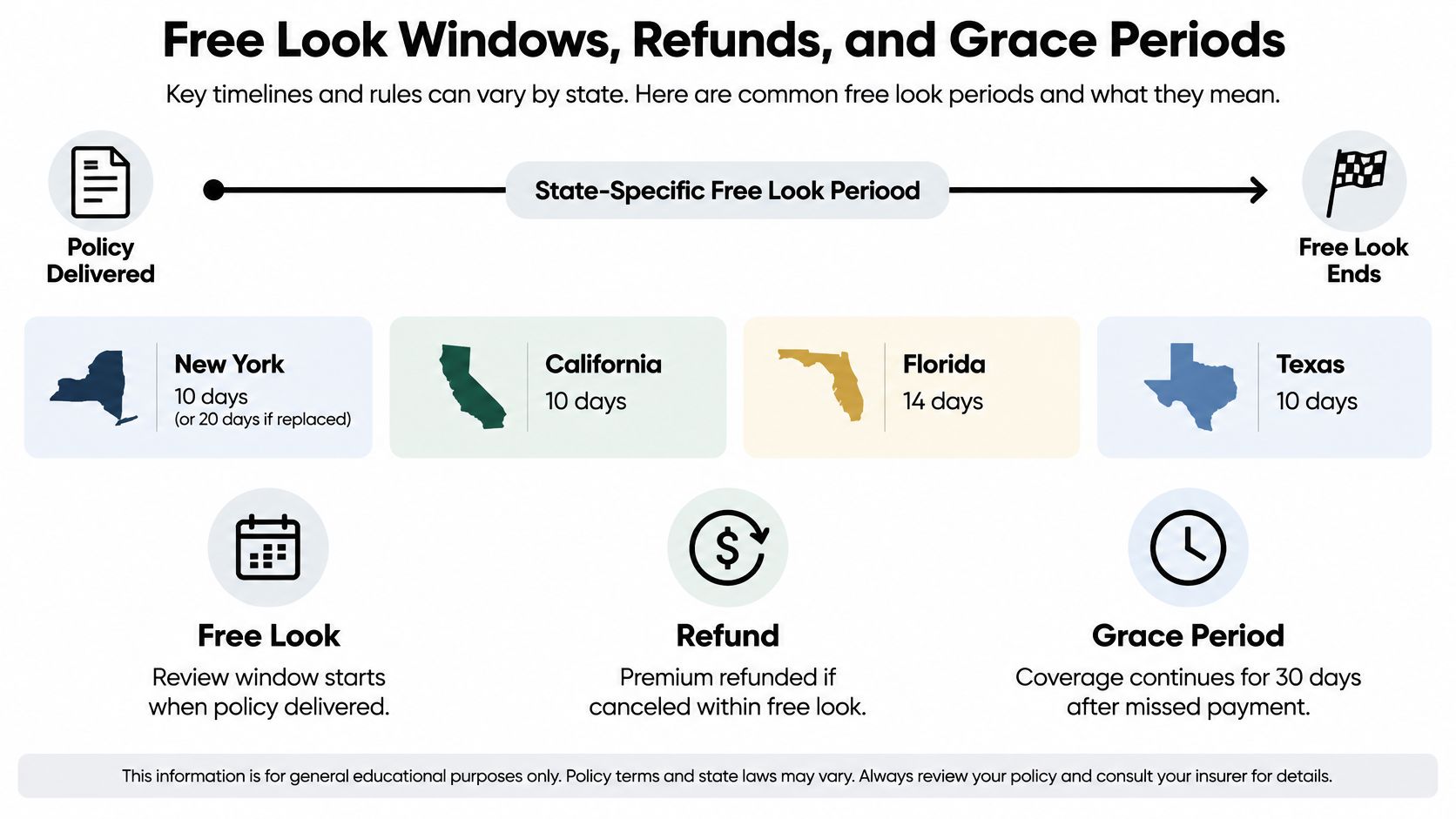
The cheapest cancellation of your life is the one you take in the first month. Every newly issued individual policy comes with a review window that lets you hand it back for a full premium refund with no penalty attached. Insurers call it the free-look period, and it exists because you're signing a legal contract you couldn't read in full before it was issued.
Free-look windows are set state by state, so the rules below are a reference point. The delivery notice that arrives with your policy carries the deadline that counts.
| Rule | Minimum window | Clock starts | Refund if you return in time |
|---|---|---|---|
| New York | 10 days minimum, up to 30 | When the policy is received | Full premium, no cancellation penalty |
| Other states | Varies by state; your policy's delivery notice prints the deadline | Generally when the policy is received or delivered | Full premium if returned within your window |
| NAIC disclosure example | An example window only; your state's rule sets yours | Generally when the policy is received | Premiums refunded during the applicable period |
The New York State Department of Financial Services guide to life insurance sets the pattern: New York requires a minimum of 10 days and permits periods up to 30. That clock starts on the day the policy reaches you, which can fall weeks after you signed the application. Some states give older buyers extra days, so read the delivery notice for your own deadline instead of trusting a minimum quoted for a different state.
What the window actually refunds
Inside the window you can return the policy for any reason. The face amount came back lower than you expected. The premium fits worse than the quote suggested. The beneficiary arrangement is wrong. The underwriter placed you in a different rate class than your agent predicted. None of those need a justification letter, and none should cost you a cancellation penalty.
Keep the record that wins disputes: the policy number, the cancellation date you requested, and proof your request arrived before the deadline. A timestamped portal upload or a certified mail receipt beats a phone call every time.
If you're still deciding, how free look periods work explains what the clock covers and what it doesn't.
Two clocks that start when the window closes
After free look, a term refund is no longer guaranteed. Some carriers prorate unused premium back to the confirmed end date. Others keep premium already earned through the current month. Ask which rule applies, in writing, before you sign anything.
The second clock is the grace period. Most policies include one before a missed payment affects coverage, which is exactly why canceling by silence is dangerous. During the grace period the policy is still active, still owed, and still able to lapse on the insurer's schedule. A written cancellation ends the contract on the date you choose; a lapse leaves the ending to the insurer, and it can cost more than the premium you were trying to avoid.
Documents and a Cancellation Letter That Sticks
The carrier's form starts the process. Your letter ends it. Insurers route paperwork through queues, and a one-page letter carrying your policy number and a stated effective date is the document that survives those queues when a form gets misfiled. Gather the source material first so the letter takes ten minutes instead of three phone calls.
Everything you'll need sits in one folder: the declarations page, the policy number, the owner's and insured's full names, the delivery date, the billing method on file, and the last four digits of a Social Security number only if a form explicitly asks for it. Keep a photo of the declarations page on your phone.
Ownership decides who can cancel. If a parent, a trust, or an ex-spouse owns the policy, your signature does nothing. If the policy backs a mortgage or a business loan, the lender holds a collateral assignment, and the insurer usually won't terminate until that assignment is released.
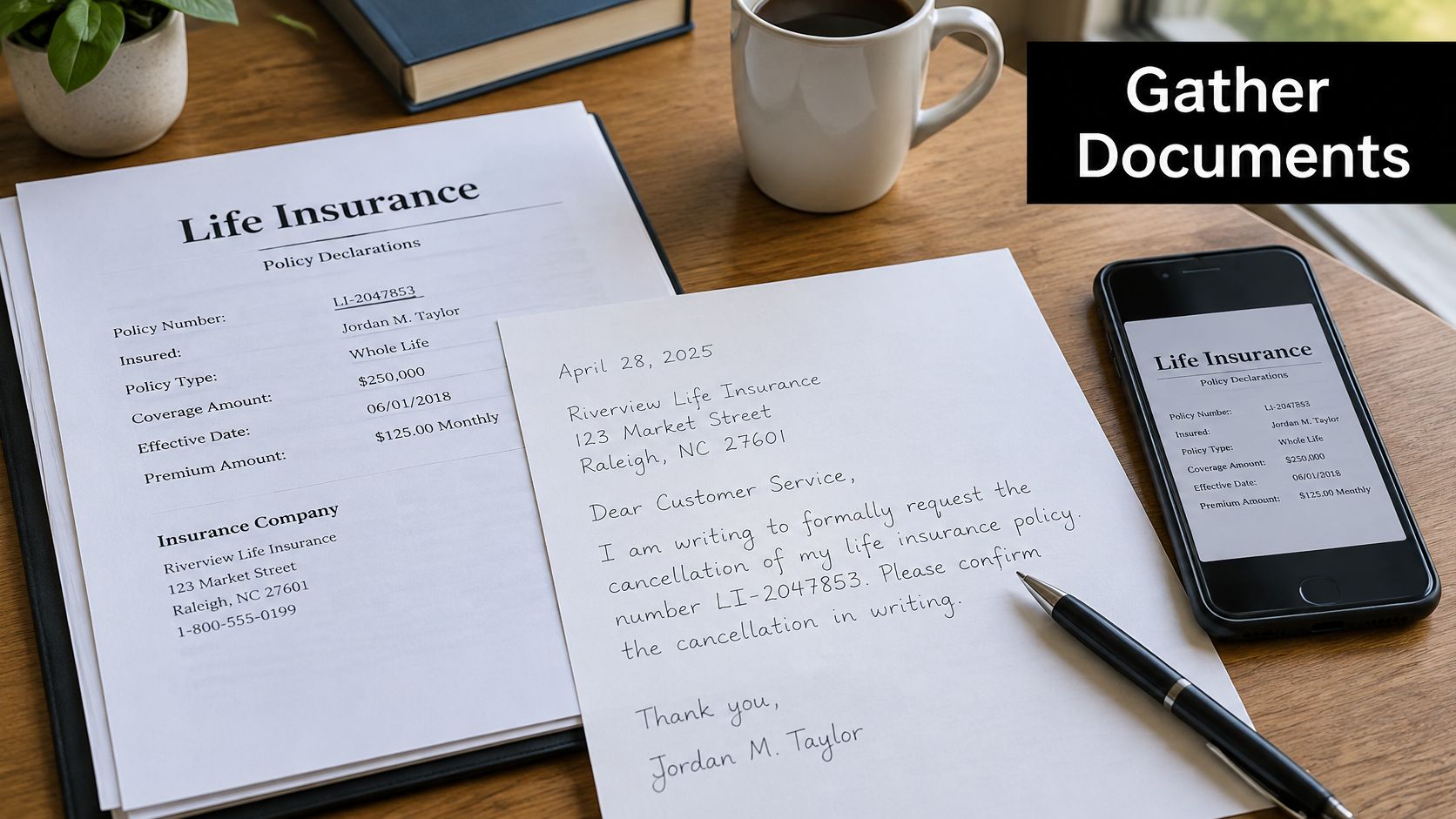
A letter you can adapt in a few minutes:
Cancellation request
[Date]
[Insurer name and claims/customer service address]
Policy number: [number]
Owner: [name]. Insured: [name].
I am the owner of the policy above and request that it be canceled effective [date]. Please send written confirmation of the termination date and of any refund or surrender proceeds, and send payment to [mailing address] or to the bank account already on file. Reach me at [phone number] with any questions.
Signature: [wet or electronic signature]
Four lines in that letter do the work. The policy number identifies the file. The requested effective date gives the insurer a target it must confirm or reject. The signature establishes authority. The payment instruction prevents a check from going to an old address. Skip the threats and the long explanation of why you're leaving. Nothing in a cancellation letter needs to justify the decision.
Send the letter together with the carrier's own form when one is required, because a letter alone can sit unprocessed. Use a channel that produces a receipt: portal upload, certified mail, or the insurer's secure message center. Save the tracking number and a PDF of everything you sent. For a cash-value policy, the letter is only half the job, because there the numbers matter as much as the paperwork.
How to Cancel a Life Insurance Policy Step by Step
Cancellation goes wrong in the same handful of places every time: someone stops a draft instead of ending a contract, someone cancels before replacement coverage is issued, or someone signs a surrender without knowing the net figure. Eight steps in order close all three gaps.
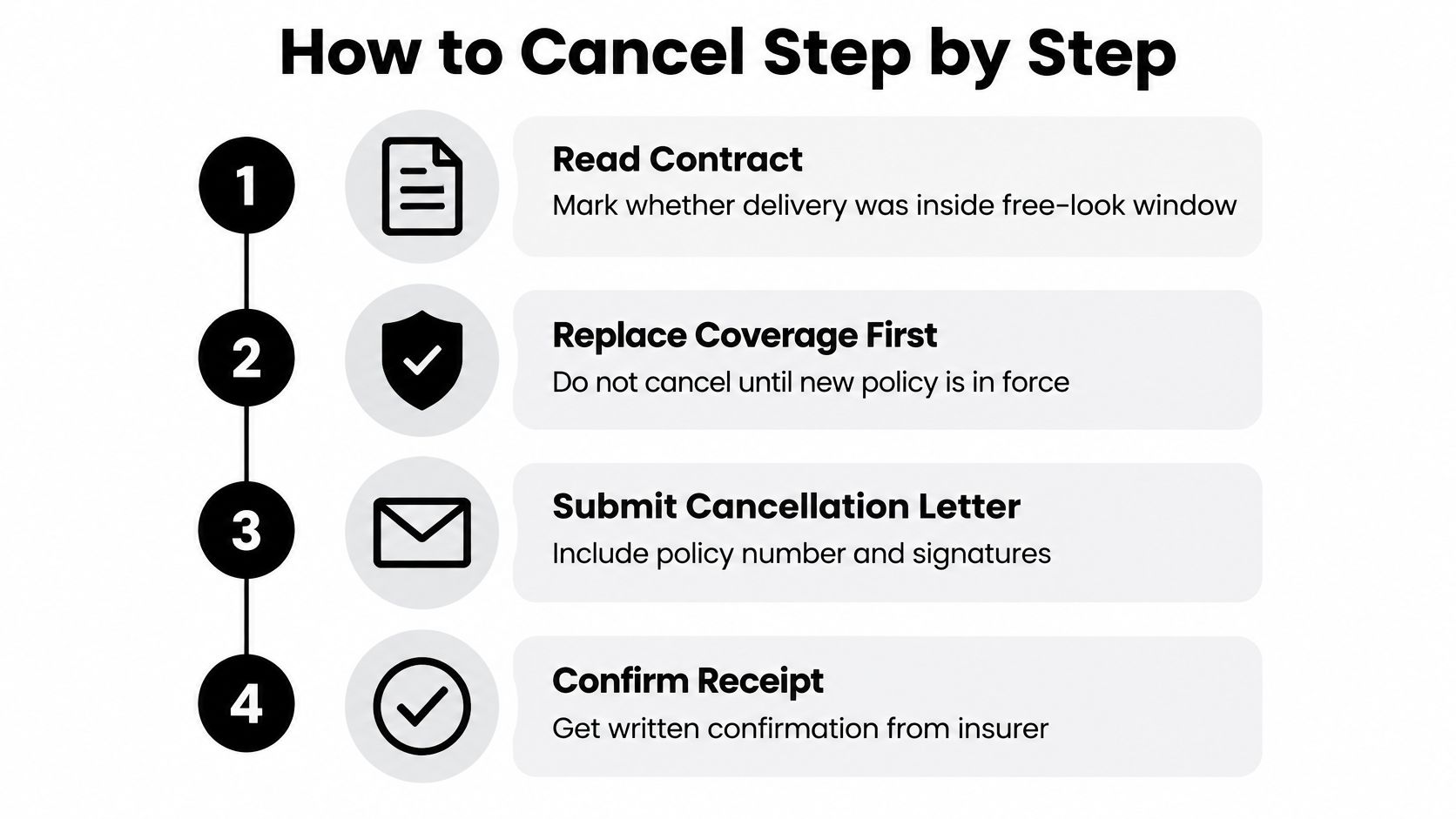
The NAIC consumer guide to life insurance, published by the Maine Bureau of Insurance, describes the same logic in three moves: establish whether you're inside the state free-look period, request the insurer's prescribed cancellation or surrender form, and submit it through a traceable channel while keeping confirmation of the effective date. Here's the full sequence with the reason each step exists.
- Read the contract and date the delivery. Mark whether you're inside the free-look window. That single fact decides whether you get a full premium refund or a surrender calculation.
- If you're replacing coverage, stop here. Don't cancel anything until the new policy is delivered, reviewed, and confirmed in force. A decline, a rating change, or an exclusion discovered late can leave you with nothing.
- Ask for the prescribed form by name. Call or message the carrier or the agent of record and request its cancellation or surrender form. A generic email asking to "close the policy" can be answered without being actioned.
- Request a written quote before you sign if the policy has cash value, an outstanding loan, or a collateral assignee. You want the net figure in writing before your signature makes it final.
- Complete the form precisely. Policy number, owner name, requested effective date, and an explicit statement that coverage should end only on that date. Vague effective dates are how policies end earlier than intended.
- Send it through a traceable channel. Portal upload with a receipt, certified mail, or the insurer's secure message center. Keep a full copy of everything.
- Confirm the outcome in writing. Get the termination date, any refund, outstanding loan balance, surrender charge, and whether a beneficiary or assignee needs notice.
- Watch the next bank draft. If a charge posts after the confirmed end date, dispute it immediately rather than assuming the system will catch up.
The most expensive mistake in that list is assuming a stopped automatic payment cancels coverage. Policies can stay active through a grace period while premiums go unpaid, and the resulting lapse carries its own consequences. If you'd rather watch the sequence once before you start, this walkthrough covers the same ground.
Surrender Charges Loans and Taxes on Cash Value
Surrendering a permanent policy is a financial transaction with a receipt, and it works nothing like an unsubscribe link. The balance shown in your online account is gross cash value. The amount that reaches your bank account is smaller. The amount the tax authorities care about is a different number again, and nobody at the call center will volunteer any of it unless you ask.
Request an in-force illustration or a surrender quote before you sign anything. It should break out each line separately.
| Line | Example | What to verify |
|---|---|---|
| Premiums paid, starting basis | $5,000 | Contract basis after dividends |
| Gross cash value | $11,500 | Current illustration, not an old annual statement |
| Surrender charges | $1,500 | Contract schedule for the policy's year |
| Loan principal and interest | $0, none outstanding | Separate payoff quote |
| Net cash received | $10,000 | Insurer net surrender figure |
| Potential taxable gain | About $5,000 | Proceeds plus loan relief minus adjusted basis |
Walk the arithmetic once with round numbers. In this example the $11,500 gross cash value shrinks by the $1,500 surrender charge to a $10,000 check, and because no loan is outstanding nothing else comes off. If you paid $5,000 in premiums and receive $10,000 after surrender adjustments, the potential taxable gain is about $5,000 rather than the full $10,000, as NerdWallet's breakdown of taxable life insurance explains. Your cost basis is generally premiums paid minus applicable dividends, and the insurer's own quote governs the final figures, not a percentage someone quoted you on the phone.
The tax side is consistent with that framing. IRS guidance on taxable income treats the amount received above your investment in the contract as includible in income, which is why a cash-value surrender deserves a conversation with a tax professional when the gain is material.
Why a policy loan changes both numbers
An unpaid loan is deducted from the death benefit while the policy is alive, and it comes off the cash value when the policy ends. Under Illinois insurance regulations on policy loans, unpaid principal and interest reduce the death benefit, and if premiums stop and the owner takes the remaining cash value, the debt reduces that instead. The trap is a small check with a large loan behind it: loan relief plus cash above your basis can create taxable income even when the payment itself is modest.
Ask for a payoff quote that lists principal, accrued interest, surrender charges, and net proceeds as separate lines. Confirm whether a Form 1099-R is expected. Then read your own contract's surrender charge schedule rather than assuming a universal percentage, because those schedules vary by policy form and year.
Practical rule: calculate the tax exposure before you sign, not after the check clears.
The same discipline applies to anything that drafts automatically. Before you trust that a recurring charge has stopped, confirm it in writing, the way you would verify a PayPal cancellation went through.
Before surrendering, ask the carrier to price the alternatives on paper: reduced paid-up insurance, extended-term coverage, or a tax-sensitive exchange. Each is a different transaction with a different outcome, and what a surrender charge actually costs is worth understanding before you compare them.
Replace Coverage Before You Cancel
Replacement is where careful people still get hurt. A new application can be delayed for weeks, issued at a different rating than the quote, declined outright, or approved with an exclusion for the exact condition that prompted the switch. Meanwhile the old policy, once canceled, may be expensive or impossible to reinstate after a change in health.
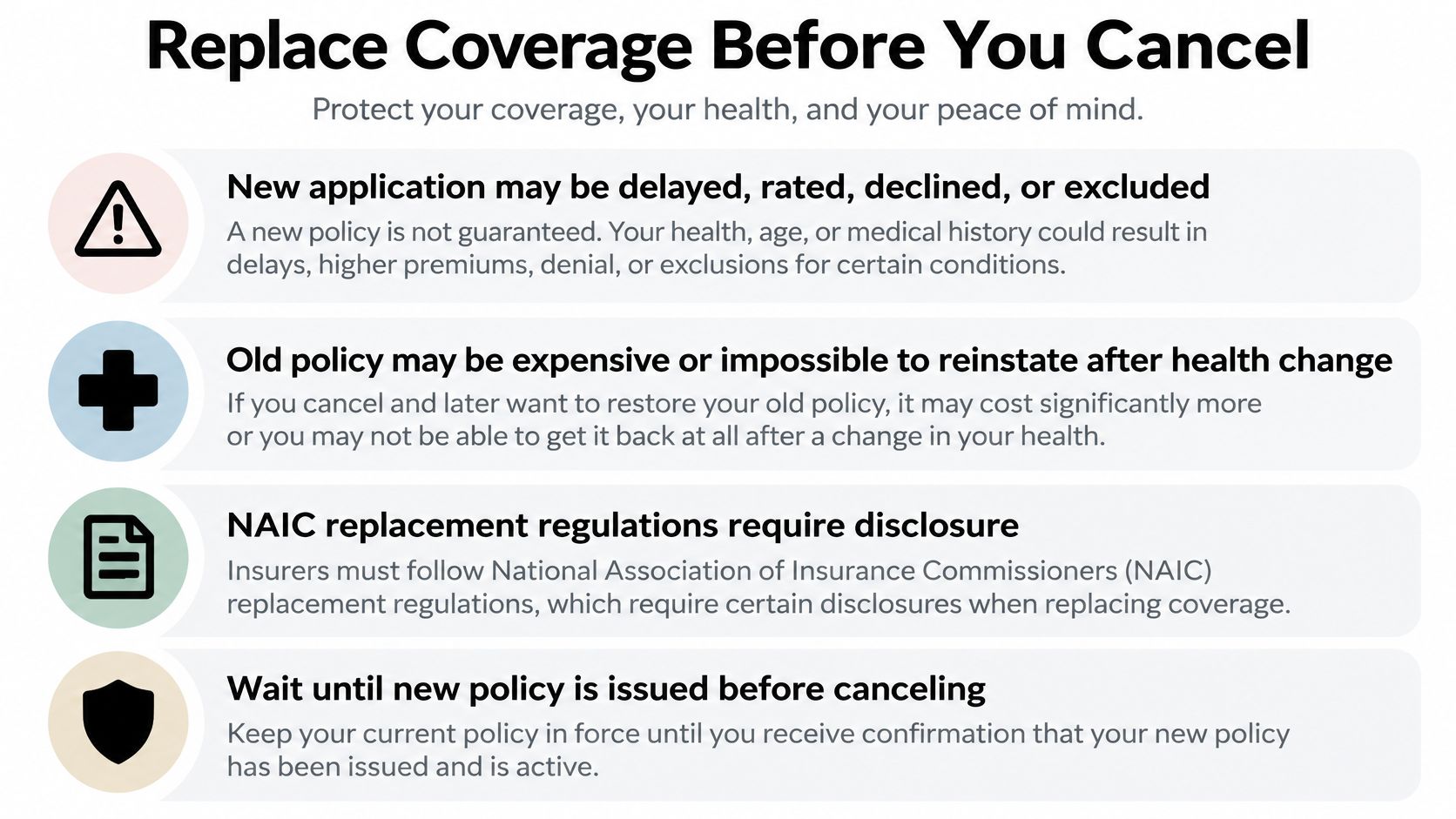
The order matters more than the paperwork. NAIC's consumer guidance on life insurance says not to cancel an existing policy until the replacement has been received, reviewed, and confirmed in force, and it adds a question worth asking first: whether the current contract can be modified rather than replaced.
That question has real answers. Depending on the policy type, coverage can be adjusted or converted to permanent insurance, which keeps the protection and the underwriting history you already have instead of starting a new medical review.
One action to take this week
Pick one row from the first table and write a single date next to it. Then act on that date, not on the feeling you get when you see the draft clear.
- Inside the free-look window: return the policy with proof of delivery and expect the premium back in full.
- Older term policy and nobody depends on the death benefit: send the carrier's form, keep the termination letter, and treat the confirmed end date as the official one.
- A spouse, mortgage, or childcare still depends on that income: bind the new coverage and wait until it's approved and the first payment is processed before the old policy ends. Coverage typically begins when approval and that first payment are done, not when you apply.
The comparison habit you'd use to choose car insurance works here too. Line up riders, exclusions, and beneficiary designations side by side before you sign the new application, not after.
The checklist that closes the gap
Before the old policy ends, confirm the new policy's delivery date and its own free-look deadline, compare exclusions and riders line by line, and check that every beneficiary designation was copied correctly rather than defaulted. Get written confirmation that the old policy is canceled on the intended date and no earlier.
Newly married couples and new parents should reassess their coverage needs before assuming the old number was wrong. A common guideline is 10 to 15 times annual income, and we'll help you tailor that figure to your mortgage, childcare, and income pattern. If your goal is a lower premium, a leaner policy can fit, and many policies start as low as $15 to $30 per month depending on age, health, and coverage amount.
The mechanics are the same ones you'd follow when switching insurance providers of any kind: new coverage in force first, written confirmation second, and the old draft stopped last.
Coveredly writes term life insurance online, with coverage you can raise or lower as your family changes, and no medical exam for most policies up to $3M. If you're replacing a policy you already own, our team will help you sequence the new application and the old cancellation so there's no gap between them. Start with a quote at Coveredly and see what fits your budget before you touch the autopay.