If two people apply for the same life insurance policy, why might one get an immediate approval while the other gets questions, a medical exam, or a higher price?
The difference isn't whether someone is healthy. Insurance underwriting is how an insurer evaluates risk, verifies information, and decides what coverage it can offer. Understanding insurance underwriting basics helps you separate what you can influence, such as complete answers and accurate records, from what you can't, such as your age or a carrier's eligibility rules.
Table of Contents
- The Underwriting Process at a Glance
- Why Age, Health and Lifestyle Drive Your Rate
- Medical Exams, Records and MIB Checks Explained
- No-Exam Underwriting and How It Really Works
- Approved, Rated or Declined
- Real Applicant Examples and What Changed Their Outcome
- Prepare Your Application Before You Apply
The Underwriting Process at a Glance
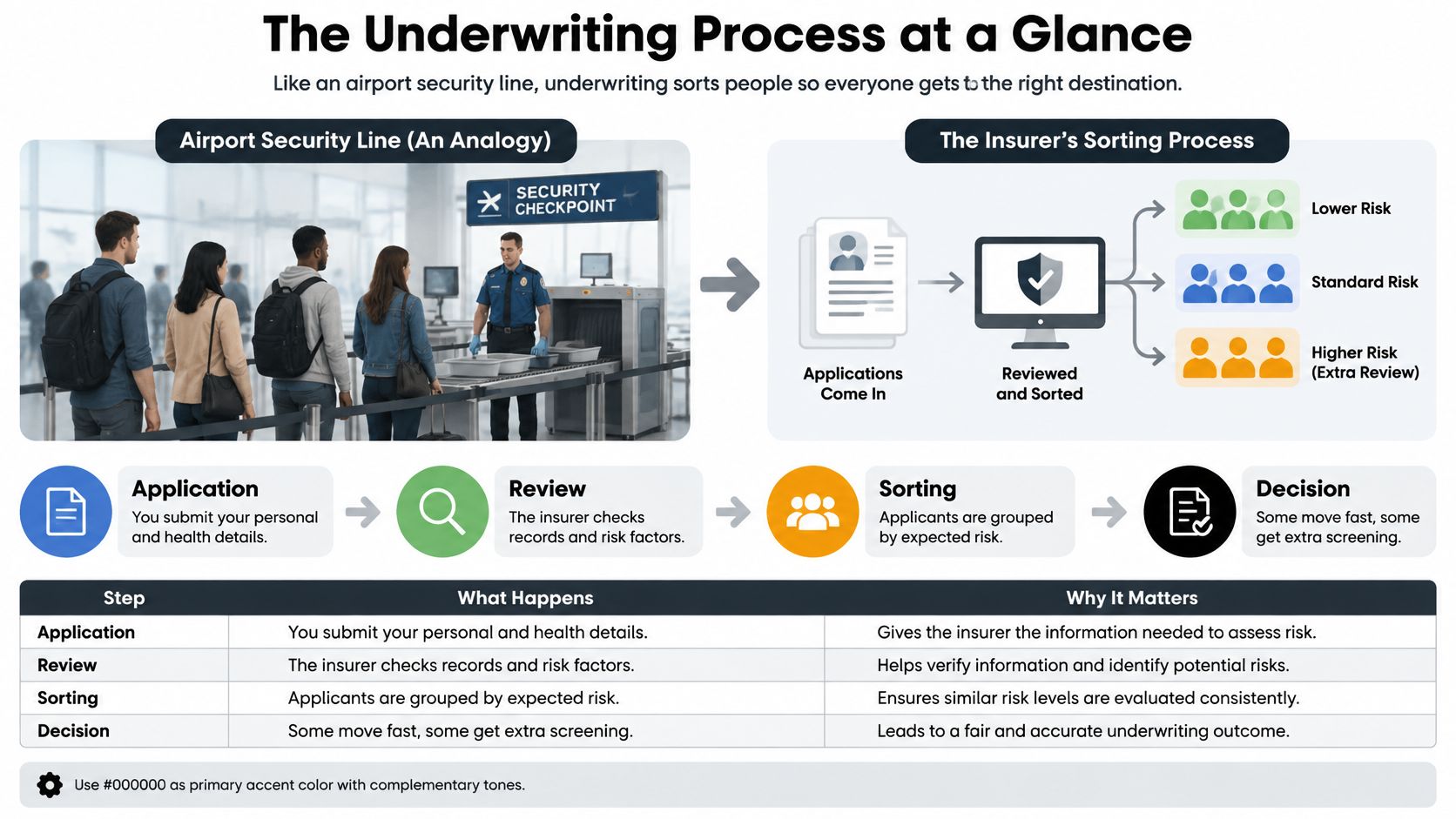
Think of underwriting as an airport security line. Some applicants move through a fast lane because their information meets the insurer's requirements. Others need extra screening before the insurer can make a decision. Extra screening doesn't automatically mean rejection.
The insurer's job is broader than checking your health. It must collect enough premium across policyholders and maintain financial resources to pay claims, a relationship reflected in EIOPA's insurance statistics framework.
This visual shows the basic sorting process.
Underwriting stages and typical timing
These are planning ranges, not promised completion dates. Several checks can run together, and a records request can extend the schedule.
| Stage | What the insurer does | Typical timing |
|---|---|---|
| Application submitted | Collects identity, health history and lifestyle answers | Minutes |
| Automated review | Checks answers against data sources and scores risk | Instant to 2 days |
| MIB and prescription checks | Compares answers with prior applications and drug records | Runs alongside automated review |
| Medical evidence | Paramedical exam or medical records request | 1 to 4 weeks |
| Underwriter review | Human review of all evidence and the rating decision | 1 to 2 weeks |
| Decision and offer | Approval, rated offer, postponement or decline | Often 2 to 6 weeks in total for a traditional case |
| Policy issue | Coverage starts once the offer is accepted and the first premium is paid, subject to policy requirements | Days after acceptance |
Accelerated underwriting can shorten the process when the insurer can verify a straightforward file digitally. No-exam cases can finish in days when the information is complete and consistent, but an initial fast review doesn't guarantee a fast final offer.
Practical rule: An application confirmation isn't proof that coverage has started. Check the policy's effective date and any outstanding requirements.
You can't control how quickly a doctor releases records or whether an insurer requests additional evidence. You can answer every question fully, respond to requests within a few days, and keep your contact details current so the file doesn't stall.
Why Age, Health and Lifestyle Drive Your Rate
Life insurers estimate mortality risk, meaning the likelihood that an insured person will die during the coverage period. They compare your circumstances with experience across large groups, rather than predicting your future from your application alone.
A mortality table records death rates across ages and other characteristics. The American Academy of Actuaries' explanation of mortality tables describes the population-based foundation behind these calculations. Your risk class connects that group-level evidence to your premium, the amount you pay for coverage.

What the insurer weighs
Age and sex are the most commonly used mortality factors, while smoking, medical history, socioeconomic circumstances, and lifestyle also help predict mortality, according to the Institute and Faculty of Actuaries' discussion of mortality risk factors. Use of particular characteristics is subject to applicable rules and fairness considerations.
Age matters because mortality generally increases as people get older. For example, someone applying at 30 rather than 50 may qualify for a different premium; a level-premium term contract can preserve its agreed premium during the selected term, subject to its provisions.
Tobacco use can substantially affect classification. For medical history, the insurer looks beyond a diagnosis: blood pressure readings, cholesterol, diabetes control, cancer treatment history, and follow-up care provide context. Body mass index, a height-to-weight measure, and family history may also enter the assessment.
Scuba diving, private flying, hazardous occupations, and other activities may prompt questions about frequency, training, and working conditions. Income mainly helps establish whether the coverage amount is financially reasonable; it isn't interchangeable with a medical risk class.
The broader distinction between personal characteristics and insurance pricing also appears in driver profile insights from QuoteFii, from QuoteFii, LLC. Auto and life insurers assess different risks, so their pricing rules aren't interchangeable.
Before applying, confirm:
- Tobacco disclosures: Check exactly what the application asks about products and use.
- Health details: Verify diagnoses, medication names, and treatment status.
- Activities: Be ready to describe hazardous work or hobbies accurately.
You can document these factors. You can't choose the insurer's classification formula.
Medical Exams, Records and MIB Checks Explained
Insurers verify a file through several layers. Each answers a different question, and no single layer necessarily tells the whole story.
What did you disclose?
Your application is your signed statement about personal information, health history, and lifestyle. Read each question carefully, including its time period. A question about consultations may require disclosure even when the doctor found nothing serious.
Prescription checks help verify treatment history, but a medication name doesn't always explain why it was prescribed. If the apparent diagnosis is wrong, the insurer may need medical context rather than a simple yes-or-no answer.
What does current medical evidence show?
A paramedical exam is a limited health assessment, not a full physical. A nurse or examiner may visit your home or workplace, measure height, weight, and blood pressure, and collect blood and urine samples. A typical visit is planned for 15 to 30 minutes, although scheduling and required tests can change the appointment.
Testing may include cholesterol, glucose, HbA1c, nicotine markers, and indicators of liver and kidney function. Our guide to the life insurance medical exam explains what applicants can expect. Don't stop prescribed medication or change treatment to influence results.
When a condition needs explanation, the insurer may request your doctor's records using your signed authorization. Provider response times and the completeness of those records affect how quickly the review proceeds.
Do outside records match?
MIB is a consumer-reporting organization holding coded information about medical conditions and hazardous activities from prior individual insurance applications. As the Wall Street Journal's MIB report explainer explains, an authorized report isn't a complete medical file, contains no full medical records or laboratory results, and cannot be the sole basis for denying coverage or setting a rate.
A mismatch is a reason to investigate, not proof that an applicant was dishonest.
Differences between your answers, prescriptions, and records can slow a file. Accurate preparation helps the underwriter distinguish a clerical error from information that changes the risk assessment.
No-Exam Underwriting and How It Really Works
No exam doesn't mean no underwriting. It usually means the insurer can assess an applicant without a paramedical visit, using application answers and authorized health information instead.
In many cases, no medical exam is needed because policies can be approved using digital underwriting and health data. With our digital application process, applicants apply in minutes and get an immediate decision, with no medical exam for most. An immediate response shouldn't be confused with a guarantee that every applicant will receive the coverage requested.
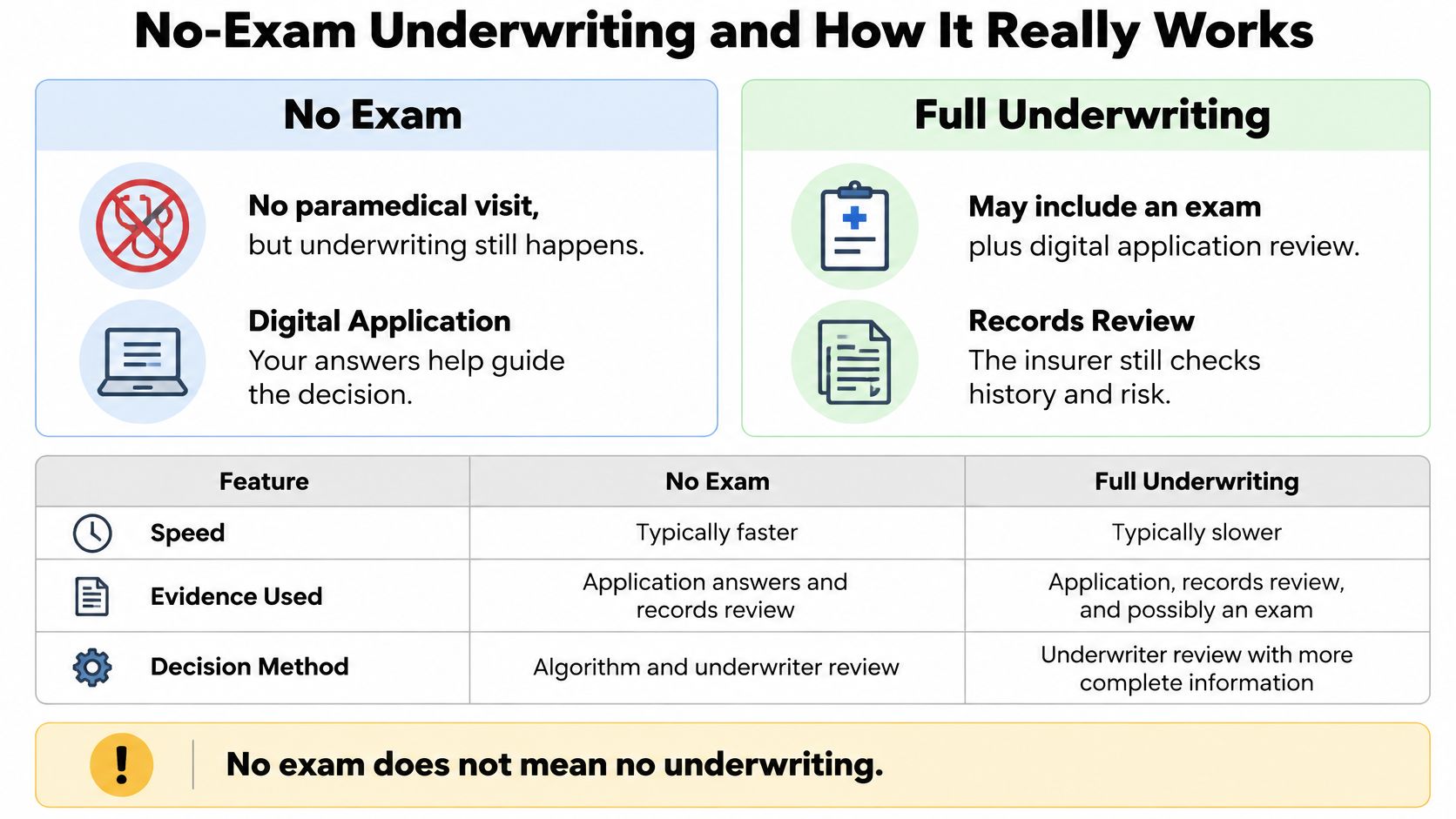
No-exam and traditional underwriting compared
| Factor | No-exam route | Traditional route |
|---|---|---|
| Evidence used | Digital application, prescription history, MIB data and other verified sources | Application, paramedical exam, lab results, MIB and medical records when needed |
| Typical time | Days when the data is clean | Often 2 to 6 weeks in total |
| Likely outcome for a healthy applicant | Fast standard decision if answers match records and eligibility rules are met | Standard rate once exam and lab results are reviewed, if standard criteria are met |
| Poor fit | Recent serious condition, complex history or answers that cannot be verified | Applicants who need a decision within days |
Speed is only part of the trade-off
Accelerated underwriting and simplified issue aren't identical. Accelerated underwriting can streamline a fuller assessment using digital evidence. Simplified issue uses a more limited selection process, and eligibility and pricing can differ.
The Society of Actuaries' simplified-issue underwriting report identifies application design, target market, distribution, selection criteria, and claims procedures as factors affecting mortality outcomes. Two programs advertising no exam can therefore reach different decisions about the same applicant.
An exam or records request isn't necessarily a worse route. It can give an underwriter evidence that a condition is stable instead of leaving an unanswered question in a digital file.
Insurers also need to examine early policy experience carefully. The Society of Actuaries' individual-life mortality study describes how mortality differs by underwriting approach and policy duration, with adverse selection particularly relevant to guaranteed-issue business. That doesn't mean every simplified application carries the same risk.
A no-exam life insurance policy may fit well when your recent health history is straightforward and your answers are readily verifiable. Complicated conditions or unresolved investigations make a records-based assessment more likely.
Approved, Rated or Declined
What does rated mean, and is a decline the end? A rated offer is still an approval, but at a higher premium because the insurer identified additional risk. A decline means that carrier won't offer coverage on the terms assessed, not that every carrier will reach the same conclusion.
Underwriting outcomes and your next step
| Decision | What it means | Your next step |
|---|---|---|
| Standard approval | Accepted at the standard rate for your risk class | Review the offer and accept before the deadline |
| Rated offer | Accepted with a higher premium because of added risk | Ask what drove the rating and whether updated records could change it |
| Counteroffer | Different term, amount or conditions than you applied for | Compare it with your original request before accepting |
| Postponed | More information is needed before a decision | Send the requested records quickly and confirm any required waiting period |
| Declined | Coverage not offered on these terms | Ask for the reason in writing and check other carriers |
When the information or model is wrong
An automated recommendation isn't always the final underwriting decision. Flagged files may go to a human underwriter, but you shouldn't assume a person has reviewed every detail.
Income changes, remote or nontraditional work, medication or diagnosis mismatches, and MIB discrepancies can prompt clarification. They aren't automatic grounds for rejection. Ask what specific information affected the result rather than guessing which answer caused it.
A 2025 Fenwick review of AI in insurance reports that 58% of surveyed life insurers use, plan to use, or are exploring AI models, while nearly one-third of surveyed health insurers reportedly didn't regularly test models for bias. The latter finding concerns health insurers, but it underscores why faster digital underwriting isn't automatically more transparent or fair.
Use this recourse checklist when a decision looks wrong:
- Get the reason in writing: Ask which records, findings, or eligibility rules drove the decision.
- Inspect the underlying information: Request the relevant consumer report or medical record through the organization that maintains it.
- Request a correction: Identify the disputed entry precisely and provide supporting documents to the doctor, reporting organization, or other record holder.
- Seek reconsideration: Send corrected records, recent laboratory results, or evidence of a controlled condition, and request human review.
Updated evidence can sometimes improve a rated offer, but it doesn't guarantee a different result. Many carriers offer flexible underwriting options for people with pre-existing conditions.
Ask directly: Was this decision based on verified medical evidence, an unresolved discrepancy, or an eligibility rule?
The insurer should be able to explain its decision. Regulators increasingly expect documentation, auditability, and bias controls for automated systems, not just a fast answer.
Real Applicant Examples and What Changed Their Outcome
The following are illustrative profiles, not actual customer cases. They show how documentation can change the review without promising a particular result.
These different circumstances call for different evidence.

A straightforward application
Consider a 31-year-old couple, both healthy nonsmokers, each applying for a 20-year term policy. If their answers match the available records and they meet eligibility requirements, they may qualify for a fast no-exam decision.
What helps isn't a short application at any cost. It's a complete application the insurer can verify without follow-up.
A controlled condition
A 44-year-old professional takes medication for well-controlled hypertension. The insurer might request records or make a rated offer, although neither result is inevitable.
A medication history and recent blood pressure readings provide evidence of control. Those documents may support a more favorable assessment than an unexplained diagnosis alone.
The video below provides another way to follow the underwriting discussion.
An answer that needs correcting
Another applicant forgets a minor doctor visit and misstates a medication. When the review flags the mismatch, the safest response is a written correction with supporting records, not an informal assumption that the omission doesn't matter.
A NAIC-published legal analysis of incontestability clauses explains that the contestability period is generally two years from issuance, although some policies specify one year or less. During that period, material misrepresentations can give the insurer grounds to contest coverage; exact policy language and applicable law matter.
The lessons are practical: complete answers beat a clean-looking form, documentation helps resolve questions, and a rating can be the beginning of a conversation rather than the end.
Prepare Your Application Before You Apply
Preparation won't change your age or erase a diagnosis. It gives the insurer a more accurate file and helps you compare offers on their actual terms.
Use this checklist before submitting:
- Gather your medical history. Collect diagnoses, treatment dates, doctors' contact details, and a current medication list. Review the life insurance health questions so you know what information to have ready.
- Estimate your coverage need. A common guideline is 10 to 15 times annual income, adjusted for your mortgage, childcare, debts, education costs, existing savings, and other support. We help tailor that starting point to your situation.
- Choose a suitable term. Match the coverage period to the years your family will depend on your income, rather than choosing only by the lowest premium.
- Compare several carriers. We compare multiple carriers to find competitive pricing. Review coverage amounts, term lengths, and conditions alongside the premium.
- Complete the application carefully. Answer the question asked. If you're uncertain about a diagnosis or date, verify it instead of guessing; applying through us is free and doesn't affect your credit score.
- Keep a complete paper trail. Save your application, authorizations, corrections, offer, and correspondence with the underwriter.
Your next step is to compare offers from two or three carriers using a complete, consistent file. Disclose other applications when asked, and if an offer isn't what you expected, request the reason in writing before deciding whether to seek reconsideration or pursue another carrier.
Coveredly offers a digital life insurance application process and compares multiple carriers to help you evaluate coverage and pricing. Visit Coveredly to start your application, get guidance on underwriting questions, and compare offers that fit your family's needs.