Think the medical exam is the hardest part of buying life insurance. That advice is outdated. For many applicants, the bigger obstacle is the pile of small administrative tasks: reconstructing medical history, finding physician details, answering financial questions, signing consent forms, and responding quickly when the insurer asks for more information.
The life insurance application process is best treated as a structured data project, not a casual form. A clean, complete application gives the insurer what it needs to route your case efficiently. A rushed application creates follow-up questions, delays, and frustration, even when your health profile is straightforward.
For a young family, newly married couple, or busy professional, preparation matters more than trying to predict every underwriting decision. You can't control an insurer's final assessment, but you can control the quality of the information you submit and how quickly you respond.
Table of Contents
- Rethinking the Biggest Hurdle in Life Insurance Applications
- Building Your Pre-Application Document Checklist
- Navigating Modern Underwriting Paths and Timelines
- Preparing for the Phone Interview and Medical Exam
- Speeding Up Approval and Avoiding Common Pitfalls
- Tailoring the Process to Your Current Life Stage
Rethinking the Biggest Hurdle in Life Insurance Applications
The medical exam gets most of the attention because it feels personal and intimidating. You may picture blood pressure readings, blood and urine samples, and difficult questions about past diagnoses. Those steps can matter, but they aren't automatically the point where applications fail.
The more common problem is effort. Industry reporting says 79% of applicants cite the amount of required effort as the top reason for abandoning a life insurance application, while 60% say filling in medical details is too much work and 56% struggle to gather provider information. Those figures come from industry reporting on application friction.
Practical rule: Treat every unanswered field as a possible future delay, not as a minor omission.
A digital application still needs accurate history. The insurer may ask about conditions, medications, treatment, physicians, occupation, hobbies, finances, and existing coverage. If you stop halfway through to search for a doctor's phone number or estimate your income, the process becomes mentally expensive. That is when applicants guess, postpone the application, or abandon it altogether.
The application is a data-gathering exercise
Underwriting evaluates information such as age, health, lifestyle, occupation, and financial circumstances. The application gives the insurer the starting record for that review. It isn't merely a form that determines whether you qualify. It establishes the facts an underwriter may verify through authorized data sources, medical records, interviews, or an exam.
That distinction changes how you should prepare. Don't open a quote page first and hope the answers come to you. Create a small dossier before you begin, then complete the form from organized information. If you regularly manage lending paperwork or other personal finance tasks, the same preparation habits described in Fintrack tips for credit applications can help you reduce errors and avoid avoidable back-and-forth.
Speed follows completeness
Automated underwriting can move quickly when the application arrives in good order and the applicant fits the carrier's rules. Traditional cases take longer because the insurer may need additional evidence, physician statements, or examination results. In both situations, incomplete data slows the human work around the technology.
The right objective isn't to hide medical history or force your application into a no-exam route. It is to submit a truthful, consistent record that gives the insurer fewer reasons to stop and ask basic questions. Good preparation won't guarantee approval, but it can remove the friction you control.
Building Your Pre-Application Document Checklist
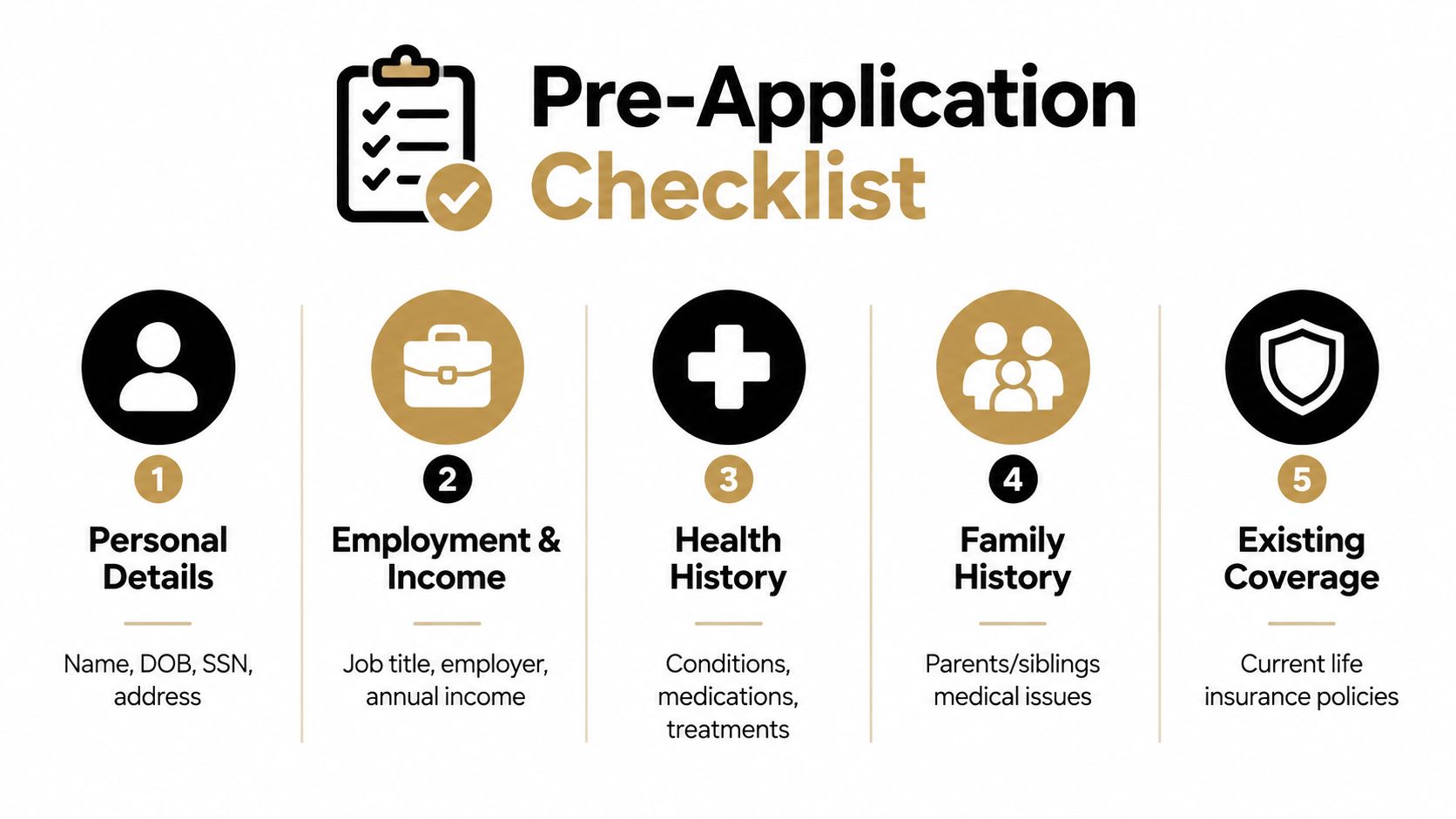
Before you request a quote, gather the information you can reasonably expect the digital intake form to request. The exact fields vary by insurer and policy, but most applications require the same broad categories. Having them ready turns a stressful research task into straightforward data entry.
Start with identity and contact information
Keep these details together in one secure note or document:
- Legal identity: Your full legal name, date of birth, Social Security number, citizenship or residency details, and current address.
- Contact details: Personal phone number, email address, mailing address, and the best times for an interview or examiner visit.
- Family information: Spouse or partner details, children or other dependents, and intended beneficiary choices.
- Employment information: Job title, employer, work location, duties, and any occupational hazards.
- Lifestyle details: Tobacco or nicotine use, alcohol use, foreign travel, aviation, dangerous hobbies, and driving history.
Don't rely on memory for beneficiary information. Decide who should receive the policy proceeds and confirm names carefully before you submit. If you're replacing or adding to existing coverage, have current policy details available so the insurer can understand the overall protection already in place.
Prepare the financial case for the coverage
The application may ask why you want coverage and whether the requested amount fits your financial responsibilities. Gather annual income, household income, net worth, outstanding mortgage balance, other debts, education obligations, business interests, and existing life insurance.
You don't need to invent a perfect formula. Start with the obligations your family would face if your income disappeared, then consider the period during which those obligations matter. A mortgage balance, childcare needs, income replacement, business commitments, and future financial goals may all influence the amount you request.
Large or complex applications may require supporting financial documents. Keep relevant tax records, financial statements, business documents, trust information, or buy-sell agreement details accessible if your adviser or carrier requests them.
Build a five-year medical history file
Medical information creates the most avoidable friction because applicants often remember diagnoses but not the details needed to verify them. Prepare:
- Conditions and dates: Diagnoses, hospitalizations, surgeries, injuries, treatments, and approximate dates.
- Medication records: Medication names, dosages, prescribing physicians, and the reason each medication was prescribed.
- Provider directory: The exact names, addresses, and phone numbers of primary care doctors, specialists, clinics, and hospitals visited during the relevant lookback period.
- Family history: Major medical issues affecting parents or siblings, when known.
- Follow-up details: Pending tests, recent abnormal results, ongoing treatment, and whether a condition is stable or under active management.
The life insurance requirements guide can help you identify the categories to organize before applying. Use records rather than guesswork whenever possible. An incorrect date or omitted specialist can create more delay than an honest answer that requires additional review.
Your best preparation tool is a complete record, not a favorable guess.
Navigating Modern Underwriting Paths and Timelines
Life insurers increasingly use triage. After you submit an application, the carrier assesses the information available and routes the case toward fully automated underwriting, accelerated underwriting, or traditional underwriting. The route depends on the insurer's rules, your age, health history, requested coverage, data results, and the amount of evidence required.
The 2025 Genre survey summary reported that participating companies handled an average of 108,510 individual life applications, representing an average of $52 billion in benefit amount in 2024. Within those workflows, 12% were eligible for fully automated decisioning, 47% for accelerated underwriting, and 41% for traditional underwriting, according to the Genre survey summary.
That distribution makes one point clear. No-exam and accelerated options are meaningful, but traditional underwriting remains a major part of the market. Don't assume the application will follow the fastest path because you apply online.
What each path actually means
Fully automated underwriting uses available application data and electronic verification to make a decision without routine human review. It works best when the applicant's information is consistent, the requested coverage fits the carrier's rules, and no major risk signal requires investigation.
Accelerated underwriting uses technology for initial triage but may send the application to a human underwriter. In a later survey covering 2025 activity, 59% of applications were eligible for accelerated underwriting, compared with 42% in 2021. Among eligible cases, 19% were approved through a fully automated workflow, 52% through human underwriter review, and 30% weren't approved on the accelerated path, according to Genre's 2025 underwriting survey takeaways.
Traditional underwriting requires deeper evidence. That may include a phone interview, paramedical exam, blood and urine samples, attending physician statements, or other records. It isn't a failure. It is the appropriate route when the insurer needs more information to assess the risk.
No exam doesn't mean no scrutiny
A no-exam application may avoid a nurse visit, but the insurer can still review prescription history, medical records, and motor vehicle data with appropriate authorization. Neutral industry coverage notes that selected applicants may receive no-exam coverage limits as high as $1 million to $3 million, but eligibility depends on factors such as age, health, and underwriting path. The important distinction is simple: no exam means no scheduled physical examination, not no underwriting.
The underwriting process for life insurance is therefore better understood as a routing system. Your digital and medical footprint helps determine whether the carrier can make a quick decision or needs additional evidence.
| Underwriting Path | Key Requirements | Average Timeline |
|---|---|---|
| Fully automated | Complete application, health answers, electronic verification, and no triggering issue requiring human review | Final decisions averaged 9 days for accelerated or automated programs in the 2020 LIMRA summary |
| Accelerated | Complete application, authorized data checks, and possible human underwriter review | The medical questionnaire or interview averaged 3 days from receipt of an application in good order, with final decisions averaging 9 days |
| Traditional | Detailed application, phone interview, paramedical exam, and possible physician records | Medical questionnaire or interview averaged 8 days, with final decisions averaging 27 days in the same LIMRA comparison |
| Traditional with extensive evidence | Exam, blood and urine samples, physician records, and follow-up documentation | Standard underwriting with an exam often takes 2 to 6 weeks, and an attending physician statement can add 2 to 4 weeks |
The LIMRA figures come from its 2020 industry trend summary. The table gives averages, not promises. A clean application can move faster, while missing records or complex medical history can extend the timeline.
Preparing for the Phone Interview and Medical Exam
The biggest risk is not the exam. It is an inconsistent or incomplete record that creates more questions, delays review, and adds administrative friction. Prepare your digital and medical footprint before either appointment so the insurer can verify your answers without repeated follow-ups.
The phone interview usually lasts 15 to 30 minutes and covers health history, hobbies, lifestyle, and finances, according to Policygenius's explanation of the underwriting process.

Keep your medical file, medication list, physician contacts, and application copy within reach. Answer only what was asked, describe diagnoses accurately, and match the information already submitted. Underwriters may compare your responses with authorized records, so consistency matters more than presenting an unusually favorable version of your history.
What the examiner does
A paramedical examiner may visit your home or office when the carrier requires an exam. The appointment often lasts 30 to 45 minutes and may include:
- Basic measurements: Height, weight, blood pressure, and pulse.
- Specimen collection: Blood and urine samples when required.
- Health clarification: Questions about diagnoses, treatments, prescriptions, surgeries, and physicians.
- Identification and consent: Confirmation that the examiner is evaluating the correct applicant and has the necessary authorization.
The exam is a standardized evidence-gathering appointment, not a full physical. The examiner records information for the insurer's underwriting team and does not decide whether you qualify for coverage.
Make the readings representative
Book the appointment when you can be calm and unhurried. Follow the examiner's fasting and hydration instructions, and bring government-issued identification if requested. Avoid intense exercise, heavy meals, caffeine, nicotine, and alcohol close to the appointment unless the examiner gives different instructions.
Do not stop prescribed medication or alter treatment to influence a reading. That can create a misleading record and damage the application. Aim for an accurate picture of your usual health.
Review this life insurance medical exam guide before the appointment so you know what to expect. Tell the examiner if anxiety is affecting you. Clear answers and steady preparation reduce avoidable friction.
Speeding Up Approval and Avoiding Common Pitfalls
A delayed application needs active management. Waiting while the insurer tries to obtain records is the least effective strategy, especially when a simple consent form or missing contact detail is holding everything up.
Sign electronic and HIPAA consent forms as soon as they arrive. Without the required authorization, an insurer generally can't order an attending physician statement. That means the underwriter may know a record is needed but still be unable to request it.
Take responsibility for the evidence
If you have a pre-existing condition, don't wait for a vague request for “more information.” Prepare a short cover letter explaining the diagnosis, treatment, current status, and relevant physician. If you already have recent records that clarify the condition, ask whether submitting them would help.
That doesn't guarantee a favorable decision. It gives the underwriter usable context instead of forcing the carrier to assemble the story through multiple requests.
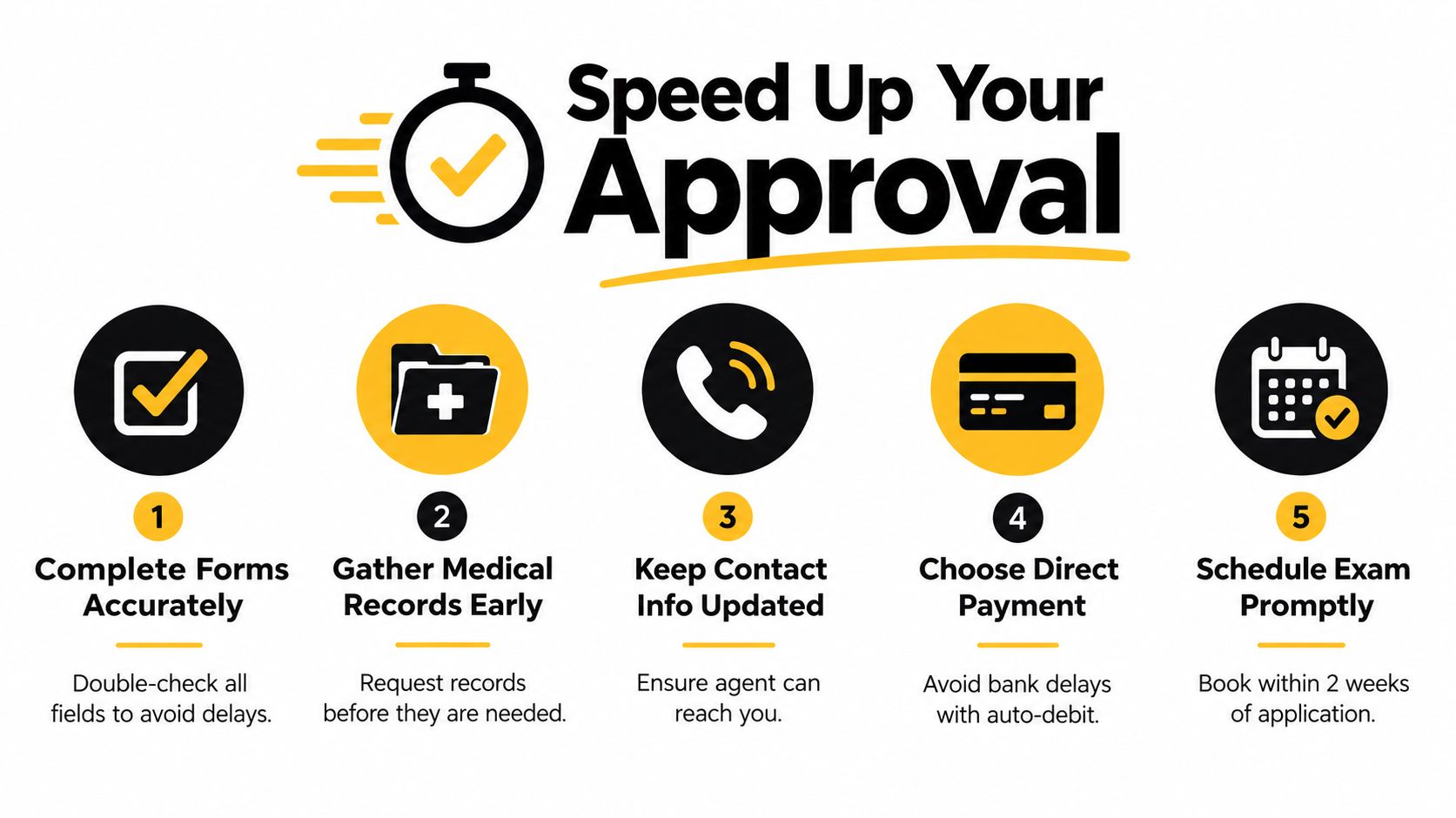
- Complete forms accurately: Review dates, medications, addresses, and financial figures before signing.
- Request records early: Contact primary care offices and specialists when you know the insurer may need documentation.
- Keep contact information current: Tell your broker, agent, and carrier if your phone number, email, or address changes.
- Choose a payment method promptly: Provide accurate banking or card details if the policy requires an initial payment.
- Schedule the exam quickly: Accept the earliest convenient appointment and complete every preparation instruction.
Monitor the application instead of guessing
Ask who owns the next action. Is the carrier waiting for your signature, an exam vendor waiting to schedule, a physician's office waiting for a records request, or an underwriter waiting for clarification? Write down the status and the date of each update.
Follow up with your broker or carrier when a promised step doesn't occur, when a provider says it hasn't received a request, or when you haven't received instructions you were expecting. Don't submit contradictory explanations to multiple people. Keep one factual timeline and use it consistently.
A prompt, truthful response is more valuable than an optimistic assumption. If the insurer asks for clarification, answer the exact question and include supporting context only when it helps.
Tailoring the Process to Your Current Life Stage
The mechanics stay similar, but the best strategy changes with your financial responsibilities.
Young families
Parents usually need protection tied to income, childcare, housing, education goals, and household services. Start by listing the costs your family couldn't easily absorb if one income disappeared. Then prepare the financial and medical information before applying, because a busy household has less capacity for repeated follow-up.
Choose a digital or accelerated path when you appear eligible and need a practical process, but don't reject traditional underwriting if the insurer requires it. A more detailed review can still produce the coverage your family needs. The priority is a policy that matches the financial exposure, not a process that merely feels fast.
Newly married couples
Marriage often changes beneficiaries, debts, housing decisions, and income protection needs. Review any individual coverage you already own, decide whether each spouse needs separate protection, and confirm that beneficiary choices reflect your current intentions.
Apply while your financial picture is clear and before a future purchase, health event, or job change complicates the record. Keep copies of applications, consent forms, and policy offers so you can compare the final terms with what you requested.
Business professionals
Professionals may need coverage for family income, executive protection, business continuity, or a buy-sell arrangement. The insurer may ask for more financial context when the requested benefit relates to business ownership or a substantial income.
Organize income records, ownership documents, existing coverage, and the business purpose before submitting. Select a term that aligns with the obligation, whether that's a mortgage period, dependent-care years, a loan, or a business agreement. Don't ask for a large benefit without being ready to explain its financial purpose.
Across all three groups, the winning habit is the same: make the application easy to verify. Choose the coverage purpose first, build the document file second, and submit only when you can answer the core questions without guesswork.
Coveredly offers an online term life insurance application with digital quoting, health questions, electronic signing, and no-exam options for most eligible applicants, subject to underwriting rules. If you want to organize your application digitally and explore coverage for your family or business responsibilities, visit Coveredly and start with the information you've prepared.