You run a growing business, support a household, and probably carry more responsibility than any job description could capture. If you died unexpectedly, your family might lose personal income just as your company loses its decision-maker, client relationships, or ownership structure. A single life insurance policy may not solve all of those problems because each one creates a different financial obligation.
Life insurance for business owners works best as a coordinated plan with three layers: personal income protection for dependents, key-person protection for business continuity, and ownership-transfer funding for partners or heirs. Once you separate those purposes, it becomes easier to choose the right owner, beneficiary, policy type, and coverage amount.
Table of Contents
- Why Your Family and Your Business Share the Same Risk
- Key-Person Life Insurance for the People You Cannot Replace
- Buy-Sell Agreements and How Insurance Funds the Ownership Transfer
- How to Calculate How Much Coverage You Actually Need
- Tax and Legal Implications Owners Should Not Skip
- Steps to Buy and Putting Your Plan in Motion
Why Your Family and Your Business Share the Same Risk
Consider a two-person agency whose founding partner dies unexpectedly. The surviving owner must keep clients reassured, maintain payroll, and decide whether the agency can continue. At the same time, the deceased partner's family may need income and may own an interest in a business they don't want to operate.
Those are connected risks, but they aren't identical. Personal life insurance can provide money for a household. Key-person coverage can give the company time and capital to replace a vital person. A buy-sell arrangement can create a process for transferring ownership without forcing the surviving owner, the company, or the family to improvise during grief.

Start with three separate questions
Ask these questions in order:
- Can the owner's household replace lost income? Consider mortgage or rent, dependents, education goals, everyday spending, and personal debts. The policy for this need usually belongs to the individual and pays the family or a trust.
- Can the business absorb the loss of a key person? Consider recruiting, training, lost relationships, interrupted revenue, debt, and the cost of interim leadership. The company may own and receive this coverage.
- Can the ownership interest transfer cleanly? Consider who buys the deceased owner's shares, how the price is calculated, and where the purchase money comes from. A buy-sell policy is designed for this obligation.
Buying one policy without identifying its job creates confusion. A company-owned policy may protect operations but leave the family without sufficient income. A personal policy may protect dependents but give surviving owners no dedicated funds to purchase shares. A buy-sell agreement may describe the transaction but fail in practice if nobody has the cash to complete it.
The planning gap is real. A 2022 Allianz Life survey of 516 business owners found that only 29% had a written buy-sell agreement, while 93% were concerned about finding the right buyer and 79% worried about federal or state taxes due at death. Those figures point to a practical lesson: succession planning isn't just about naming a successor. It also requires funding, valuation, tax review, and communication with the people affected.
Planning rule: Define the financial obligation first. Choose the policy only after you know who needs the money and why.
Key-Person Life Insurance for the People You Cannot Replace
A key-person life insurance policy protects the business from the financial disruption caused by the death of an essential owner, executive, salesperson, technician, or specialist. Think of that person as a load-bearing wall. The building may remain standing after the wall is removed, but only if the owners have a support plan ready.
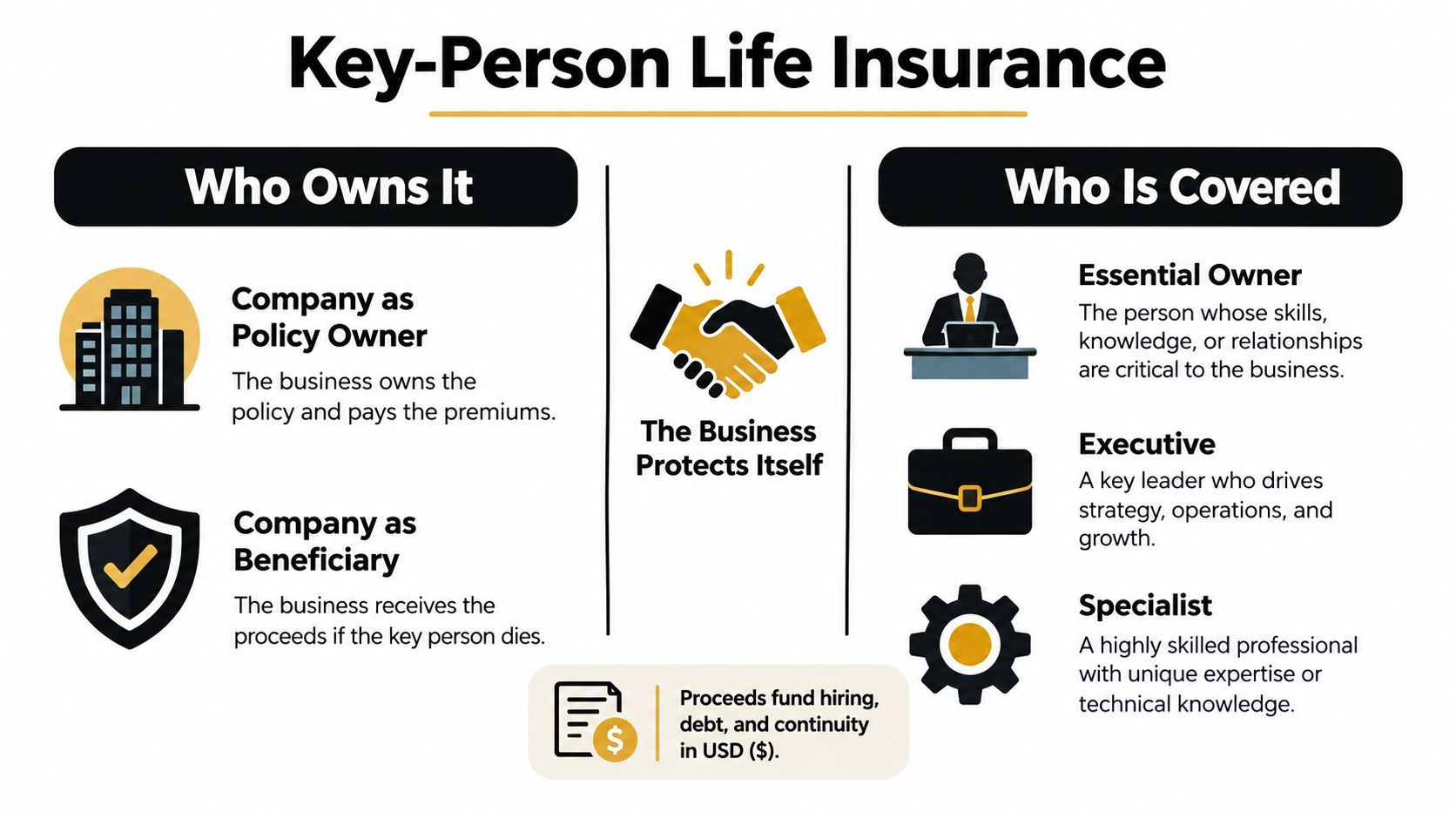
The typical structure is straightforward. The business owns the policy, pays the premiums, and names itself as beneficiary. If the insured key person dies, the company receives the death benefit and can use it for recruiting, training, disrupted revenue, business obligations, or operational stability. The National Association of Insurance Commissioners' explanation of small-business coverage describes this business-owned and business-beneficiary structure.
Match ownership to the purpose
The most common mistake is treating key-person coverage as a substitute for personal family protection. It isn't. The beneficiary and intended use determine the policy's job.
| Dimension | Key-Person Policy | Personal Life Insurance |
|---|---|---|
| Policy owner | Usually the business | Usually the individual |
| Premium payer | The business | The individual |
| Beneficiary | Usually the business | Family, trust, or named beneficiaries |
| Main purpose | Business continuity after a key person dies | Household income and financial protection |
| Typical uses | Recruiting, debt, revenue disruption, and stabilization | Living costs, debts, care, and long-term family needs |
Start by identifying dependence, not title. A founder may be important because of technical knowledge, customer relationships, signing authority, or the ability to make fast decisions. A specialist may be less visible but just as difficult to replace. Review the roles that would create the largest operational gap if the person disappeared tomorrow.
Coverage should reflect the likely disruption, not an arbitrary percentage of revenue. Consider the cost of recruiting, the time required to train a replacement, obligations that continue during the transition, and revenue that may be delayed. The company should also document why the insured person creates a legitimate economic risk.
For a practical risk-mapping exercise, owners can review reducing key person risk with Synopsix alongside a broader continuity plan. A dedicated key-person life insurance policy can then be evaluated against the specific role and exposure.
Two compliance points deserve attention early. Premiums generally aren't deductible when the business is directly or indirectly a beneficiary under IRC §264(a)(1). Also, the death benefit's income-tax treatment depends on following employer-owned insurance rules, including documented notice and consent. Keep those decisions with your CPA and attorney rather than treating them as application paperwork.
Buy-Sell Agreements and How Insurance Funds the Ownership Transfer
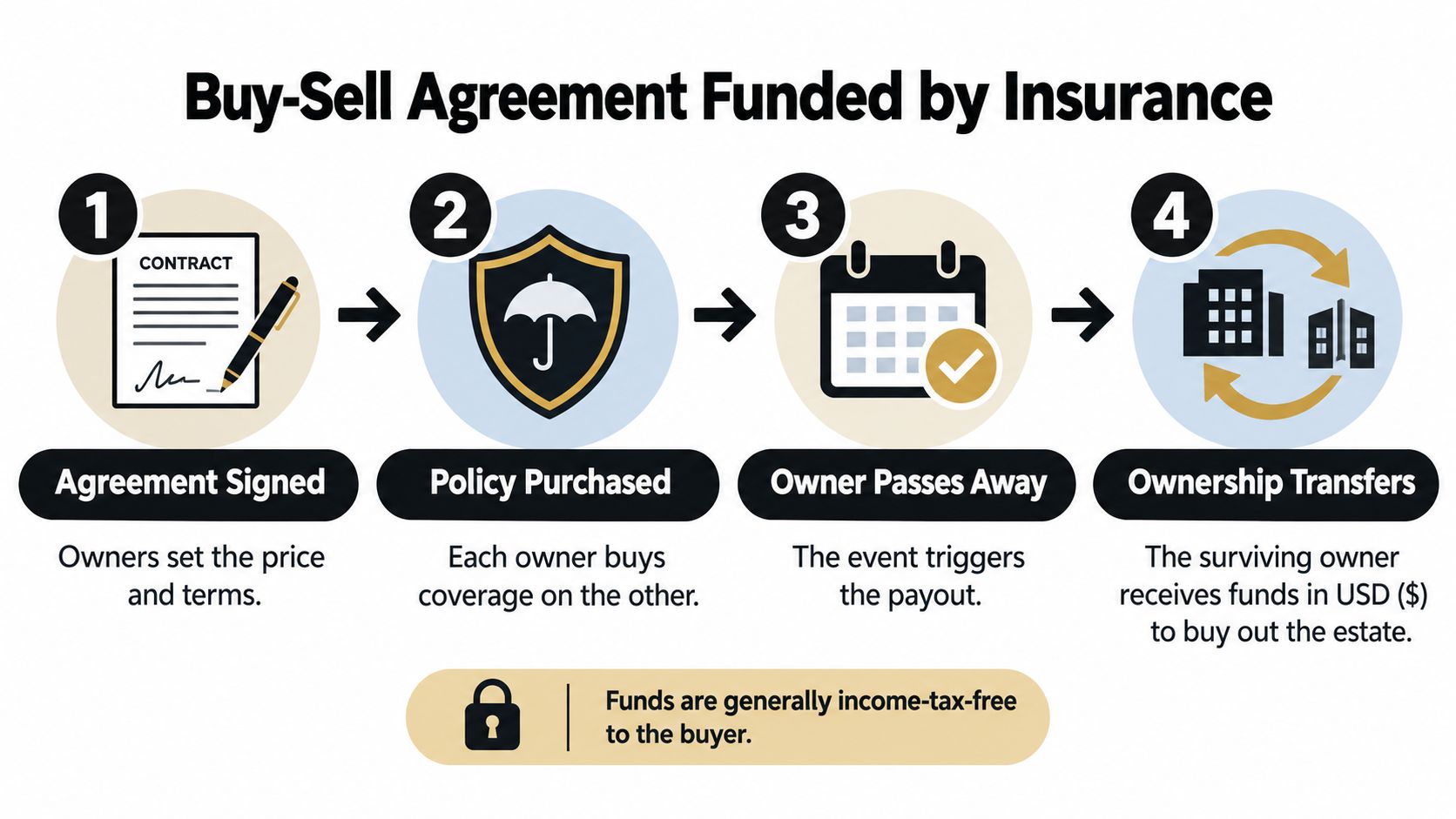
A buy-sell agreement is a contract among owners that answers a difficult question before a crisis occurs: what happens to an owner's interest when that person dies? The agreement can establish who may buy the interest, who must sell, how the price is determined, and how the transfer is completed.
Insurance supplies the liquidity. The agreement supplies the obligation. Neither works reliably without the other.
Two structures, different mechanics
In a cross-purchase arrangement, each owner typically owns coverage on the other owners and uses the proceeds to purchase the deceased owner's interest. In an entity-purchase arrangement, the company owns the policies, receives the death benefit, and redeems the deceased owner's shares. These mechanics are summarized in the Banner Life business succession toolkit.
Cross-purchase structures can place the purchase obligation and insurance proceeds directly with the surviving owners. Entity redemption may be administratively simpler because the company owns the policies and completes the redemption. The better choice depends on entity type, number of owners, tax circumstances, governance documents, and the desired ownership outcome.
Valuation language matters just as much as policy ownership. The agreement might use a periodically updated fixed price, a formula tied to a financial measure such as EBITDA, or an independent appraisal process. If the valuation is stale, the policy may be too small for the purchase obligation or unnecessarily large relative to the actual interest.
Review the arrangement after changes in revenue, debt, ownership percentages, or enterprise value. Also check lender collateral assignments. A lender with priority over proceeds up to the secured debt balance may reduce the money available for the ownership transfer.
The tax consequences can be more complicated than the paperwork suggests. In 2024, the U.S. Supreme Court's decision in Connelly v. United States made the relationship between corporate-owned insurance proceeds, redemption obligations, and estate valuation especially important for some U.S. C-corporation owners. Life insurance proceeds used to fund a redemption may increase the company's value for estate-tax purposes without a corresponding offset for the redemption obligation.
That doesn't mean every entity-purchase arrangement is wrong. It means the choice is a legal and tax decision, not merely an administrative preference. A CPA and corporate attorney should review the agreement, valuation method, policy ownership, beneficiaries, debt arrangements, and estate plan together. Owners looking for a broader succession-planning checklist can also use this guide from MyOfficeOps, then discuss the resulting questions with their advisors.
For owners and partners, a detailed review of life insurance for business partners should end with one clear answer: who owns the policy, who receives the proceeds, who buys the shares, and how is the purchase price calculated?
How to Calculate How Much Coverage You Actually Need
Coverage should follow obligations, not a generic multiple of revenue. Revenue doesn't tell you how much income a family needs, what debt survives the owner, or what it costs to replace a founder.
Separate the calculation into three layers:
- Family income replacement: Estimate the household resources needed after the owner's death. Include dependents, housing, personal debts, care needs, and the income gap the family would face.
- Business continuity: List loans, leases, payroll pressure, recruitment, training, interim leadership, and revenue disruption. These costs belong to the business layer.
- Ownership transfer: Use the buy-sell valuation and ownership percentage to identify the purchase obligation. This amount must align with the policy and the agreement.
Use an obligations worksheet
Suppose an owner supports a household and co-owns a consulting firm. Instead of starting with revenue, the owner lists the household income gap, the firm's continuing obligations, the cost of hiring leadership, and the amount required to purchase the ownership interest. Each line becomes a planning question, not an assumed insurance formula.
| Type of Lender | Action | Deadline |
|---|---|---|
| Personal lender or household budget | Identify debts and income needs that would remain after death | Before requesting quotes |
| Business lender or landlord | Confirm loans, guarantees, leases, and collateral assignments | Before setting business coverage |
| Surviving owner or estate | Confirm the buy-sell price and purchase obligation | Before policy ownership is finalized |
The table uses “lender” broadly as the party whose financial claim must be understood. A bank may have rights under a collateral assignment, while a landlord, creditor, family member, or estate may depend on a separate obligation. Ask who must be paid, how quickly, and from which policy proceeds.
A life insurance needs analysis can help organize the personal side, but business owners should bring the completed numbers to an advisor who can coordinate the business and estate layers.
Check the concentration risk first
A 2025 Hiscox survey of 6,250 small-business owners across the United States and Europe found that 74% had some level of underinsurance. The same source reports NAIC survey data indicating that 71% of small businesses depend on one or two individuals for organizational success. See the Hiscox protection-gap report for the survey context.
Those findings support a more useful question than “How much coverage can I buy?” Ask, “Which loss would create the largest obligation, and what would reduce that obligation?” Documenting procedures, developing a successor, cross-training staff, and reducing dependence on one person may lower the eventual insurance need.
Term coverage can fit a defined obligation window, such as a loan period, a young family's income gap, or the years required to transition leadership. Permanent coverage may be considered where the obligation is intended to last for life, but the higher complexity and cost require careful modeling.
Tax and Legal Implications Owners Should Not Skip
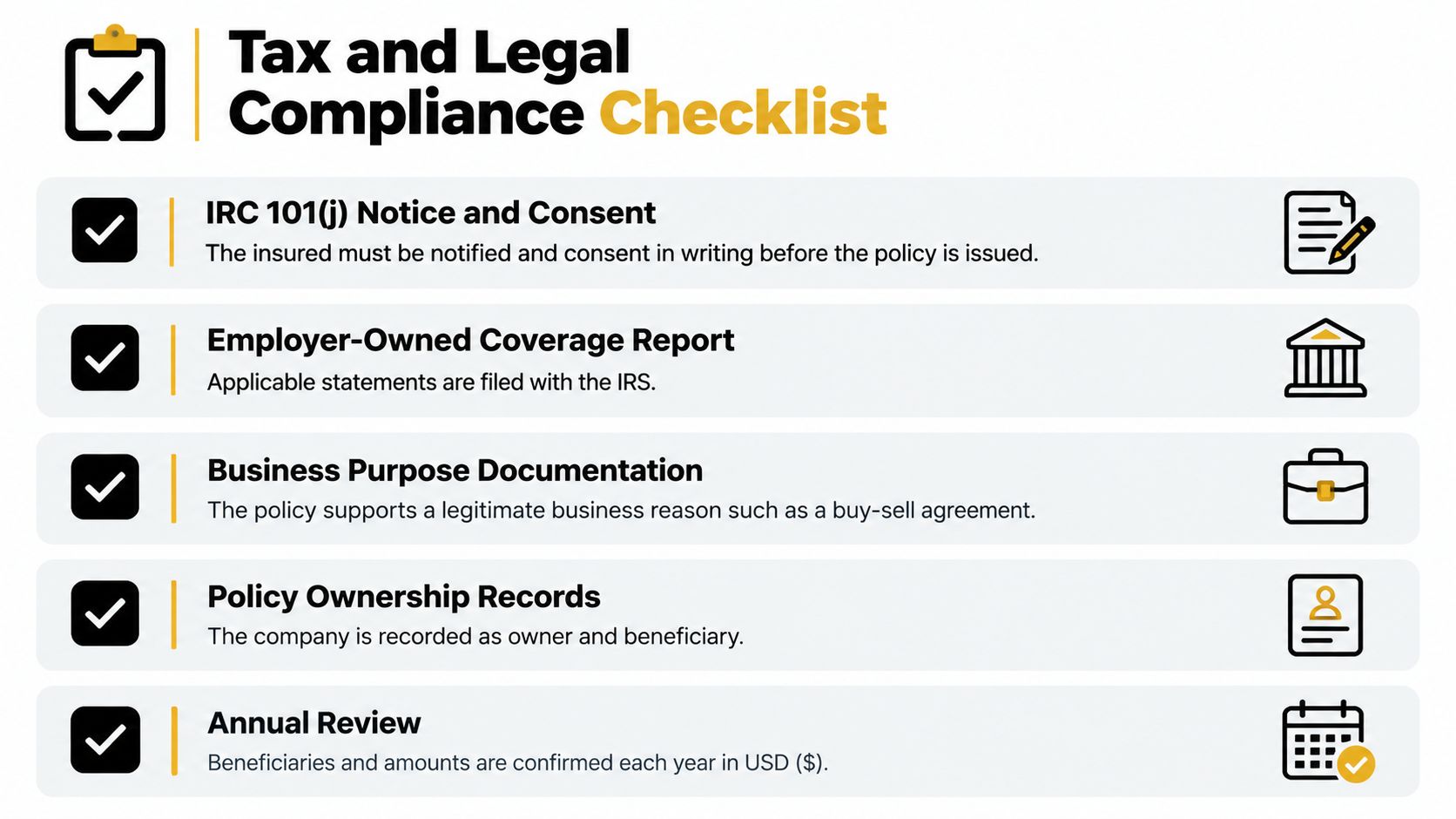
A policy can be financially appropriate and still create trouble if the business doesn't follow the tax and documentation rules. Employer-owned life insurance requires a clear sequence before the policy is issued.
Under IRC §101(j), the business generally needs to provide written notice before issuance, state the maximum coverage amount, tell the insured that the business will receive the proceeds, and obtain the insured's written consent. That consent must include permission for coverage to continue after employment ends. The requirements are summarized in this explanation of employer-owned life insurance compliance.
Treat the paperwork as part of the policy
If the notice-and-consent process isn't completed, the federal income-tax exclusion can be restricted. The excluded amount generally may not exceed premiums and other amounts paid for the contract, which can expose the business to taxable income at the moment it is dealing with a death and an operational disruption.
Keep the signed forms with the policy file. Record the policy as employer-owned in tax and corporate records, confirm the beneficiary designation, and coordinate the arrangement with the buy-sell agreement and governance documents. Applicable employer-owned contracts may also require Form 8925.
Compliance checkpoint: Don't wait until underwriting is complete to ask whether consent was obtained. The notice, maximum coverage amount, beneficiary disclosure, and written consent should be handled before issuance.
Policy type also needs to match the obligation. Term insurance can suit a temporary risk, such as a defined debt period, a founder's early operating years, or a specific transition window. Permanent insurance may be considered for a lifelong buy-sell obligation or another need intended to remain in force, but it introduces more cost, assumptions, and policy-management decisions.
Neither type automatically creates a tax advantage. Premiums are generally not deductible when the business is a direct or indirect beneficiary under IRC §264(a)(1). Model the policy as a liquidity and risk-transfer asset, not as a deductible operating expense or simple tax shelter.
A CPA can evaluate reporting, beneficiary, and estate-tax effects. A corporate attorney can draft or revise the buy-sell agreement and confirm that the ownership and redemption mechanics work under the governing entity documents. Owners seeking context on proactive tax strategy for businesses can use that resource to prepare questions, but the final structure should be built for the company and jurisdiction.
Steps to Buy and Putting Your Plan in Motion
Start with a blank page and write the three layers separately. Don't request a quote before identifying the people who depend on you, the obligations the business must meet, and the ownership transfer that would occur after death.
Build the planning file
Gather:
- Household information: Dependents, income needs, personal debts, housing costs, and existing personal coverage.
- Business obligations: Loans, leases, guarantees, payroll commitments, recurring contracts, and operating reserves.
- Ownership records: Cap table, shareholder agreement, valuation method, existing buy-sell agreement, and policy schedule.
- People data: Key employees, succession candidates, roles, compensation, and the cost of recruiting replacements.
- Insurance records: Current policies, owners, beneficiaries, coverage amounts, premium schedules, and collateral assignments.
Then ask each owner to describe the intended outcome. Does the family want to operate the business, sell the interest, or receive cash? Does the surviving owner have both the obligation and the authority to buy? Written answers often reveal gaps that a policy illustration won't show.
Choose coverage by job
For personal income replacement, an individual policy may be appropriate. For business continuity, the company may consider key-person coverage on an owner or employee whose death would create a measurable economic disruption. For ownership transfer, align the policy with the buy-sell structure and valuation.
A no-exam digital route can fit some straightforward term-life needs, particularly personal income replacement or term key-person coverage on a younger owner who meets the carrier's eligibility criteria. Coveredly offers online term life insurance, with up to $3 million of coverage and no exams for most applicants. Larger permanent policies, complex ownership structures, older insureds, unusual medical histories, or estate-sensitive arrangements may require traditional underwriting and advisor involvement.
Don't treat speed as a substitute for coordination. Before binding coverage, confirm the applicant, policy owner, beneficiary, premium payer, consent file, and agreement all point to the same intended outcome.
Schedule recurring reviews
A policy isn't finished when the application is approved. Review the agreement, valuation, ownership, beneficiaries, and coverage after material changes in revenue, debt, ownership, or family circumstances. Set an annual review so stale documents don't undermine a current policy.
A 2022 MassMutual study of 800 U.S. business owners found that 32% had a buy-sell agreement in place. Among those owners, 46% funded the agreement with life insurance, while 36% of all owners had life insurance specifically for estate-tax purposes. The figures reinforce the need to check both the agreement and its funding instead of assuming one guarantees the other.
Your action list is simple: separate the three layers, list the obligations, confirm the ownership-transfer mechanics, compare policy options, and schedule the review. Loop in your CPA and corporate attorney for tax, estate, entity, and agreement decisions.
Coveredly offers online term life insurance that can help business owners explore personal income protection or a straightforward key-person need, with up to $3 million of coverage and no exams for most eligible applicants. Visit Coveredly to review an online coverage option, then coordinate the policy with your CPA, attorney, and succession plan.