It's 10:40 on a Tuesday night. The mortgage statement is open in one tab, a daycare invoice in another, and a life insurance quote form in a third. You type in your age, pick $500,000 for 20 years, and a number appears in seconds. It looks affordable. It also isn't an offer yet, and that gap between a displayed price and a bound policy is where most applicants get surprised.
Term coverage is the most popular and affordable type of life insurance, built around a set period such as 20 years, and it delivers pure protection with no investment component. That simplicity is exactly why people trust the first number too quickly. When you quote term life insurance, you're getting an estimate based on what you told the form, not what an underwriter will eventually verify.
I'd treat that first figure as a starting hypothesis. The decision comes after you've seen the renewal premium, the grace period, the coverage start date and the underwriting class you qualify for.
Table of Contents
- What to Have Ready Before You Request a Quote
- How to Get a Term Life Quote Step by Step
- What Moves Your Term Life Premium Up or Down
- Choosing Coverage Amount, Term Length and Exam Option
- Check Renewal Costs and Policy Terms Before You Accept
- Compare Your Quotes and Pick Coverage Today
What to Have Ready Before You Request a Quote
A quote is only as accurate as the details behind it. Two people can fill in the same form for the same policy and get different prices because one remembered a medication start date and the other guessed.
The inputs that decide your rate
Gather these before you open any form. Each one exists for a reason, and knowing the reason helps you answer accurately instead of optimistically.
| Input | Why insurers ask | Example |
|---|---|---|
| Age or date of birth | Sets the base rate and mortality risk | A 34-year-old pays less than a 44-year-old for the identical policy |
| Tobacco or nicotine use | Places you in a risk class; the look-back period varies | Vaping usually counts, so list it |
| Height and weight | Calculates BMI, a standard underwriting factor | Your height in feet and inches plus your current weight in pounds |
| Health conditions and medications | Determines your underwriting class | Blood pressure controlled by one medication, with the start date |
| Occupation and hobbies | Measures exposure to risky work or activities | Office work, or recreational scuba diving |
| Annual income and debts | Shows how much income protection you need | Your annual salary alongside your current mortgage balance |
| Coverage amount and term length | Determines the face amount and how long coverage lasts | $500,000 for 20 years |
| State of residence | Applies state rules and rate filings | Rules and rates vary by state |
Age is the one input you can't negotiate. Insurers price off your age at application, and some use your nearest birthday rather than your last one, which can shift you into a higher bracket months before you expect it.
Nicotine deserves a second look at the wording. Many forms ask about the past 12 months, others use a longer window, so read the question rather than assuming your own definition of "quit." Cigarettes, vaping, patches and chewing tobacco all tend to land in the same bucket.
Health details work in your favor when they're specific. "High blood pressure" reads worse than "blood pressure controlled since March on one medication," because the second version tells an underwriter the condition is stable. Our guide to life insurance health questions walks through the conditions that come up most often and how they're typically classified.
Practical rule: Write every answer on one page before you start. You'll finish the form in about ten minutes and won't enter numbers that contradict each other on the second screen.
A one-page worksheet looks like this: date of birth, height and weight, nicotine status with a date, each diagnosis with its medication and start date, job title, hobbies, income, mortgage balance, target coverage amount, term length and state. That's the whole list. Nothing on it requires a phone call to your doctor.
How to Get a Term Life Quote Step by Step
The process runs in a set order, and skipping ahead is what produces sticker shock later. The NAIC Life Insurance Buyer's Guide lays out the sequence: quantify the need and duration, compare term against permanent coverage, collect age, face amount, health, occupation, lifestyle and policy-term inputs, then verify renewal premiums, affordability, exclusions, conversion provisions and the insurer's financial strength before you buy.
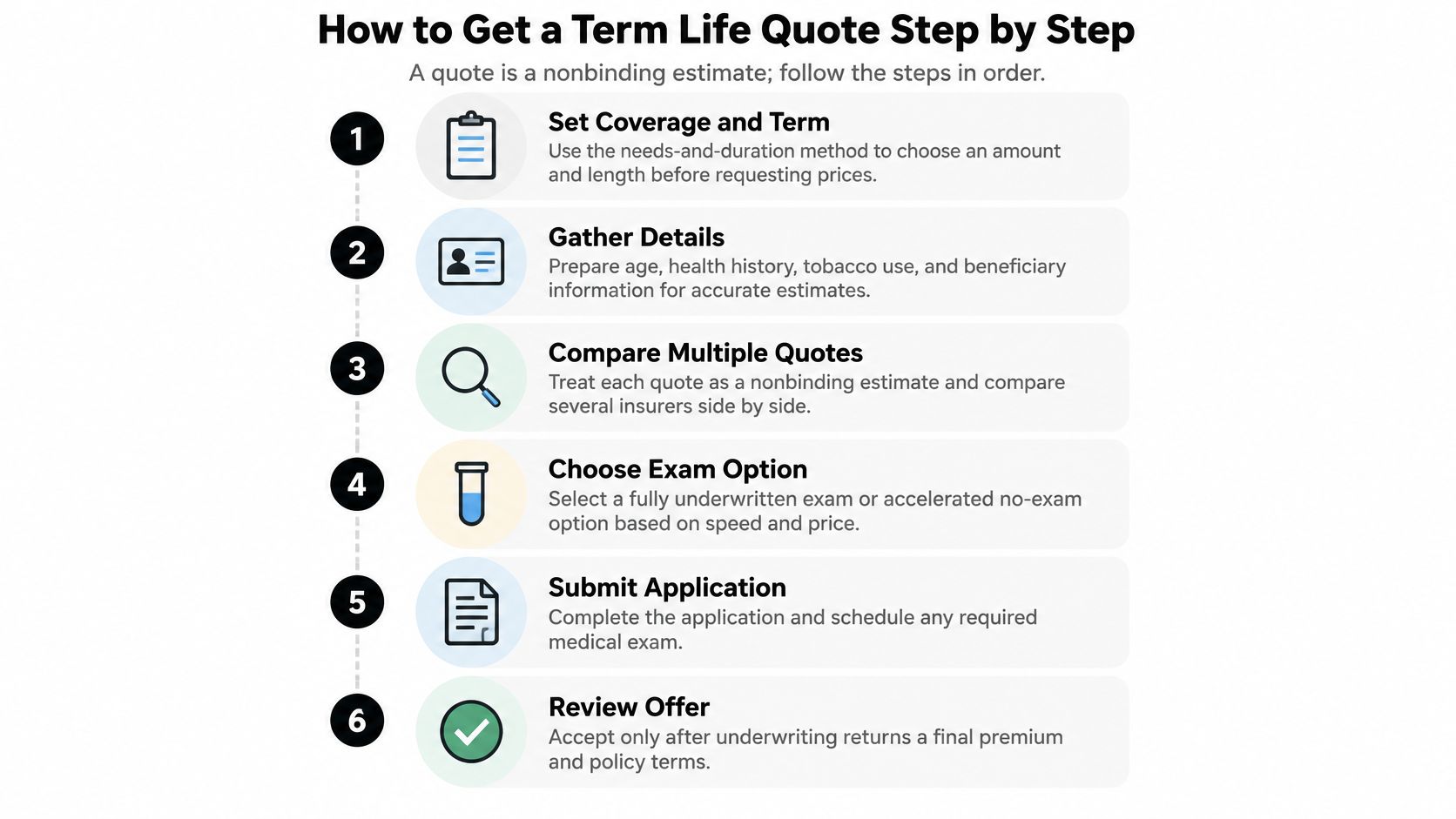
Set the coverage target and term first. Build the amount from your actual obligations and pick the year the last one ends. The common mistake is choosing a round number because it feels tidy, then discovering it doesn't cover the mortgage.
Enter your details into the digital form. Age, health, tobacco use, occupation and coverage amount take most applicants only minutes. Our whole application process is fully digital, from quote to policy issuance, and most applicants apply in minutes and get an immediate decision with no medical exam.
Compare several carriers on identical inputs. Same age, same face amount, same term, same payment frequency. We compare multiple carriers to find competitive pricing, because two insurers can price the same risk profile differently based on how their underwriting treats one condition.
Treat the number as provisional. Expect follow-up checks on prescriptions, medical history and finances. A displayed price can change after verification, and that's normal rather than a bait-and-switch.
Recalculate after every material change. A new diagnosis, a change in nicotine use or a different term length all move the price. Decide only after the final version reflects your real situation.
Why the first number moves
Society of Actuaries modeling identified face amount, underwriting/preferred class, insurance plan, issue year and attained age as the five most influential mortality-risk variables, according to the NAIC buyer's guide. Notice how many of those are decided by the insurer, not by you.
The principal pitfall is treating a low initial quote as a final offer. Simplified underwriting uses fewer risk-segmentation tools, which can increase adverse selection and produce mortality worse than expected, so carriers price that uncertainty in.
Stop comparing when two or three quotes match your coverage target, your term and a premium you can keep paying. A fourth quote rarely changes the decision.
What Moves Your Term Life Premium Up or Down
Say two 38-year-olds each request $500,000 of 20-year term coverage. One is a non-smoker with clean labs. The other vapes daily and started a second blood pressure medication four months ago. The second quote comes back several times higher, and nothing about the product changed. Only the risk profile did.

Reading the price factor by factor
Cost anxiety is the main reason people stall. In recent U.S. survey data cited in the NAIC's consumer life insurance guidance, 38% of respondents named cost as the leading reason for not buying life insurance, while 24% estimated that a 20-year, $250,000 policy for a healthy 30-year-old would cost more than three times the approximately $13 monthly figure cited in the survey. Many of our policies start as low as $15 to $30 per month, depending on age, health and coverage amount.
| Factor | How it affects the premium | Typical direction |
|---|---|---|
| Age at application | Mortality risk rises with age | Higher at older ages |
| Tobacco or nicotine use | Usually places you in a higher-cost risk class | Often much higher |
| Health conditions and medications | Can move you into a lower or higher underwriting class | Higher with uncontrolled conditions |
| Coverage amount | Larger face amounts cost more | Higher with each increase |
| Term length | Longer terms carry more years of risk | 30-year costs more than 10-year |
| Occupation and hobbies | Hazardous work or activities raise risk | Higher for risky work |
| Payment frequency | Monthly billing can carry extra fees | Monthly often costs slightly more than annual |
A useful quote breakdown tells you which factor is doing the damage. If nicotine is driving the price, the fix is a documented quit date and a requote later. If term length is driving it, you can shorten the term today. Our overview of how underwriting works explains how carriers sort applicants into classes and what evidence moves you up one.
What you can change and what you can't
Split the list into two columns on your worksheet. Changeable: term length, coverage amount, payment frequency, and over time your weight, nicotine status and how well a condition is controlled. Fixed: your age at application and any diagnosis already in your records.
That split keeps you from wasting weeks chasing a price you can't reach. Any single figure remains a reference point until underwriting closes, so ask what class the quote assumes and what would happen if you land one class lower.
Choosing Coverage Amount, Term Length and Exam Option
The most common mistake is buying a round number that was never tested against a household budget. $500,000 sounds substantial until the mortgage, five years of income replacement and childcare consume most of it, leaving little for education.

Build the number from the bottom up
Add the income your dependents would need replaced for the years they still rely on you, outstanding debts including the mortgage balance, and childcare or education costs. Then subtract savings and the income a spouse would continue earning.
A common guideline is 10 to 15 times annual income. Treat that as a range for checking your calculation, not as the answer itself. Coveredly helps tailor coverage to each situation, and eligible policies can be raised or lowered as life changes without starting over.
Term life provides pure protection without investment components, so the amount and term drive the outcome. Match the term to the last major obligation. A 10-year term fits short debts. A 20-year term fits young children who should be independent by then. A 30-year term fits a new mortgage you may still be paying in your sixties.
Traditional underwriting versus no exam
Convenience does not automatically produce the better deal. No-exam policies may carry lower coverage limits and fewer rider options, while traditional underwriting can provide access to higher amounts when your health is strong. A quick quote remains a nonbinding estimate until underwriting approves the rate class behind it.
| Option | Speed | Evidence needed | Coverage ceiling | Best fit |
|---|---|---|---|---|
| Traditional underwriting | Often takes weeks | Medical exam, labs and records | Typically higher limits | Strong health and large coverage needs |
| No-exam term, most applicants | Fast decision for many applicants | Health questions and digital health-data checks | May be lower than traditional limits | Urgent protection and quick decisions |
| No-exam term, higher limit | Quick digital decision for eligible applicants | Health questions plus medical, prescription and financial checks | Up to $3M, depending on eligibility | Larger needs that qualify without an exam |
“No exam” does not mean “no underwriting.” Digital underwriting still reviews health answers and health data, so an omitted prescription or condition can change the approved class and premium.
Coveredly offers term life with no medical exams for policies up to $3M, and many carriers offer flexible underwriting options for people with pre-existing conditions. The details of that route are covered in Coveredly's guide to no-exam term life insurance.
My recommendation: take the faster route when protection is urgent, and consider the exam when your health is strong and you need a higher limit. Run the same coverage amount through both routes, then ask what evidence could change the underwriting class before trusting the monthly price. Also get the post-level-period premium and missed-payment grace period in writing before accepting either option.
Check Renewal Costs and Policy Terms Before You Accept
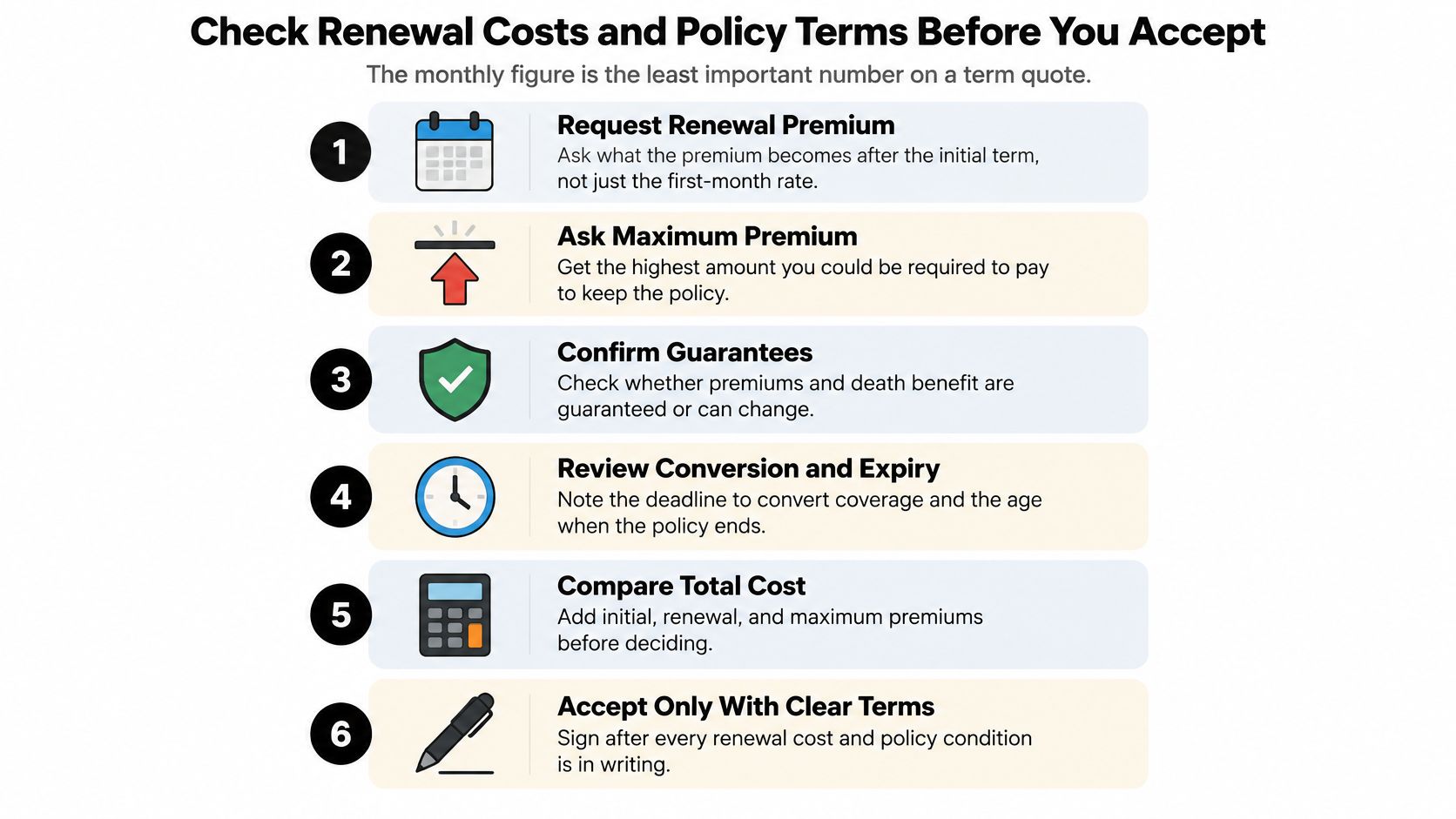
The monthly figure is the least important number on a term quote. It tells you what year one costs. It says nothing about year twenty-one, and that's where households get caught.
Ask for the price after the level period
Many term policies reprice once the level-premium period ends, and the increase is steep because it reflects your age at that point rather than your age when you applied. Ask for two numbers in writing: the renewal premium and the highest premium you could be required to pay to keep coverage. Then ask yourself whether that figure fits a budget where you're also paying for a teenager's car insurance.
If the answer is no, you have three options. Shorten the term so it ends before the obligation does, buy a larger amount now while you're younger and healthier, or confirm the conversion deadline so you can move to permanent coverage without new underwriting.
The terms that decide when you're actually covered
An approved quote isn't protection. Coverage typically begins once the policy is approved and the first payment is processed, so a policy you've been "approved" for but haven't funded yet pays nothing. Most policies include a grace period before coverage is affected by a missed payment, but the length differs by policy, so read the actual clause instead of assuming a month.
| Policy term | What to confirm |
|---|---|
| Renewal premium | The price you pay after the level-premium period ends |
| Highest possible premium | The maximum you could be required to pay to keep coverage |
| Level-premium period | How many years the premium stays fixed |
| Grace period | How long coverage continues after a missed payment |
| Coverage start date | When protection begins after approval and the first payment |
| Conversion rights | Whether the policy can become permanent coverage |
| Financial strength rating | The insurer's rated ability to pay claims |
A quote you can't afford in year twenty-one isn't a cheap policy. It's a policy you'll lapse.
Keep the quote and the issued policy side by side and read them line by line. Face amount, term, class, premium and payment frequency should match exactly. Because our process is fully digital from quote to issuance, both documents sit in one place, and the price shown is the price paid, with no hidden costs. If a figure differs, resolve it before the first payment clears, not after.
Compare Your Quotes and Pick Coverage Today
The best quote is the one that matches your coverage need at a price you can keep paying, not the lowest figure on the screen. Put two or three quotes side by side with identical age, coverage amount, term length and payment frequency, then check the renewal premium, highest possible premium, grace period and start date on each. A quote that's cheapest today but reprices sharply after the level period isn't the better choice.
For a wider view of how carriers structure their plans, HearSmart's roundup of term life coverage options is a useful reference when you're deciding between term lengths and riders.
Act in three steps:
- Pick the quote that meets your coverage target from the needs calculation, not the one with the smallest monthly number.
- Confirm the policy terms in writing with the carrier before accepting, including renewal pricing and the conversion deadline.
- Apply using the inputs already on your one-page list, so nothing gets re-entered from memory.
Coverage can be raised or lowered as life changes, without starting over, so this decision isn't permanent. Our team guides customers through every step and helps them choose coverage for their situation. Request the quote with your input list complete, then set a calendar reminder to review coverage after your next major life event, whether that's a child, a new mortgage or a marriage.
We built Coveredly to make this whole process digital, affordable and flexible, with term life up to $3M and no medical exams for most applicants, instant approvals for many, and coverage you can ladder up or down as your financial needs change. If you've got your one-page input list ready, you can compare real carrier quotes side by side and see the renewal terms before you commit at Coveredly.