You're comparing mortgage protection, thinking about your children's future, or trying to replace income before a new financial responsibility becomes harder to manage. Then the application asks for your age, date of birth, desired term, and health history. That first field seems simple, but it can determine whether you're eligible, how long coverage can last, whether a medical exam is required, and how much flexibility you'll have later.
Term life insurance age limits aren't one universal cutoff. They work more like a grid with two directions: the age when you enter the policy and the age when the policy must end. Once you understand both, the choices at almost any life stage become easier to evaluate.
Table of Contents
- Why Your Age Is the First Question Term Life Asks
- Entry Ages vs Expiration Ages, The Two Limits Everyone Mixes Up
- How Term Lengths Shrink as You Get Older
- Underwriting, Medical Exams, and Why No-Exam Has Its Own Age Ceiling
- A Real Buyer Scenario at 42 Locking In a 20-Year Term
- Conversions, Renewals, and What Happens When You Outlive the Term
- Choosing Coverage by Life Stage, From Your 20s to Your 70s
- Putting It Together and What to Verify Before You Apply
Why Your Age Is the First Question Term Life Asks
A new parent may want coverage until a child is financially independent. Someone signing a first mortgage may want protection through the repayment period. A small-business owner may need a policy that gives the business time to recover if a key person dies. In each case, age is the first filter because it affects the insurer's estimate of risk and the length of time the company may need to provide protection.
A younger applicant usually has more available term lengths and a longer planning horizon. A 28-year-old considering a 30-year term could potentially keep coverage through much of their working life. A 68-year-old may still find term insurance, but the available durations can be narrower, the premiums higher, and the underwriting requirements more demanding. In India, for example, the general minimum entry age is 18, while the usual maximum entry age is 60 to 65, depending on the product. Some online plans allow entry to 65 with coverage extending to 80 to 85, while traditional plans may cap entry at 60 and coverage at 75. This overview of term insurance age limits in India illustrates why the rule belongs to the policy, not to the buyer's age.
Age influences three separate decisions
When you enter an application, age can affect:
- Price: Insurers generally treat older applicants as carrying greater mortality risk, which tends to raise premiums.
- Term choice: A carrier may not offer a long term if it would extend beyond its maximum contract age.
- Approval route: A simplified or no-exam option may have a lower age ceiling than the carrier's fully underwritten product.
Use an age-based planning tool, such as this guide to life insurance rates by age, to start with your financial timeline rather than a headline price. Then ask two questions: Can I enter at my current age, and will the policy remain active until the date my family needs it?
Practical rule: Don't ask only, “Can I buy term insurance?” Ask, “Which term, underwriting path, and expiration age are available to me now?”
That shift prevents a common mistake. A policy can accept your application today yet still end too soon to cover a mortgage, dependent, business obligation, or retirement transition.
Entry Ages vs Expiration Ages, The Two Limits Everyone Mixes Up
Every term policy has an entry-age limit and an expiration-age limit. They answer different questions.
The minimum entry age is the youngest age at which someone can apply for that policy. For standard term insurance, 18 is a common minimum in India, while other markets and product types may use different rules. The maximum entry age is the oldest age at which the insurer will issue a new policy. In India, that maximum is generally 60 to 65, but product-specific ranges matter. In the United States, carrier rules can vary widely, especially for older applicants and shorter terms.
The second axis is the policy's maturity or expiration age. A neutral senior-life guide reports that term coverage commonly ends at 80, 85, or 90, depending on the insurer and contract, while some companies stop fully underwritten term around 80 and no-exam term closer to 75. This explanation of term life insurance for seniors shows why entry eligibility alone doesn't tell you how long protection will last.
A practical way to read the two limits
Suppose a carrier allows a 20-year policy for a 60-year-old. The policy would reach age 80 at the end of the term. A 30-year policy may be available to a younger applicant but unavailable at 60 because it would run beyond the carrier's maximum contract age.
The table below is a planning framework, not a promise from every insurer. Actual limits belong to the specific carrier and policy form.
| Carrier Tier | Min Entry Age | Max Entry Age | Typical Max Expiration Age |
|---|---|---|---|
| Standard term market | 18 | 60 to 65 | 75 to 80 |
| Flexible online term | 18 | Up to 65 | 80 to 85 |
| Senior-focused term | Varies | May extend beyond 65 | 80 to 90 |
Carrier differences can be substantial. A 2026 comparison reports that Pacific Life and Protective allow 10-year term purchases up to age 80, while Penn Mutual caps that purchase age at 69 and Nationwide at 70. The comparison of senior life insurance carriers reinforces the central point: there is no single market-wide maximum.
How Term Lengths Shrink as You Get Older
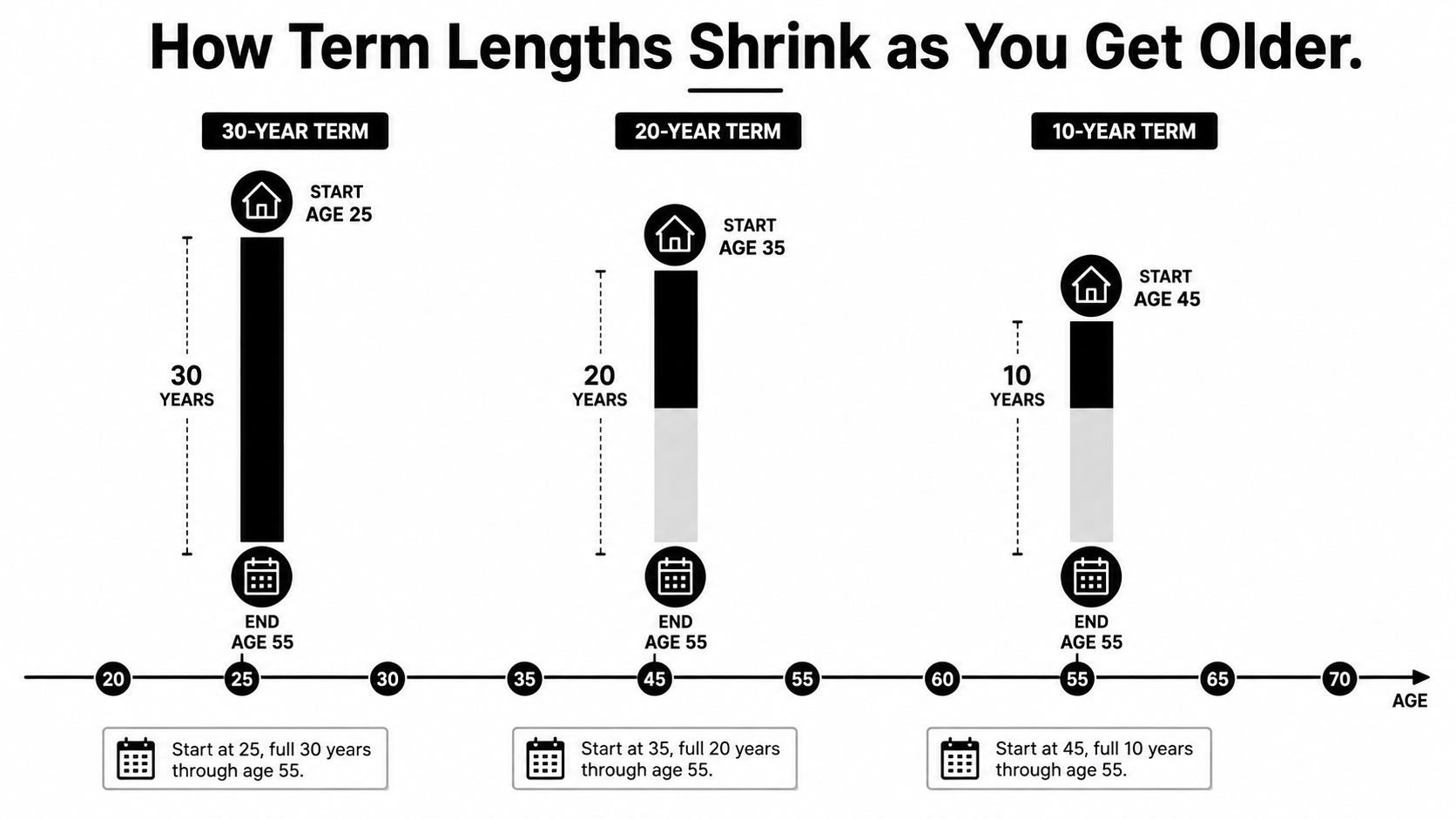
A term policy has to fit inside the carrier's permitted coverage window. If the insurer wants the policy to end by a particular upper age, the maximum term becomes shorter as the applicant gets older.
A younger buyer might compare 10-, 20-, and 30-year options. An older buyer may see only a 10-year or 15-year term, depending on the carrier, health profile, and requested coverage. Market summaries describe many products as available only until about 75 to 80, with the longest term shrinking as the applicant's age rises. This underwriting guide also highlights that accelerated underwriting can end earlier than the underlying term product. Some carriers may issue a term policy to 80 while limiting no-exam eligibility to around 60.
The age-plus-term calculation
The basic calculation is simple:
Starting age + selected term = approximate expiration age.
A 30-year term bought at 25 would end around 55. A 20-year term bought at 35 would end around 55. A 10-year term bought at 60 would end around 70. Those examples show why the same term length doesn't carry the same planning value at every age.
The available choices may be narrower than a simple calculation suggests. A carrier may not offer a 30-year term to someone in their 50s if the contract would exceed its upper age threshold. Similarly, a buyer in their 60s may need to choose a shorter term even when the need for coverage continues.
A shorter policy may cost less per year than a longer one, but it also protects a smaller part of your timeline. If your goal is mortgage repayment, dependent care, college funding, or business continuity, compare the policy's end date with the date that obligation should realistically finish. The cheapest term isn't useful if it expires before the risk disappears.
Underwriting, Medical Exams, and Why No-Exam Has Its Own Age Ceiling
Two applicants of the same age can face different paths. One may qualify for accelerated underwriting using electronic records and a focused questionnaire. Another may need a paramedical exam, blood work, medical records, or additional documentation because of age, health history, requested coverage, or the insurer's rules.
A fully underwritten application gives the insurer more medical information. That can make it the more practical route for someone seeking larger coverage or a longer term, especially when a no-exam program's age or face-amount limits have already tightened.
Why simplified issue narrows with age
A 2019 Society of Actuaries survey of 27 companies found that the most common minimum issue age for accelerated underwriting was 18, the average minimum was 19.7, and the highest minimum was 50. For maximum age, the most common limit was 60, the average was 55.2, and the highest was 85. The survey summary and explanation of age limits provides historical context for why accelerated programs have always used age bands.
Another industry analysis found that almost half of programs offering $2 million or more use age bands that reserve the highest amounts for younger applicants, typically 40 or 50. The most common maximum issue age for accelerated underwriting is 60, with only a few programs reaching 65. This underwriting guide connects age, requested face amount, and the likelihood that an insurer will require more evidence.
| Underwriting Type | Typical Age Ceiling | Exam Required | Max Coverage |
|---|---|---|---|
| Fully underwritten term | Carrier-specific, may extend to older ages | Often yes | Determined by income, health, and underwriting |
| Accelerated underwriting | Commonly around 60, with some programs extending to 65 | Often no, but requirements can change | Tiered by age and product |
| Simplified or no-exam term | Often narrower than full underwriting | No routine exam | Usually lower or age-tiered |
Coveredly's no-exam model fits into the simplified and accelerated side of this comparison. It uses information such as prescription histories, MIB records, and simplified-issue rules, so the applicant may avoid an exam room, but the trade-off is a narrower eligibility framework than some fully underwritten products. Learn more about how life insurance underwriting works before deciding that “no exam” automatically means “available at every age.”
Young, healthy applicants often benefit from speed and convenience when the requested coverage fits the program. Older applicants with stable records may still qualify, but they should compare the no-exam ceiling with the full-underwriting option rather than assuming the faster route is the broadest route.
A Real Buyer Scenario at 42 Locking In a 20-Year Term
Maya is 42 and wants a $500,000, 20-year term policy. Her mortgage still has years left, and she wants protection while her two children move through college. The policy would end at 62, so its term fits the part of her financial plan she is trying to protect.
Her application begins with identity and financial details, followed by a prescription check. The carrier then asks for a brief paramedical exam, and the underwriter reviews the results before offering a standard rate. Maya's age doesn't eliminate her choices, but it does make the end date important. A 30-year term would take her to 72, which may exceed the ceiling of some carriers even if another insurer offers it.
The decisions Maya still has to make
Maya isn't finished once she finds a policy that accepts her age. She needs to examine:
- Renewability: Can she continue coverage after the level-premium period, and how will the renewal pricing work?
- Conversion: Can she exchange some or all of the term coverage for permanent insurance without new medical underwriting?
- Term design: Would two 10-year policies provide useful flexibility, or would that structure leave her with insufficient protection after the first term ends?
At age 62, Maya may also be approaching a conversion deadline under her contract. The exact window depends on the policy, so she should read the conversion provision at purchase rather than waiting until her health or finances change.
Her example shows why a policy's expiration age deserves as much attention as its entry age. She can qualify today, but the right product still depends on how long the mortgage, education costs, and family income needs will remain.
Conversions, Renewals, and What Happens When You Outlive the Term
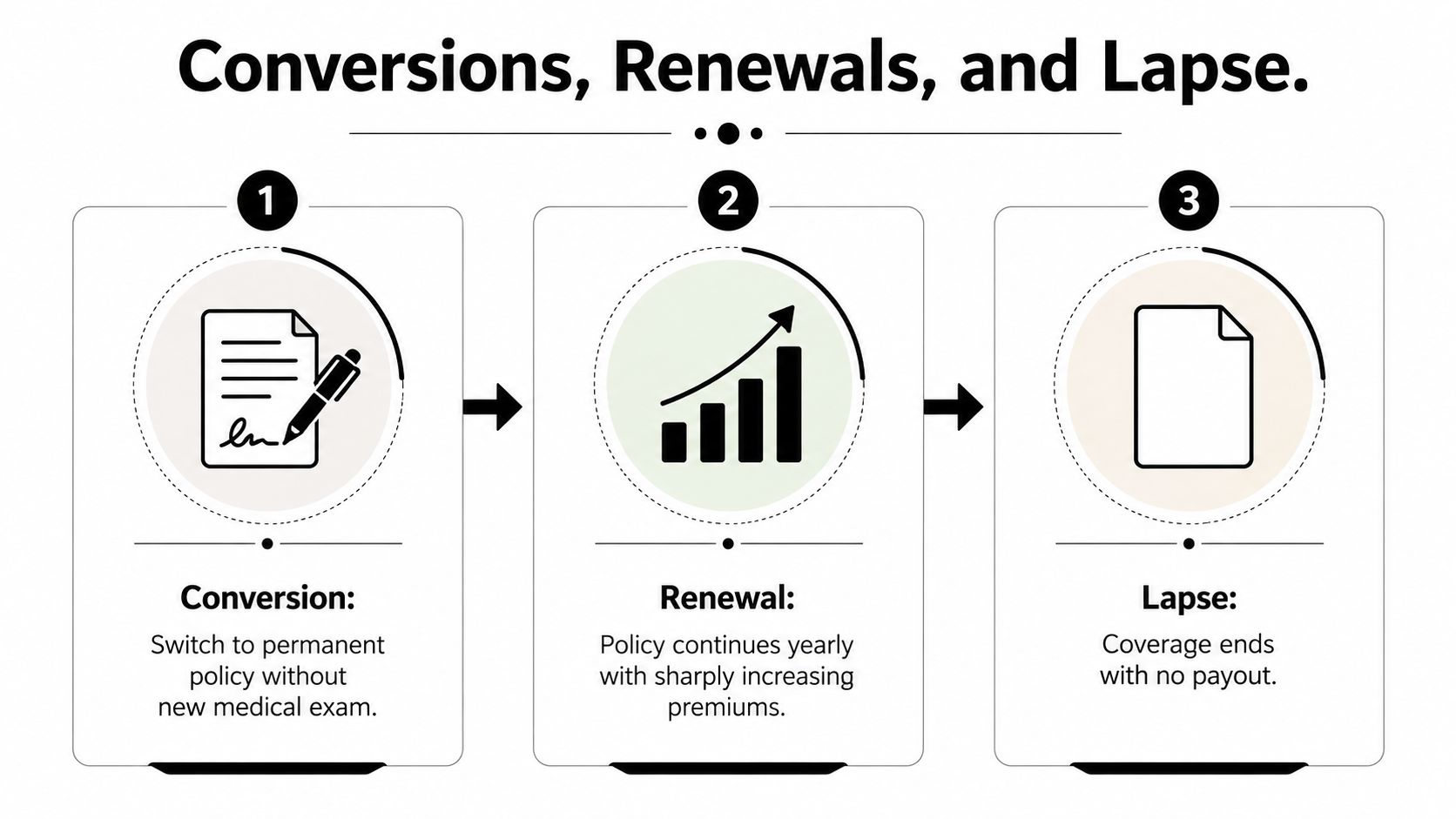
A term policy usually gives you several possible outcomes at the end of the level-premium period. You may convert, renew, or allow the policy to lapse. Each path solves a different problem, and none should be treated as an automatic continuation of the original protection.
Conversion lets you exchange term coverage for a permanent policy under the contract's rules, often without new medical underwriting. That option can matter if your health has declined and a fresh application would be difficult. Conversion deadlines vary, and rights commonly expire around 70, so the policy language matters more than a general assumption.
Renewal usually continues coverage for another period, often annually, with premiums recalculated at your older age. The price can rise sharply, which makes renewal more suitable as a bridge than as a permanent affordability strategy. Some policies limit renewability to 95 or to the original expiration age, depending on the contract.
Lapse means coverage ends because premiums aren't paid or the policy reaches its final date. If the insured dies after lapse, the term policy generally doesn't provide the death benefit.
Match the exit route to the need
- Convert when health is the concern. A permanent policy may preserve coverage when new underwriting could create a problem.
- Renew when the need is temporary. Renewal can bridge a short gap while a mortgage is paid, assets accumulate, or dependents become independent.
- Lapse when the risk is gone. If dependents are grown and your assets can cover final obligations, paying for more coverage may no longer fit your plan.
Some seniors discover too late that they need protection after the term's expiration age. At that point, guaranteed-issue whole life or final-expense insurance may be among the remaining options, although policy features and costs differ. This guide to what happens when term life insurance expires can help you identify the decision points before the deadline.
A short video can reinforce the differences between these paths:
Choosing Coverage by Life Stage, From Your 20s to Your 70s
Your age doesn't determine one perfect policy. It changes the balance between affordability, term length, underwriting flexibility, and the time your family needs protection.
In your 20s, the main advantage is time. The common entry minimum of 18 is easy for most adult applicants to meet, and a longer term can cover future obligations before they fully arrive. A 30-year term bought early may carry protection into the buyer's 50s or 60s, depending on the starting age and contract.
During your 30s and 40s, the policy usually connects to concrete responsibilities. Mortgage debt, children, business income, and a spouse's retirement plan can all influence the term. No-exam options may appeal to healthy applicants who want a simpler application, but the policy still needs to match the desired coverage amount and expiration date.
How the priorities change later
Applicants in their 50s should compare carriers carefully because some maximum entry ages and term choices begin to exclude them. A 20-year term may remain available with one insurer while another offers only a shorter duration.
From 60 through 69, the available term often narrows to 10 or 15 years, depending on the carrier and underwriting route. Expiration ages such as 80 or 85 can become the binding constraint. From 70 onward, term insurance may still be available through selected senior-focused carriers, but choices can include stricter underwriting, shorter terms, graded benefits, or guaranteed-issue features. Whole life and final-expense policies often become more relevant for people seeking lifelong protection.
| Age Band | Typical Entry / Expiration Age | Practical Term Length | Best Fit |
|---|---|---|---|
| 20s | Entry from 18, expiration often 75 to 85 | Longer terms may be available | Income replacement and future family protection |
| 30s to 40s | Entry generally available, expiration depends on carrier | 20-year terms often fit major obligations | Mortgage, children, and household income |
| 50s | Some carrier entry limits begin to narrow | 10- or 20-year options may require comparison | Debt payoff and remaining working years |
| 60s | Entry and expiration rules become more restrictive | Often 10- or 15-year terms | Shorter financial obligations and bridge coverage |
| 70s | Fewer carriers and more specialized underwriting | Short terms or senior-focused products | Final obligations and targeted protection |
If you're comparing options for yourself or a spouse, a resource focused on life insurance best for over 40 can add useful context. Treat any recommendation as a starting point, then verify the actual contract dates, age limits, and underwriting rules with the insurer.
Putting It Together and What to Verify Before You Apply
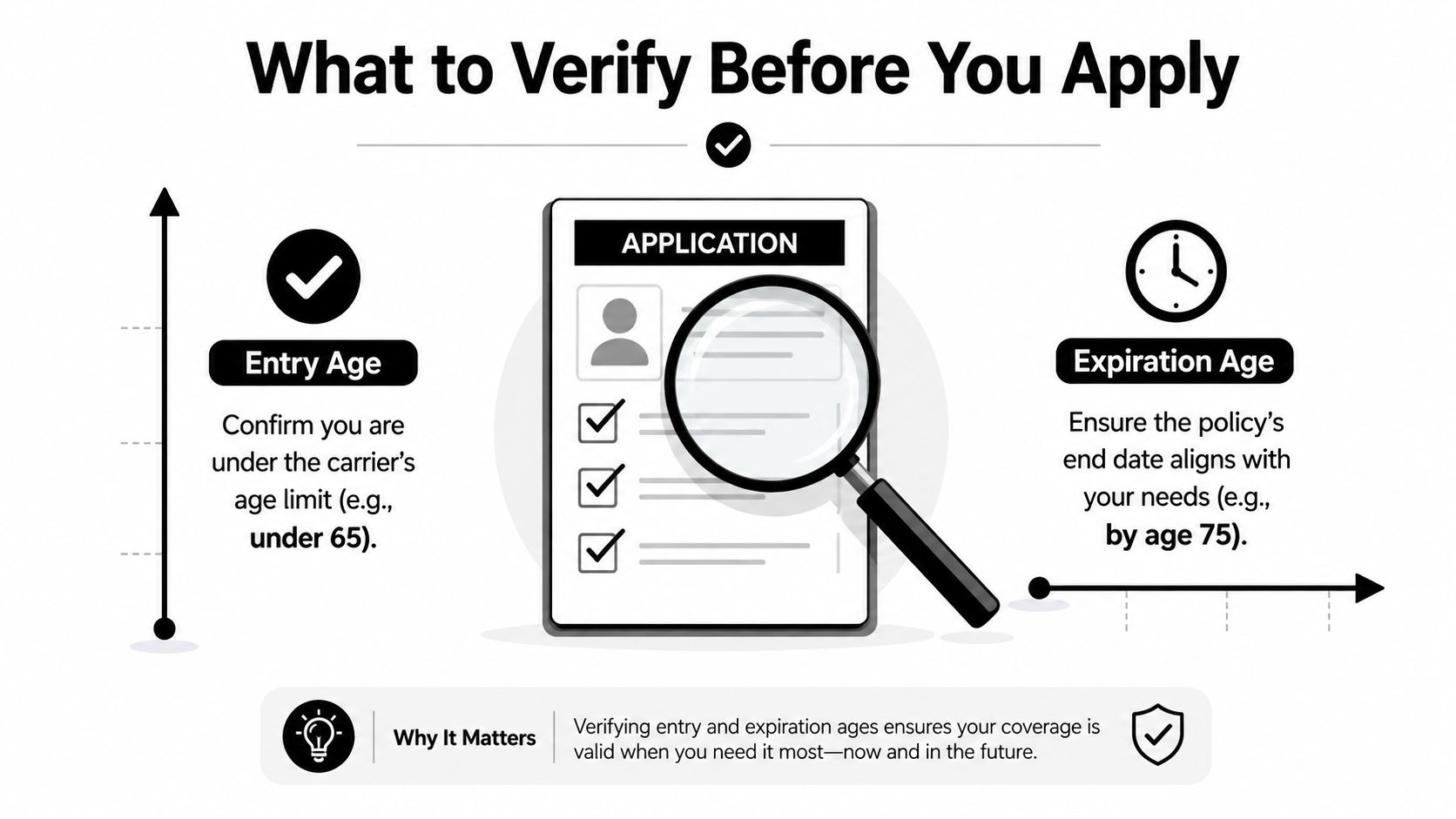
The two-axis model gives you a practical answer to the age-limit question. Entry age determines whether the carrier can issue a new policy to you. Expiration age determines whether that policy will still be active when your mortgage, dependents, business, or final financial obligations require protection.
Before applying, verify these four items in the policy materials:
- Your issue-age eligibility: Check the carrier's minimum and maximum issue age for your exact date of birth, not just the age shown in a general advertisement.
- The contract end date: Confirm the maturity or expiration age and calculate the date the coverage stops.
- The available term: Ask which terms are offered at your current age, not which terms appear on the insurer's general product page.
- The underwriting route: Determine whether your age and health profile fit full underwriting, simplified issue, accelerated underwriting, or no-exam eligibility.
For no-exam applications, confirm that the age rules are current. Carriers can revise issue-age ceilings, coverage tiers, and term availability, so an older online article may not reflect the offer you receive. Also ask whether conversion or guaranteed renewability is included, and read the deadlines carefully.
Before you sign: Write down the age when coverage begins, the age when it ends, and the financial obligation the policy is meant to protect. If those dates don't line up, keep comparing.
A quote is only useful when it fits your timeline. Check the two age axes, compare the underwriting path with your priorities, and choose a policy that remains meaningful after the application is approved.
Coveredly offers online term life insurance with no-exam options for most applicants and coverage of up to $3 million, subject to eligibility and underwriting rules. Visit Coveredly to explore an age-appropriate quote and compare the available term and application paths against your own expiration timeline.