Healthy adults ages 18 to 30 overestimated the median premium for a $250,000, 20-year level-term policy by roughly 10 to 12 times in 2025, according to LIMRA research on younger adults and life insurance cost. That gap between guessed cost and real cost keeps many young families from even getting a quote. The better question isn't whether term life is affordable in year one. It's whether the policy you pick still works when the level period ends, when your health changes, or when a child, mortgage, or job change rewrites your obligations.
Table of Contents
- Term Life Options Side by Side
- Matching Term Length to Your Obligations
- Level Versus Decreasing Coverage and the Renewal Cliff
- Conversion, Renewal and Riders to Check
- Full Exam, Accelerated and No-Exam Underwriting
- Match Your Life Stage and Confirm Your Choice
Term Life Options Side by Side
Term life insurance options make the most sense when you judge them by duration and flexibility, not by the first monthly quote alone. The need is widespread. LIMRA's 2024 Life Insurance Fact Sheet reported that 51% of consumers said they owned life insurance in January 2024, and 42% of U.S. adults, approximately 102 million people, said they needed life insurance or needed additional coverage. Among owners, 22% said they did not have enough. Many households have some coverage and still have a gap.
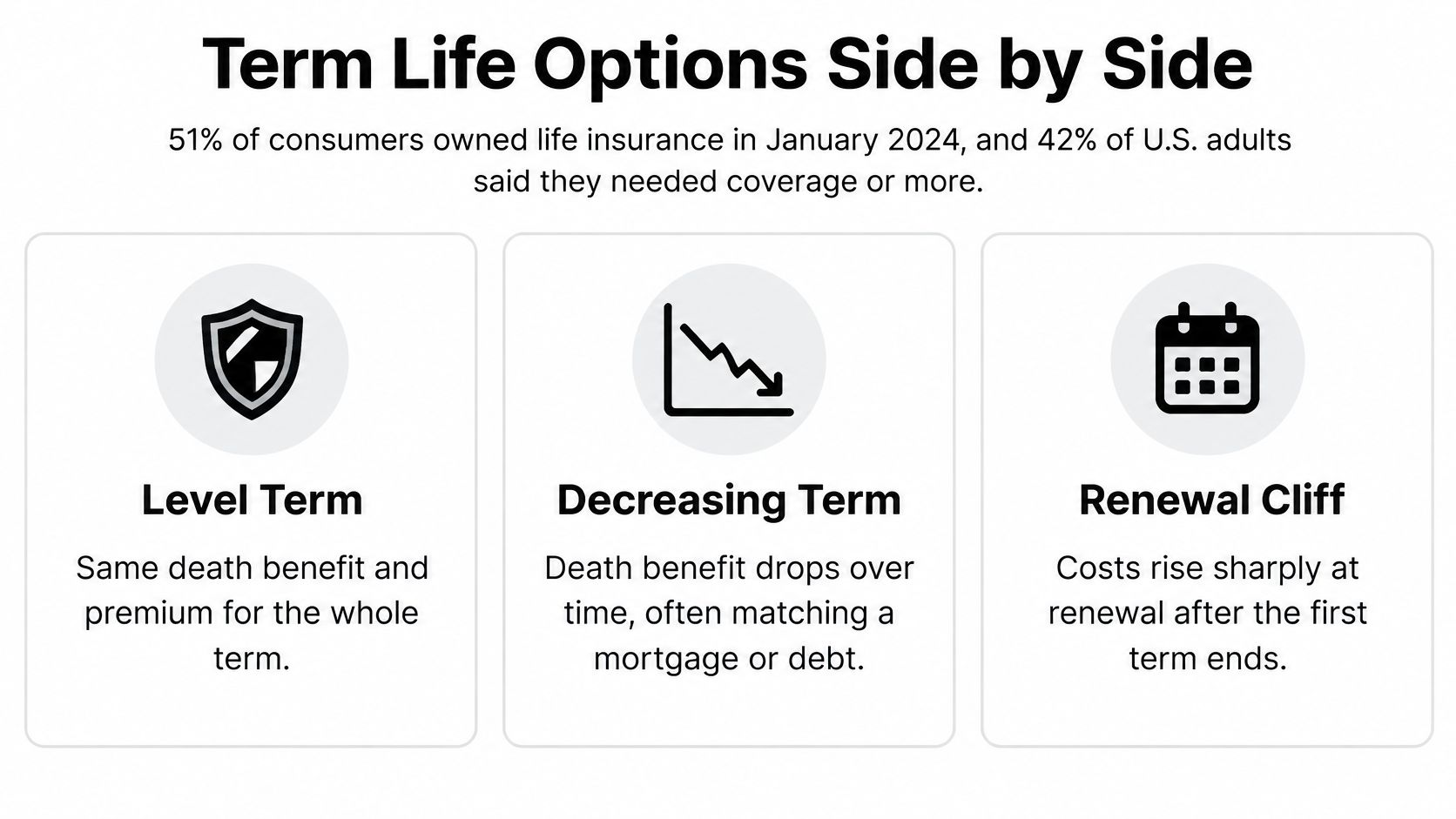
Term life insurance provides pure protection for a set period, such as 20 years, without investment components. That's why it's an affordable way to buy a large death benefit during the years when your income matters most. Whole life is different. It covers the insured for their entire life and includes a cash value savings component that grows over time, with premiums significantly higher than term life.
Term Life Options Compared on Premium, Benefit and Fit
| Option | Premium pattern | Benefit over time | Best fit |
|---|---|---|---|
| Level term (10, 15, 20 or 30 years) | Fixed for the whole term | Fixed for the whole term | Income replacement and mortgages with a known end date |
| Decreasing term | Fixed for the whole term | Falls each year on a set schedule | Debts that shrink, such as a repayment mortgage |
| Annual renewable term | Resets each year and rises with age | Stays in force only while renewed | Short bridges where the need ends soon |
| Convertible term | Same as the base term | Can be exchanged for permanent cover within a set window | Buyers unsure whether they will want permanent cover later |
| Whole life (permanent comparison) | Level for life, significantly higher than term | Lifetime benefit plus a cash value component | Lifelong dependents or estate planning |
A level premium and convertibility solve different problems, and confusing them leads to poor choices. A level premium gives you price stability for the chosen period. Convertibility protects your future insurability if your health changes and you later want permanent coverage. You can have one without valuing the other, but you should know which problem you're paying to solve.
Practical rule: price the option that matches the obligation, not the option with the lowest first-year premium.
Use three questions to build your shortlist. First, how long does the financial need last? That sets your term length. Second, should the benefit shrink as a debt does? That points you toward level or decreasing cover. Third, might you need permanent coverage later? That tells you whether a conversion option deserves real weight in your comparison.
Matching Term Length to Your Obligations
Say you're 30, you've just taken a 25-year mortgage, and your youngest is two. A 20-year policy looks cheaper, so it's tempting. Run the dates before you take the saving. That term ends when your child is 22 and the mortgage still has five years to run, so a death in year 22 leaves your family with no payout for the remaining loan or for a young adult who may still need support. A 25- or 30-year term outlasts the last obligation, which is the whole point of the cover.
That logic is built into how term life works. The National Association of Insurance Commissioners consumer guide on choosing life insurance describes term cover as a death benefit paid during a defined period, with common terms such as 10 or 20 years, rather than protection lasting the insured's whole lifetime. Most term policies build no cash value you can draw on while alive, which is why term generally buys the largest amount of protection per premium dollar. Pure protection suits temporary obligations: replacing income while children are dependent, protecting a mortgage, or covering a business obligation during a working career.
Term Length Matched to Common Obligations
| Term length | Obligation it commonly covers | Main risk if chosen |
|---|---|---|
| 10 years | Short debts, or a bridge until a child reaches independence | Cover ends while the need may still exist, forcing a renewal decision at older-age prices |
| 15 years | The dependent years for a young child | Renewal after year 15 at much higher premiums if the need runs longer |
| 20 years | Mortgage-length needs for buyers in their 30s and the core working years | Premiums rise sharply after the level period if obligations outlast the term |
| 30 years | A 30-year mortgage taken in the early 30s or a long career | Highest total premium of the standard lengths and a long commitment to pay |
Read the right-hand column as the true price of each option. The end of the level period is where a cheap term gets expensive: renewing at 50 costs far more than the premium you locked in at 30, and new health issues can make replacement cover harder to qualify for.
For the amount, a common guideline is 10 to 15 times annual income, and we help tailor that starting point to your debts, dependents, and existing cover. Treat the multiple as a first estimate, then adjust. A one-income household with a large mortgage and two toddlers needs more than a dual-income couple with no children and a small loan. If a rental property forms part of the family's safety net, count what it reliably nets after costs rather than the gross rent; owners working out that figure can look at ways to maximize rental income in Pitt Meadows before adding it to the coverage math.
The length you pick today is also not the last word. Coverage can be raised or lowered as life changes, without starting over, so a term sized to current obligations can still adapt if you take on a bigger mortgage or pay one off early.
Do the exercise on paper before requesting quotes. List each obligation, write the year it ends, and pick the shortest standard term that runs past the last one. Our guide on how long your life insurance term should last uses the same end-date method, so bring your list of dates to the quote.
Level Versus Decreasing Coverage and the Renewal Cliff
Most comparisons stop at the first-year premium, which is the least informative number on the page. The better question is what each policy does once the guaranteed period ends or your life changes shape.

A level term policy keeps the same death benefit and the same premium for the whole term. That steadiness suits income replacement, because your children's living costs don't fall on a neat schedule. Rent, food, childcare, and transport stay stubbornly high even as a mortgage balance drops.
A decreasing term policy keeps the premium fixed while the benefit falls each year on a set schedule. That matches a repayment mortgage, where you owe less every year. If the only job of the policy is to clear that loan, paying for a benefit that never shrinks can mean paying for cover you no longer need. Our explainer on how decreasing term life insurance works walks through the payout schedule in more detail.
One more wrinkle sits between the two: some term policies let you raise or lower coverage as life changes, without starting the contract over. That adaptability is worth more at year 15 than a small premium saving at year 1.
A Worked Example in Dollars
Say you buy a $500,000 level policy for 20 years. If you die in year 19, your beneficiaries still receive $500,000. Now say you buy a decreasing policy tied to a 20-year loan that started at the same amount. By year 19, it pays roughly the remaining loan balance, which may be far less than $500,000.
The two policies answer different questions. Level protects income and living costs. Decreasing protects a specific shrinking debt. A household comparing loan costs, including readers following a home financing outlook for first responders, is working on the debt half of that split. The income half still needs its own answer, because one policy rarely does both jobs well.
What Happens at the Renewal Cliff
The video below explains the cost jump many owners face when a level period ends.
Society of Actuaries research on term shock lapse reports that historical actuarial assumptions for the cumulative lapse rate from the end of the level-premium period through the following duration rose from roughly 88% to 96% as term length increased. A separate experience report in the same research found a 60.9% duration-10 shock lapse rate across 10-year level-term plans, with substantial variation by insurer, product design, and policy attributes.
Read those figures as a warning about timing. People drop coverage at exactly the moment replacement cover costs more or may be medically unavailable. A policy that looks cheap during its guaranteed period can become unattractive at renewal. Compare the guaranteed level period with the actual length of your need, and treat post-term renewal premiums as a contingency rather than your base plan.
Conversion, Renewal and Riders to Check
The checklist below summarizes the contract points that decide whether a policy can adapt later.
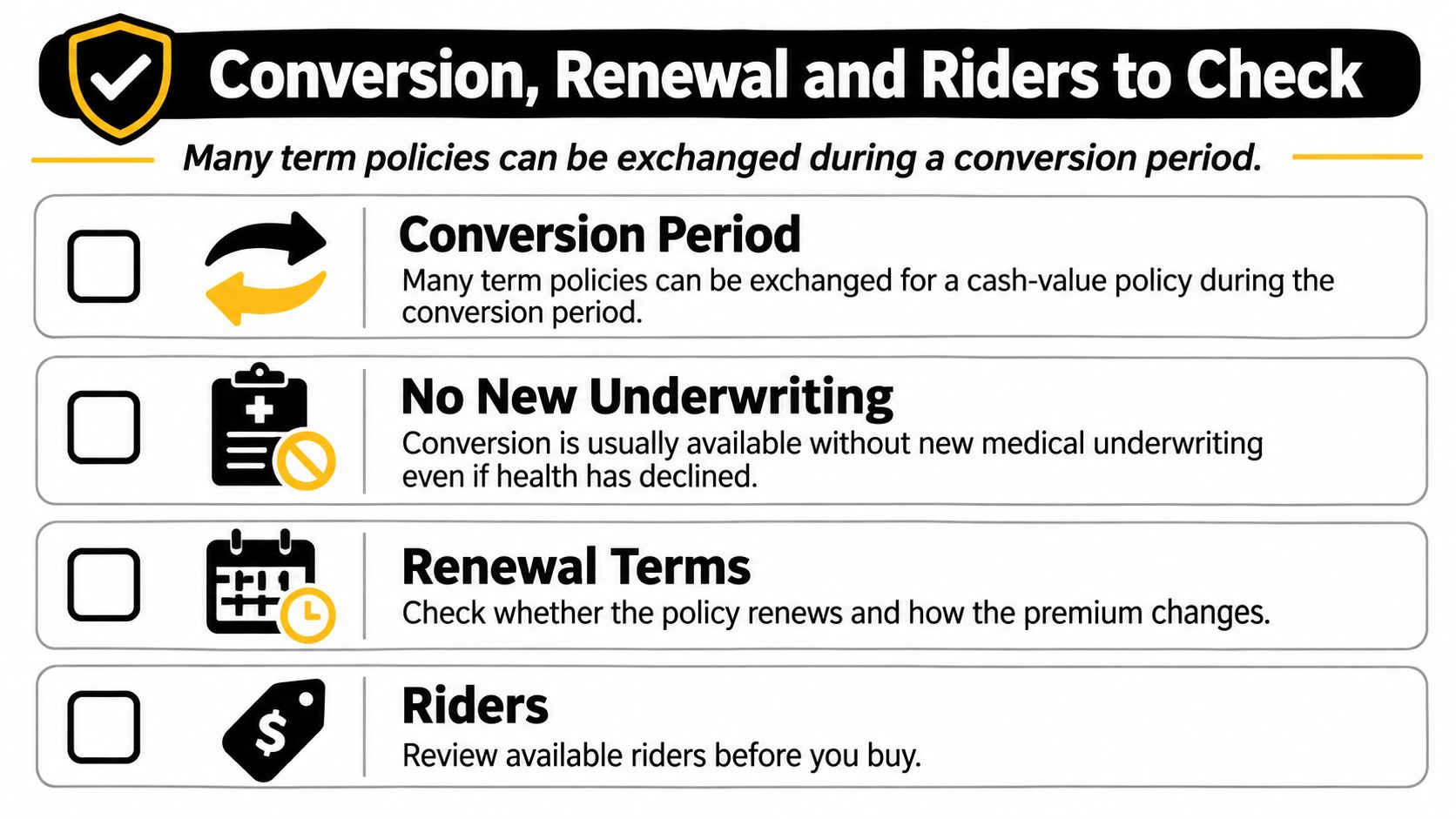
Depending on the policy type, coverage can be adjusted or converted to permanent insurance. That's valuable, but only if the rules fit your timeline. Under guidance from the National Association of Insurance Commissioners in the Rhode Island consumer life insurance guide, many term policies permit renewal without new medical underwriting, even when the insured's health has deteriorated, but renewal premiums can increase substantially and the right may end at a specified age. Some policies also let you exchange term coverage for permanent, cash-value insurance without proving insurability, though the converted policy generally carries higher premiums because pricing is based on your attained age and the permanent policy's broader guarantees.
Seven Provisions to Compare Before You Buy
- Conversion deadline: Does the window close before the level period ends?
- Eligible permanent products: Which specific policies can you convert into?
- Convertible amount: Can you convert the full face amount or only part of it?
- Conversion pricing basis: Is the new premium based on your attained age?
- Guaranteed renewal schedule: What will each renewal year cost?
- Maximum renewal age: At what age does the renewal right end?
- Renewal underwriting: Does renewal require new medical evidence?
These provisions preserve insurability after a major health event. They don't preserve your original price or benefit structure. Read them as an escape route with a cost, not as a continuation of today's deal.
Riders Worth a Yes or No Answer
A child term rider covers your children for a small added cost, usually with a modest benefit. Ask yourself, does this rider duplicate coverage you already have through work, or does it meet a need your household has?
A waiver of premium rider pays your premiums during a qualifying disability, so coverage stays in force when income stops. Check its definition of disability carefully, because waiting periods and own-occupation rules vary. Does this rider duplicate employer disability coverage, or does it fill a gap you'd otherwise carry alone?
An accelerated benefit for terminal illness lets you access part of the death benefit early after a qualifying diagnosis. An added term rider for a spouse bolts extra coverage onto your policy instead of buying a separate one. For each, ask the same question. Does it duplicate employer coverage, or does it meet a need your household has?
Full Exam, Accelerated and No-Exam Underwriting
Underwriting sets both your price and your speed to approval. The path you're offered depends on your health data, your age, and the amount you apply for. You don't always get to choose freely, but you can apply for the path you expect to qualify for and understand what each one asks of you.
In many cases no medical exam is needed, because many policies are approved using digital underwriting and health data. Many carriers also offer flexible underwriting options for people with pre-existing conditions. Applicants can often apply in minutes and get an immediate decision, with no medical exam for most.
Underwriting Paths for Term Life Applicants
| Path | Medical exam | Decision speed | What you answer | Best for |
|---|---|---|---|---|
| Fully underwritten | Usually yes, with blood and urine tests | Weeks | Full medical history and records | Larger amounts and applicants seeking the lowest rates |
| Accelerated underwriting | Often none, with health data checked | Days to weeks | Detailed questionnaire plus database checks | Healthy applicants buying moderate amounts |
| No-exam digital underwriting | None for most applicants | Often immediate | Short health and lifestyle questions | Applicants who want speed and privacy, with exam requested if data is unclear |
| Simplified issue | None | Days | A few health questions | Applicants with routine conditions buying smaller amounts |
No-exam doesn't mean no health review. It means the insurer reviews data first and asks for an exam only if something needs clarifying.
That caveat surprises people. A paramedical exam may be requested if the data raises questions, for example if prescription records and your answers don't line up. Our guide to what a life insurance medical exam involves explains what to expect if that happens. An exam adds time, and it usually includes height, weight, blood pressure, and blood and urine samples.
Four Steps That Protect Your Application
- Gather your records first: List recent prescriptions, diagnoses, and treating doctors before you start.
- Apply for the appropriate path: Match the path to your health and amount, not just the fastest promise.
- Answer every question exactly: Omissions can jeopardize a claim, even honest ones about a medication you stopped.
- Ask about alternatives if rated up: If you're declined or priced higher, ask whether another path or carrier could issue the policy.
The entire process can run digitally from quote to issuance. That speed helps, but accuracy matters more than speed. A fast approval built on a wrong answer protects no one.
Match Your Life Stage and Confirm Your Choice
Cost confusion, not cost itself, stops many young buyers. A 2025 LIMRA article on closing the life insurance coverage gap reported that 90% of U.S. life-insurance prospects said they needed a better understanding of life insurance before purchasing, while roughly one-third of Gen Z and Millennials said they were unsure how much coverage they needed or which type to buy. It also reported that healthy adults ages 18 to 30 estimated the price of a $250,000, 20-year level-term policy at roughly 10 to 12 times its actual median cost. Scenario-based thinking beats a generic salary multiple here, because your life stage decides what the money must do.
The photo below shows the kind of side-by-side review worth doing before you commit.

Four Households, Four Different Answers
A newly married couple with shared debt and no children faces a smaller, clearer risk. If one partner died, the other would still owe rent or a mortgage, car payments, and any joint loans on one income. A smaller level policy can cover those shared obligations without overbuying. A conversion option deserves attention here, because children, a house purchase, or a health change can arrive within a few years and permanent coverage may become relevant. Buying a modest policy early, while you're young and healthy, locks in insurability you can build on later.
A young parent with a mortgage has the longest list. The payout may need to replace income, fund childcare, keep the household in its home, and cover future education costs. Choose a term that ends after the last dependent year and after the mortgage, not the cheaper term that ends between them. Level coverage usually fits because family living costs don't shrink on a loan schedule. If one parent stays home, consider cover for that parent too. Their childcare and household work has real economic value, and replacing it costs money even though no salary disappears.
A self-employed buyer with variable income should prioritize a longer level period. Income swings make annual renewable coverage risky, because premiums rise every year whether business is good or slow. A level premium turns one major cost into a predictable line in an unpredictable budget. Decreasing term is usually a poor fit for income replacement, since your family's need for your earnings doesn't fall the way a loan balance does. Base your amount on a conservative average of recent income, then revisit it after a strong year or a major contract.
A professional with employer coverage often assumes the problem is solved. Audit it first. LIMRA reports that 55% of working adults have life insurance through an employer, yet the median basic workplace benefit is only a flat $20,000 or one times salary, and more than half of people who have insurance only through work believe that amount is sufficient, according to LIMRA's 2025 facts about workplace life insurance benefits. One times salary rarely replaces income for long or clears a mortgage. Workplace cover can also end or change when you switch jobs, which is exactly when a new individual policy costs more.
Three Steps to Confirm Your Choice
Step 1 is a benefits audit. Write down your employer benefit amount, whether it's portable, its conversion deadline, any exclusions, and what happens when you change employers. Check whether supplemental workplace coverage requires evidence of insurability. Then decide what individual coverage must add. Couples should coordinate here. If one partner has strong workplace benefits and the other has none, individual cover may matter more for the uninsured partner and for the stay-at-home parent whose contribution isn't a salary.
Step 2 is choosing your underwriting path based on your timeline. If you're closing on a house or expecting a baby soon, speed may justify a digital path. If you're buying a large amount and you're in excellent health, full underwriting may reward patience with a lower price. There's no universally right answer. There's a right trade-off for your deadline and your health profile.
Step 3 is comparing quotes from several carriers side by side. Compare the same amount, the same term, and the same riders, then look past the premium at renewal schedules and conversion deadlines. We compare multiple carriers to find competitive pricing, so you can see real quotes together instead of guessing across separate applications.
For context on price, many policies start as low as $15 to $30 per month, depending on age, health, and coverage amount, and we offer term life insurance with no medical exams for policies up to $3M. Use the 10 to 15 times annual income guideline only as your starting point, then tailor it to your mortgage, childcare years, and debts. If estate planning is part of your picture, this overview of protecting your family's life insurance payout explains one structure some families discuss with a lawyer.
Revisit your choice after major life events, including a marriage, a first child, a home purchase, a job change, or a shift to self-employment. A policy you bought early isn't a life sentence. It's a foundation you adjust as obligations grow or fall away. Request a personalized quote to see which term life insurance options fit your household, your end dates, and your budget today.
You don't need to guess your way through term length, underwriting, or renewal costs, and you shouldn't buy on first-year price alone. At Coveredly, we'll help you compare term life insurance options from multiple carriers, apply online in minutes, and get a decision with no medical exam for most applicants up to $3M. Get your personalized quotes side by side today and pick the policy that still fits when your level period ends.