A healthy 30-year-old man may pay about $18.16 a month for a $500,000, 20-year term policy, while the same profile at 60 may pay about $199.32 a month, nearly ten times more (2026 term-life rate data). The best age to get life insurance is the earliest point when someone depends on your income, shares your debt, or would face a financial gap if you died.
That answer is more useful than saying “buy it in your 20s.” Age controls price, but life events create the need. A single professional with no dependents may reasonably prioritize other financial goals, while a newly married couple, first-time homeowner, or new parent has a clear reason to act.
My rule is straightforward: buy when your financial responsibilities begin, and buy earlier if you can qualify for a favorable rate while healthy. Waiting until the need feels urgent can mean paying more, accepting fewer options, or discovering that a new health condition has changed your eligibility.
Table of Contents
- The Short Answer on Age and Life Insurance
- How Insurers Price Life Insurance by Age
- What Coverage Costs at Different Ages
- Life Events That Signal It's Time to Buy
- Why Waiting Can Backfire Even If You Feel Healthy
- Age Limits and How Late You Can Still Buy
- How to Decide the Right Age for You
The Short Answer on Age and Life Insurance
A healthy 30-year-old nonsmoking woman could pay about $10.56 per month for a $500,000, 20-year term policy, compared with about $72.41 at age 60. For men, the same comparison is about $18.16 at age 30 and $199.32 at age 60, according to published 2026 term-life pricing examples. Exact premiums vary by insurer, health profile, tobacco use, coverage amount, and policy design. The pricing lesson is direct: waiting makes coverage materially more expensive.
Chronological age is only half the decision. The better question is, which financial event makes life insurance necessary?
Practical rule: Buy life insurance when another person would suffer financially if your income disappeared.
That point commonly arrives with one or more of these events:
- Marriage or domestic partnership: Your partner may rely on your income or share household obligations.
- Buying a home: A mortgage can create a major financial exposure for the surviving borrower.
- Having or adopting a child: Childcare, housing, education, and daily living costs continue after a parent dies.
- Starting or joining a business: Co-owners may need funding to manage ownership changes, debts, or key-person risk.
- Taking on shared debt: A co-signed loan or private debt can leave another person responsible for payments.
The right buying age is the earliest point when you have dependents, debt, or income that needs protecting, provided the premium fits your budget. If you are young, healthy, and already have a spouse, child, mortgage, or co-signed obligation, waiting usually creates a poor trade-off.
Premium by age snapshot
The table below uses published examples for a healthy nonsmoker buying $500,000 of 20-year term coverage. Annual figures are calculated from the stated monthly premiums, and the final column shows the monthly cost relative to age 30.
| Age | Monthly Premium | Annual Cost | Cost vs Age 30 |
|---|---|---|---|
| 30, woman | $10.56 | $126.72 | 1.0x |
| 40, woman | $15.21 | $182.52 | 1.4x |
| 50, woman | $32.29 | $387.48 | 3.1x |
| 60, woman | $72.41 | $868.92 | 6.9x |
| 70, woman | $197.11 | $2,365.32 | 18.7x |
| 30, man | $18.16 | $217.92 | 1.0x |
| 40, man | $28.03 | $336.36 | 1.5x |
| 50, man | $68.99 | $827.88 | 3.8x |
| 60, man | $199.32 | $2,391.84 | 11.0x |
The broader life insurance rates by age show why timing matters, but the decision should follow the obligation, not a magic birthday. Locking in a policy before a major milestone can preserve lower pricing, while the coverage amount still needs to match a real financial responsibility.
How Insurers Price Life Insurance by Age
Age is one of the clearest price drivers in life insurance. Insurers begin with mortality tables, actuarial data that estimates the likelihood of death within a defined period for people in a particular age and gender band. A younger applicant generally represents lower expected claim risk, while an older applicant represents higher expected risk.
That estimate becomes part of the premium calculation. The insurer also reviews the requested death benefit, policy term, health classification, tobacco use, occupation, and hobbies. These inputs can change the quote, but age advances every year and remains a central pricing factor.
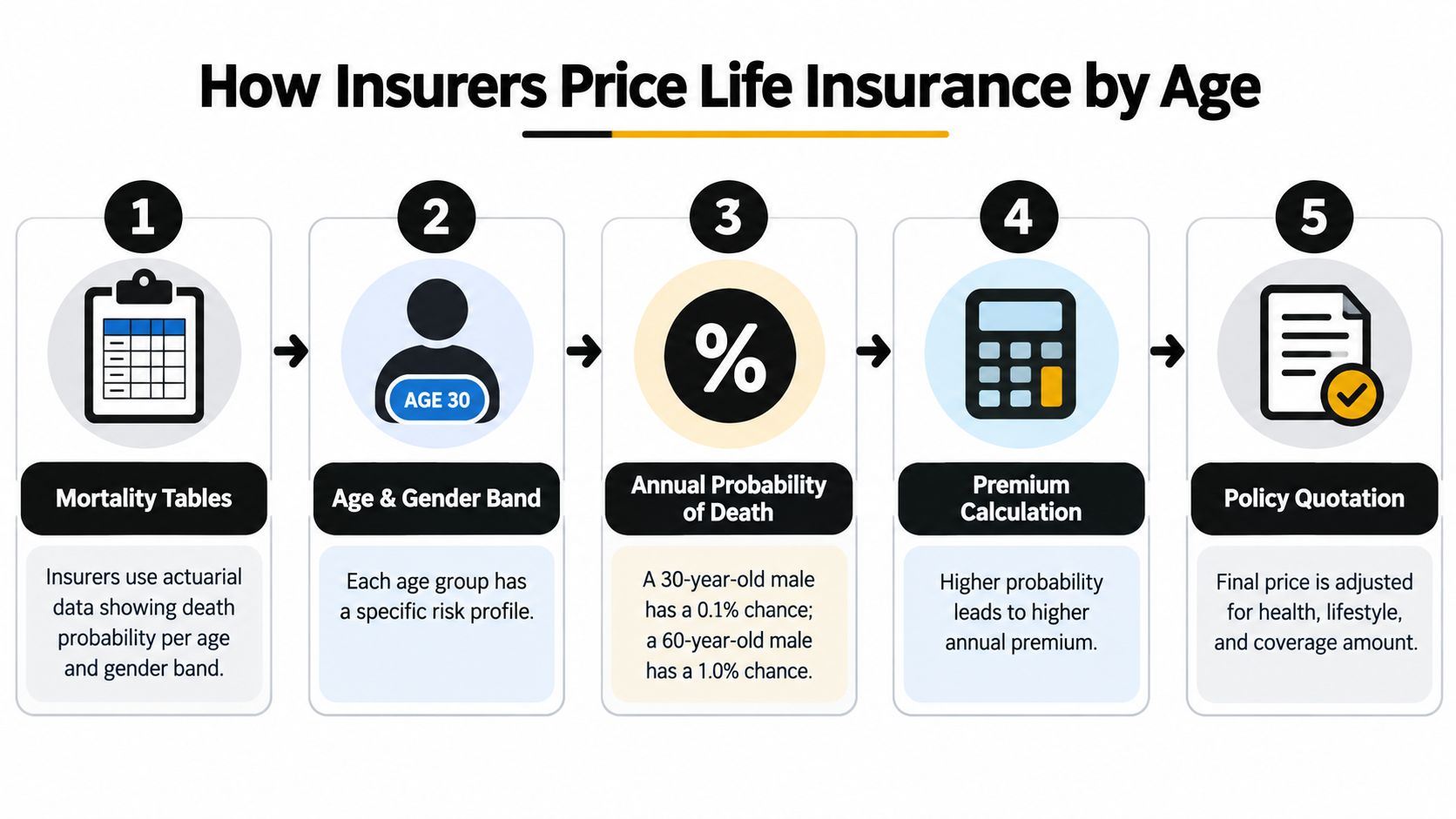
Term insurance adds a useful form of price stability. After the insurer issues the policy, the premium is typically level for the selected term. You are not re-priced at every birthday. Apply earlier, and the insurer generally uses your age and health at application to set the rate for that policy period. The mechanics of age-based term insurance pricing explain why delaying a purchase can affect the initial premium, while aging during an active level-term policy usually does not change it.
Why delay changes the quote
Waiting creates a new application at an older age. The insurer then evaluates you in a different mortality band, alongside whatever has changed in your health, tobacco use, work, or activities. The practical rule is simple: if a real financial obligation already depends on your income, do not wait for a symbolic birthday to buy coverage.
Other underwriting inputs still affect the final offer:
- Health class: Medical history and current conditions influence the rate category.
- Tobacco use: Smoking and other tobacco use can raise premiums substantially.
- Occupation: Higher-risk work can affect eligibility or pricing.
- Hobbies: Activities with significant accident risk may receive additional scrutiny.
- Coverage design: Benefit amount, term length, riders, and policy type all influence cost.
Age differs from these factors because it increases without any action from you. You can stop using tobacco, improve your health, or change jobs, but you cannot make your application younger. A strong buying window usually appears when your financial responsibility begins and your health still supports favorable underwriting. Underwriting looks at the whole application, so the strongest rate goes to the applicant whose health, occupation, and age align at the moment of signing. Learn how insurers assess those details in underwriting life insurance.
What Coverage Costs at Different Ages
Age is often the biggest pricing lever you can control. A $500,000, 20-year term policy may cost roughly $215 per year for a healthy 30-year-old man, about $330 at 40, about $815 at 50, and about $2,342 at 60 for the same coverage structure, according to published premium examples by age.
Those figures illustrate the direction of pricing, not a personal quote. Medical history, tobacco use, family history, occupation, hobbies, carrier, underwriting class, and state can all change the offer.
| Age | Estimated Monthly Premium | 20-Year Total Cost | Multiplier vs Age 25 |
|---|---|---|---|
| 25 | $20 | $4,800 | 1.0x |
| 35 | $35 | $8,400 | 1.75x |
| 45 | $75 | $18,000 | 3.75x |
| 55 | Not specified in the verified data | Not specified | Not specified |
A separate comparison of healthy applicants shows about $20 per month for a 25-year-old, $35 for a 35-year-old, and $75 for a 45-year-old buying $500,000 of term coverage (comparison of life insurance costs for younger adults). The verified source does not provide a defensible age-55 premium for this table, so there is no reason to invent one.
The total-cost trap
The monthly payment hides the long-term price. At the illustrative rates above, the age-25 applicant pays about $4,800 over 20 years, while the age-45 applicant pays about $18,000. Both examples represent the same stated death benefit and policy duration.
Gender can affect pricing as well. In published 2026 examples, a healthy 30-year-old nonsmoking woman paid about $10.56 per month, compared with about $18.16 for a comparable man buying the same coverage and term (2026 rate comparison). Actuarial mortality expectations influence those differences, but insurers also assess health, tobacco use, lifestyle, and the rest of the application.
Do not use a rule claiming that every five-year delay doubles the premium. The increase changes with age, health, policy type, and carrier. The reliable rule is more practical: term life rates by age rise sharply, especially as applicants move into later age bands. If you already know coverage will be needed, buying earlier can preserve a lower rate and reduce the chance that a health change makes insurance harder to obtain.
Use a term life insurance cost guide to understand the main pricing factors, then request a live quote at your current age and health class. Carrier-specific underwriting can shift an illustrative figure by 20 percent or more, so treat tables as planning tools, not promises.
Life Events That Signal It's Time to Buy
The right buying age is usually the date a financial obligation becomes shared. Life insurance matters when your death could leave someone else with lost income, an unpaid mortgage, business disruption, or debt they agreed to carry.
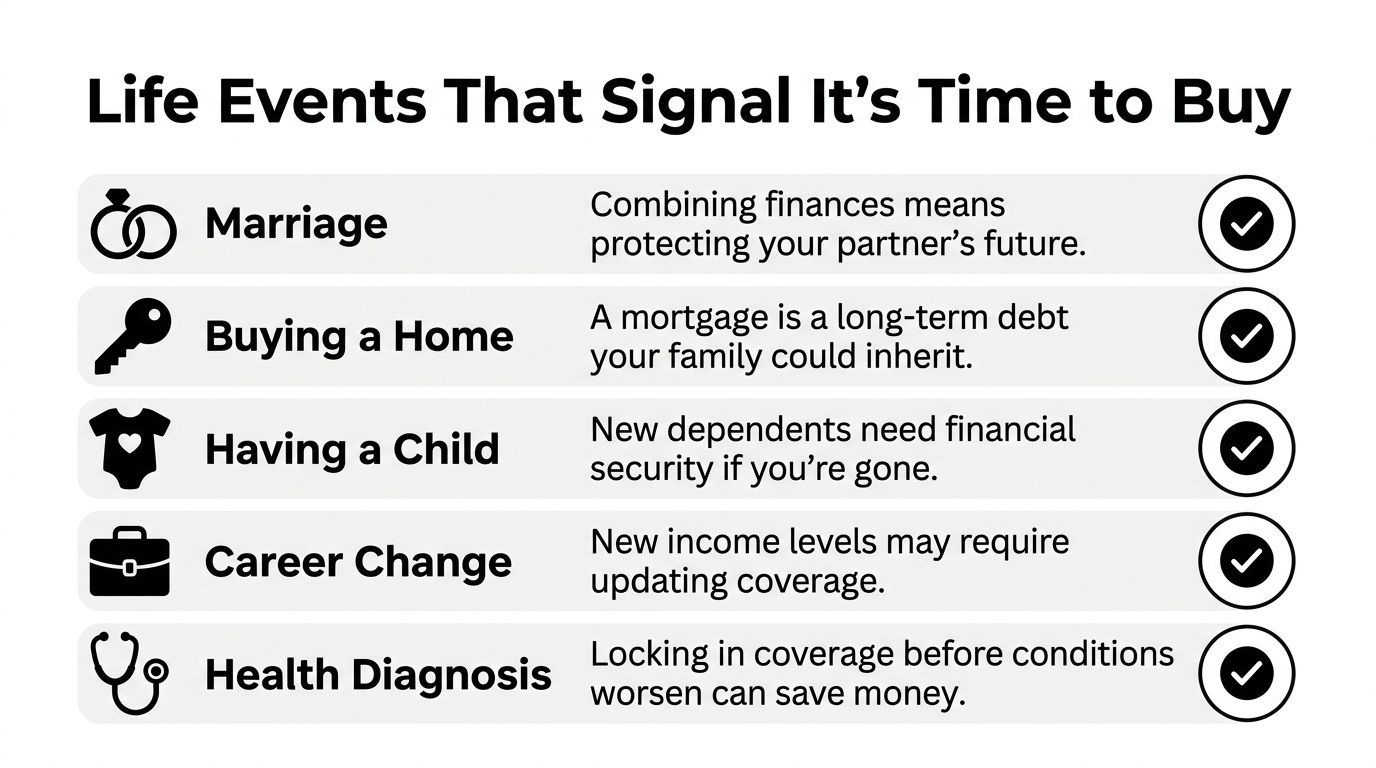
Marriage or domestic partnership
Marriage combines income, housing costs, savings goals, and debt. If your partner could not maintain the household without your earnings, apply when the relationship creates that dependence, not at some arbitrary age.
Decision prompt: Would your partner need money to replace your income, cover shared expenses, or move to more affordable housing?
Buying a home
A mortgage creates a direct liability. The surviving partner may keep the home only if remaining income can support the payments and other household costs.
Decision prompt: Start with the mortgage balance. Then account separately for income replacement and ongoing expenses.
Having or adopting a child
A child creates a long financial obligation. The surviving parent may need help with childcare, housing, education, and time away from work.
Decision prompt: Use income replacement as a starting point, sometimes multiplying income by ten for new parents, then add debts and future obligations. That framework helps organize the estimate, but it is not a universal formula.
Starting or buying into a business
Business ownership can expose both your family and your partners to financial problems. The company may need money for business debt, ownership changes, or the loss of a person whose work is difficult to replace.
Decision prompt: Could your co-owners fund a buyout, meet company obligations, and replace your role without insurance proceeds?
Taking on significant shared debt
Co-signed private debt can shift repayment to a partner, family member, or business associate. Life insurance provides cash to address that obligation when the person who created the income or repayment capacity dies.
Decision prompt: List every debt another person would have to repay or refinance after your death. Use that list to set the minimum coverage amount.
People without dependents, shared debt, or income-replacement needs can wait and revisit the decision after a major change. If two or more of these exposures already apply, start the application now rather than waiting for another renewal cycle.
When a milestone like marriage or a mortgage arrives, treat that date as your review deadline. A practical guide to buy life insurance after a life change can help you organize the review around income, debt, and the people who would bear the loss.
Why Waiting Can Backfire Even If You Feel Healthy
Good health today doesn't guarantee the same underwriting result later. An insurer evaluates your health at application, assigns a rate class, and uses that snapshot to price the policy. If your health improves after issuance, the insurer typically doesn't lower the locked premium, but if your health worsens before you apply, the new condition can affect the offer.
Potential underwriting complications include high blood pressure, sleep apnea, Type 2 diabetes, BMI, or a cancer scare. Depending on the condition, an insurer may apply a table rating, increase the premium, request more medical evidence, postpone the application, or decline it.
The practical risk is losing insurability, not losing a few dollars in monthly savings. A policy you could qualify for at a preferred rate remains available only if you can still meet the insurer's underwriting standards when you apply.
A diagnosis can change the economics
The examples below are editorial illustrations required to show the underwriting trade-off. They aren't verified market quotes and shouldn't be treated as guaranteed pricing.
| Applicant Profile | Rate Class | Monthly Premium | Change vs. Healthy |
|---|---|---|---|
| 38-year-old nonsmoker, no listed diagnosis | Preferred Plus | $24 | Baseline |
| Same applicant at 47 with new hypertension diagnosis | Standard | $58 | $34 more per month |
The point isn't that every hypertension diagnosis produces this exact result. The point is that health changes can affect both price and eligibility, while age continues to advance in the background.
If you already have a financial trigger, waiting for a more convenient moment exposes your family to two risks at once. You may pay more because you're older, and you may receive a less favorable offer because your health has changed.
That doesn't mean you should buy a policy you can't afford or skip an emergency fund to purchase unnecessary coverage. It means “I'm healthy now” is an argument for applying while healthy, not an argument for postponing the application.
Age Limits and How Late You Can Still Buy
There isn't one universal life insurance age limit. The maximum issue age depends on the insurer, product, term length, riders, and underwriting rules. Many insurers stop issuing new term policies around ages 75 to 80, while whole life may remain available into the mid-80s or even 90 in some cases (senior life insurance age limits).
A specific insurer example shows how product design narrows the window. Legal & General lists a maximum issue age of 77 for standard life insurance, 74 for decreasing life insurance, and 67 when critical illness cover is added. Standard and decreasing policies must end by age 90, while policies with critical illness cover must end by age 75 (maximum issue age and policy-end examples).
Product availability changes with age
| Product Type | Typical Max Issue Age | Key Restriction Past Age 60 |
|---|---|---|
| Level term life | Around 75 to 80 | Available term length and underwriting options may narrow |
| Whole life | Often into the mid-80s or later | Premiums can be substantially higher |
| Decreasing life insurance | Product-specific, often lower than standard cover | Benefit is designed to reduce over time |
| Critical illness rider | Can reduce maximum issue age | Rider may impose a younger entry age and earlier policy end |
Past 60, medical underwriting often becomes the practical gatekeeper. Simplified-issue, no-exam, guaranteed-issue, and guaranteed universal life products may be available, but each comes with different pricing, benefit structures, and eligibility rules. Don't assume a policy advertised for older applicants offers the same term length or flexibility as one available to a younger buyer.
If you want a long level term, your decision window may close in your mid-40s because longer terms have younger maximum entry ages. If your objective is permanent coverage for final expenses or legacy planning, the door may stay open later, but the price and policy design will be different.
The right question isn't merely “what is the term life age cutoff?” Ask instead: How long must the policy last, and what is the latest age at which the insurer will issue that term?
How to Decide the Right Age for You
Age matters less than the event that creates your need, but age still controls cost and insurability. Use a simple process rather than waiting for a perfect answer.
Start with your financial exposure
Inventory the people and obligations that would be affected by your death:
- Dependents: Who relies on your income, unpaid care, or daily support?
- Debts: Which mortgages, loans, or private obligations could another person inherit or struggle to repay?
- Income replacement: How much money would your household need to maintain housing and basic stability?
- Business responsibilities: Would a partner or company need funds to manage your ownership interest or replace your role?
Don't begin with the policy size. Begin with the financial gap.
Get a current price baseline
Request a quote for a 20-year term policy at your current age. A real quote tells you more than a generic age chart because it reflects your health, tobacco status, state, desired benefit, and carrier options.
Then compare the premium with your budget and the cost of waiting. Published age comparisons show that the same coverage can become dramatically more expensive as the applicant moves through older age bands, while a level term policy generally keeps its premium steady after issue (age-based pricing mechanics).
Use this decision checklist
- Income dependence: Does anyone rely on your paycheck or unpaid household work?
- Financial hardship: Would your death force someone to sell a home, take on debt, or reduce essential spending?
- Current insurability: Could you qualify for standard underwriting today?
- Upcoming milestone: Are marriage, homeownership, parenthood, or a business commitment close enough to affect your needs?
- Policy fit: Does a term policy cover the years when your financial obligations are greatest?
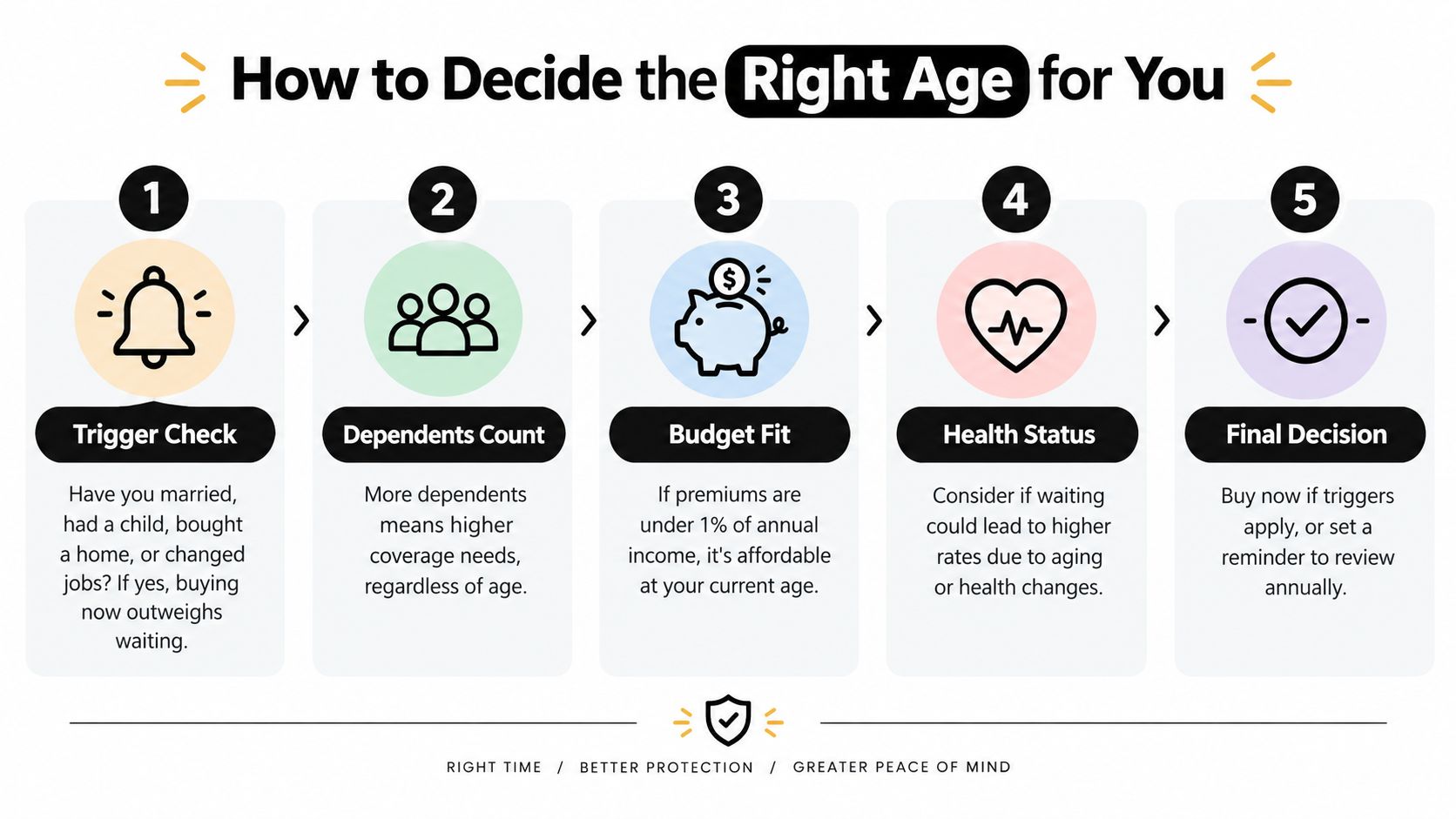
If anyone depends on you, a death would create financial hardship, or you can qualify favorably today, act instead of postponing. If you're between 20 and 40 and any answer is yes, apply now rather than waiting another year.
Coveredly offers online life insurance, including up to $3 million of term coverage with no exams for most applicants, so you can compare an option designed around digital applications and flexible coverage needs. Visit Coveredly to review your choices and start pricing coverage around the life event that makes protection necessary.