You've just bought a home, welcomed a child, or moved into a role where your income supports more than your own lifestyle. Your employer may provide life insurance, but you're not sure how much it covers or what happens if you leave. A quick online quote promises an affordable premium, yet the cheapest policy may expire before your mortgage is paid or offer no useful conversion option if your health changes.
That's why knowing what to look for in term life insurance matters. Term life is straightforward when you focus on the contract: the right death benefit, a term that matches your obligations, a premium you can keep paying, underwriting you can complete accurately, and an insurer capable of honoring the claim. Ignore those details and a policy can leave your family exposed precisely when protection matters most.
Table of Contents
- What Term Life Protection Is Actually For
- Stress Testing Your Coverage Amount and Term Length
- Evaluating Policy Flexibility and Conversion Rights
- Deciding Which Riders Actually Add Value
- Navigating the Modern Underwriting Process
- Checking Insurer Strength and Fine Print Exclusions
- Your Action Plan for Securing the Right Coverage
What Term Life Protection Is Actually For
A young couple with one child can face a serious income gap after one death. One partner earns most of the household income, while the other provides childcare and works part-time. The mortgage, everyday spending, and future plans rely on both contributions, even if only one appears on a pay stub.
Employer-provided coverage may look sufficient until the couple tests it against real expenses. Would it replace income for long enough? Would it help keep the mortgage current? Would it cover childcare if the surviving parent needed to work more? Would the protection continue after a job change?
Term life insurance answers those risks for a defined period. It pays a death benefit when the insured dies while the policy is active, provided premiums are paid and the claim satisfies the contract. Its job is income protection during the years when dependents, debt, childcare, and education costs place the greatest demands on the household budget.
The buying mistake is comparing term and permanent insurance by premium alone. They serve different purposes, so judge term coverage by whether it protects the years your family needs income, rather than by whether its price resembles a lifetime policy.
Practical rule: Treat term life as a financial bridge. Set the policy to carry your family through the years when losing your income would cause the largest immediate disruption.
Coverage should give beneficiaries room to manage the consequences of death, not merely provide a nominal payout. Account for housing, care arrangements, debt, and long-term goals. Pair the policy with legal preparation, including guardianship planning for parents, so money and decisions about children are addressed together.
Review a plain-language explanation of term life insurance benefits before choosing a policy. Then ask one direct question: what temporary financial risk would your family struggle to absorb without you?
Stress Testing Your Coverage Amount and Term Length
The “10x your income” rule is a shortcut, not a financial plan. It can understate the needs of a family with a large mortgage and young children, or overstate the needs of someone with substantial assets, limited debt, and a partner who can quickly replace income.
Start with the event sequence your family would face after your death. The first need is immediate liquidity. Then comes income replacement, housing, childcare, education, and obligations that don't disappear because the policyholder does.
Global underinsurance shows why this exercise deserves more attention. Swiss Re-linked reporting estimated the 2024 global mortality protection gap at USD 432 billion, and households had insured only about 44% of the protection they would need if a breadwinner died. See the global mortality protection gap reporting for that benchmark. Your household doesn't need to copy a market statistic, but it should avoid choosing a death benefit by guesswork.
Build the amount from obligations
Use present needs and future responsibilities, then subtract resources that would be available to your beneficiaries. Don't count an employer policy as permanent unless you understand its portability and continuation terms. Don't count assets that your family would need for another purpose.
| Financial Obligation | Calculation Method | Example Scenario |
|---|---|---|
| Immediate cash needs | Estimate final expenses, emergency liquidity, and short-term household bills | The surviving partner needs cash before income and accounts are reorganized |
| Income replacement | Estimate the income the household would need while the surviving partner adjusts work and care arrangements | A parent reduces work temporarily because childcare becomes more demanding |
| Mortgage and debts | Add the balances your family would want to repay or service | The household wants housing costs reduced rather than forcing a move |
| Childcare and education | Estimate future care and education obligations without relying on a single income multiplier | Children still need care, activities, and education funding |
| Existing resources | Subtract usable savings, investments, and valid insurance already in force | A separate policy or liquid asset offsets part of the required benefit |
Now test the result against disruption. What happens if the surviving partner leaves the workforce for a period? What if a mortgage payment changes when its current arrangement ends? What if education costs rise while the surviving parent is also paying for childcare? Those questions expose an amount that looks adequate on paper but fails under pressure.
A life insurance needs calculator can help organize the inputs, but don't let any calculator replace judgment. For a deeper discussion of the amount itself, use how much term life insurance you need.
Match the term to your longest obligation
Common choices include 10-, 20-, and 30-year coverage windows. Pick the period that reaches the end of your most important financial dependency, not merely the date that produces the lowest quote.
A shorter term may work when the need is narrow and temporary. A longer term can make more sense when children are young, the mortgage runs for many years, or your career income supports several dependents. If the policy expires while your family still relies on your earnings, replacing it later may be more expensive and your health may make approval harder.
Coverage test: Your term should last until the financial consequences of your death become manageable without your current income.
Evaluating Policy Flexibility and Conversion Rights
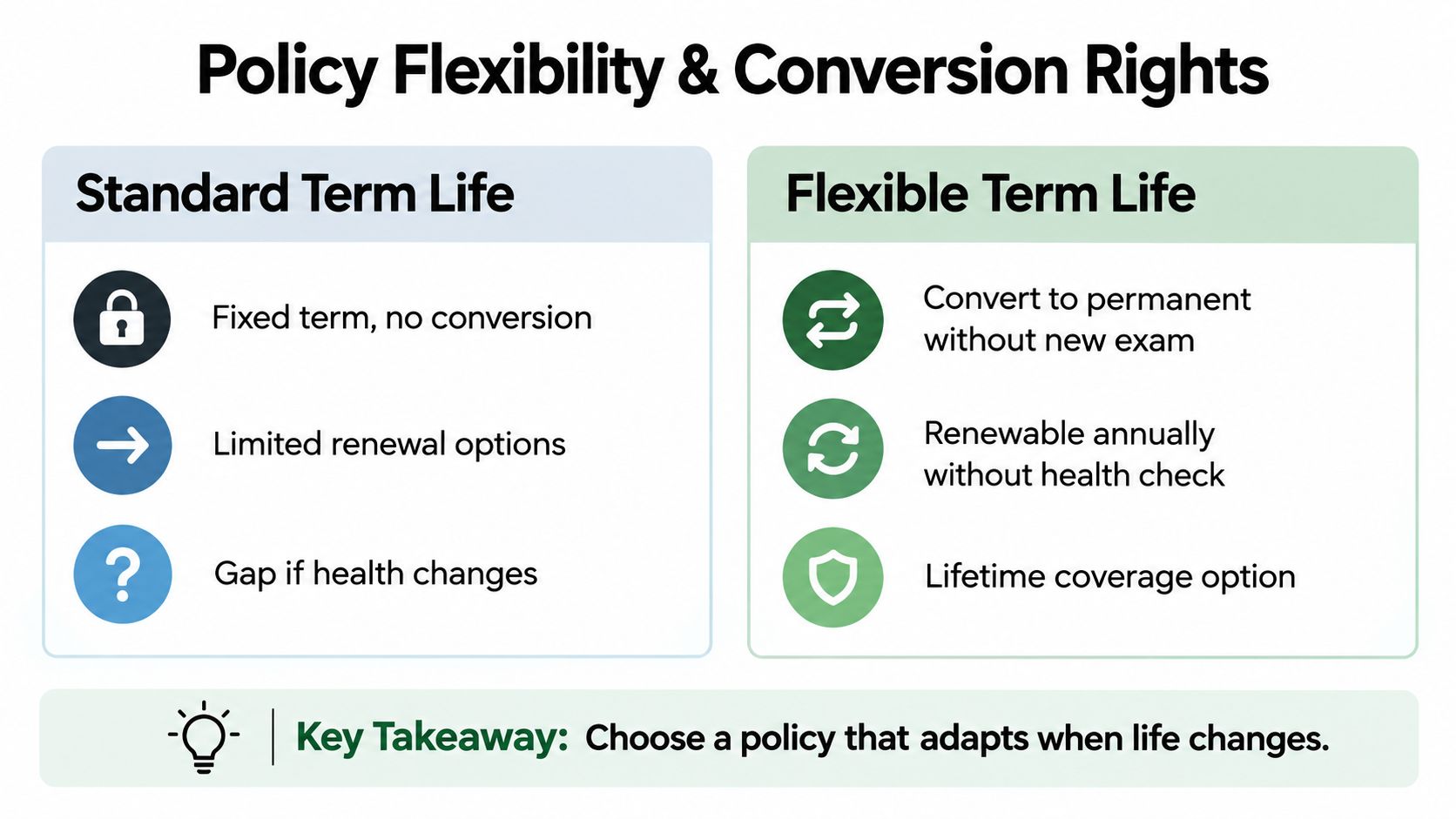
The cheapest quote can become a poor decision if it locks you into a policy that stops fitting your life. Before comparing premiums, inspect the renewable term and conversion option provisions in the contract.
Renewability allows you to continue coverage after the initial term under the policy's stated rules. The cost may rise because you're older, so renewability isn't a promise of cheap lifelong protection. It is a safety valve when you still need insurance but don't want to start from scratch.
Convertibility is more valuable when your health or goals may change. A conversion option can let you exchange term coverage for permanent insurance without a new medical exam, subject to the policy's deadlines, eligible products, and maximum amounts. That feature can protect your future insurability if a serious diagnosis arrives after you buy the term policy.
Read the premium language carefully
Ask whether the premium is level for the initial term or subject to annual increases. A level premium means the scheduled payment remains consistent during the guaranteed period. Annual renewable coverage can start at a lower cost and rise as renewal occurs, so compare the long-term structure rather than the opening payment.
Consumer confusion is widespread. Corebridge research found that 59% incorrectly believe term life builds cash value, while 57% of Gen Z incorrectly believe most term policies have annually increasing premiums. Those figures appear in Corebridge's life insurance insights. Term life generally doesn't build cash value, and many policies use level premiums during the guaranteed term, but your contract controls.
Before applying, confirm:
- Conversion deadline: Identify the final date or age by which conversion is allowed.
- Eligible policies: Check which permanent policies accept conversion.
- Conversion amount: Verify whether you can convert all or only part of the benefit.
- Renewal pricing: Read the schedule or formula for post-term premiums.
- Premium guarantee: Confirm exactly how long the quoted payment is guaranteed.
A policy with clear flexibility may deserve consideration even if its premium is not the absolute lowest. For a focused explanation of the mechanics, review life insurance policy conversion. Buy optionality when it addresses a real risk, not because an agent uses it as a selling point.
Deciding Which Riders Actually Add Value
Riders should solve a specific vulnerability. If you can't explain what event activates a rider and what it pays, don't add it.
Accelerated death benefit
An accelerated death benefit rider may allow access to part of the death benefit while the insured is alive after a qualifying terminal illness, specified disease, or long-term-care condition. It can provide valuable liquidity when medical or care costs disrupt the household.
Check whether accessing the benefit reduces the amount paid to beneficiaries, whether fees apply, and which medical definitions trigger payment. This rider can be meaningful, but it isn't a substitute for health insurance, disability insurance, or an emergency reserve.
Waiver of premium
A waiver of premium rider can keep the policy active if the insured becomes totally disabled under the contract's definition. The wording matters. Some policies require a waiting period, restrict qualifying conditions, or distinguish between the inability to perform your own occupation and any occupation.
For a professional whose income funds the policy, this rider can protect coverage during a period when premiums become harder to pay. Compare it against existing employer disability benefits and your personal disability policy. Don't pay twice for the same protection without understanding the difference.
Child and spouse riders
A child term rider can add modest coverage for eligible children, while a spouse rider can provide term protection for a partner under the same broader contract. These features may simplify administration, but they shouldn't distract from insuring the adults whose income and unpaid labor keep the household running.
For a single-income family, the stay-at-home parent has economic value even without a salary. Replacing childcare, transportation, household management, and future earning capacity can require substantial funds. Evaluate a separate policy or rider based on that contribution, not merely on the size of a paycheck.
Riders to question
Accidental-death additions can sound attractive because they promise an extra payout for a narrow cause of death. Yet the household's financial need exists regardless of whether death results from illness or accident. Prioritize the base death benefit first, then add a rider only if its trigger fills a gap that other coverage doesn't address.
Check every rider for exclusions, expiration dates, claim definitions, and cost. An inexpensive rider with a narrow trigger may be less useful than a stronger base policy with a dependable premium.
Navigating the Modern Underwriting Process
Underwriting isn't a judgment about your character. It's the insurer's process for classifying mortality risk and deciding the premium and approval terms. The main factors include age, tobacco use, body build, blood pressure, and personal and family medical history, as described in technical underwriting guidance on mortality classification.

A straightforward application may still involve more evidence than the form suggests. Insurers can evaluate the application, prescription history, paramedical exam, laboratory results, MIB data, and attending physician statements. Each source answers different questions, so skipping an exam doesn't mean skipping risk review.
The practical lesson is to apply accurately the first time. Gather medication details, diagnoses, procedures, dates, and physician information before you begin. Guessing or minimizing a condition can create a mismatch between your application and medical records, which may cause delays or complications during claims review.
Evidence order affects the experience
MIB summarizes research indicating that using electronic health records first can improve decision rates and lower overall underwriting costs. The MIB explanation of evidence order also describes how applications, prescription data, exams, labs, MIB information, and APS records contribute different predictive value.
That doesn't guarantee instant approval. It does mean the process can use digital evidence before requesting every possible record. Applicants should compare insurers on how they collect information, how clearly they explain outstanding requirements, and whether the quote is conditional on further underwriting.
Protect your classification
Health improvements can support a better application, but don't postpone necessary coverage while waiting for a perfect profile. Accurate disclosure matters more than presenting yourself attractively. Tobacco use, blood pressure, body build, medical history, prescriptions, and family history can affect classification, so answer every question fully and consistently.
Coveredly offers an online term life quote and application flow, with up to $3 million of coverage with no exams for most applicants, as described in its publisher information. Treat that as a product feature to verify during your own application, not as a guarantee that every applicant receives the same process or result.
Checking Insurer Strength and Fine Print Exclusions
A low premium doesn't compensate for a contract you don't understand or a carrier you haven't evaluated. The policy is a promise that may need to perform far in the future, so check the insurer's financial strength ratings from independent agencies and review complaint information through your state insurance regulator.
Compare carriers on equal terms. A lower quote may reflect a different premium guarantee, fewer conversion rights, narrower riders, or a different underwriting classification. Put the quote beside the policy illustration and contract provisions, not beside another number stripped of context.
Treat the application as a legal document
The contestability period deserves special attention. Many life insurance policies allow the insurer to investigate and potentially deny a claim for material misrepresentation during the first two years after the policy becomes effective, as explained in the contestability period overview.
That rule makes accuracy essential. Disclose diagnoses, treatment, prescriptions, tobacco use, hazardous activities, and other facts the application asks about. Don't assume an omission is harmless because it seems unrelated to the eventual cause of death. The insurer may compare your answers with medical and prescription records during a contestability review.
Read exclusions before signing
Look for language addressing suicide, criminal activity, hazardous hobbies, aviation, foreign travel, and other restricted risks. The exact provisions vary by policy and jurisdiction, so don't rely on an agent's summary when the contract uses a specific definition.
Also inspect reinstatement and lapse provisions. Missing payments can end coverage, and restarting a lapsed policy may require new health information or evidence of insurability. A policy that fits your needs on paper is useless if the payment system allows an accidental lapse.
Contract check: Ask for the full policy, not only the quote. Highlight the premium guarantee, beneficiary rules, exclusions, contestability language, renewal schedule, and conversion provisions before you accept delivery.
Your Action Plan for Securing the Right Coverage
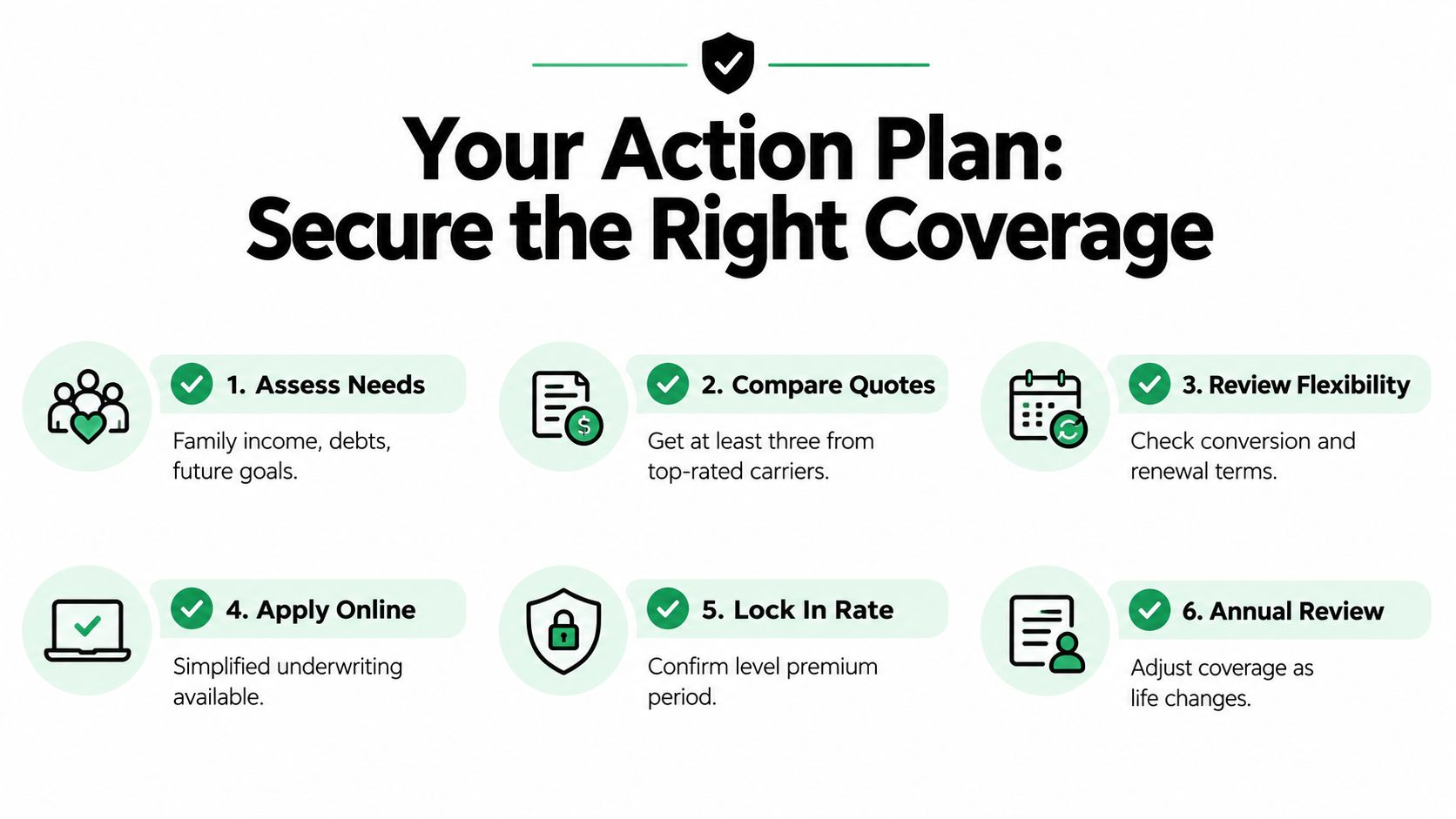
Turn the decision into a short process. Start with the financial event sequence, then compare contracts that solve the same problem. Don't let an online application push you toward a benefit amount or term length before you've calculated what your household would need.
Follow the decision sequence
- Assess the household: Add immediate cash needs, income replacement, debts, mortgage, childcare, and education goals. Subtract only resources your beneficiaries can use.
- Choose the runway: Select a 10-, 20-, or 30-year term based on the longest period your dependents or major obligations rely on your income.
- Compare equivalent quotes: Match benefit, term, premium structure, underwriting requirements, riders, renewal provisions, and conversion rights.
- Verify the carrier: Review financial strength ratings, licensing, complaints, and claims service before treating a quote as a serious option.
- Audit the contract: Confirm the beneficiary designation, premium guarantee period, contestability language, exclusions, renewal schedule, and conversion deadline.
- Make payment automatic: Use automated payments, monitor notices, and keep policy documents where your partner or executor can find them.
Revisit the policy after major changes
Review coverage after a marriage, birth, home purchase, divorce, career change, business launch, or substantial shift in household income. Update beneficiaries after family changes, and make sure the designation aligns with your estate and guardianship arrangements.
Don't cancel an existing policy before the replacement is approved, issued, and active. A new application can produce different underwriting results, and replacing coverage restarts important contractual timelines. Keep evidence of premium payments and store the insurer's contact information with your financial records.
The right policy is not the one with the smallest opening payment. It's the one that remains adequate through the years your family depends on you, stays affordable under your real budget, and gives your beneficiaries a contract they can understand.
Coveredly provides an online term life insurance quote and application flow, including coverage and term choices designed for comparing the factors discussed here. Visit Coveredly to review your options, then choose a death benefit and term that match your family's actual financial runway.